When your child won’t go, don’t argue them into movement. Start with one sentence that lowers the alarm: “You’re safe. We’re doing the first tiny step only.”
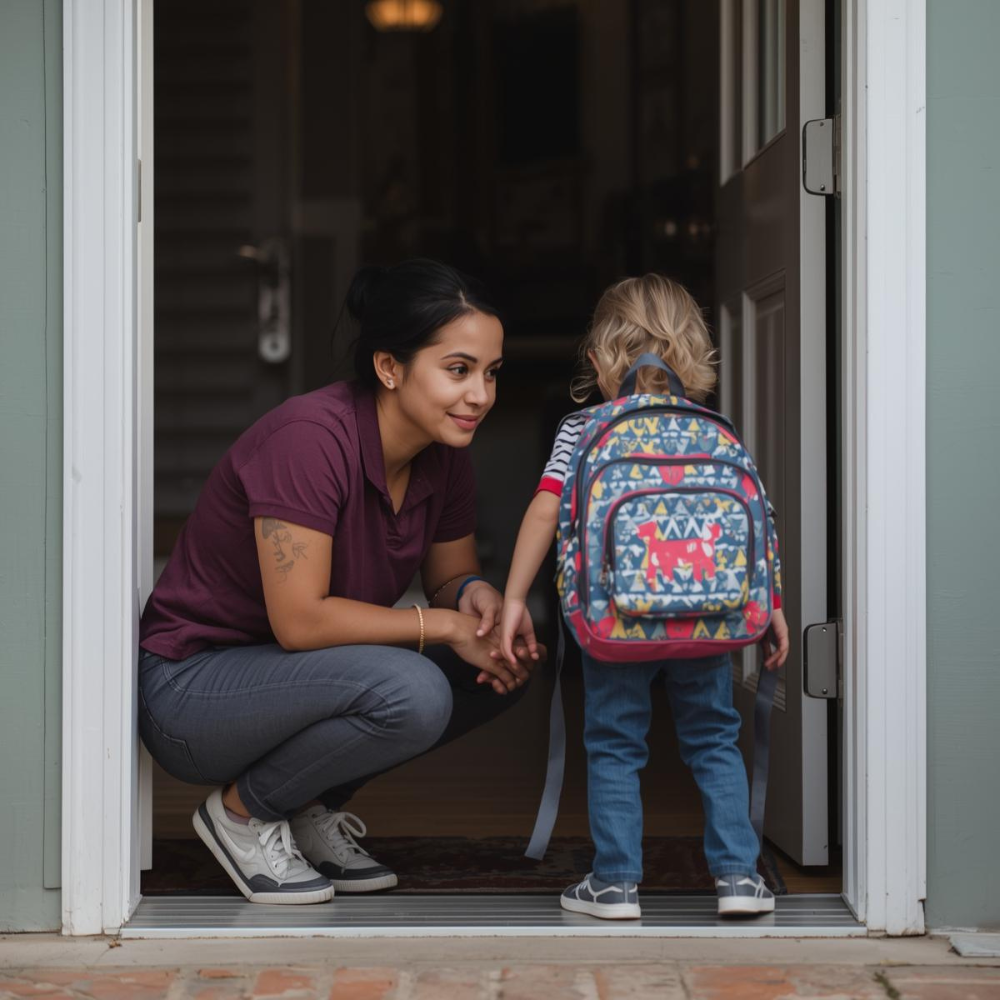
Big transitions don’t need big speeches. They need a first move.
What “won’t go” usually means
When a child won’t go to school, won’t walk into the party, or won’t get out of the car at practice, it’s tempting to treat it like defiance.
Most of the time, it’s not defiance. It’s a transition alarm. Transitions are hard because they combine three stressors at once:
Separation: leaving your safe person or safe place
Uncertainty: not knowing exactly what will happen next
Evaluation: “Will I be okay there?” “Will I mess up?” “Will I be alone?”
So the refusal isn’t about the destination. It’s about the moment your child’s brain predicts danger.
What not to do (because it increases the alarm)
Avoid “Why?” questions
“Why won’t you go?” often forces a child to justify a feeling they can’t explain. It can trigger shame or escalation.
Avoid stacking consequences in the heat
Consequences don’t calm a nervous system. They usually intensify it.
Avoid big speeches
Logic is useful after regulation, not before it. Your goal is simple: lower the alarm enough to make a first move possible.
The core idea: transition anxiety needs a “bridge,” not a push
A bridge has three parts:
Connection: “I’m with you.”
Clarity: “Here’s what happens first.”
Control: “You get one small choice.”
This is how you turn “won’t go” into “can take one step.”
The 4-part “Go Script” (use it verbatim)
1) Name it without judgment
“This is a hard transition.”
2) Signal safety and partnership
“You’re safe. I’m with you. We’re not fighting.”
3) Shrink the task to one tiny step
“We’re doing the first step only.”
4) Offer a tiny choice that still moves forward
“You can choose A or B.”
That’s the whole structure. Now here are plug-and-play versions for the transitions parents face most.
Child won’t go to school (school refusal and separation anxiety)
In the morning at home: “Your brain is sounding the alarm about school. You’re safe. First step only: shoes on.”
Then: “Do you want your left shoe first or your right shoe first?”
At the door:
“First step only: we walk to the car. That’s it.”
In the car (outside school):
“This is the hardest moment. I’m staying calm. First step only: open the door.”
Then: “Do you want to hold my hand to the sidewalk, or walk next to me?”
At drop-off:
“We’re doing the same goodbye every time. Hug, phrase, handoff, go.”
Your phrase should be short and consistent, like: “You’re safe. I’ll come back. First move now.”
If your child’s “won’t go” is strongest at night (anticipatory worry), this companion post can help with what to say and what to do before bed:
https://www.yabbitrabbit.com/parent-resources/bedtime-anxiety-in-kids-what-to-say-and-what-to-do
Child won’t go into the party (social transitions)
At the entrance: “Parties can feel loud and unknown. You’re safe. First step only: we stand here for 10 seconds.”
Then choose one:
“Do you want to find the snacks first, or find one person we know?”
“Do you want to hold my hand for one minute, or link arms?”
If they freeze: “Freezing is your brain trying to protect you. We’re not deciding the whole party. First step only: one hello.”
Your job is not to convince them to enjoy it. Your job is to help them enter without their nervous system taking over.
Child won’t go to practice (performance transitions)
Practice mixes transition anxiety with evaluation anxiety.
In the car: “Your brain thinks practice is a test. It’s not a test. First step only: we walk to the door.”
At the door: “First step only: we say hi to coach.”
Then: “Do you want to say ‘hi’ or just wave?”
If they say “I can’t”: “You can’t do the whole practice right now. That makes sense. Let’s do one brave move.”
The “Two-Minute Bridge” for any transition
Use this when your child is stuck and you need a reliable structure.
Minute 1: regulate
Slow your voice
Get low to their eye level
One sentence only: “You’re safe. I’m with you.”
Minute 2: first move
One tiny step
One tiny choice
Then move
This works because it respects the real problem: a child can’t access flexibility when they feel unsafe.
How to set boundaries without turning it into a power struggle
You can be warm and firm at the same time.
Try this boundary line: “I won’t force you, and I won’t debate. We are going. Your job is to choose your first step.”
That sentence does two things:
Removes the fight
Returns control in a safe-sized way
If your child tends to hesitate across many areas (not just one transition), it can help to understand the deeper pattern of hesitation and avoidance so you can respond consistently: https://www.yabbitrabbit.com/parent-resources/psychology-of-hesitation-in-children-yabbit-the-rabbit
When to get extra support
This post is for common transition anxiety, not crisis-level situations.
Consider extra support if:
School refusal is frequent and escalating
Your child has panic symptoms (hyperventilation, vomiting, shaking)
They’re missing significant school time
The fear is spreading to more places and activities
Support does not mean something is “wrong” with your child. It means the alarm system needs help recalibrating.
Invest in your child’s emotional growth
If your child freezes before transitions, The Rabbit in the Moon gives them language for that exact moment, without labels. Yabbit’s journey is about hesitation, first moves, and tiny brave steps that build real confidence over time.
FAQs
Is it normal for a child to refuse school because of separation anxiety?
Yes, especially during new routines, after breaks, or during stress. Separation anxiety can show up as school refusal when the transition moment feels unsafe.
What should I say when my child won’t get out of the car at school?
Keep it short and predictable: “You’re safe. First step only: open the door.” Then offer a tiny choice that moves forward (hand-hold vs walk beside you).
Should I let my child stay home when they refuse school?
It depends on severity, but frequent staying home can accidentally teach avoidance. If your child is physically safe, aim for consistency, tiny steps, and collaboration with the school for a supportive plan.
How do I handle drop-off without making it worse?
Use a consistent goodbye routine: brief hug, one phrase, handoff, go. Long negotiations often increase anxiety by signaling that something is truly dangerous.
Why does my child refuse to go to parties or practice?
Social and performance environments can trigger uncertainty and evaluation fear. The refusal is often the nervous system trying to avoid discomfort, not a lack of character.
What if my child’s transition anxiety causes meltdowns?
Treat it as an alarm, not disrespect. Regulate first, then ask for the first move. Calm voice, eye-level posture, one tiny step, one tiny choice.
How can I help my child become more independent with transitions?
Independence grows from repeated successful starts. Use the same “Go Script” every time, then gradually reduce support: from hand-holding to walking beside, to a wave, to an independent entry.