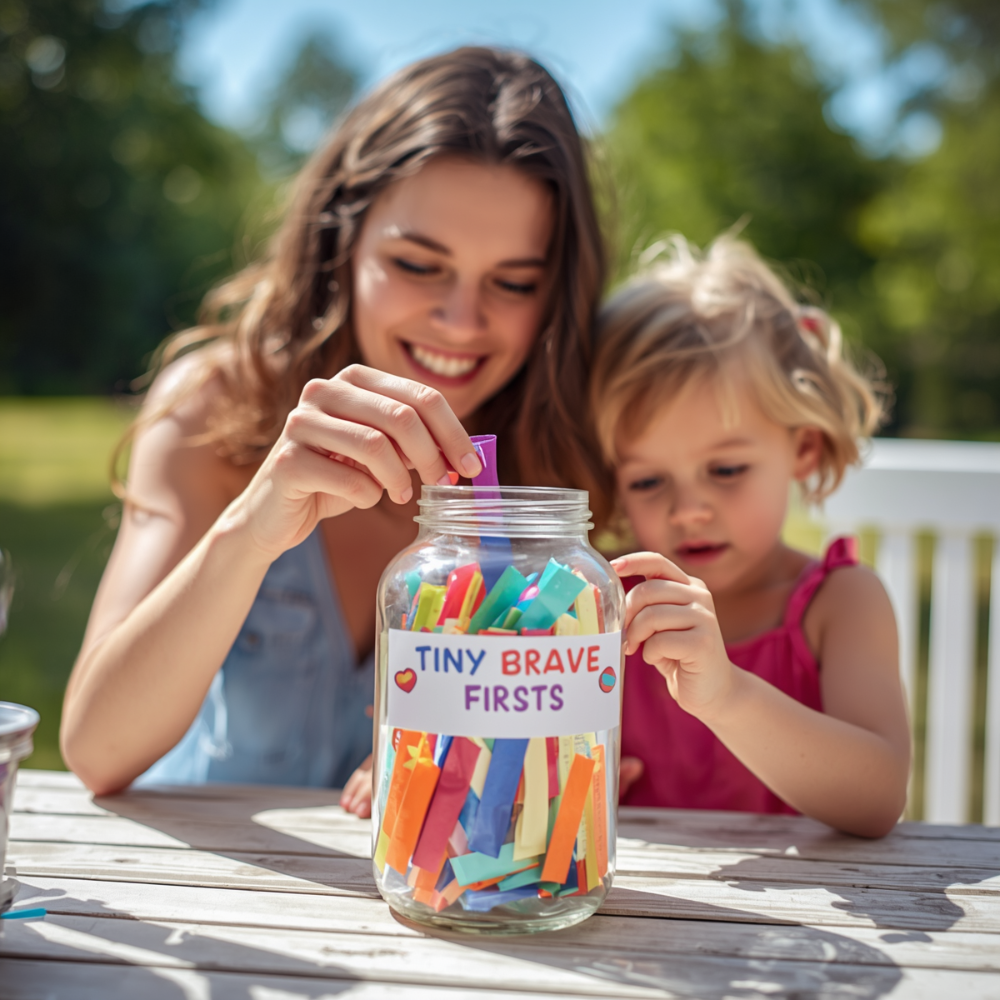
Summer is full of small chances to practice courage. A brave first does not need to look dramatic to count.
Summer has a funny reputation. Adults picture long afternoons, bare feet, watermelon slices, sprinklers, sidewalk chalk, and children floating happily from one adventure to the next.
Real summer can be a little more complicated.
For a hesitant child, summer is full of firsts. The first swim lesson. The first day of camp. The first time joining a neighborhood game. The first unfamiliar food at a picnic. The first moment when another child asks, “Do you want to play?” and the answer gets stuck somewhere between wanting to join and feeling ready.
Those moments are not failures. They are opportunities.
The goal is not to pack summer with pressure disguised as enrichment. It is not to turn every trip to the park into a confidence-building assignment. It is simply to notice the small, ordinary moments where a child can practice moving toward something new with support.
That is the heart of a tiny brave hop.
A tiny brave hop is the smallest meaningful step a child can take toward something that feels hard. It might be touching the water before getting into the pool. It might be standing near the group before joining the game. It might be trying one bite instead of finishing the whole plate. It might be saying hello while still holding your hand.
Summer is a beautiful time to practice because play lowers the stakes. There is room to experiment. There is room to stop on a win. There is room for courage to arrive wearing flip-flops.
Why hesitant children need smaller summer starts
Some children leap into new experiences. Others watch first. They study the room, ask questions, imagine what could go wrong, and wait for their body to feel safer.
That does not mean they lack courage. It means their first step needs to be smaller.
When adults say, “Just jump in,” “Go make a friend,” or “Try it, you’ll like it,” we usually mean well. But a hesitant child may hear the whole mountain when we are trying to describe the first foothold.
The Yabbit approach is different. Instead of asking a child to complete the whole activity, we help them find the first doable move. Yabbit pauses before something big. Snail brings steady persistence. Together, they give children a language for courage that does not require instant confidence.
This summer, you can turn that language into play.
For a deeper explanation of the method, read: https://www.yabbitrabbit.com/parent-resources/how-to-help-your-child-take-tiny-brave-hops
Before the activity: use the four-question Yabbit pause
Before choosing a craft, game, or outing, start with a short conversation. Keep it casual. This should feel more like curiosity than an interview conducted beneath a tiny courtroom lamp.
Ask:
What feels hard?
The child may be worried about getting wet, being watched, meeting someone new, making a mistake, or not knowing what to do.
What feeling is here?
The answer might be nervous, shy, worried, frustrated, unsure, or excited and scared at the same time.
What would help?
A parent nearby. Watching first. Holding a hand. Practicing at home. Bringing a familiar object. Trying for only five minutes.
What tiny brave hop comes first?
Not the whole challenge. Just the next small move.
You do not need to ask all four questions every time. Sometimes one question is enough: “What would make the first step feel smaller?”
That question can change the whole day.
1. Make a Tiny Brave Firsts Jar
This is the easiest activity to begin with because it takes ten minutes to set up and can last all summer.
Find a clear jar, a small basket, or any container your child enjoys. Cut colorful pieces of paper into slips. Then sit down together and write simple brave firsts your child may encounter during summer.
Start with these:
Wave hello
Touch the water
Try one bite
Ask to join
Take one tiny hop
Then add a few that fit your child’s real life:
Stand near the group
Say one word
Put one foot in
Hold the ball
Try for two minutes
Ask one question
Pick one new thing
Walk to the door
Fold the slips and place them in the jar.
A few times each week, let your child draw one. The activity is not a dare. It is not a contract. The goal is to talk about what the brave first might look like and choose a version that feels possible.
If the slip says touch the water, that might mean dipping one finger into the pool. If it says ask to join, your child might practice the words at home before trying them at the park. If it says wave hello, a wave from beside your leg still counts.
Parent phrase to use:
“Let’s make this small enough to try.”
The jar works because it turns courage into something playful and concrete. Children can see the slip, hold it, talk about it, and shape the first move with you.
2. Turn sidewalk chalk into a bravery map
Sidewalk chalk is one of summer’s finest inventions. It is cheap, colorful, washable, and nearly impossible to take too seriously.
Draw four large shapes on the driveway or sidewalk:
The hard thing
The feeling
The first step
The tiny brave hop
Ask your child to help fill them in with pictures or words. A child nervous about swim class might draw a pool under the hard thing, a worried face under the feeling, a toe touching water under the first step, and feet standing on the pool stairs under the tiny brave hop.
Then walk or hop through the chalk path together.
You can also make a simpler version with stepping stones. Each circle represents one small move:
Watch
Stand closer
Touch
Try one part
Stop on a win
This activity works especially well for children who think visually. The hard thing stops floating around as one giant cloud. It becomes a path with a beginning.
Parent phrase to use:
“We do not have to cross the whole sidewalk today. Let’s choose one circle.”
3. Try a five-minute brave-start sensory activity
Some children hesitate before a new activity because they are not sure what will happen once they begin. They worry that trying one thing will mean being expected to finish the whole thing.
A five-minute brave-start activity lowers that pressure.
Set up a simple sensory tray outside or at the kitchen table. You can use water, colorful pom-poms, cups, spoons, bubbles, play dough, smooth rocks, leaves, or any safe household items that invite exploration.
Then use this sequence:
Touch one thing
Name one feeling
Try one small job
Stop on a win
For example, your child might touch one pom-pom, say the activity feels new, scoop one pom-pom into a cup, and stop after that success. Another day, they may choose to continue.
The stopping part matters. When a hesitant child learns that trying does not trap them, starting becomes safer.
Parent phrase to use:
“You can stop after one brave start. Anything extra is a bonus.”
4. Practice joining with one tiny job
Many children hang back at summer activities because joining a group feels too vague. A parent says, “Go play,” but the child does not know where to enter.
Give the child one tiny job instead.
At a backyard craft table, picnic, camp activity, or family gathering, try this sequence:
Touch one piece
Say one feeling
Try one tiny job
Join when ready
The job could be placing one block, carrying one cup, choosing one marker, handing someone a ball, adding one sticker, or stirring one bowl. The point is not productivity. The job gives the child a doorway.
A child does not always need to join the whole social world at once. Sometimes belonging begins with handing over a crayon.
Parent phrase to use:
“You do not have to jump into the whole activity. Let’s find one little job.”
5. Use summer play to practice brave starts
Play is the best rehearsal room because the stakes are naturally lower. You can practice brave starts with blocks, bubbles, a stacking toy, a backyard obstacle course, a puzzle, or a simple ball game.
Use this four-step rhythm:
Pick one thing to try
Say what feels hard
Make the first move tiny
End with: “I started.”
That last phrase is important.
Children often think success means finishing, winning, joining fully, or doing something without fear. But for a hesitant child, beginning deserves its own celebration.
If the child places one block and stops, say, “You started.” If they roll the ball once, say, “You started.” If they stand near the sprinkler but do not run through it yet, say, “You started.”
This teaches a quieter form of confidence. The child begins to see evidence that they can move, even before they feel completely ready.
Parent phrase to use:
“You did not have to finish the whole thing. You started, and that counts.”
6. Build a brave little summer basket
A brave little summer basket is part activity kit, part invitation. Keep it by the door, on a patio, or near your child’s favorite reading spot.
Fill it with simple items:
A copy of The Rabbit in the Moon
Sidewalk chalk
Bubbles
A small magnifying glass
Nature-walk cards
Crayons and index cards
A few Tiny Brave Firsts Jar slips
Stickers or stamps
A small notebook for brave-hop memories
Your child can choose one item when they need a low-pressure summer activity. A magnifying glass might lead to a five-minute nature walk. Chalk might become a bravery map. Bubbles might become a game of trying one new movement. The notebook can hold drawings of moments when the child took a tiny brave hop.
Do not over-engineer it. This is a basket, not a small corporate retreat.
The basket works because it keeps courage close to play. It also gives the child choice, and choice often makes a new activity feel safer.
Parent phrase to use:
“Pick one thing from the basket. We only need one small adventure.”
7. End the day with a Yabbit story check-in
Summer activities do not need to end with a formal review session. But a calm read-aloud can help a child notice the brave moments they might otherwise forget.
At bedtime or during a quiet afternoon break, read The Rabbit in the Moon. Then ask one or two simple questions:
What felt hard today?
What feeling showed up?
What helped?
What tiny brave hop came first?
Was there a moment when you started, even if you did not finish?
Keep it light. Some children will answer immediately. Others may shrug, lean against you, or talk about something else entirely. That is okay. The book is still giving the family a language for moments that may become easier to discuss later.
This ritual connects the day back to Yabbit and Snail. Yabbit helps children recognize the pause. Snail reminds them that steady persistence still counts. The tiny brave hop gives the child a next move small enough to imagine.
For more ways to use the story as an emotional tool, read: https://www.yabbitrabbit.com/parent-resources/picture-books-teach-coping-skills-kids
How to know whether the tiny brave hop is small enough
Parents often ask how small the first step should be. The honest answer is: probably smaller than you think.
A good tiny brave hop should feel possible while the child is still nervous. It should not require the fear to disappear first.
If your child is refusing the step completely, shrink it again.
Instead of jumping into the pool, sit on the edge.
Instead of sitting on the edge, walk to the stairs.
Instead of walking to the stairs, watch another child for one minute.
Instead of joining the game, hold the ball.
Instead of holding the ball, stand nearby.
Instead of saying hello, wave.
Instead of waving, practice the wave at home.
The tiny brave hop is not an escape hatch from growth. It is how growth begins.
What to say when your child does not want to try
When a child refuses, adults often feel the temptation to turn up the pressure. Summer plans have been made. The lesson has been paid for. Everyone else seems to be participating. The clock is ticking.
But pressure often makes the doorway narrower.
Try language like this:
“Something feels hard. Let’s figure out which part.”
“You do not have to do the whole thing. We are choosing one small first move.”
“Would you rather watch first or touch one piece?”
“You can stop after one brave start.”
“Your tiny brave hop still counts, even if it looks small to someone else.”
The goal is not to remove every uncomfortable feeling. The goal is to help your child experience something important: I can feel unsure and still move a little.
That belief is worth carrying long after summer ends.
Why The Rabbit in the Moon belongs in a brave summer
The Rabbit in the Moon is not a summer workbook. It does not ask children to complete a chart before breakfast or earn a sticker for every emotion. Its strength is simpler and more lasting.
Yabbit gives children a character who hesitates without being treated as broken. Snail brings persistence without turning the story into a lecture. The phrase tiny brave hop gives families language they can use at the pool, the park, a birthday party, a new camp, a summer sport, or a quiet afternoon at home.
That is why the book fits so naturally into these activities. It helps parents replace the pressure to “be brave” with a better invitation:
Let’s make the first step small enough to try.
The Rabbit in the Moon is a meaningful investment in your child’s emotional growth.
If your child hangs back, avoids starting, worries about new experiences, or needs a smaller doorway into courage, The Rabbit in the Moon belongs in your summer basket.
Yabbit is not fearless. He pauses. He worries. He needs time. But with Snail’s steady persistence beside him, he learns that courage does not have to arrive all at once. It can begin with one tiny brave hop.
For parents, teachers, grandparents, and caregivers, The Rabbit in the Moon offers more than a bedtime story. It gives children a shared language for fear, hesitation, trying, and the brave little beginnings that help confidence grow.
FAQs
What are good summer activities for hesitant kids?
The best summer activities for hesitant kids are playful, low-pressure activities that make the first step small. A Tiny Brave Firsts Jar, sidewalk chalk bravery map, sensory tray, backyard joining activity, brave little summer basket, and bedtime Yabbit check-in can all help children practice courage without feeling pushed.
What is a tiny brave hop?
A tiny brave hop is the smallest meaningful step a child can take toward something that feels hard. It might be touching the water, waving hello, trying one bite, standing near a group, or completing one small part of an activity. The goal is not instant confidence. The goal is a doable beginning.
How do I help my child try new summer activities without pressure?
Start by naming what feels hard and choosing one very small first move. Give your child a limited choice, such as watching first or touching one piece. Let the child stop on a win when appropriate. Repeated positive beginnings can help new activities feel safer over time.
What should I say when my child hangs back at a summer activity?
Try saying, “Something feels hard. Let’s make the first step smaller,” or “Would you rather watch first or try one tiny job?” These phrases acknowledge the feeling while keeping a path forward open.
Are these summer activities only for anxious children?
No. These activities are especially useful for anxious, shy, or hesitant children, but any young child can benefit from practicing small starts, naming feelings, trying new things, and recognizing quiet forms of courage.
How can The Rabbit in the Moon help with summer confidence?
The Rabbit in the Moon gives children a relatable character who hesitates and a steady companion who keeps going. Yabbit and Snail help families talk about fear, persistence, and first steps in language children can understand. The phrase “tiny brave hop” makes courage feel more manageable.
What if my child is not ready to complete the activity?
Completion is not always the first goal. For a hesitant child, watching, touching one item, standing nearby, or trying one small part may be the right brave hop for that day. When children learn that beginning is safe, they are more likely to return and take another step later.