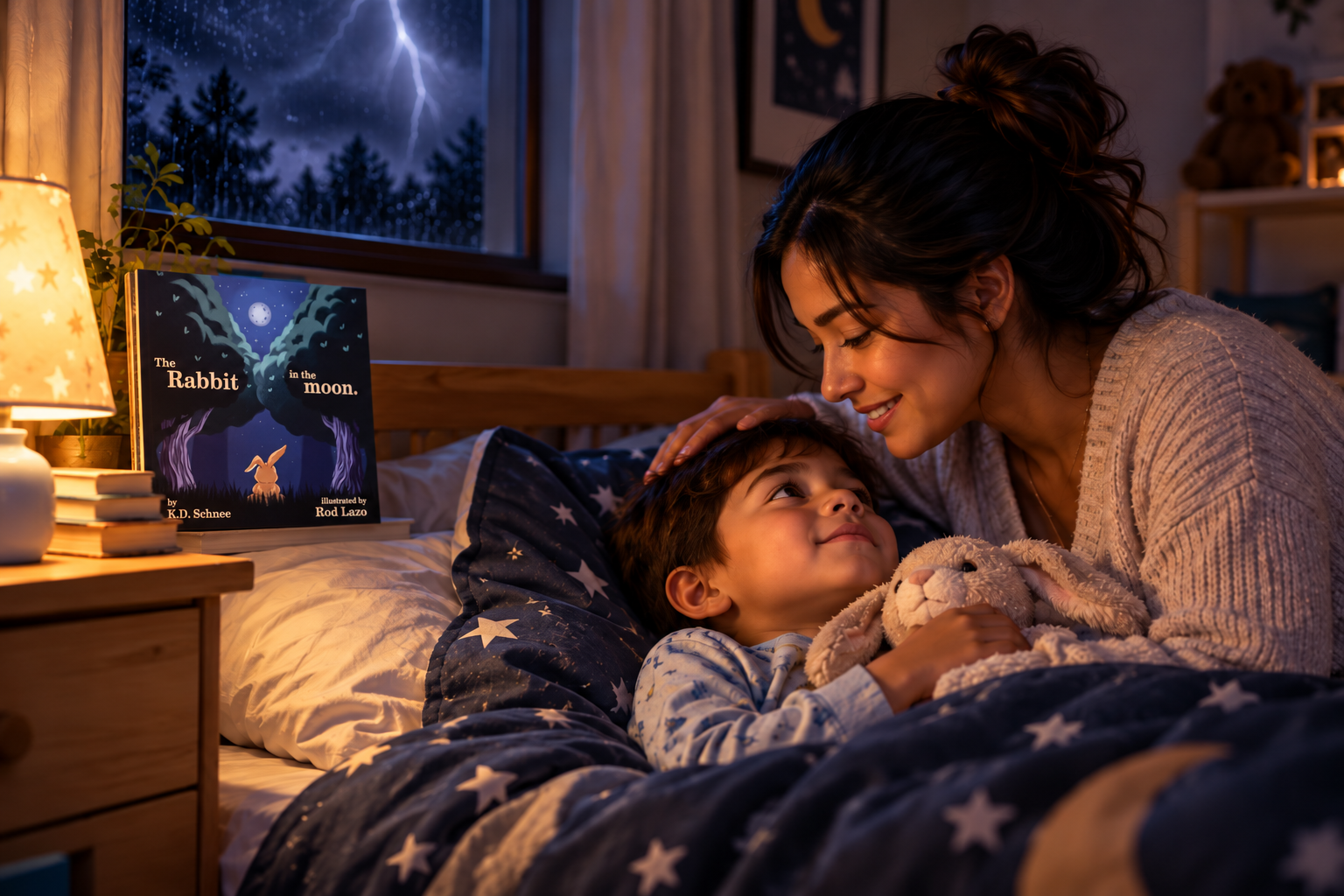
Bedtime anxiety in toddlers and young children often becomes easier to manage when parents acknowledge the fear, keep nighttime predictable, and help children build confidence in small steps.
Bedtime Anxiety in Toddlers and Young Children: What Helps When They’re Afraid of the Dark
A child who happily went to bed last month can suddenly become deeply suspicious of the same bedroom once the lights go out. Shadows look different, ordinary noises seem louder, and the few feet between a parent and the bedroom door can feel much farther than they did during the day.
For parents, the change can be confusing because nothing obvious has happened. The room is the same, the bedtime routine is familiar, and yesterday’s stuffed animals have somehow become tonight’s questionable silhouettes. Yet fear of being alone in the dark is a common childhood fear, according to the American Academy of Pediatrics, and it often occurs during years when children’s imaginations are becoming more powerful while their ability to judge what is realistically dangerous is still developing. HealthyChildren.org
The goal is not to convince a frightened child that darkness is wonderful or to demand that they prove they are brave by tolerating it without support. Parents can help much more by making bedtime predictable, acknowledging what feels scary, and gradually giving the child experiences that show them they can handle a little more of the night than they could before.
That is a very different lesson from simply saying, “There’s nothing to be afraid of.”
What Helps a Toddler or Young Child Who Is Afraid of the Dark?
When a child is afraid of the dark, the most helpful response usually combines emotional reassurance with a predictable bedtime structure. Acknowledge that the room can feel different after the lights go out, remind the child that the adults are responsible for keeping them safe, and then continue with a familiar routine rather than rebuilding the entire evening around the fear.
Small accommodations can be useful while confidence grows. A soft nightlight, an open bedroom door, a favorite stuffed animal, or a parent sitting nearby for a short period may help a child settle, particularly when these supports are used consistently rather than becoming larger and more complicated every night. The American Academy of Pediatrics specifically suggests that a little one who is fearful in darkness may benefit from a small amount of light, such as a nightlight near the doorway. HealthyChildren.org
The important word is gradually. Bedtime confidence usually develops more successfully when a child experiences manageable amounts of independence instead of being moved overnight from “Mom stays until I am asleep” to “You are on your own now.”
Why Do Toddlers Suddenly Become Afraid of the Dark?
Fear of the dark can seem to appear out of nowhere because adults experience darkness very differently from young children.
During the day, a bedroom is filled with familiar information. The child can clearly see the dresser, chair, toys, curtains, and pile of clothes that somebody promised would be put away yesterday. At night, those same objects become shapes without much visual detail, and a developing imagination is left to interpret them.
Young children are also becoming increasingly capable of imagining events that are not actually happening in front of them. That new ability gives childhood much of its magic, but it can also give shadows, monsters, burglars, strange noises, and mysterious shapes a little too much creative funding after bedtime.
This does not mean a child is being irrational in the dismissive sense of the word. The fear feels real because their brain is trying to explain incomplete information, and nighttime provides plenty of it.
Bedtime Anxiety Is Not Always About the Dark
A child may say, “I’m scared of the dark,” even when darkness is only part of what makes bedtime difficult.
For some children, the real problem is separation. They feel comfortable while a parent is sitting beside them, but anxiety rises the moment that parent leaves. Other children become caught in worries from the day, begin imagining what might happen tomorrow, or simply struggle with the transition from family activity into being alone and quiet.
Still others discover that bedtime is an unusually effective moment for remembering every urgent need they have ever had. Suddenly there is one more drink, one more bathroom trip, one forgotten question about dinosaurs, and an important matter concerning what everyone will eat next Tuesday.
Understanding what is underneath the bedtime resistance matters because different problems need different responses. If darkness is the main fear, gradually making the room feel understandable and manageable may help. If the child is struggling primarily with separation, the work may be more about tolerating a parent’s departure and learning to settle independently.
For a broader guide to nighttime worry, stalling, separation, reassurance, and bedtime routines, see Bedtime Anxiety in Kids: What to Say and What to Do.
Talk About the Fear Before Everyone Is Exhausted
Bedtime is not always the best time to conduct a thorough investigation into bedtime anxiety.
When a child is already frightened and tired, long conversations can unintentionally make the fear feel more important. Parents are also less likely to deliver their finest emotional coaching at 9:17 p.m. after hearing the seventh request for water.
Talk about nighttime fears earlier in the day when everyone is calm. Ask what feels different when the room becomes dark, whether anything in particular looks scary, and what the child worries might happen after you leave.
The answer may surprise you. A parent may assume the child fears monsters when the real issue is the sound of the heating system, a moving curtain, headlights crossing the ceiling, or the possibility that they will wake up and nobody will be nearby.
Once you know what the child is actually afraid of, you can respond to the real problem instead of negotiating with an invisible committee of nighttime possibilities.
Validate the Fear Without Confirming the Danger
There is an important difference between saying “I believe that you feel scared” and saying “Yes, there may be something scary in your room.”
Parents can acknowledge a child’s experience without agreeing with the frightening conclusion. You might say, “The room looks different when it gets dark, and I can understand why that shadow surprised you. You are safe here, and we know what is making the shadow.”
The American Academy of Pediatrics recommends listening sympathetically to childhood fears while avoiding ridicule or pressure to act brave before the child is ready. That balance gives children two messages at the same time: their feelings are worth taking seriously, and the adults are not frightened by what is happening.
This is especially important for toddlers and preschoolers, who often borrow emotional information from the adults around them. A calm parent does not make the fear disappear instantly, but calm behavior communicates that the situation is manageable.
What Should You Do When Your Child Says There Is a Monster?
Arguing with a frightened three-year-old about the scientific evidence against bedroom monsters is unlikely to become anyone’s finest parenting moment.
It is usually more helpful to respond to the experience underneath the statement. You might say, “That shape looks scary from your bed. Let’s see what is making it,” and briefly show the child that the strange shape is a jacket, toy, curtain, or chair.
What you want to avoid is accidentally turning monsters into something the household must repeatedly inspect for. If parents search the closet six times, spray “monster repellent,” check beneath the bed after every request, and perform a nightly monster-security sweep, a young child may reasonably conclude that monsters apparently require a surprising amount of adult management.
A brief reality check can make the environment more understandable. Repeated rituals can sometimes teach the child that they cannot feel safe until the checking has been completed.
Make the Bedroom Familiar Before the Lights Go Out
A child who is frightened by nighttime shadows may benefit from exploring the room while it is still light enough to understand what they are seeing.
Sit on the bed together and notice which objects create shadows. Turn the main light off and on, adjust the curtains, or move an object that repeatedly becomes frightening after dark. The goal is not to eliminate every shadow but to help the child connect nighttime shapes with ordinary daytime objects.
You can also let the child participate in preparing the room. Choosing where a comfort object sleeps, deciding whether the door stays slightly open, or placing the nightlight in a familiar location gives the child some appropriate control without making them responsible for managing the fear alone.
When bedtime arrives later, the room is less mysterious because the child has already explored what changes when the light changes.
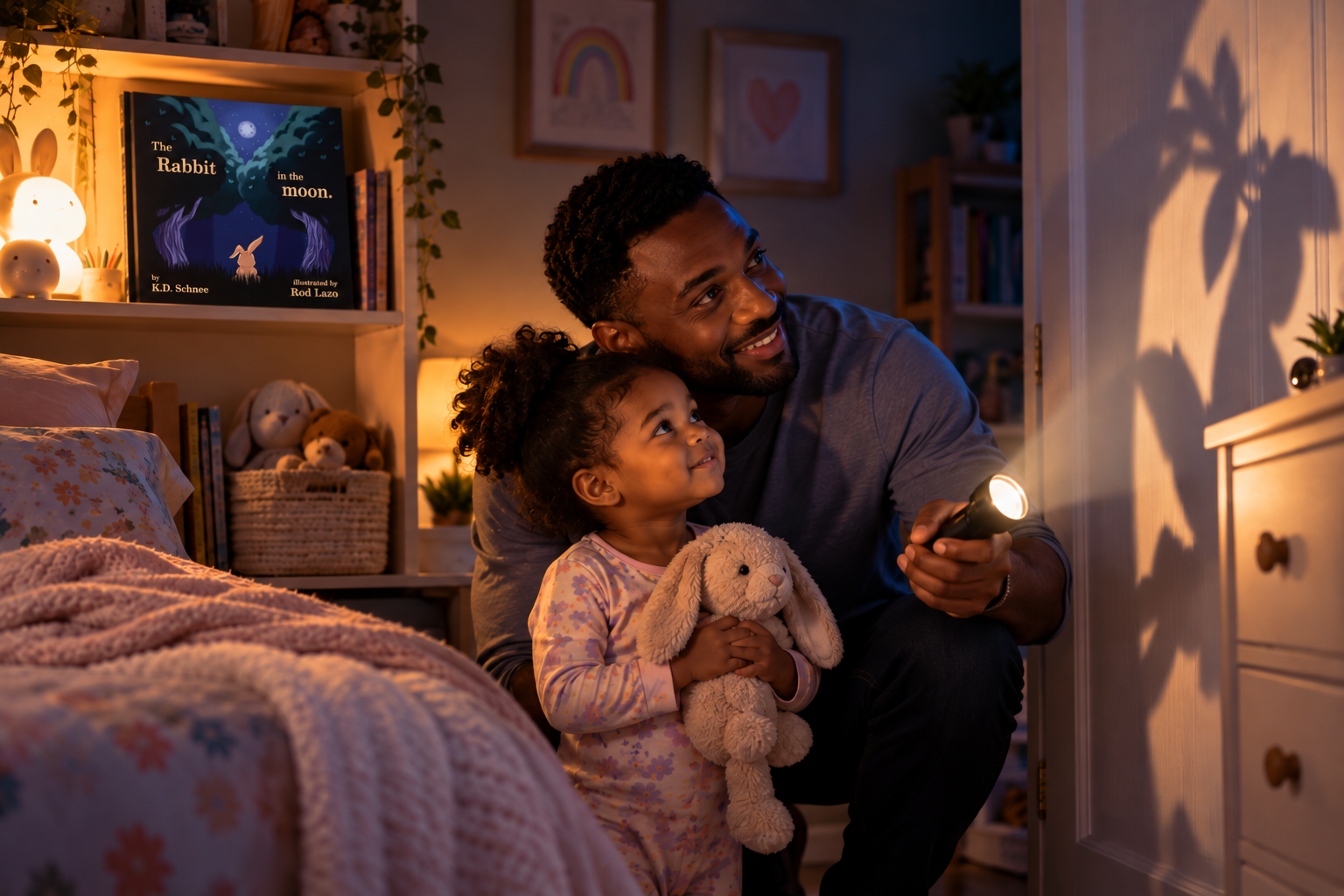
Exploring a bedroom before lights-out can help a child understand that unfamiliar nighttime shapes are often familiar objects seen differently in low light.
Should a Child Who Is Afraid of the Dark Use a Nightlight?
A nightlight can be a perfectly reasonable support for a child who is afraid of the dark. The American Academy of Pediatrics suggests using a small amount of light, such as a nightlight in the hallway near the bedroom door, when a young child is fearful in darkness. The broader sleep goal is still to keep the environment conducive to sleep rather than turning the room into a miniature airport runway.
Think of the nightlight as a bridge rather than a test. If a small amount of light helps your child remain in bed, settle, and practice sleeping with less parental involvement, it may be doing useful work.
There is also no prize for achieving complete darkness at the earliest possible age. As a child becomes more comfortable, the light can be dimmed, moved farther away, or eventually removed if the child no longer needs it.
Keep the Bedtime Routine Predictable
Young children often handle difficult transitions more easily when they know exactly what comes next.
A bedtime sequence does not have to be elaborate. Bath or wash-up, pajamas, teeth, a picture book, a hug, a familiar closing phrase, and lights-out can be enough when it happens in a recognizable order.
When fear appears, try to preserve the basic structure rather than adding an entirely new ceremony every night. A routine that expands whenever anxiety rises can gradually teach the child that feeling frightened earns additional checks, stories, conversations, and delays.
Warmth and boundaries can live in the same bedtime.
Give Reassurance Without Making Reassurance the Requirement for Sleep
A frightened child naturally wants reassurance from a parent. There is nothing wrong with providing it, but reassurance becomes less helpful when the child cannot settle without hearing the same answer again and again.
A child may ask whether they are safe, hear yes, and then ask whether you are absolutely sure. A few moments later, they may wonder whether something could come through the window or whether you will still be awake if they call.
Trying to answer every hypothetical question can accidentally turn bedtime into an endless search for certainty. The child feels better briefly, then needs the next answer because complete certainty never arrives.
Instead, choose a calm message you can repeat without reopening the entire discussion. You might say, “I know nighttime feels scary right now. You are safe, I am nearby, and it is time for your body to rest.”
That response provides connection while allowing bedtime to continue.
Be Careful About Letting Fear Rewrite the Rules Every Night
When a child is genuinely frightened, parents understandably want to do whatever gets everyone through the night.
One night beside the child can become several nights. Then the child may need a parent lying on the bed, followed by a parent remaining until they are fully asleep, followed by a small constitutional crisis when the parent attempts to leave.
The issue is not that comforting your child is harmful. Comfort is important, but children can become accustomed to the conditions that are present when they fall asleep and then understandably seek those same conditions again.
When a family wants to build more independent sleep, gradual change is often easier than abrupt withdrawal. Child Mind Institute describes a “fading” approach in which a parent slowly reduces their presence, perhaps beginning near the bed and moving farther away over time, while continuing to validate the child’s fear and encourage progress. Child Mind Institute
Parents do not need to copy a particular method exactly. The useful principle is that independence can be practiced in steps.
Make the First Step Smaller Than “Sleep Alone All Night”
For a child with bedtime anxiety, “Go to bed and sleep until morning” may contain several challenges at once.
The child has to separate from a parent, tolerate darkness, cope with noises, lie quietly with their thoughts, fall asleep independently, and possibly wake during the night without seeking the same reassurance again. When those tasks are bundled together, the whole night can feel enormous.
This is where a Tiny Brave Hop can help.
One child’s first step might be lying in bed while the parent sits beside the door instead of beside the pillow. Another might tolerate a slightly dimmer nightlight, fall asleep with the bedroom door open but without a parent in the room, or stay in bed for several minutes after a frightening thought before calling for reassurance.
The step should be meaningful but manageable. Courage grows when the child experiences, “That was uncomfortable, and I handled it,” rather than when the child is pushed so far that bedtime becomes a nightly battle.
What to Do When Your Child Keeps Coming Out of the Bedroom
Repeated trips out of the bedroom can be exhausting because fear and limit-testing often become tangled together. A child may genuinely feel anxious and also discover that coming out produces more parental contact. Those two things can be true at the same time, which is why the response can remain warm without becoming increasingly elaborate.
If you have already listened to the fear and know the child is safe, walk them back calmly and keep the interaction brief. Use the same reassuring language rather than starting a fresh conversation every time.
Consistency makes the boundary easier to understand. If one trip leads to a quick return to bed but the fifth trip leads to twenty minutes on the sofa with a parent, persistence has received a rather attractive reward.
The child can be disappointed by the boundary and still be supported through it.
Do Not Make Bravery Mean “No Fear Allowed”
Adults sometimes praise a child by saying, “See? There was nothing to be afraid of.” The intention is encouraging, but it can erase the part that actually required courage. The child did feel afraid, and they still managed the bedtime step.
A more useful observation might be, “You were nervous when I left the room, and you stayed in your bed anyway,” or, “That shadow worried you, and once we figured out what it was, you were able to settle.” This teaches the child that courage and fear can exist at the same time.
That distinction matters far beyond bedtime. A child who believes bravery means never feeling afraid may conclude they have failed every time fear appears. A child who understands bravery as taking a manageable step while fear is present has something they can actually practice.
Picture Books Can Make Nighttime Fear Easier to Talk About
Picture books give children a little emotional distance from their own fear. Instead of being questioned directly about why they are scared, children can watch another character become worried, misunderstand something in the dark, need reassurance, or discover a way to keep moving even while feeling uncertain. That allows parents to talk about fear without making the child feel as though bedtime has turned into an interview.
Stories can also make the bedtime routine itself more predictable. Reading in the same place, at roughly the same point in the evening, gives the child a familiar bridge from family time into sleep. For books specifically chosen for children who struggle with nighttime darkness, see Picture Books for Kids Afraid of the Dark: Stories That Help Night Feel Safer.

Picture books can help children explore fear of the dark at a safe emotional distance while making reading part of a predictable bedtime routine.
Where The Rabbit in the Moon Fits at Bedtime
The Rabbit in the Moon is not a book specifically about fear of the dark, and I would not pretend that it is.
Its value at bedtime comes from something more fundamental. Yabbit understands what it feels like when the next step suddenly seems bigger once he is standing in front of it. He hesitates, worries, and needs time without being treated as though his fear is a character flaw.
That emotional experience will be familiar to many children at bedtime. A child may want to sleep in their room and still freeze when the parent reaches the doorway, just as they may genuinely want independence while also wishing somebody would stay beside them all night.
Snail’s role matters because he brings steadiness rather than pressure. He does not require Yabbit to become fearless before moving forward, which gives families a useful language for bedtime: we do not have to solve the whole night right now, but we can find the next small brave hop.
For one child, that may mean letting a parent sit farther away. For another, it may mean keeping the nightlight but giving up repeated room checks. The goal is not to produce a fearless sleeper by Friday but to help the child discover that they can gradually do more than fear tells them they can.
Nighttime Anxiety, Nightmares, and Night Terrors Are Not the Same Thing
A child who is afraid before falling asleep is having a different experience from a child who wakes after a nightmare or experiences a night terror.
Nightmares are frightening dreams that can wake a child and leave them seeking comfort. Night terrors generally occur during deeper sleep, are especially common in toddlers and preschoolers, and can involve crying, screaming, sweating, or appearing terrified even though the child is not fully awake and may not remember the episode later. HealthyChildren.org
That distinction matters because a child who is calmly discussing monsters before sleep needs a different response from a sleeping child experiencing a night terror.
If you are unsure what is happening, particularly when nighttime episodes are intense, frequent, or unusual, discuss what you are seeing with your child’s pediatrician rather than assuming every nighttime problem is anxiety.
When Bedtime Anxiety Deserves Additional Attention
Fear of the dark is common, and many childhood fears soften with time and support. The American Academy of Pediatrics notes that most childhood fears are mild, while more extreme or persistent fears can become disruptive enough to interfere with ordinary life.
Consider talking with your child’s pediatrician or a qualified child mental-health professional if nighttime anxiety is becoming more intense instead of gradually improving, consistently prevents the child from sleeping, creates significant daytime exhaustion, produces extreme distress, or begins affecting school, family life, or other normal activities.
You should also speak with a medical professional when sleep problems include breathing concerns, significant snoring, unusual nighttime behaviors, or anything else that makes you wonder whether anxiety is really the whole explanation. Nationwide Children’s similarly advises parents to contact a child’s doctor when significant nighttime fears or sleep difficulties are affecting daytime behavior.
Getting additional help does not turn an ordinary childhood fear into a diagnosis. It simply gives the family more information when bedtime has become too difficult to solve with ordinary routines and gradual practice.
An Authoritative Resource for Parents
The American Academy of Pediatrics offers a useful overview of common childhood fears, including fear of being alone in the dark, along with guidance on responding sympathetically without ridiculing children or pressuring them to act brave.
Buy The Rabbit in the Moon
If bedtime becomes difficult because your child hesitates when the room grows quiet or the next step feels larger than expected, The Rabbit in the Moon offers a story about that emotional moment without asking the child to become fearless.
Yabbit worries and hesitates, while Snail brings companionship and steady persistence. Together, they give families a gentler way to talk about courage as something that can begin in small steps, which is often exactly what a worried child needs when bedtime feels too big.
A child does not have to conquer the darkness tonight. They may only need to discover that they can take one small brave hop farther than yesterday, then build from there.
Frequently Asked Questions About Bedtime Anxiety and Fear of the Dark
Is it normal for toddlers to be afraid of the dark?
Yes. Fear of being alone in the dark is recognized by the American Academy of Pediatrics as a common childhood fear. Young children have active imaginations and may interpret shadows, noises, or the absence of visual information very differently after the lights go out. HealthyChildren.org
Why did my child suddenly become afraid of the dark when they were fine before?
Children’s fears can change as imagination, awareness, language, and understanding of the world develop. A child who previously paid little attention to darkness may suddenly become capable of imagining what could be hiding in it, which means the fear can appear even when nothing in the bedroom has changed.
Should I let my child use a nightlight?
A small nightlight can be a reasonable comfort for a young child who is afraid of darkness. HealthyChildren.org specifically suggests a small amount of light, such as a nightlight near the bedroom door, for a little one who feels fearful in the dark. HealthyChildren.org
Should I check under the bed when my child says there is a monster?
It can help to briefly investigate an actual shadow or unfamiliar shape so your child understands what they are seeing. Try not to turn monster checking into a repeated bedtime ritual, however, because extensive checking can unintentionally make the imagined danger seem more plausible or teach the child that they cannot settle until someone has inspected the room again.
What should I say when my toddler says they are scared at bedtime?
Acknowledge the feeling without confirming the frightening interpretation. You might say, “I know the room feels different when it is dark. You are safe, I am nearby, and we are going to do bedtime one step at a time.” The language matters less than keeping your tone calm and your response consistent.
How can I help my child learn to sleep without me in the room?
Gradual change can be easier than suddenly removing all parental presence. Some families begin with a parent beside the bed and slowly increase the distance over time, allowing the child to practice settling with a little less help as confidence develops. Child Mind Institute describes this gradual reduction of parental presence as a form of “fading.” Child Mind Institute
When should I be concerned about bedtime anxiety?
Talk with your pediatrician or a qualified mental-health professional if nighttime fear is severe, persistent, worsening, repeatedly disrupting sleep, or interfering with the child’s daytime life. It is also important to seek medical advice when sleep difficulties involve breathing problems, significant snoring, unusual nighttime episodes, or other symptoms that may have a cause beyond anxiety. Nationwide Children's Hospital
Final Thought
Fear of the dark occupies a peculiar place in childhood because the thing frightening the child is often not the darkness itself. It is everything the child’s imagination is able to place inside the spaces they can no longer clearly see, combined with the very real challenge of separating from the people who make the world feel safest.
Parents do not have to defeat that imagination or prove that the fear is silly. We can help children understand what they are seeing, keep bedtime familiar, offer comfort without building endless reassurance rituals, and gradually make room for more independence.
The measure of progress does not have to be a completely dark bedroom or a child who never calls for a parent again. Progress may begin when the same child who once needed you beside the pillow can tolerate you sitting near the doorway, when one room check becomes enough, or when a frightening shadow becomes something they can identify for themselves.
Those changes may look small from outside the bedroom. For the child learning to feel safe in the dark, they are anything but small.