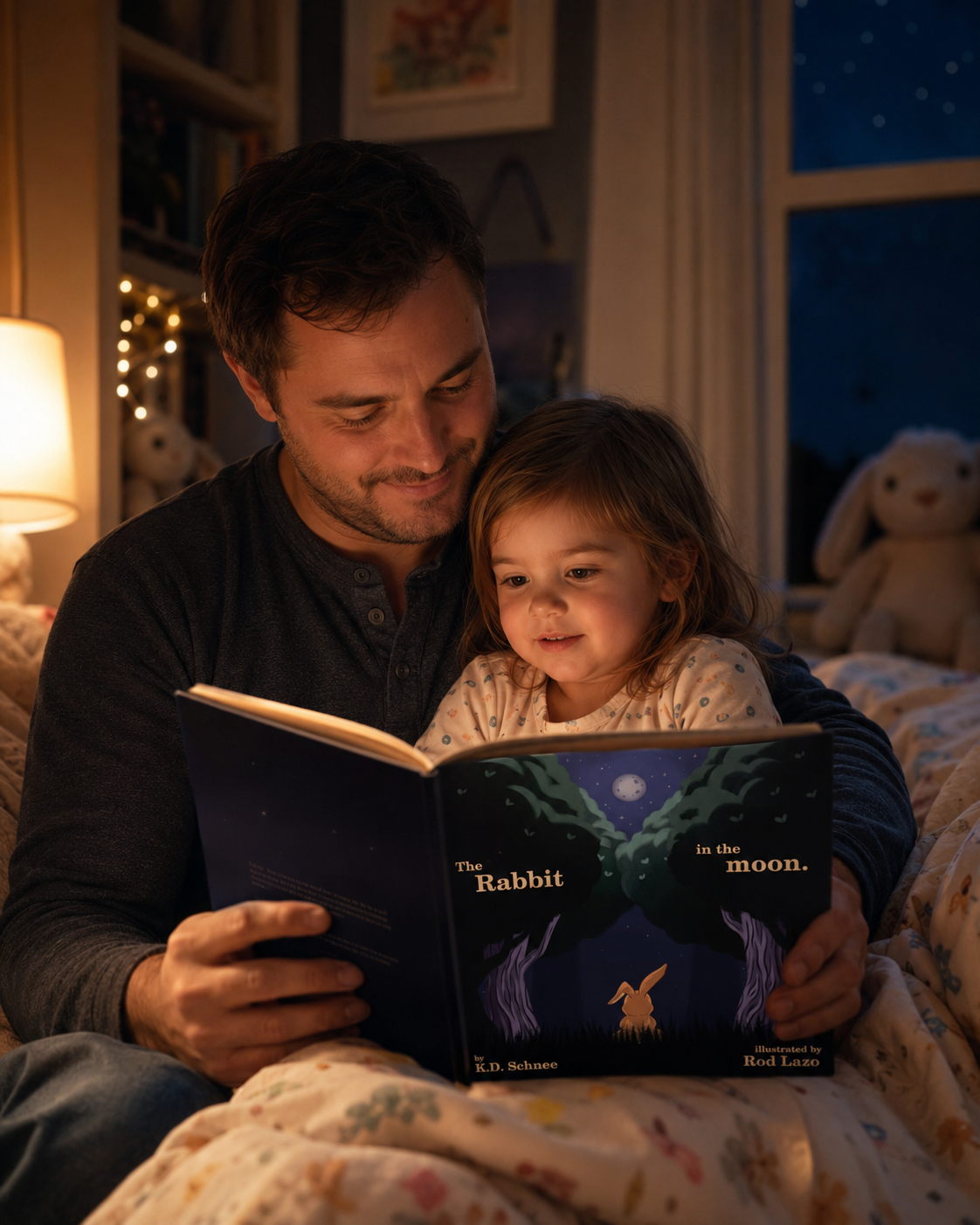
The right bedtime story does not tell a child the dark is silly. It helps the dark feel safer to sit beside.
The best books for kids afraid of the dark help children feel safe inside nighttime fear instead of telling them there is nothing to be afraid of.
That is the answer I would give parents first.
When a child is afraid of the dark, the goal is not to win an argument with their imagination. The goal is to help them name what feels big, feel connected to someone safe, and find one small brave step toward rest.
A good bedtime book can help because stories give fear a shape. Shadows become something to notice. Sounds become something to talk about. Night becomes less of a giant blank wall and more of a place a child can understand.
For children who worry at night, the right picture book should be calm, emotionally honest, visually safe, and gentle enough to become part of a bedtime rhythm. It should not mock fear. It should not make the dark scarier. It should help a child feel less alone before the lights go out.
Why are children afraid of the dark?
Children are often afraid of the dark because darkness changes the way the world feels.
A bedroom that seemed ordinary during the day can feel different at night. A jacket on a chair becomes a shape. A hallway creak becomes a question.
A shadow stretches. A parent leaves the room. The house gets quiet. Imagination, which is wonderful at noon, sometimes becomes a tiny moonlit playwright after bedtime.
That does not mean the child is being dramatic. It means their brain is trying to make sense of what it cannot see.
For young children, the line between imagination and reality can still be soft. They may know that monsters are not real in the daytime, but at night the feeling can still take over. The body reacts before logic arrives. Fear does not always wait for facts.
That is why “There is nothing to be scared of” often does not work. The sentence may be true, but it does not meet the child where the fear is living. A better approach is to help the child feel seen and safe first.
What should books for kids afraid of the dark do?
Books for kids afraid of the dark should do three things: recognize the fear, lower the emotional temperature, and show a small way forward.
Recognition matters because children need to know they are not strange for feeling scared. The book should make the child think, “Someone else knows what this feels like.” That recognition alone can soften shame.
Calm matters because bedtime is not the time for a story that turns fear into fireworks. A book about the dark should not be so exciting, spooky, or visually intense that it makes the room feel louder after the cover closes.
A small way forward matters because children need more than reassurance. They need something they can do. That action may be looking around the room with a parent, choosing a nightlight, naming one shadow, holding a comfort object, reading one familiar page, or taking one tiny brave hop toward staying in bed.
The best bedtime books help fear move from enormous to manageable. They do not erase the night. They make the night feel less alone.
Should a book say there is nothing to fear?
Not too quickly.
A child who is afraid of the dark usually does not need the adult to prove that the room is safe. They need the adult to help their body feel safe enough to believe it. That is a different job.
If a book rushes into “There is nothing to be afraid of,” it may accidentally make the child feel silly, corrected, or unseen. A better book lets the fear be real for a moment, then gently shows that the child can be supported inside it.
For a child, that emotional sequence matters.
First: I see that this feels big.
Then: You are not alone.
Then: Let’s find the small next step.
That is the same spirit behind the Tiny Brave Hop Method. We do not ask a child to leap straight into confidence. We help the next step become small enough to try.
At bedtime, a tiny brave hop might be lying down with the door open, turning on a small light, reading one calming page, checking one shadow with a parent, or saying, “That is my chair, not a monster.”
Small does not mean unimportant. At night, small can be the whole bridge.
What kinds of books help with fear of the dark?
The most helpful books for fear of the dark usually fall into a few categories.
Some books are calming bedtime books. These use rhythm, repetition, soft language, and predictable endings to help the child’s body settle.
Some books are reassurance books. These help children feel connected to a parent, caregiver, sibling, or steady presence when bedtime separation feels hard.
Some books are imagination books. These help children understand that their mind can create pictures in the dark and that those pictures can be questioned, softened, or changed.
Some books are courage books. These help children take one small step while the fear is still there.
For many children, the best shelf has more than one kind.
A child afraid of the dark may need a calming book on ordinary nights, a reassurance book during separation-heavy seasons, and a courage book when they are ready to practice staying with the feeling a little longer.
The trick is not finding one perfect book that does every job forever. The trick is matching the story to the child’s nighttime fear.
What is the difference between fear of the dark and nightmares?
Fear of the dark usually happens before sleep or when a child wakes and notices the room feels dark, quiet, or uncertain. Nightmares happen during sleep and can leave the child scared after waking.
The two can overlap, but they are not exactly the same. A child afraid of the dark may stall before bedtime, ask for extra lights, resist being alone, or repeatedly call for a parent. A child having nightmares may wake suddenly, cry, describe a scary dream, or become afraid to go back to sleep.
Books can help with both, but they may help in different ways.
For fear of the dark, choose books that make the room, shadows, and nighttime imagination feel safer. For nightmares, choose books that offer comfort, reassurance, and a way to talk about scary thoughts after waking.
A child with nightmares may need a very gentle story before bed, not one that names too many scary possibilities. A child afraid of the dark may need a story that helps them look at the night differently.
In both cases, the adult’s calm matters. The story is not replacing the parent’s presence. It is helping the parent’s presence become language.
How can picture books make night feel safer?
Picture books make night feel safer by letting children look at fear outside themselves.
A child may not want to say, “I am scared.” But they can look at a character and say, “He looks worried.” They can notice the moon. They can point to a shadow. They can ask why the page got darker. They can talk about the story without feeling like they are the story.
That distance is one of the quiet powers of picture books.
Illustrations also matter. A good nighttime picture book can show darkness without making it terrifying. It can use color, light, softness, and expression to help children feel the emotional shift from fear toward safety.
This is one reason The Rabbit in the Moon uses night so carefully. The darkness is real enough for children to recognize, but the world is still beautiful enough for them to stay with. Night becomes something the child can sit inside, not something they have to run from.
For a deeper look at how the book’s colors and illustrations help children read feelings before words, read: https://www.yabbitrabbit.com/parent-resources/rabbit-in-the-moon-illustrations-help-children-read-feelings
Why The Rabbit in the Moon helps with nighttime fear
The Rabbit in the Moon helps children with nighttime fear because it understands the emotional size of night.
Yabbit’s world shifts as the story moves into deeper darkness. The moon, shadows, quiet spaces, and unknown path all carry feeling. A child can sense that the journey is becoming bigger, but the story does not abandon them there.
Yabbit is not fearless. He pauses. He feels the size of what is ahead. That matters because a child who is afraid of the dark does not need a character who laughs at fear. They need a character who knows what it is to hesitate.
Snail matters too. Snail brings steadiness. He does not shame Yabbit for pausing. He does not make courage loud. He simply helps the journey continue.
That is a powerful model for bedtime.
A child can feel afraid and still be supported. A child can pause and still move forward. A child can take one tiny brave hop toward rest while the room still feels dark.
That is the kind of courage children can actually use.
How should parents read books about the dark?
Read them during calm moments, not only during the crisis.
If your child is already crying, panicking, or exhausted, the book may not land in the same way. The body is already in charge. A bedtime story works best when it becomes familiar before the hardest moment arrives.
During the day or earlier in the evening, you can read the book slowly and let your child notice the pictures. You might ask one gentle question, not ten.
“What do you notice about this page?”
“How does the night feel here?”
“Who is helping?”
“What made the next step smaller?”
Then stop.
Do not turn the book into a flashlight interrogation. The goal is not to extract the perfect emotional answer. The goal is to build a small shared language you can return to later.
At bedtime, you might say, “This feels like a Yabbit moment. What is one tiny brave hop?” That is often better than trying to explain the entire book while everyone is tired.
What should parents say when a child is scared of the dark?
Start with connection before correction.
A child who is scared at night needs to feel that you are close, calm, and not annoyed by their fear. That does not mean bedtime has no boundaries. It means the boundary works better when the child feels emotionally held.
Try scripts like:
“I believe that the dark feels big right now.”
“You are safe, and I am close.”
“Let’s look at one shadow together.”
“Your imagination is very busy tonight.”
“We do not have to solve the whole night. Let’s find one tiny brave hop.”
“This is a Yabbit moment. You can feel unsure and still take one small step.”
These scripts are useful because they do not argue with the child’s fear. They also do not hand the fear the steering wheel.
The message is: I see the feeling. I am here. The next step can be small.
That is often what children need most.
What should parents avoid saying?
Try not to shame the fear.
Avoid phrases like “That’s silly,” “You’re too old for this,” “There is nothing to be scared of,” or “Just go to sleep.” Even when adults are exhausted, those sentences can make a child feel alone inside the fear.
Also avoid making the dark more interesting than it needs to be. Long explanations about monsters, ghosts, nightmares, or scary possibilities can accidentally feed the imagination you are trying to calm.
The goal is not to create a courtroom case against darkness. The goal is to help the child feel safe enough to rest.
It also helps to avoid turning every night into a brand-new negotiation. Children often need predictable bedtime rhythms. If the plan changes constantly, the uncertainty can make nighttime feel even bigger.
A small, steady routine can be kinder than a large, dramatic rescue.
How can the Tiny Brave Hop Method help at bedtime?
The Tiny Brave Hop Method helps by making nighttime courage smaller.
A child afraid of the dark may not be ready to sleep all night with the lights off and the door closed. That may be too big. If the step is too big, the child may panic, resist, or need more reassurance than before.
A tiny brave hop might be:
Looking at one shadow with a parent.
Choosing one comfort object.
Turning the nightlight on.
Keeping the door open a little.
Listening to one calming song.
Reading one page again.
Letting the parent sit nearby for two minutes, then move slightly farther away.
Saying, “I am safe in my room.”
The important thing is that the step is small enough for the child to try and clear enough for the child to understand. For a hesitant child, bedtime courage is not a performance. It is practice.
One tiny brave hop. Then another, when they are ready.
How do you build a bedtime book stack for fear of the dark?
A strong bedtime book stack for fear of the dark should include three kinds of books: a calming book, a feeling book, and a courage book.
The calming book helps the body settle. This is the book with rhythm, repetition, softness, and predictability.
The feeling book helps the child name what night does to their imagination. This is the book that makes fear feel understandable without making it bigger.
The courage book helps the child take one small step toward rest. This is the book that says, “You can still begin, even while the feeling is here.”
The Rabbit in the Moon can serve as both a feeling book and a courage book because it helps children recognize hesitation, nighttime uncertainty, support, and one tiny brave hop forward.
For broader bedtime book recommendations for worried or anxious children, read: https://www.yabbitrabbit.com/parent-resources/calming-bedtime-picture-books-for-anxious-children
When should parents seek more help?
Most childhood fear of the dark can be supported with warmth, routine, reassurance, and time.
But if fear of the dark is causing constant sleep loss, intense bedtime distress, major family disruption, school-day exhaustion, or a child who becomes unable to sleep without significant distress, it is wise to talk with your pediatrician or a qualified child mental health professional.
The same is true if nightmares are frequent, unusually intense, connected to trauma, or interfering with your child’s daily functioning.
Books are beautiful tools. They can help children name fear, feel connected, and practice courage. But they should not be asked to do every job alone.
A good story can be part of the support system. It does not have to be the whole system.
Why stories help night feel safer
Stories help night feel safer because they give children a path through the feeling.
The dark can feel shapeless. A story gives it shape.
A scary thought can feel private. A story makes it shareable.
A child may feel stuck. A story shows movement.
That is the reason bedtime books matter so much. They do not simply fill the last minutes before sleep. They help children rehearse safety, connection, imagination, and courage in a form they can return to night after night.
For a child afraid of the dark, the right story can become a little lantern. Not one that makes the whole room bright. One that helps the next step appear.
Buy the Book
If your child is afraid of the dark, worries at bedtime, or needs courage made smaller at night, The Rabbit in the Moon belongs on your shelf.
Yabbit is not fearless. He pauses. He worries. He feels the size of the nighttime journey before him. Snail brings steadiness, persistence, and quiet support. Together, they help children understand that courage does not have to arrive all at once. It can begin with one tiny brave hop.
For parents, teachers, grandparents, and counselors, The Rabbit in the Moon offers more than a bedtime story. It gives children language for hesitation, fear, nighttime uncertainty, support, and brave little beginnings.
It is a meaningful investment in your child’s emotional growth and a gentle story to return to when night feels bigger than the room.
FAQs
What are the best books for kids afraid of the dark?
The best books for kids afraid of the dark are stories that help children feel safe, seen, and supported at bedtime. Look for books with calming rhythm, gentle illustrations, emotional honesty, and a small way forward.
Can picture books help children who are scared at night?
Yes. Picture books can help children talk about nighttime fear through characters, shadows, color, and story. A child may find it easier to talk about a character’s fear before talking directly about their own.
Should I tell my child there is nothing to be afraid of?
It is better to start with connection. Try saying, “I know the dark feels big right now. You are safe, and I am close.” Children often need to feel understood before reassurance can reach them.
Is The Rabbit in the Moon good for kids afraid of the dark?
Yes. The Rabbit in the Moon is a strong bedtime choice for children who feel worried, hesitant, or unsure at night. Its moonlit world helps children see fear gently, while Yabbit and Snail show that courage can begin with one tiny brave hop.
What should I do if my child has nightmares?
Comfort your child, help them feel safe, and keep the response calm. During the day, you can use gentle stories to talk about scary dreams or imagination. If nightmares are frequent, intense, or disruptive, speak with a pediatrician or qualified child mental health professional.
How can I help my child be brave at bedtime?
Make bedtime bravery small. A tiny brave hop might be turning on a nightlight, checking one shadow, holding a comfort object, reading one calming page, or staying in bed for a short, manageable step.
When should I get professional help for fear of the dark?
Seek help if fear of the dark causes constant sleep loss, extreme distress, major family disruption, or problems during the day. Books and routines can help, but persistent or intense anxiety deserves professional support.