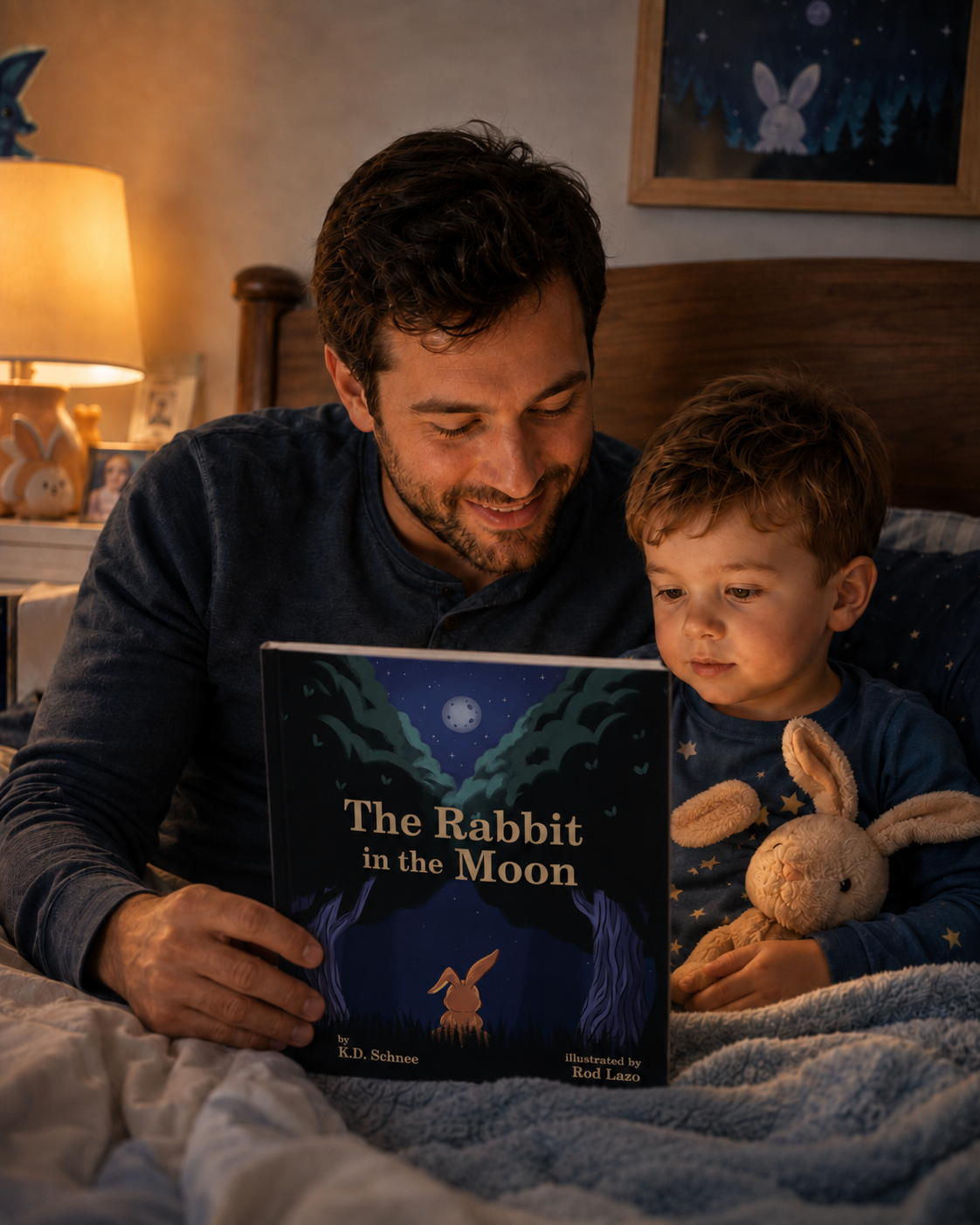
Bedtime gets easier when children know what comes next and have language for what feels big.
Yabbit the Rabbit helps make bedtime easier for parents by turning the end of the day into something smaller, calmer, and easier to repeat. Instead of asking children to suddenly relax, separate, and fall asleep all at once, The Rabbit in the Moon gives families a story, a phrase, and a gentle routine they can return to night after night.
For many families, bedtime is not just about sleep. It is the moment when the house gets quiet and a child’s feelings finally have room to rise. The same child who seemed fine at dinner may suddenly need water, one more hug, the hallway light, a different stuffed animal, a question about tomorrow, or a full investigation into the sound outside the window.
That does not mean your child is trying to make bedtime difficult. Often, it means the transition feels big. The day is ending. You are leaving the room. The lights are lower. The brain is tired, but not calm yet.
As the creator of Yabbit the Rabbit and The Rabbit in the Moon, I think of bedtime as one of the clearest “tiny brave hop” moments in family life. A child does not always need a brand-new strategy. They often need the same steady sequence, the same warm words, and one small next step that helps the night feel safe enough to enter.
Why bedtime can feel harder for hesitant children
Bedtime asks a lot of a young child. It asks them to stop playing, leave the brightness of the day, separate from a parent, lie still, and trust that everything is okay in the dark. For a hesitant or anxious child, that can feel like too many emotional tasks stacked together.
This is why “just go to sleep” rarely works as well as adults wish it would. Sleep is not something a child can force simply because we are tired and ready to clock out of the bedtime opera. A child may need help moving from the energy of the day into the quiet of night.
A picture book can help with that shift because it gives the child a bridge. The story slows the room down. The parent’s voice becomes part of the routine. The child can settle into something familiar before the final goodbye.
That is where Yabbit becomes useful.
1. Yabbit gives children language for bedtime feelings
A lot of bedtime resistance is really emotional overflow.
Children do not always know how to say, “I am worried,” “I do not want to be alone,” “The dark feels different,” or “My brain is still busy.” Instead, they stall, bargain, cry, ask repeated questions, or suddenly become very concerned about the exact placement of a blanket corner.
Yabbit gives that feeling a softer doorway. A child can talk about Yabbit being unsure before they are ready to talk about themselves. They can notice a character’s hesitation, worry, or brave little step and begin to understand their own feelings through story.
That matters because bedtime gets harder when children feel misunderstood. Once a child has words for the feeling, the parent has something to respond to besides the behavior.
You might say, “This feels like a Yabbit moment,” or, “Your worry is here, and we can still take one tiny brave hop toward rest.”
That is much more useful than trying to argue a child out of being scared.
2. Yabbit turns bedtime into tiny brave hops
For a tired child, bedtime can feel like one huge demand: put everything away, brush teeth, change clothes, read, separate, lie down, stay there, and fall asleep.
That is a lot.
The Tiny Brave Hop Method helps because it breaks the routine into smaller steps. Instead of treating bedtime as one giant finish line, you help your child move through the next clear action.
Pajamas.
Brush teeth.
Choose the book.
Read the story.
Dim the light.
One hug.
One closing phrase.
Parent steps out.
The steps should stay simple and predictable. The goal is not to make bedtime complicated. The goal is to make it familiar enough that the child’s body and mind start to understand what comes next.
For a deeper guide to using small brave steps with hesitant children, read: https://www.yabbitrabbit.com/parent-resources/how-to-help-your-child-take-tiny-brave-hops
A tiny brave hop does not magically erase bedtime anxiety, but it gives the child somewhere to place their foot.
3. Yabbit helps parents stay warm and firm
When bedtime stretches too long, even patient parents can start to unravel at the edges.
That is normal. You may have been steady for thirteen hours already. You may still have dishes, emails, laundry, or your own exhausted brain waiting outside the bedroom door. By the fourth “one more thing,” it is easy to respond with urgency.
But a child’s nervous system usually does not calm down because a parent becomes more urgent. Bedtime tends to go better when the parent can stay warm and firm at the same time.
Yabbit helps because the language is simple. You do not need a speech. You need a phrase you can repeat without turning bedtime into a negotiation.
Try: “I am right here. Your feelings are safe. And it is still bedtime.”
That sentence holds both sides of the moment. It validates the feeling without handing the night over to it.
Warmth says, “I see you.”
Firmness says, “The routine is still holding.”
Children need both.
4. Yabbit makes separation feel safer
For many children, the hardest part of bedtime is not pajamas, brushing teeth, or the story. It is the moment when the parent leaves.
That separation can feel enormous. Even a child who seems independent during the day may struggle when the room gets quiet and the door begins to close. The worry may sound like, “Stay with me,” “I’m scared,” “Don’t go,” or “I need one more hug.”
Stories help because they create connection before separation. When a parent reads The Rabbit in the Moon, the child gets closeness, rhythm, voice, and comfort before the final goodnight. The story also gives the child a phrase to carry into the room after the parent leaves: one tiny brave hop.
That hop might be lying down with the blanket pulled up. It might be holding a stuffed animal. It might be keeping the door cracked. It might be knowing that a parent will check back once.
If darkness or nighttime fears are a major part of bedtime in your home, this related guide may help: https://www.yabbitrabbit.com/parent-resources/books-for-kids-afraid-of-the-dark
The goal is not to make your child pretend they are not scared. The goal is to help them feel safe enough to practice being alone in small, manageable ways.
5. Yabbit gives families a bedtime ritual they can repeat
Parents often think they need a new solution every night. Most children need the opposite.
They need repetition.
A bedtime ritual does not have to be elaborate. In fact, the simpler it is, the more likely you are to repeat it when everyone is tired. The power comes from the familiar order, the familiar story rhythm, and the familiar closing words.
A Yabbit bedtime ritual might look like this:
Brush teeth.
Pajamas.
Read The Rabbit in the Moon.
Name one tiny brave hop from the day.
Choose one tiny brave hop for bedtime.
Say the same closing phrase.
You might close with:
“Tonight, your job is rest. Tomorrow, we’ll take the next tiny brave hop.”
That kind of repetition gives children a sense of safety. They know what is coming. They know how the night ends. They know the parent will not invent a completely different emotional maze every evening.
Predictability is not boring to a child who feels unsure. It is ballast.
What should parents say when bedtime starts to wobble?
When bedtime starts to wobble, keep your words short.
A tired child does not need a long explanation of why sleep matters or why the family schedule depends on this exact moment going smoothly. They need calm, clear language that brings them back to the routine.
Try:
“This is the hard part.”
“You are safe.”
“We are on the next tiny brave hop.”
“I will check on you after one song.”
“Your job is rest now.”
“You do not have to be fearless. You just have to take one tiny brave hop.”
These phrases work because they are steady. They do not dismiss the feeling, but they also do not turn every worry into a new negotiation. Bedtime improves when children know the parent can hold the boundary without losing the warmth.
Why The Rabbit in the Moon belongs in a bedtime routine
The Rabbit in the Moon belongs in a bedtime routine because it gives children a calm story about hesitation, support, courage, and one small step forward.
Yabbit is not fearless. He pauses. He worries. He feels the size of the journey before him. Snail brings steadiness and quiet support. Together, they show children that bravery can be small, soft, and imperfect.
That is exactly the kind of courage many children need at bedtime.
They do not need to conquer the night. They need to enter it.
The right bedtime story can help children feel less alone with worry and more prepared for the small transition ahead. It also gives parents language they can use when the lights go down and the feelings come up.
External Resource
The American Academy of Pediatrics recommends a simple “Brush, Book, Bed” routine to help families create a healthier nighttime rhythm: https://www.healthychildren.org/English/healthy-living/oral-health/Pages/Brush-Book-Bed.aspx
Buy the Book
If bedtime has become one of the hardest parts of your day, The Rabbit in the Moon can help make the routine feel softer, safer, and easier to repeat.
Yabbit gives children a character who understands hesitation. Snail brings steadiness. The story gives families a calming read-aloud, and the phrase “one tiny brave hop” gives parents something simple to say when bedtime feelings get big.
The Rabbit in the Moon was written for children who pause before hard things, and bedtime is often one of those moments. It gives families more than a story. It gives them language for courage, comfort, and the next small step toward rest.
[INSERT YOUTUBE LINK HERE]
Optional caption: A short parent reflection from KD Schnee on using Yabbit, storytime, and one tiny brave hop to make bedtime feel safer.
FAQs
How does Yabbit the Rabbit make bedtime easier for parents?
Yabbit helps make bedtime easier by giving children language for worry, breaking the routine into tiny brave steps, and creating a calming story ritual parents can repeat each night.
Why does my child fight bedtime even when they are tired?
Children often fight bedtime because tired does not always mean calm. Bedtime can bring up separation, darkness, worry, and the transition from a busy day into quiet.
What is a tiny brave hop at bedtime?
A tiny brave hop at bedtime is the next small step your child can take toward rest. It might be putting on pajamas, choosing the book, lying down, holding a stuffed animal, or letting a parent step out for one minute.
Is The Rabbit in the Moon good for bedtime?
Yes. The Rabbit in the Moon works well as a bedtime story because it is gentle, emotional, and built around courage that feels small enough for children to understand.
What should I say when my child is scared at bedtime?
Try saying, “I believe this feels big. You are safe, and it is still bedtime.” Then guide your child back to the next small step in the routine.
Should bedtime be the same every night?
A consistent routine helps many children feel safer because they know what comes next. The exact routine does not have to be perfect, but the order and tone should feel familiar.
When should I ask for help with bedtime anxiety?
If bedtime fear or sleep disruption lasts for weeks, causes major distress, affects school or family life, or feels unmanageable, talk with your pediatrician or a qualified child mental health professional.