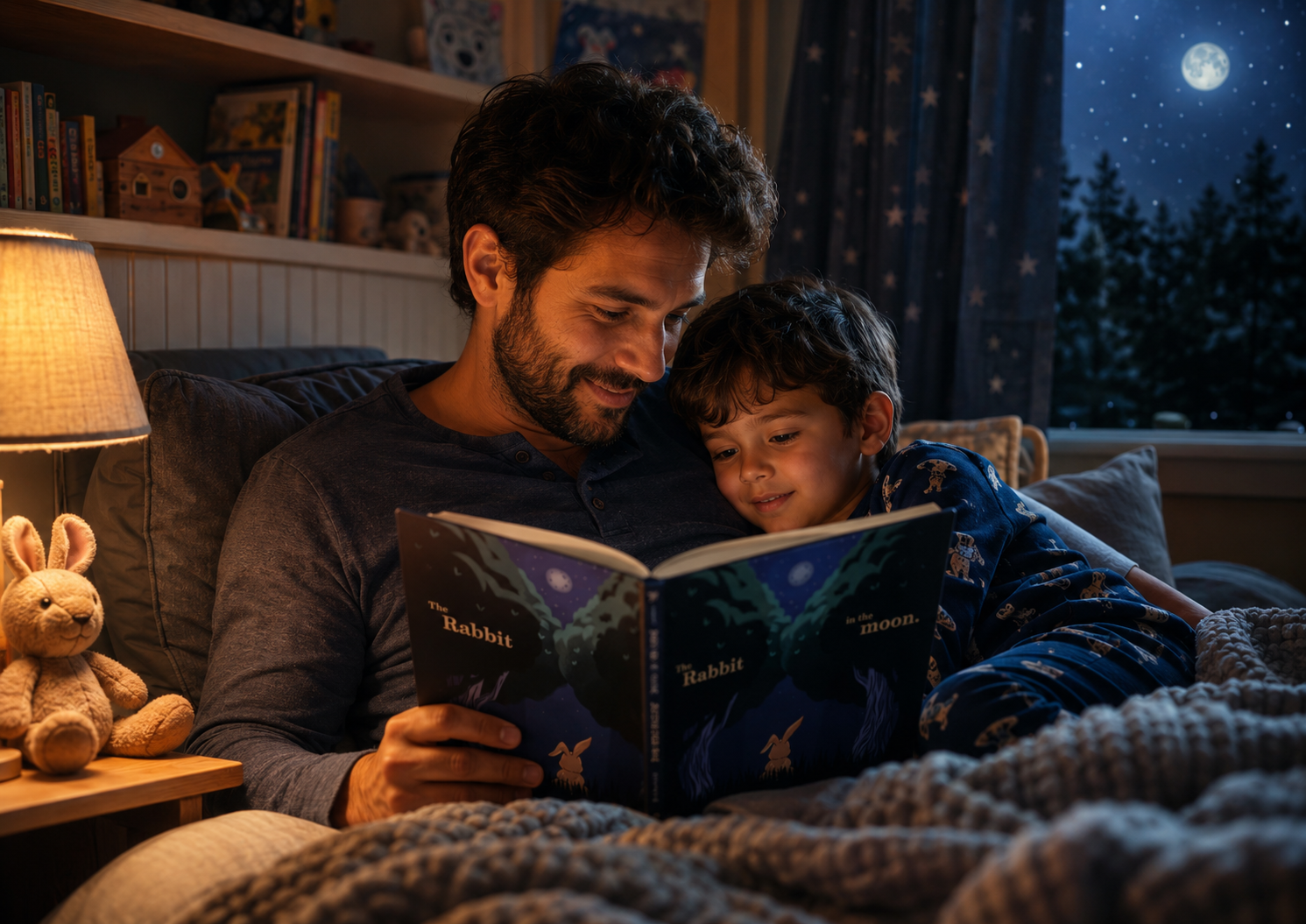
A bedtime story does more than end the day. It gives a child connection, language, imagination, and a softer place to practice courage.
Reading to children every night is one of the simplest ways to help a child feel connected, calmer, and more ready for the world.
I do not say that because bedtime has to become another perfect parenting performance. It does not. Some nights are messy. Some nights are late. Some nights the child is upside down, the dog is barking, someone needs water, and the book is being held together by sheer parental will.
That still counts.
The power of reading to children is not found in making bedtime look peaceful from the outside. It is found in what happens over time when a child repeatedly hears a trusted voice, sits inside a story, follows a character through a feeling, and learns that hard moments can be named, understood, and softened.
A bedtime story gives a child more than words. It gives rhythm. It gives closeness. It gives imagination. It gives emotional practice. It gives a small, reliable bridge from the noise of the day into the quiet of night.
For hesitant children, that bridge can matter even more.
A child who worries, stalls, freezes, or avoids starting may not need a lecture at bedtime. They may need a story. They may need a character who also pauses. They may need language for a feeling they have not been able to explain yet. They may need the comfort of hearing, again and again, that courage can begin in a small way.
That is why bedtime reading has always felt bigger to me than a routine. It is one of those small family rituals that can quietly shape a child’s inner life.
1. Reading at bedtime builds emotional security
One of the strongest mental benefits of reading to children every night is the emotional safety it creates.
Children do not only hear the story. They hear the voice reading it. They feel the pause before the page turns. They notice that someone is sitting with them, giving them attention, staying close, and helping the day come down gently.
That repeated experience matters.
A child’s world can feel enormous. New classrooms, new people, new expectations, new mistakes, new transitions, new fears. By nighttime, even a child who looked fine all day can suddenly feel full. Bedtime is often when worries that stayed hidden during the day come tapping from inside the walls.
A story gives those worries somewhere softer to land.
When you read to a child at night, you are not only entertaining them. You are helping create a predictable pocket of connection. The child learns, “This is a time when I am close to someone. This is a time when the world slows down. This is a time when I do not have to carry everything alone.”
That emotional security is not flashy. It does not announce itself. It builds like lamplight, night after night.
For a hesitant child, that kind of safety can become the soil where courage begins.
2. Bedtime reading helps children calm their bodies and minds
A good bedtime routine tells the body what comes next.
Brush teeth. Pajamas. A quieter room. A familiar book. A calmer voice. The same chair, the same blanket, the same small ritual that says, “The day is ending now.”
Children need those signals because transitions are hard. Bedtime asks a child to leave activity, attention, play, noise, and closeness, then enter stillness. For many children, that is not a gentle little hop. It is a cliff.
Reading helps make the cliff smaller.
A bedtime story gives the child something to follow as the body begins to settle. The rhythm of the words, the turning of pages, and the predictable shape of a story can all help lower the emotional temperature. The child is not being thrown directly from busy into sleep. They are being guided.
This is especially important for children whose feelings get louder at night. The room darkens. The house gets quiet. Imagination wakes up. A shadow becomes a question. A sound becomes a what-if. A parent stepping away can feel much bigger than it did the night before.
The right bedtime book does not ignore that. It helps the child feel safer inside it.
If bedtime worry is part of your child’s nightly rhythm, this related guide may help you choose stories that meet that feeling gently:
https://www.yabbitrabbit.com/parent-resources/calming-bedtime-picture-books-for-anxious-children
3. Reading aloud grows language in a natural way
Children build language by living inside language.
They hear how sentences move. They hear words they may not hear in everyday conversation. They begin to understand rhythm, pattern, expression, cause and effect, and the music of a sentence before they can explain any of it.
That is one of the quiet gifts of reading aloud.
A child may hear a word in a story long before they use it. They may not stop you and ask for a definition. They may not repeat it that night. But the word has entered the room. It has a picture beside it, a feeling attached to it, a character carrying it.
That is how language becomes less like a lesson and more like a lived experience.
Picture books are especially powerful here because the illustrations help hold meaning. A young child can look at Yabbit’s face, Snail’s movement, the moonlit sky, or the deepening colors of the page and begin to connect words with feeling. They are not just hearing language. They are watching it become visible.
For children who are still learning how to explain themselves, this matters deeply.
A child may not be able to say, “I feel uncertain because the moment feels too big.” But after enough stories, they may be able to say, “This feels like Yabbit.” That is language growth too. Not just more words, but more useful words.
4. Stories build attention, listening, and memory
Following a story takes mental work.
A child listens, remembers, predicts, wonders, and connects. They learn that one event leads to another. They notice that characters want things, fear things, lose things, try things, and change. They begin to understand sequence: beginning, middle, end.
That may sound simple to adults. For a child, it is a full little orchestra.
Reading at bedtime gives children a chance to practice attention without making attention feel like a test. They are not sitting at a desk being asked to perform. They are tucked in, leaning close, following a story because they care what happens next.
That difference matters.
Some children struggle to focus when the task feels pressured. But a story can invite focus instead of demanding it. The child wants to know what Yabbit will do. They want to know if Snail will keep going. They want to know what happens when the night feels big.
That kind of attention grows quietly.
Over time, read-aloud time helps children practice listening, patience, memory, and comprehension. They begin to hold more of the story in their minds. They remember what happened last night. They correct you if you skip a line. They ask for the same book again because repetition helps them master the shape of it.
That repeated return is not a problem. It is part of the learning.
5. Bedtime stories help children understand feelings
This is one of the reasons I care so much about picture books.
Children often feel things before they can explain them. They may act out a feeling, avoid a feeling, hide a feeling, or melt down under a feeling long before they can name it clearly.
Stories help because they give feelings a safe distance.
A child can talk about Yabbit’s hesitation before talking about their own. They can notice that Snail keeps going without feeling accused of giving up. They can see that a character is worried, unsure, brave, disappointed, or supported, and that recognition begins to build emotional language.
The page holds the feeling still long enough for the child to look at it.
That is very different from trying to process a feeling in the middle of the real-life moment. When a child is crying at drop-off, frozen before a game, or refusing to try something new, the feeling is already in charge. But in a story, the child can observe the feeling from a safer place.
This is where bedtime reading can become emotionally powerful without becoming heavy.
You do not need to turn the book into therapy. You do not need to pause on every page and ask ten questions. Sometimes one sentence is enough: “That part felt big for Yabbit.” Or, “Snail stayed with him.” Or, “He was still scared, but he took one tiny brave hop.”
Those small observations become language your child can borrow later.
For more ways to use picture books to help children name feelings gently, read: https://www.yabbitrabbit.com/parent-resources/emotional-literacy-activities-for-picture-books
6. Reading every night helps children imagine courage
Imagination is not just pretending.
For children, imagination is rehearsal.
When a child hears a story, they practice entering a situation that is not happening to them directly. They imagine the dark path, the unsure character, the hard beginning, the helper beside them, and the next small step. They get to try on courage without being forced into a real-world performance before they are ready.
That is a beautiful mental benefit of reading.
Stories let children imagine who they might become. Not in a grand, dramatic way. In a small, believable way. A child can imagine being a little braver at school. A little calmer at bedtime. A little more willing to try. A little more able to say, “I can take one tiny brave hop.”
That is why the right children’s book can stay with a child.
It does not only entertain them for ten minutes. It gives them an inner picture they may return to later. When a moment feels hard, the story can rise quietly in the background. Yabbit paused. Snail kept going. The night felt big. The next step was small.
That kind of imaginative rehearsal matters because children do not build courage by being told to “just be brave.” They build it by seeing courage made believable.
They need stories where bravery still has a heartbeat.
Why bedtime reading matters for hesitant children
A hesitant child is not always refusing. Sometimes the beginning just feels too big.
That is why bedtime reading can be so helpful. It gives children a daily experience of moving gently through a beginning, a feeling, and an ending. It helps them practice staying with a story even when the moment becomes uncertain.
The repetition itself is comforting.
You open the book. You enter the story. Something happens. A character feels something. The story continues. The ending arrives. The child is safe.
Over time, that rhythm teaches something important: feelings can move. A scary page can turn. A worried character can continue. A hard moment does not have to be the end of the story.
That is exactly the emotional world behind The Rabbit in the Moon.
Yabbit is not fearless. He does not leap into courage as if hesitation never existed. He pauses. He worries. He feels the size of the task in front of him. Snail, steady and determined, helps the journey continue without shaming the pause.
That is the kind of story many hesitant children need.
Not a story that says fear is silly.
Not a story that demands confidence on command.
A story that says courage can begin quietly, with one tiny brave hop.
How to make bedtime reading more meaningful without making it harder
Parents do not need a complicated bedtime reading plan.
Start with consistency when you can. Choose a time that feels realistic for your family. Let the book become a cue, not a chore. Some nights you may read three books. Some nights you may read three pages. The goal is not perfection. The goal is connection.
It also helps to let children return to familiar books. Adults sometimes want novelty, but children often crave repetition because repetition creates mastery. A favorite book lets the child know what is coming. That predictability can calm the nervous system and make the story feel like a safe room they know how to enter.
When you read, keep the emotional conversation gentle. You can ask a simple question like, “How do you think Yabbit feels here?” or “What changed on this page?” But you do not need to turn bedtime into an interview. Often, children absorb the story more deeply when they are allowed to listen without pressure.
The best bedtime reading feels like an invitation.
Come sit close.
Let the day settle.
Let the story hold what felt big.
Let courage become smaller.
That is enough.
Why The Rabbit in the Moon belongs in a bedtime routine
The Rabbit in the Moon was created for children who hesitate before big moments, and bedtime can be one of the biggest moments of the day.
At night, children are tired. The room is darker. Separation can feel sharper. Worries can become louder. A child who seemed brave at breakfast may suddenly need more reassurance when the lights go down.
Yabbit understands that feeling.
The story gives children a character who pauses without being judged. It gives them Snail, whose steady persistence shows that continuing does not have to mean rushing. It gives parents language that can return later: tiny brave hop, Yabbit moment, one small step.
That is what makes the book useful beyond the page.
A bedtime book should not only help a child fall asleep. The best bedtime books help a child feel safer inside themselves. They build connection, language, imagination, and emotional courage one read-aloud at a time.
The Rabbit in the Moon was built for that kind of quiet work.
Buy the Book
If you are looking for a bedtime picture book that supports emotional growth, courage, and connection, The Rabbit in the Moon belongs on your shelf.
Yabbit is a hesitant rabbit who feels the size of a difficult journey before he begins. Snail brings steadiness, persistence, and quiet support. Together, they help children understand that bravery does not have to arrive all at once. It can begin with one tiny brave hop.
For parents, teachers, grandparents, and counselors, The Rabbit in the Moon offers more than a beautiful bedtime story. It gives children language for hesitation, fear, support, and the small brave beginnings that help confidence grow.
The Rabbit in the Moon is a meaningful investment in your child’s emotional growth.
FAQs
What are the mental benefits of reading to children every night?
Reading to children every night can support emotional security, language development, attention, listening, imagination, empathy, and confidence. It also gives children a predictable moment of connection with an adult, which can help the day feel calmer and more complete.
Does reading at bedtime help children calm down?
For many children, yes. A familiar bedtime story can become part of a predictable wind-down routine. The steady voice, repeated rhythm, and quiet connection can help the child transition from the busyness of the day into rest.
How long should I read to my child every night?
There is no perfect number of minutes. Even a short read-aloud can matter when it is warm, consistent, and connected. Some nights may allow for a longer story. Other nights may only allow a few pages. The habit matters more than making every night perfect.
Can bedtime reading help anxious or hesitant children?
Yes, especially when the book helps the child feel seen without pressure. Hesitant children often benefit from stories that name worry gently, show courage in small steps, and offer language the family can use later in real-life moments.
Why are picture books helpful even after a child starts reading independently?
Picture books do more than teach words. They use illustration, rhythm, expression, and shared reading to help children understand feelings, relationships, and difficult moments. A child may be able to read simple books alone and still need picture books for emotional growth.
Is The Rabbit in the Moon a good bedtime book?
Yes. The Rabbit in the Moon works well as a bedtime picture book because it gives children a gentle way to understand hesitation, fear, support, and courage. It is especially useful for children who need brave moments to feel smaller and safer.
What if my child asks for the same bedtime book every night?
That can be a good thing. Repetition helps children feel secure, understand language, remember story structure, and gain confidence. A familiar book can become part of the child’s emotional routine, especially at bedtime.