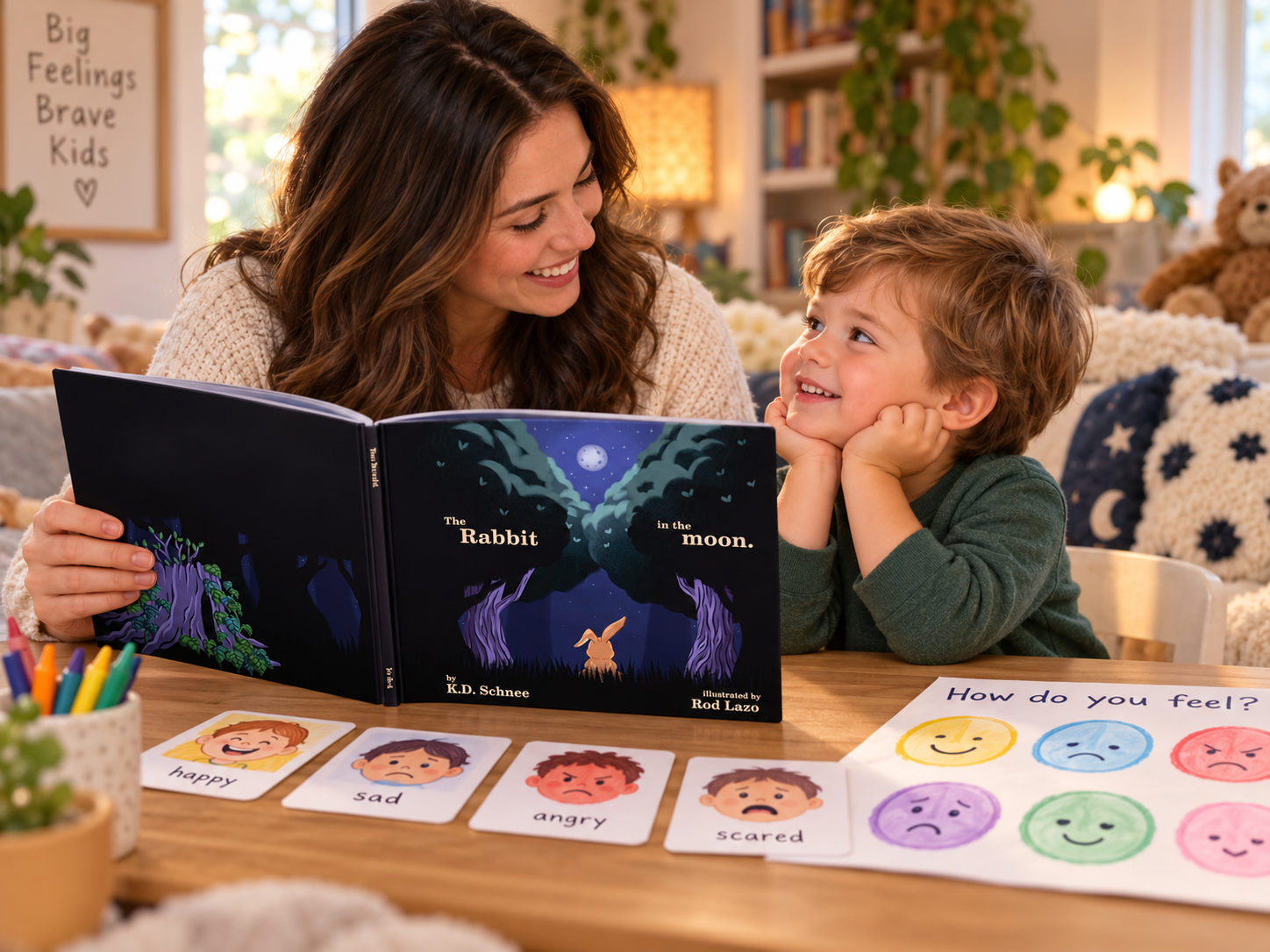
Picture books give children a natural way to practice emotional literacy by noticing feelings, reading expressions and body language, building emotional vocabulary, and talking about what helps a character move forward.
A child does not need to know the word embarrassed to know that something uncomfortable is happening inside them. They may feel their cheeks get hot, hide behind you, become angry, refuse to participate, or suddenly decide they never wanted to do the activity in the first place. The feeling often arrives before the vocabulary.
Picture books give children a useful way into that gap.
Instead of asking a child to explain an emotion while they are experiencing it, a story lets everyone look at somebody else first. A character worries about school, gets left out, makes a mistake, loses their temper, misses someone, hesitates before trying, or discovers that things did not go according to plan. The emotional experience is right there on the page, but the child does not have to stand in the middle of it.
That distance can make an enormous difference. Children can notice a character’s expression, posture, words, choices, and surroundings before anyone asks them to talk about themselves. They are learning the language of feelings through story, which is one of the reasons picture books can be such useful tools for emotional literacy.
The goal is not to turn every read-aloud into a lesson. Storytime should still feel like storytime, not a pop quiz wearing pajamas. A few thoughtful questions and activities, used naturally over time, can do far more than interrogating a child after every page.
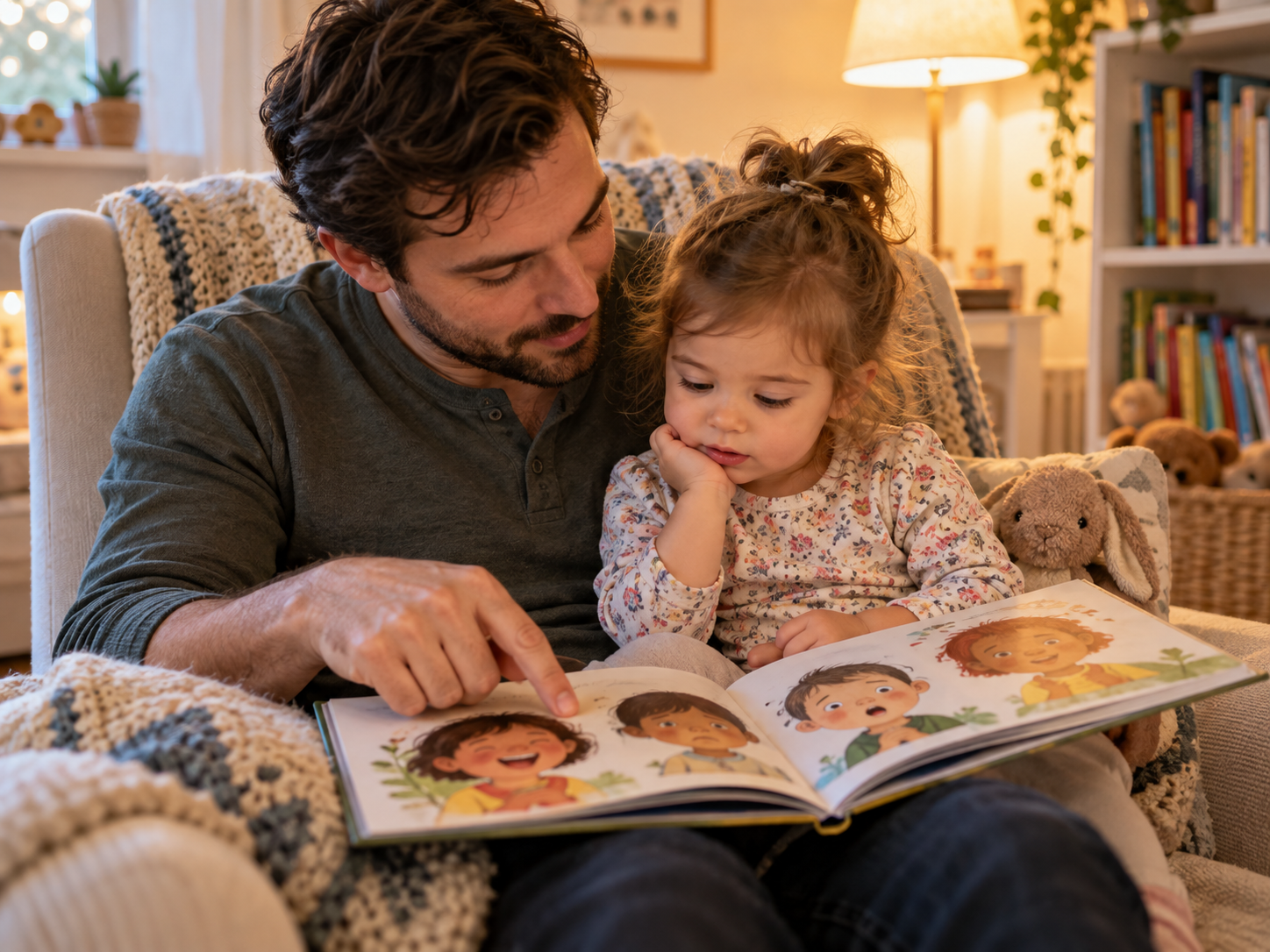
Emotional literacy can grow during ordinary read-alouds when children are encouraged to notice expressions, body language, emotional words, and what changes during a story.
Quick Answer: What Are Emotional Literacy Activities for Picture Books?
Emotional literacy activities for picture books are simple ways of using stories and illustrations to help children recognize, name, understand, and talk about emotions. Parents and teachers can pause at an important scene, ask what a character might be feeling, notice clues in the illustrations, explore where emotions appear in the body, compare emotional words, or discuss what helped the character after something became difficult.
These activities work best when they remain part of the reading experience rather than taking it over. You do not need a worksheet, a lesson plan, or a twenty-minute discussion after every book. One thoughtful question can sometimes give a child more useful emotional language than an elaborate activity.
The purpose is not to produce the “correct” answer. It is to help children become more curious and precise about what feelings look like, what may cause them, how they affect behavior, and what can happen next.
What Does Emotional Literacy Mean for Children?
Emotional literacy is a child’s developing ability to recognize and understand emotions in themselves and other people, find words for those feelings, and begin making sense of how emotions influence behavior and choices.
For young children, that development often starts with broad categories. Something feels good, bad, scary, exciting, or upsetting. As their emotional vocabulary grows, they can begin making finer distinctions. “Bad” might become disappointed, lonely, jealous, embarrassed, frustrated, or worried. “Scared” might become nervous, uncertain, startled, overwhelmed, or afraid of making a mistake.
Those distinctions are useful because different feelings may call for different responses. A lonely child may need connection. A frustrated child may need a break or a different strategy. A nervous child may need reassurance and a smaller first step. A disappointed child may need help accepting that something did not turn out as hoped.
Emotional literacy does not mean expecting children to calmly identify every emotion while they are upset. Adults are not particularly famous for doing that either. It means gradually giving children a richer emotional vocabulary and more opportunities to understand what may be happening inside themselves and the people around them.
Why Picture Books Are So Useful for Emotional Literacy
Picture books give children two sources of emotional information at once: the words tell one part of the story while the illustrations tell another. A character may insist that everything is fine while their expression, posture, distance from the group, or surrounding colors suggest something much more complicated.
That gives children practice reading emotions instead of merely memorizing emotion words.
A child might notice that a character is standing apart from everyone else before they know the word lonely. They may see clenched hands and a lowered head before identifying frustration. They may notice that a character who seemed frightened earlier is now standing taller, moving closer, or reaching toward someone.
These visual details are especially valuable for young children because emotional understanding often develops before a child has the vocabulary to explain everything they notice. A picture gives the feeling somewhere to live while the language catches up.
The National Association for the Education of Young Children has highlighted picture books as useful tools for helping families support social-emotional development and begin conversations about feelings, friendship, perseverance, self-concept, and other experiences that can be difficult to discuss directly.
For a deeper look at how illustrations themselves help children interpret emotion, read Why The Rabbit in the Moon’s Illustrations Help Children Read Feelings Before Words.
How to Use Emotional Literacy Activities Without Ruining the Story
You do not need to use all seven activities every time you read. In fact, doing so would probably convince your child that every picture book comes with an oral examination.
Choose one activity when the story naturally creates an opening. On another night, simply read.
Some children enjoy talking about every expression they see. Others prefer listening quietly and may say very little until hours or days later. Both children can be learning. Emotional literacy is not measured by how much a child performs during the read-aloud.
It also helps to follow the child’s attention. If they keep returning to an illustration, notice what they are noticing. If they laugh during a scene you expected them to find serious, let them laugh. If they disagree with your interpretation of a character, ask why rather than correcting them immediately. Emotional understanding becomes richer when children learn that people can interpret the same situation differently.
The seven activities below can be used with almost any picture book containing meaningful emotional moments.
1. Name the Feeling, Then Make the Word More Precise
The simplest place to begin is by asking what a character seems to be feeling. Younger children will often choose a broad word such as happy, sad, mad, or scared, and those words are perfectly good starting points.
The next step is not to tell the child that their answer is too simple. Instead, offer possibilities that make the emotional vocabulary more precise.
If the child says a character is sad, you might wonder together whether they seem disappointed, lonely, left out, discouraged, or hurt. If the child chooses mad, the feeling might also contain frustration, jealousy, embarrassment, impatience, or feeling overwhelmed. If a character seems scared, you might explore whether they are nervous, uncertain, startled, worried, or afraid of failing.
You can make the conversation more interesting by asking what evidence the child sees. Perhaps the character is looking away, standing alone, squeezing something tightly, or hiding behind another person. The child is no longer merely matching a face to a vocabulary word; they are learning to explain why an emotion makes sense.
In The Rabbit in the Moon, for example, Yabbit can be described as scared, but that does not capture everything happening inside him. Hesitant, uncertain, overwhelmed, reluctant, and worried about beginning all describe different parts of his experience. Giving children access to those distinctions creates a much larger emotional map.
2. Find the Feeling in the Character’s Body
Children often experience emotion physically before they can explain it verbally. Nervousness may appear as a tight stomach, fast heartbeat, shaky hands, or the sudden desire to use the bathroom. Embarrassment may bring hot cheeks or a lowered face. Frustration may show up in tense shoulders, clenched hands, a louder voice, or tears that seem to arrive out of nowhere.
Picture books give children a low-pressure way to notice those signals.
Choose an emotionally important illustration and ask, “What do you think this feeling is doing in the character’s body?” You might look together at their hands, shoulders, eyes, mouth, posture, or position on the page. Younger children may enjoy physically copying the posture and noticing what it feels like.
The point is not to teach children that every stomachache means anxiety or that one expression always represents one emotion. Bodies are more complicated than that. The purpose is to help children understand that feelings are not floating vocabulary words; emotions can affect how our bodies feel and behave.
That awareness can eventually help a child notice their own early signals. A child may not be ready to say, “I am becoming anxious about soccer practice,” but they may begin to recognize, “My stomach gets tight when I think about going.” That is useful information, even before the child knows what to do with it.
3. Pause and Predict What the Character Might Do Next
Prediction is usually taught as a reading-comprehension skill, but it can also be a surprisingly good empathy exercise.
Pause before turning the page during an emotional moment and ask what the child thinks the character might do next. Then follow with the more revealing question: “Why do you think they might do that?”
Now the child has to connect emotion with behavior.
A character who feels excluded may move away from the group. Someone who feels embarrassed may become angry. A nervous character might refuse something they actually want to do. A disappointed character may quit. A child who feels supported may decide to try again.
There does not have to be one correct prediction. In fact, discussing two plausible reactions can be even more useful. You might say, “Maybe she walks away because she feels embarrassed, or maybe she tells her friend that the comment hurt. Which do you think she will do?”
That kind of conversation helps children understand something adults sometimes forget: behavior usually has a story underneath it.
4. Sort the Moment Into What Happened, What Was Felt, and What Helped
When emotions become intense, events can blur together. This activity slows one story moment down and separates it into three understandable pieces: what happened, what the character felt, and what happened next that helped.
Suppose a character has to walk into a new classroom. What happened is that they entered an unfamiliar place where they did not know everyone. They might have felt nervous, lonely, shy, excited, or several of those things at once. What helped might have been a teacher greeting them, another child offering a seat, seeing something familiar, or simply having enough time to watch before joining.
The structure works especially well because it teaches children that feelings have context. The character did not become nervous for no reason, and the story did not change simply because someone ordered them to stop feeling nervous.
You can later use the same framework in ordinary family life. After a difficult moment has passed, you might ask what happened first, what the experience felt like, and what helped even a little. That is usually a more productive conversation than beginning with “Why did you do that?”
For younger children, keep the structure conversational rather than formal. You do not need three columns and a clipboard unless your child genuinely enjoys three columns and a clipboard.
5. Help the Character Find Better Words
Children are often more generous with fictional characters than they are with themselves, which makes a struggling character an excellent place to practice supportive language.
Choose a moment when the character is discouraged, afraid, angry, or embarrassed and ask what someone kind might say to them. You can also ask what the character could say to themselves if they were trying to make the next moment a little easier.
A child might suggest, “You can ask for help,” “You don’t have to do all of it yet,” “You can try again,” or “It’s okay that you’re nervous.” Older children may find more nuanced language, such as reminding the character that one mistake does not determine what happens next.
This activity quietly develops two skills at once. Children practice empathy by thinking about what another person needs to hear, and they build language that may eventually become available for their own difficult moments.
Avoid insisting that every statement sound positive. “Everything will be fine” may not be true, and children know it. Language such as “You can start with one part” or “You can ask someone to stay with you” is often more credible because it acknowledges that the situation may still be difficult.
6. Draw the Emotional Change in the Story
Some children express emotional ideas more easily through drawing than conversation. Instead of asking them to explain how a character changed, invite them to draw the character at two different moments: when the feeling was strongest and later, when something began to shift.
Then look at the two pictures together. You can talk about what changed in the character’s face, body, surroundings, size, distance from other people, or use of color. The child may reveal an emotional interpretation they never would have produced in response to a direct question.
This activity is especially useful because it helps children see that feelings have movement. A character may remain disappointed but become calmer. Fear may become curiosity. Anger may soften after someone listens. Nervousness may remain present even as the character becomes willing to take a step.
That is a more accurate emotional lesson than suggesting that successful stories always end with the difficult feeling disappearing.
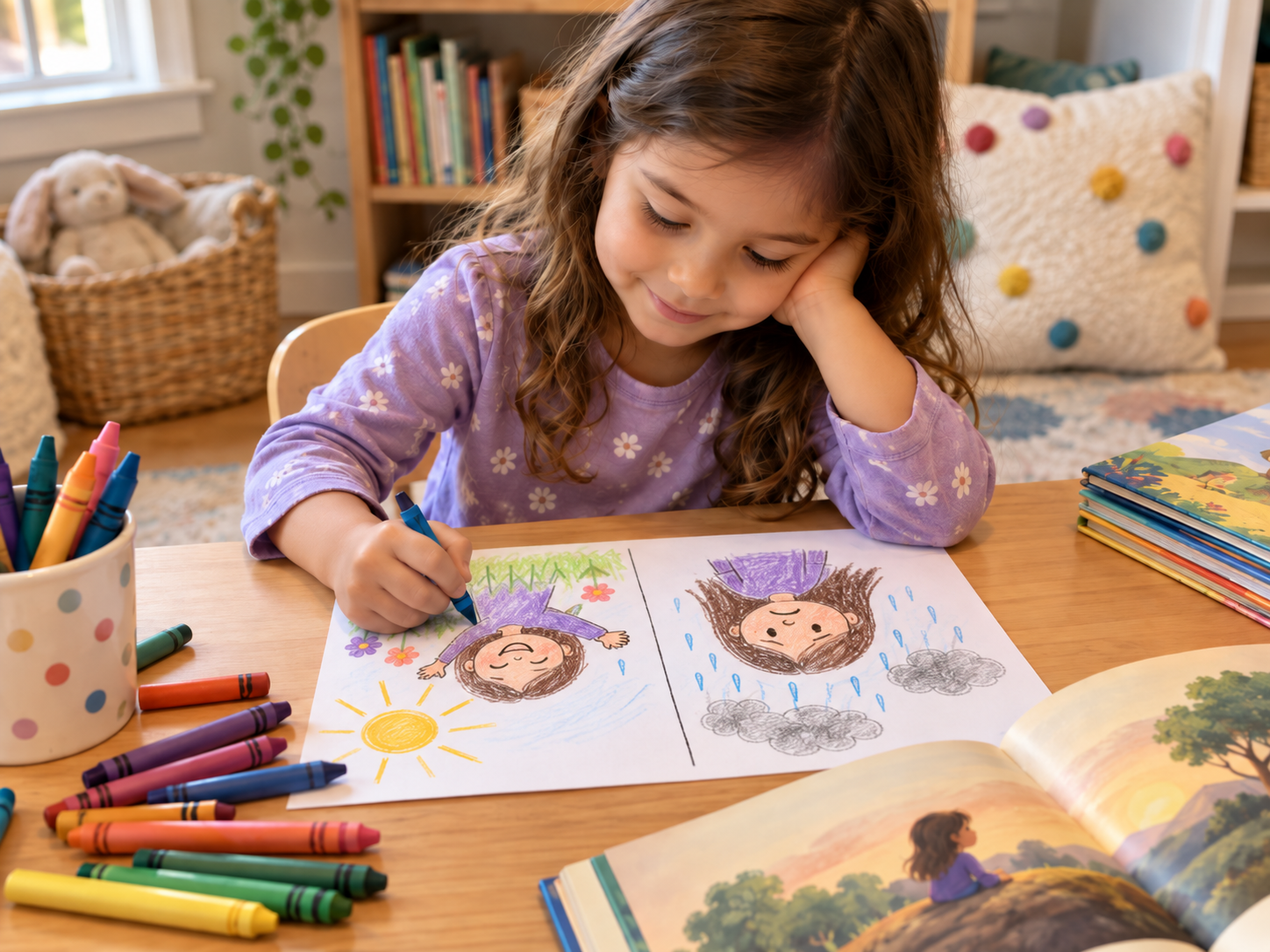
Drawing a character before and after an emotional turning point can help children notice how expressions, body language, color, and behavior change as a story unfolds.
7. Connect the Story to One Real-Life Tiny Brave Hop
This final activity moves carefully from the character’s experience toward the child’s own life.
After discussing something difficult the character faced, you might ask whether your child has ever felt something similar. Keep the question open enough that declining to answer remains perfectly acceptable. Children should not have to disclose something personal merely because an adult bought a book about feelings.
If the child makes a connection, talk about what a manageable next step could look like. A child nervous about joining a game may decide that watching from nearby is the first step. Someone worried about a new class may want to visit the room beforehand. A child afraid of getting something wrong might try the first problem with help rather than completing an entire page alone.
This is where emotional literacy begins connecting to action. Naming a feeling is valuable, but children also benefit from discovering that understanding the feeling can help them decide what to do next.
That idea sits at the center of the Tiny Brave Hop Method, which focuses on making the first step manageable when a child wants to move forward but the whole challenge feels too large.
A Tiny Brave Hop is not a trick for making uncomfortable feelings disappear. It gives the child somewhere realistic to begin while those feelings are still present.
How to Use These Emotional Literacy Activities at Home
At home, emotional literacy usually grows through accumulation rather than formal instruction. A parent who occasionally names what they see in a story is already doing useful work: “She looks disappointed because she worked hard and it didn’t turn out the way she expected,” or, “He still seems nervous, but now he is standing closer.”
Those comments model emotional language without requiring the child to respond.
You can also allow books to become family shorthand. If a character handled a mistake, separation, worry, disagreement, or new experience in a memorable way, the story may return naturally when a similar situation appears in real life. The parent does not need to deliver the moral again. A simple reference to the character can reopen a conversation the family has already had.
Most importantly, resist the temptation to make every book useful. Children deserve to read ridiculous stories, beautiful stories, adventures, mysteries, nonsense, and books whose primary contribution to emotional development is making everybody laugh on the couch. Emotional literacy belongs inside a rich reading life, not on top of it.
How Teachers Can Use Picture Books to Build Emotional Literacy
In classrooms, picture books have an advantage that individual conversations do not: everyone has experienced the same story. A teacher can refer back to a character or scene without singling out the child who is struggling that day.
The class might already understand what it means to make a first step smaller, notice when frustration is building, distinguish disappointment from anger, or recognize that someone can feel excited and nervous simultaneously. Shared stories create shared language, which can be useful during transitions, group work, conflict, mistakes, performances, and unfamiliar activities.
Teachers can also use the same picture book more than once. On the first reading, let the story breathe. On another reading, focus on illustrations. Later, return to one emotional scene and ask what the children notice now. Repetition often reveals details children missed the first time and keeps emotional learning from becoming another one-and-done classroom exercise.
The National Association for the Education of Young Children specifically encourages using picture books and conversations around them to support young children’s social and emotional development. That approach is valuable because the book provides a shared situation everyone can discuss without requiring a particular child to become the example.
Why Illustrations Matter as Much as the Words
Adults naturally focus on what a picture book says, but children are often receiving emotional information from parts of the page nobody has read aloud.
Color can make a scene feel warm or uneasy. Distance can show isolation or connection. A character who occupies very little space on a page may feel different from one who suddenly fills it. Darkness, light, posture, eye direction, landscape, and proximity to another character can all contribute to the emotional story.
This is why asking “What do you notice?” can sometimes produce a richer conversation than immediately asking “How does the character feel?” The first question lets the child gather evidence before assigning a label.
It also respects the particular intelligence of picture books. Illustration is not decoration wrapped around the “real” story. In a strong picture book, visual storytelling carries information that the words deliberately leave unsaid.
How The Rabbit in the Moon Can Be Used for Emotional Literacy
The Rabbit in the Moon gives children several emotional threads to follow without announcing them as lessons.
Yabbit experiences hesitation. He wants to help, but wanting to do something does not prevent him from feeling the size of what lies ahead. Children can notice how uncertainty appears in his expressions, his behavior, and his movement through the story without needing Yabbit to explain every feeling aloud.
Snail brings a different emotional pattern. He is persistent and purposeful, but his role is not to shame Yabbit into moving faster. That contrast gives children an opportunity to notice that people can carry different strengths into the same difficult moment.
The illustrations add another layer because the story moves through changing light, color, atmosphere, distance, and landscape. A child can often sense that an emotional moment has changed before they have language sophisticated enough to describe exactly how.
That is the kind of picture-book experience I find especially valuable. The story gives children something to notice first, while the adult can supply language gradually rather than explaining the emotion before the child has had a chance to see it.
What Emotional Literacy Should Not Become
There is a danger in becoming so enthusiastic about emotional learning that adults begin asking children to analyze every feeling they have.
Children sometimes do not know exactly what they feel. Adults do not always know either. A child may feel two or three things at the same time, change their mind, reject the word you offered, or decide they would rather continue reading than discuss the character’s internal life.
That uncertainty deserves room.
Emotional literacy should expand a child’s ability to understand experience, not create pressure to narrate every experience perfectly. Adults can offer language, wonder aloud, and help children notice patterns without demanding disclosure or insisting on one interpretation.
The goal is not a child who can produce a flawless emotional report on command. It is a child with more words, more awareness, more empathy, and more ways to make sense of what is happening when feelings become complicated.
Buy The Rabbit in the Moon
If your child sometimes wants to try but hesitates when the moment of beginning arrives, The Rabbit in the Moon offers an emotional story rather than a lecture about bravery.
Yabbit gives children a character who understands uncertainty from the inside, while Snail brings persistence and support. Together, their journey gives families opportunities to talk about hesitation, friendship, worry, determination, and what courage can look like when confidence has not arrived yet.
For parents and teachers, the book can become part of an emotional vocabulary that continues after reading. A child does not have to conquer every difficult feeling at once. Sometimes recognizing what is happening and finding one small way forward is enough for the next page to begin.
Frequently Asked Questions About Emotional Literacy and Picture Books
What are emotional literacy activities for picture books?
Emotional literacy activities for picture books are questions, observations, drawing exercises, and conversations that help children recognize emotions in a story, build more precise feeling vocabulary, notice emotional clues, understand why characters behave as they do, and connect those insights to everyday situations. They work best when they remain playful and conversational rather than becoming a test of whether the child understood the “lesson.”
Why are picture books good for teaching children about emotions?
Picture books combine language with facial expressions, posture, color, setting, relationships, and action, allowing children to gather emotional information in several ways at once. They also let children discuss a character’s experience before being asked to talk about their own, which can make difficult feelings easier to approach.
At what age can children begin emotional literacy activities?
Simple emotional literacy conversations can begin during the preschool years and grow more sophisticated as a child’s vocabulary and understanding develop. Younger children may identify basic feelings and visual clues, while older children can explore mixed emotions, motivation, perspective, and the difference between what a character feels and what they choose to do.
What is the easiest emotional literacy activity to try after reading?
Begin by asking what one character might be feeling and what clues helped the child decide. If the child gives a broad word such as sad, mad, happy, or scared, offer a few more precise possibilities and talk together about which one fits the scene best.
How many emotional literacy activities should I use with one picture book?
Usually one activity is enough for a single reading. Repeated, natural conversations are more useful than trying to extract every possible emotional lesson from one story, and children should still have plenty of opportunities to enjoy books without being asked questions afterward.
Can emotional literacy activities help hesitant children?
They can help hesitant children recognize and describe some of the feelings that appear before avoidance, freezing, or refusal, although emotional literacy is not a treatment for anxiety or other mental health concerns. A child who can distinguish nervousness, uncertainty, embarrassment, frustration, or fear of failure may have an easier time communicating what makes a particular situation difficult and considering what kind of support would help.
Final Thought
Picture books give children an unusual luxury: they can study a feeling without having to be the person experiencing it at that moment. They can watch another character get angry, worry, hesitate, make a mistake, feel left out, recover, ask for help, or find enough courage to move forward while remaining safely on the other side of the page.
Over time, those stories help build a vocabulary children can carry into their own lives. The goal is not to teach them the perfect name for every emotion or convince them that difficult feelings should disappear quickly. It is to help them notice more, understand more, and have more language available when their own experiences become difficult to explain.
Sometimes that begins with nothing more complicated than opening a picture book together and asking, with genuine curiosity, “What do you think is happening inside this character right now?”