What to Do First When Your Child Is Afraid to Try Again
Some children are not especially afraid of the first attempt. They will join the game, step into the pool, start the worksheet, raise their hand, or try the new activity. But if that first attempt ends badly, everything changes.
The child who was willing five minutes ago now wants out. They may refuse to try again. They may get angry, cry, shut down, or insist they no longer care.
From the outside, the reaction can look dramatic or stubborn. But underneath it is often something more understandable:
That felt awful, and I do not want to feel that way again.
The first move is not a speech about winning, losing, or never giving up. The first move is to help your child feel safe enough to take one small step back toward the thing they now want to avoid.
One tiny brave hop to try today:
Instead of asking your child to repeat the whole activity, ask for a smaller return. Touch the ball once. Write one sentence. Watch the next turn. Stand near the group. Practice one swing. Try for five seconds.
The goal is not instant confidence. The goal is a believable re-entry.
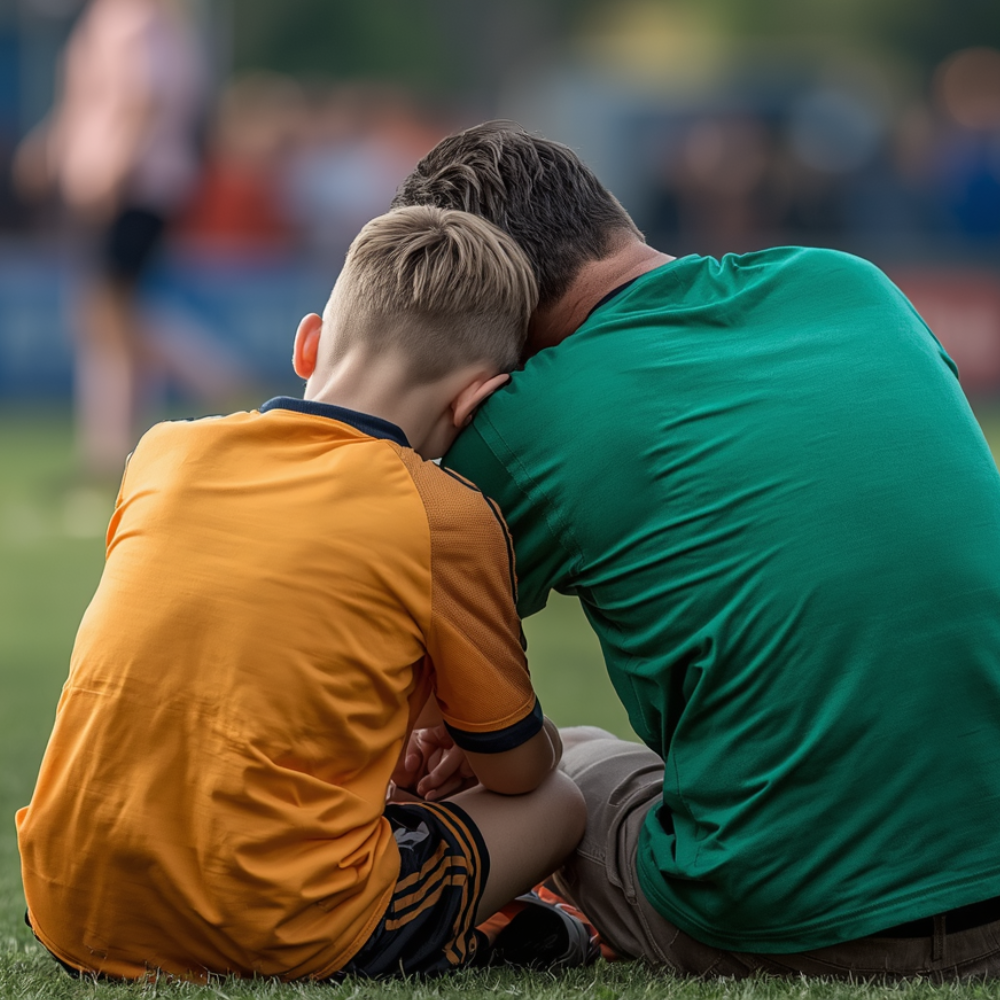
After failure, the next brave hop may need to be smaller than the first one.
Why Trying Again After Failure Is Its Own Emotional Skill
Adults often talk about confidence as though it is one thing. It is not. There is confidence before the attempt, when a child does not know what will happen yet.
Then there is confidence after the stumble, when the child remembers exactly what happened last time.
They remember the missed goal.
The wrong answer.
The scraped knee.
The strikeout.
The laughter.
The correction.
The disappointment on someone’s face.
The hot feeling in their own cheeks.
The next attempt is not only about uncertainty anymore. It is about memory.
That is why trying again requires a different kind of bravery. A child needs help understanding that a failed attempt is something that happened. It is not proof of who they are.
A Real Childhood Moment Behind This Shelf
This topic is personal to me. When I was a child, I once struck out to end a Little League game. My father was away on business, and I was crying and upset after the game.
My mother did not deliver a grand speech. She took me to the batting cages.
The lesson was not that losing did not hurt. It did. The lesson was that the story did not have to end at the strikeout. There could still be one more swing.
That memory stayed with me because children do not always need to be rescued from disappointment. Sometimes they need a calm adult beside them while they take one small step back toward the thing that hurt.
That is the emotional territory behind this book list.
What Kind of Book Helps After a Child Fails?
Not every book about growth mindset will reach a child who is afraid to try again.
Some stories rush past the sting of failure too quickly. They jump straight from mistake to triumph and leave out the part children actually struggle with: the emotional bruise in the middle.
The most useful picture books tend to do three things well.
They tell the truth about disappointment.
Children do not need adults to pretend a mistake is nothing. They need help understanding that a painful moment can be real without becoming the ending.
They separate the child from the outcome.
A mistake is an event. It is not an identity.
They make the return feel believable.
The next step should not require a heroic leap. It should feel small enough that a hesitant child can imagine taking it.
14 Picture Books for Kids Afraid to Try Again After Failing
The right book depends on what your child is carrying away from the difficult moment.
Some children feel embarrassed.
Some get frustrated.
Some become perfectionistic.
Some replay the mistake until the next attempt feels impossible.
Some need help believing that one tiny brave hop still counts.
Use These Books When the First Attempt Felt Painful or Embarrassing
1. The Rabbit in the Moon
I am putting this book first transparently and intentionally. Yes, this is my book. I am including it because it belongs in this conversation.
The Rabbit in the Moon understands the child who does not simply need motivation. Yabbit the Rabbit is the hesitant character. He feels the size of the journey in front of him. He worries. He pauses. He is not instantly ready.
Snail brings a different emotional strength. He is persistent, determined, and steady. He does not shame Yabbit or replace him. He helps balance him.
That combination matters for a child who is afraid to try again after failing.
Many books celebrate the triumphant moment. The Rabbit in the Moon respects the pause before it. It shows children that fear, memory, and movement can exist at the same time.
The next brave step does not have to be loud. It can be one tiny brave hop.
2. After the Fall by Dan Santat
This is one of the strongest picture books for post-failure courage.
The emotional center of the story is not the fall itself. It is what happens afterward, when the memory of the fall starts shaping the future.
For children who have already felt embarrassed, hurt, or disappointed, that makes the book especially useful.
It understands that the hard part is not always the first attempt.
Sometimes the hard part is the return.
3. Jabari Tries by Gaia Cornwall
This is an excellent book for children whose frustration rises after the second or third attempt does not work.
Jabari feels excited, then discouraged, then overwhelmed. That sequence will feel familiar to many families.
The book makes persistence feel human rather than polished. Trying again does not always look calm. Sometimes it means taking a breath, accepting help, and returning differently.
4. Giraffes Can’t Dance by Giles Andreae
This book works especially well when a child’s fear of failure includes the fear of being watched.
Some children are not only afraid of doing something badly. They are afraid of doing it badly in public.
That social layer matters.
Giraffes Can’t Dance offers a warmer way to talk about embarrassment, comparison, and finding a place where a child can move at their own rhythm.
Use These Books When Frustration or Perfectionism Takes Over
5. The Most Magnificent Thing by Ashley Spires
This book understands frustration beautifully.
A child tries, gets angry, feels defeated, steps away, and eventually returns with a different perspective.
That pattern is realistic. It shows children that taking a pause is not the same as quitting forever.
Sometimes distance creates room for the next attempt.
6. Beautiful Oops! by Barney Saltzberg
This is a playful choice for children who react strongly to visible mistakes.
Instead of pretending the error did not happen, the book turns the error into raw material.
A spill, tear, smudge, or crooked line can become part of something new.
That shift can be especially valuable for young perfectionists who treat mistakes like tiny alarms.
7. The Dot by Peter H. Reynolds
The Dot is a classic because it understands how intimidating a blank page can feel.
Its central invitation is small: make one mark.
For children who are afraid to try again academically, artistically, or publicly, that message matters.
The first move does not have to impress anyone.
It only has to begin.
8. The Magical Yet by Angela DiTerlizzi
This book is useful for children who collapse quickly into finality:
“I can’t do it.”
“I am bad at this.”
“I will never get it.”
The word “yet” creates room between struggle and identity.
It does not pretend the task is easy. It reminds children that the story is still moving.
9. The Thing Lou Couldn’t Do by Ashley Spires
Lou wants to protect herself from the feeling of not being able to do something yet.
That is what makes the book emotionally sharp.
The story is not only about ability. It is about the urge to hide from the possibility of getting it wrong in front of others.
For a child who refuses the next attempt because the previous one felt exposing, this book can open a useful conversation.
10. Rosie Revere, Engineer by Andrea Beaty
Rosie Revere, Engineer is a strong choice for children who like building, experimenting, and solving problems but struggle when their idea does not work immediately.
The story helps children see that a failed attempt can still be meaningful.
The effort taught them something.
That is not the finish line, but it is movement.
11. The Girl Who Never Made Mistakes by Mark Pett and Gary Rubinstein
This is a useful read-aloud for children who treat perfection as protection.
The story creates room for error without making mistakes feel like a punishment or catastrophe.
It can help children imagine a life where being imperfect is not only survivable, but freeing.
12. Ish by Peter H. Reynolds
Ish is especially valuable for children who become harsh with themselves after a mistake.
Sometimes the biggest obstacle is not the failed attempt itself. It is the story the child tells themselves afterward.
Ish loosens that grip.
It creates a little breathing room between “perfect” and “worth doing.”
Use These Books When the Mistake Has Turned Into Worry
13. What Do You Do With a Problem? by Kobi Yamada
This is a strong conversation starter for children who replay the mistake until it becomes larger than the original event.
A worry can grow when it is avoided.
This book helps make the worry visible enough to discuss without shaming the child for having it.
14. Ruby Finds a Worry by Tom Percival
Ruby Finds a Worry is not narrowly about retrying after failure, but it belongs here because some children carry the previous mistake into the next attempt as anticipatory worry.
They may need to name the knot in their stomach before they can move back toward the activity.
The book gives children a way to recognize the feeling before the feeling starts running the entire show.
What to Say When Your Child Is Afraid to Try Again
A child who has already experienced failure does not need a long lecture. They need a sentence that leaves room for the disappointment and still opens a small door.
Try:
“That felt hard. You do not have to do the whole thing again today. Let’s find one small way back in.”
“The mistake was something that happened. It is not who you are.”
“You can take a pause without quitting forever.”
“Let’s practice one tiny part, not the whole mountain.”
“You do not have to prove anything. We are practicing the return.”
“I noticed that you tried again even though the last time hurt. That was brave.”
Avoid rushing too quickly into:
“Shake it off.”
“It was not a big deal.”
“You have to get back out there.”
“Everyone makes mistakes.”
“Stop being so hard on yourself.”
Those phrases may be well intentioned. But when the disappointment still feels enormous, they can sound like the child is wrong for feeling it.
The stronger sequence is:
Acknowledge the feeling.
Shrink the re-entry.
Praise the return.
The Tiny Brave Hop Back Into the Hard Thing
Trying again does not have to mean repeating the entire difficult moment immediately. A tiny brave hop can be much smaller.
After a sports mistake:
Touch the ball once. Practice one swing. Watch the next drill. Take one shot without keeping score.
After a difficult school assignment:
Write one sentence. Solve one problem. Make one imperfect mark. Set a five-minute timer.
After an embarrassing social moment:
Wave to one person. Stand near the group. Practice what to say with a parent first.
After a frustrating creative project:
Make a messy version on purpose. Draw one line. Build one small piece.
After a difficult swimming lesson:
Sit near the pool. Put feet in the water. Watch another child try. Practice one movement with support.
The return should feel small enough to be possible.
For a complete step-by-step framework, read: https://www.yabbitrabbit.com/parent-resources/how-to-help-your-child-take-tiny-brave-hops
When Fear of Failure Looks Like Perfectionism
Some children do not refuse because they dislike the activity. They refuse because they cannot guarantee a good outcome.
They erase repeatedly.
They abandon the drawing.
They refuse the worksheet.
They melt down after a correction.
They want to quit the sport after one difficult practice.
Perfectionism can make the second attempt feel dangerous because the child is no longer only trying the task. They feel as though they are defending their identity.
Instead of raising the pressure, lower the stakes.
Try:
“This one is the practice version.”
“Messy is allowed.”
“We are not trying to impress anyone. We are trying one small part.”
“Start is the win today.”
For more practical scripts, read: https://www.yabbitrabbit.com/parent-resources/perfectionism-in-kids-why-they-wont-start-shrink-the-stakes
How to Use These Books So They Actually Help
Read the story during a calm moment. Do not wait until the child is already flooded with disappointment. Let the story become familiar before you try to use its language during a difficult moment.
Ask one good question.
Try:
“What was the hardest part for the character?”
“What made trying again feel possible?”
“Did the character have to feel completely ready first?”
“What was the smallest brave step?”
“What would one tiny brave hop look like for us?”
One question is enough. The goal is not to turn a picture book into a worksheet wearing a tiny bow tie. The goal is to give your child language they can carry into the next real moment.
How The Rabbit in the Moon Helps
There are many strong picture books about mistakes, perseverance, and resilience. The Rabbit in the Moon stands out because it understands the emotional space between the hard moment and the next attempt.
Yabbit is not fearless.
He hesitates.
He worries.
He feels the scale of the task.
He needs help finding a way to begin.
Snail does not shame that hesitation. He brings persistence and purpose beside it. That pairing gives families a more honest picture of courage.
One part of a child may want to hide. Another part may still want to move forward. Both can be true.
The next step does not have to erase the fear. It only has to be small enough to take.
When to Seek More Support
Picture books can help children talk about disappointment, mistakes, and trying again. They can give families useful language and create calmer pathways back into difficult moments.
But a book is not a replacement for professional support.
If fear of failure becomes persistent or regularly interferes with school, sleep, play, friendships, activities, or daily family life, talk with your child’s pediatrician or a qualified mental health professional.
Buy the Book: Bring a Tiny Brave Hop Home
If your child is willing to try until one difficult moment changes everything, The Rabbit in the Moon can give your family a calmer language for the return.
Yabbit helps children feel seen without being labeled. Snail shows persistence without pressure. Together, they show children that courage after disappointment does not have to begin with a giant leap.
It can begin with one tiny brave hop.
FAQs
What kind of books help kids try again after failing?
The most helpful books acknowledge that disappointment can hurt, separate the child from the outcome, and make the next attempt feel emotionally possible. The best book is not always the one with the loudest motivational message. It is the one that understands the child’s real sticking point.
Why does my child shut down after one mistake?
Some children experience a mistake as more than information. It can feel embarrassing, discouraging, or exposing. The child may avoid the next attempt because they do not want to experience that feeling again.
Is fear of trying again the same as laziness?
Usually not. A child may look unwilling when they are actually protecting themselves from discomfort, embarrassment, or another disappointing outcome. A smaller return often works better than more pressure.
Should I make my child try again immediately?
Not always. A calm pause can help. The next step should be small enough that your child can re-enter without feeling overwhelmed. That might mean watching first, practicing one tiny piece, or returning later during a lower-pressure moment.
What should I praise after my child fails?
Praise the recovery process. Notice that your child stayed with the feeling, accepted help, returned to the activity, or tried one small part again. The return is the brave part.
Is The Rabbit in the Moon a good book for kids afraid to fail?
Yes. The Rabbit in the Moon is especially useful for children whose fear shows up as hesitation, avoidance, or difficulty beginning again after something feels too big. Yabbit and Snail give families a story-based language for balancing hesitation with persistence.
When should I talk to a professional?
If fear of failure becomes persistent, intense, or disruptive to school, sleep, play, friendships, activities, or daily routines, talk with your child’s pediatrician or a qualified mental health professional.
Final Thought
A child who is afraid to try again is not always saying:
“I do not care.”
Sometimes they are saying:
“I cared, and it hurt.”
The answer is not to pretend the hurt did not happen. The answer is to help the child discover that the story can keep moving.
One more swing.
One small return.
One tiny brave hop.