When a hesitant child hangs back, most adults focus on the behavior they can see. They see the refusal. The stalling. The “I don’t want to.” The moment the child pulls away from the very thing they seemed ready to do thirty seconds earlier.
But what often matters most is happening underneath that moment. Many hesitant kids are not just afraid. They are hard on themselves for being afraid. That is the part adults miss.
A child can feel nervous about trying something new and, within seconds, add a second layer of pain on top of it: Why am I like this? Everyone else can do it. I’m being bad. I can’t do it right.
That inner tone matters. A lot.
Because bravery does not grow well in the presence of shame. It grows in the presence of safety. And one of the most powerful forms of safety a child can learn is this: how to be kind to themselves while they are still scared.
That is why self-kindness is often the real first step to bravery for hesitant kids.
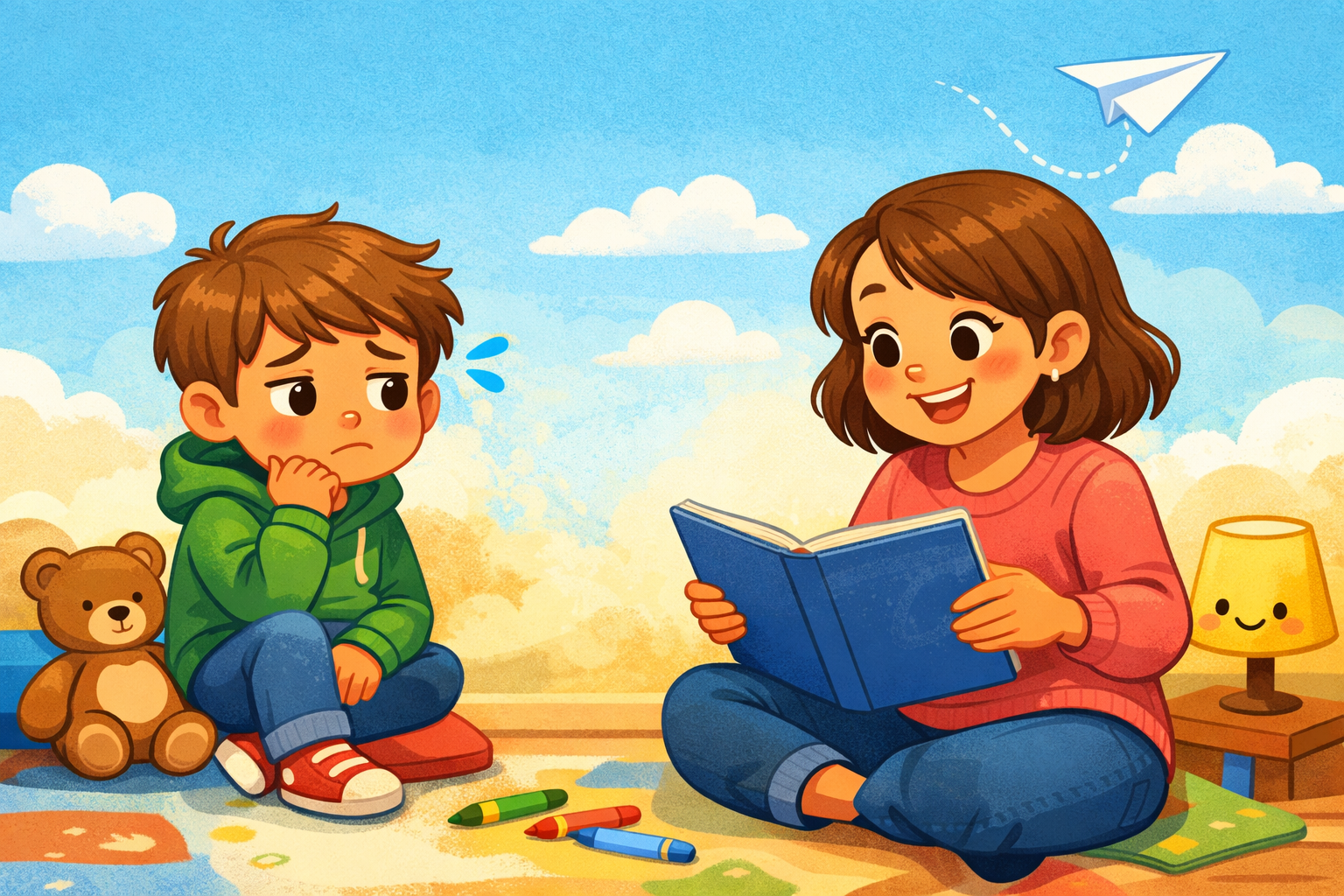
For many hesitant kids, bravery does not begin with pressure. It begins with a kinder inner voice.
The mistake adults make with hesitant kids
When children hesitate, adults often rush to motivation. We say:
“You can do it.”
“Don’t be scared.”
“Just try.”
“Be brave.”
The intention is loving. The effect is not always helpful.
Why? Because those phrases often skip over the emotional experience the child is actually having. They push toward action before the child has any internal footing.
For a hesitant child, bravery is not just a decision. It is a nervous-system event. And if the child’s inner voice is already turning fear into failure, more pressure only makes the doorway narrower.
The child does not need a bigger speech. They need a kinder way to stand inside the moment.
Why self-compassion for children matters so much
When people hear the phrase self-compassion for children, they sometimes worry it sounds too soft. It is not soft. It is stabilizing.
Self-compassion helps a child do three important things:
It lowers shame.
When a child learns, “It’s okay to feel unsure,” the feeling stops becoming proof that something is wrong with them.
It keeps the moment from getting bigger.
Fear is hard enough. Fear plus self-criticism becomes much harder to move through.
It makes action more possible.
Children are more likely to try when the attempt does not feel like a test of their worth.
This is one of the deepest truths in emotional growth: children do not become braver by being shamed out of hesitation. They become braver when they learn they can stay connected to themselves while doing something hard.
That is why teaching kindness matters so much in brave moments. Not kindness only toward others. Kindness inward.
What Yabbit the Rabbit shows children that many adults forget
One of the reasons Yabbit the Rabbit works so well as a character is that he reflects a child’s internal experience honestly.
He hesitates. He feels the size of the moment. He does not magically transform into a fearless version of himself because someone tells him to toughen up.
That is important. Children need characters who do not erase fear too quickly. They need stories that show courage developing without pretending the fear was never there.
What Yabbit models, quietly and powerfully, is this:
You can be afraid without turning against yourself.
You can pause without becoming a problem.
You can need a smaller first step and still be moving toward bravery.
That is a different emotional lesson than simple confidence talk. It is wiser, more durable, and more humane.
If you want the deeper psychology behind why some children freeze before trying, this internal post fits naturally here: https://www.yabbitrabbit.com/parent-resources/psychology-of-hesitation-in-children-yabbit-the-rabbit
The voice inside the hesitant child
A lot of hesitant children do not need help because they lack thought. They need help because their thoughts get sharp too quickly.
They may not say it out loud, but inside the moment many children are thinking things like:
“I’m the only one who can’t do this.”
“If I can’t do it right, I shouldn’t start.”
“Everyone is looking at me.”
“I already messed it up.”
“I’m not brave like other kids.”
Notice what these thoughts have in common. They are not just about the task. They are about identity.
That is where the parent shift matters so much. We do not want fear to become a child’s self-definition. We want to help the child separate the feeling from the self.
Not:
“You are being difficult.”
More like:
“This feels big right now.”
“Your body is unsure.”
“You don’t have to be mean to yourself because this feels hard.”
That is self-kindness in practice.
How to teach self-kindness without making it feel forced
Parents sometimes worry that teaching self-kindness will sound unnatural or overly therapeutic. It does not have to. It can be simple, specific, and grounded in the moment.
Name the feeling without judgment.
“This feels hard.”
Not: “You’re overreacting.”
Normalize the wobble.
“Lots of kids feel unsure before they start.”
Not: “Why are you the only one doing this?”
Give the child kinder words to borrow.
“I can be scared and still do one small part.”
That is a usable sentence.
Shrink the demand.
Self-kindness becomes believable when the task also becomes manageable. Children are more willing to speak gently to themselves when the step in front of them is not enormous.
Praise the tone, not just the outcome.
If your child says, “I was nervous, but I tried a little,” that is not a small moment. That is the moment.
The goal is not to create perfect self-talk. The goal is to interrupt unnecessary harshness and replace it with language the child can actually carry.
What self-kindness can sound like for a child
Here are the kinds of phrases that help hesitant kids build bravery without turning fear into shame:
“It’s okay that this feels hard.”
“I only need to do the first tiny part.”
“I can be nervous and still try.”
“Starting small still counts.”
“I don’t have to be perfect to begin.”
These are not magic lines. They are emotional tools. And the best thing about tools is that children can practice them.
At first, they borrow the language from us. Later, if we are consistent, it becomes part of the child’s own internal voice. That is how bravery gets built from the inside out.
Why SEL picture books matter here
This is one reason SEL picture books matter so much.
A good social-emotional book gives a child distance from their own struggle. It lets them watch a character hold fear, uncertainty, embarrassment, or hesitation without becoming swallowed by it. That distance lowers defensiveness. It creates room for reflection.
Picture books also do something adults cannot always do in the moment: they slow the experience down.
A child may not be able to talk clearly about fear in the middle of a hard moment. But later, with a story, they can often point to a character and say, “That part felt like me.” That is powerful.
Stories help children rehearse emotional truth before the next real-life test arrives. They give families shared language. They make abstract ideas concrete.
That is why books like The Rabbit in the Moon are not just bedtime stories. They are emotional rehearsal spaces.
If your child’s hesitation tends to spill into overwhelm, meltdowns, or shutdowns, this companion post is the best next read: https://www.yabbitrabbit.com/parent-resources/big-feelings-in-children-how-to-help-your-child-cope
The real sequence is not bravery first
Adults often imagine the sequence like this:
First the child becomes brave. Then the child tries.
But for many hesitant kids, the sequence works more like this:
First the child feels understood. Then the child becomes a little less harsh with themselves. Then the step feels smaller. Then they try.
That is why self-kindness matters so much. It is not a bonus skill. It is often the bridge.
A child who learns, “I can be scared and still speak kindly to myself,” is learning a form of courage that will outlast any one moment, one classroom, one performance, or one difficult day.
That is the kind of bravery I trust.
Invest in your child’s emotional growth
If your child hesitates before trying, shuts down when something feels too big, or tends to turn fear into self-criticism, The Rabbit in the Moon was written for those moments.
It gives children a story where fear is not mocked, pressure is not the answer, and bravery begins with one small, doable step.
If the book helps your family, one honest review also helps another parent find the right emotional tool at the right time.
FAQs
What is self-compassion for children?
Self-compassion for children means helping kids respond to mistakes, fear, and struggle with kindness instead of harsh self-judgment. It teaches them that hard feelings are part of being human, not proof that something is wrong with them.
Why is self-kindness important for hesitant kids?
Because many hesitant kids do not just feel fear. They judge themselves for feeling fear. Self-kindness lowers shame, keeps the moment from escalating, and makes it easier for children to take a small brave step.
Can teaching kindness really make kids braver?
Yes. Children are more willing to try when the attempt does not feel tied to their worth. Kindness creates emotional safety, and emotional safety makes action more possible.
How do I teach my child self-kindness in everyday life?
Use calm, simple language in the moment. Name the feeling, normalize the struggle, shrink the task, and offer kinder words your child can borrow, like “I can be nervous and still try one small part.”
Are SEL picture books actually helpful for emotional growth?
They can be extremely helpful. SEL picture books help children recognize emotions, see characters work through hard moments, and borrow language they can later use in real life.
Is The Rabbit in the Moon a good SEL picture book?
Yes. It is especially useful for children who hesitate, avoid starting, or need courage to feel smaller and more manageable. Yabbit’s journey helps children see that fear does not have to turn into self-rejection.
What should I say when my child is hard on themselves?
Try: “This feels hard, and you don’t have to be mean to yourself about it.” Then shrink the next step. Children usually do better with one kind, usable sentence than a long explanation.