
Children can hesitate before new experiences for many reasons, including temperament, uncertainty, fear of mistakes, and worry. Understanding what is behind the pause can help parents support the first step without turning hesitation into a character flaw.
A child can be excited about soccer on Monday and refuse to leave the car when practice arrives on Saturday. They can ask to attend a birthday party and then cling to a parent's leg at the door, or spend days talking about swimming lessons only to announce that they are absolutely not getting into the pool.
From the outside, those moments can be confusing. The child wanted to go, so why are they suddenly refusing? Sometimes the answer is hesitation.
Hesitation lives in the space between wanting to do something and feeling ready to begin it. For some children, that space lasts only a few seconds. For others, it can become filled with questions, predictions, excuses, worry, embarrassment, or a sudden conviction that they never wanted to do the activity in the first place.
That pause does not automatically mean a child has anxiety, lacks confidence, or is being defiant. Children approach unfamiliar people, places, activities, transitions, and expectations differently, and temperament is one part of that difference.
Understanding hesitation matters because the response a child receives in that moment can either help them explore what feels difficult or turn the pause itself into another source of pressure. It is also the emotional space that inspired Yabbit the Rabbit.
Yabbit is not valuable because he teaches children to stop hesitating. He is valuable because he hesitates too, allowing children to see that a pause before the first step does not mean the story has to end there.
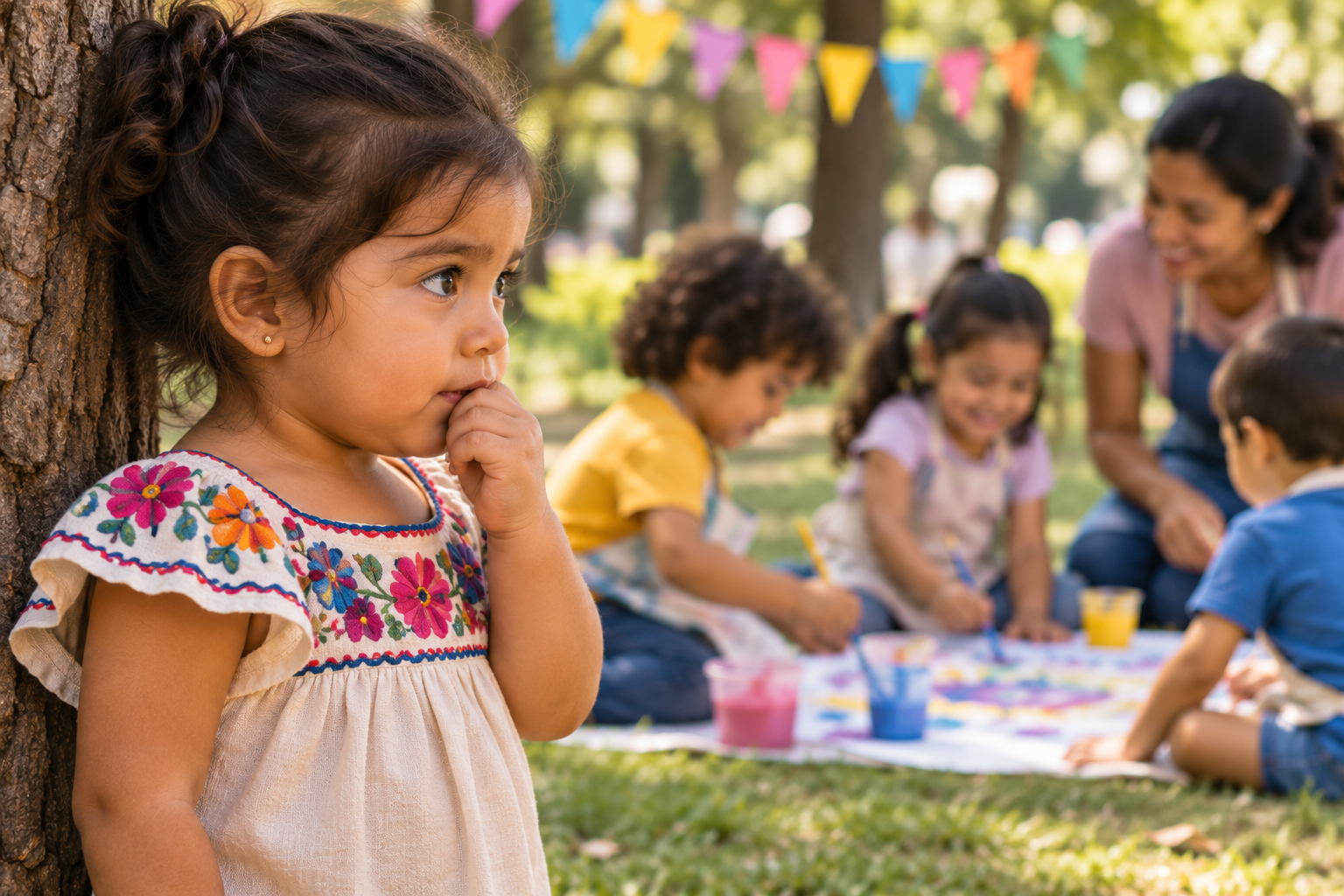
Some children approach unfamiliar experiences immediately, while others prefer to watch, understand what is happening, and become comfortable before joining.
Quick Answer: Why Do Some Children Hesitate Before Trying?
Children hesitate for different reasons. A new experience may feel unpredictable, a child may need more time to become comfortable with unfamiliar situations, or they may be worried about making a mistake, being watched, separating from a parent, failing, or not knowing exactly what to do.
Temperament matters too. The American Academy of Pediatrics describes approach and withdrawal as one dimension of temperament, meaning children naturally differ in how quickly or cautiously they respond to new people, places, foods, routines, and experiences. Some children are simply slower to warm up than others, and that difference is not a flaw that needs to be removed.
The important question is therefore not, “Why can't my child just be brave?” A more useful question is, “What is making this particular beginning feel difficult?”
Hesitation Is a Description, Not a Diagnosis
“Hesitant child” can be useful language because it describes something parents actually see. A child pauses, watches, refuses, stalls, backs away, changes the subject, or says “I can't” before an experience has really begun. It should not become a diagnosis or a permanent identity.
A socially confident child can hesitate before trying a difficult sport. An adventurous child can freeze when asked to read aloud. A child who loves school can become reluctant before a performance, and a child who happily talks to strangers may be extremely cautious about unfamiliar foods.
Hesitation can also overlap with shyness or anxiety without being the same thing. Shyness usually describes discomfort or inhibition in social situations, while hesitation can appear around almost anything that asks a child to cross from the familiar into the uncertain.
Anxiety is different again. Anxiety can contribute to hesitation and avoidance, but not every cautious child has an anxiety disorder, and an ordinary pause before something unfamiliar should not automatically be medicalized.
That distinction protects children from being defined by one difficult moment.
Temperament Helps Explain Why One Child Jumps In and Another Watches First
Parents with more than one child often discover this difference without needing a textbook. One child walks into a room full of unfamiliar people and begins exploring before the adult has removed their coat. Another stands beside the parent, watches everything carefully, and joins only after the room has become predictable enough to feel comfortable.
Neither child is doing childhood correctly.
The American Academy of Pediatrics identifies a child's response to novelty as part of temperament. Its guidance describes some children as slower to warm up, noting that they may initially withdraw from unfamiliar people or circumstances and become more comfortable after they have had time to adjust.
ZERO TO THREE makes a similar distinction, explaining that children who are slow to warm up may spend time observing new situations before participating. It also emphasizes that there is no single “right” temperament and that cautious children can benefit from time and sensitive support rather than being pushed to react like more immediately outgoing children.
This is important when thinking about Yabbit because his hesitation should not be interpreted as weakness. He notices difficulty before acting, which is an experience many children recognize even when their reasons for pausing are different.
Sometimes the Hardest Part Is the Transition From Thinking to Doing
A child can talk confidently about an experience while it remains theoretical. They can imagine playing on the team, sleeping at Grandma's house, climbing the wall, attending the party, getting onstage, or walking into the new classroom. The challenge changes once the moment arrives and the child has to make the first move.
That is when uncertainty becomes immediate. The child may suddenly wonder where to stand, who will talk to them, whether everyone else already knows what to do, whether they will make a mistake, or whether they can change their mind if the experience becomes uncomfortable.
Adults already have thousands of experiences telling us that unfamiliar situations usually become more manageable once they begin. Young children have a much smaller library of evidence.
Sometimes they need to watch first. Sometimes they need to know what will happen next. Sometimes they need the first action separated from the entire activity so they are not being asked to emotionally swallow the whole experience at once.
That does not mean the goal should always be retreat. It means we should understand what the starting line looks like from the child's side of it.
Fear of Mistakes Can Look Like Fear of Trying
Not every hesitant child is afraid of the activity itself. Some are afraid of what trying might reveal. A child may hesitate because everyone else seems better at soccer, because they do not know how their picture will turn out, or because they believe asking a question will expose something they think they should already understand.
These children sometimes say “I can't” before they have gathered enough information to know whether they can. Perfectionism can make the first step particularly difficult because beginning creates the possibility of an imperfect result. Not starting protects the child, temporarily, from having to discover whether the attempt matches the picture they already have in their head.
Adults can accidentally intensify this by focusing heavily on performance. If the emotional spotlight is always on being talented, winning, getting the answer right, or producing something impressive, trying begins to carry more risk.
For a child who fears mistakes, courage may therefore look surprisingly ordinary. It might mean putting one mark on the blank page, attempting the first problem, joining the warm-up, or doing something badly enough to learn how to do it better.

For some children, the first meaningful act of courage is not completing a challenge. It is becoming willing to begin before they know exactly how well it will go.
Hesitation Can Turn Into Avoidance
A pause and an escape are not always the same thing. Sometimes a child simply needs more information or a little time to adjust. Other times, repeatedly avoiding the situation becomes the way the child manages the discomfort surrounding it.
That distinction matters particularly when anxiety is involved. Child Mind Institute explains that avoidance can provide immediate relief for anxious children, but repeatedly escaping feared situations can strengthen the pattern over time. In clinical treatment for anxiety, trained professionals often use carefully structured, gradual exposure so children can learn to tolerate discomfort safely rather than continually avoiding it.
That does not mean parents should turn every hesitation into homemade exposure therapy or force a frightened child through an activity. It means there is an important middle ground between forcing and automatically escaping. A parent can acknowledge that something feels difficult while still remaining curious about whether there is a smaller, realistic way to approach it.
Why “Just Try It” Often Misses the Real Problem
“Just try it” makes perfect sense from the adult side of the experience. The parent can already see that the first swimming lesson is only thirty minutes, the teacher is kind, the other children are beginners too, and nobody cares whether the first kick looks graceful. The child may not yet possess that evidence.
When an adult says, “There's nothing to worry about,” the intention is reassuring, but the child's body may still be communicating something very different. When we insist that an experience is easy, we can accidentally add a second problem: now the child is struggling with the activity and wondering why something everyone calls easy feels hard to them.
A better response does not require agreeing that the situation is dangerous. Parents can recognize the feeling while remaining confident that the child can gradually handle the challenge.
The American Academy of Pediatrics specifically advises parents not to ridicule children's fears or pressure them to be brave, noting that children may need time to confront and move beyond fears gradually. The message becomes, “I can see that this feels difficult, and I still believe you can find a way into it.” That is very different from either “There's nothing to be afraid of” or “Fine, you never have to do it.”
Make the First Step Smaller Than the Whole Challenge
Adults tend to describe activities by their finished form.
“Go to soccer.”
“Join the party.”
“Take the swimming lesson.”
“Read the book.”
“Do your homework.”
To a hesitant child, each phrase can contain dozens of smaller actions bundled together. Going to soccer means changing clothes, arriving at an unfamiliar field, leaving the parent, meeting the coach, finding the team, understanding the drill, being watched, touching the ball, and possibly getting something wrong. No wonder the starting line sometimes feels crowded.
Making the first step smaller does not mean pretending the larger activity does not exist. It means identifying the next action the child can actually imagine doing.
The first step might be putting on the uniform. It might be walking to the edge of the field together, watching one drill, saying hello to the coach, standing near the group, or participating in the warm-up. Once the child is moving, the next step can become visible.
This idea became the foundation of the Tiny Brave Hop Method, a practical family framework inspired by Yabbit's way of moving through uncertainty. It is not a clinical treatment for anxiety, but a simple language parents can use to make an overwhelming beginning more concrete.
Give the Child Some Agency Without Making Avoidance the Only Option
Children usually handle uncertainty better when they have some meaningful sense of participation in what happens next. That does not require handing every decision to the child. Parents still decide that school happens, teeth get brushed, necessary medical care takes place, and family responsibilities exist.
Agency can live inside the boundary. A child might choose whether to watch the class from the doorway or sit beside the parent for the first few minutes. They might choose which shoe to put on first, whether to introduce themselves or have the parent begin, or which small part of an unfamiliar food to explore.
The purpose is not to create endless negotiations. It is to help the child experience themselves as someone participating in the beginning rather than someone being transported through it. That small difference can matter.
Praise the Approach, Not Only the Outcome
If success only counts when the child completes the activity, many important acts of courage disappear. The child who walks into the birthday party but stays beside a parent has moved farther than the child who would not enter yesterday. The child who puts their feet in the pool has done something meaningful even if they are not yet ready to swim across it.
Parents can notice those actions without turning every step into a standing ovation.
“You walked over even though you weren't sure yet.”
“You tried the first part.”
“You stayed long enough to see what it was like.”
That kind of reflection helps locate courage in the child's behavior rather than in the final result. It also gives a hesitant child a more reachable definition of success.
What Yabbit Helps Children Understand About Hesitation
Yabbit was never meant to be the rabbit who already knows exactly how to be brave. His usefulness comes from the opposite direction.
Yabbit can imagine reasons not to move forward. He experiences uncertainty, pauses, and needs time before taking the next step. Snail provides persistence and companionship, but he does not replace Yabbit as the hero of his own story.
That matters because children who hesitate do not always need another fearless character demonstrating how effortlessly brave people behave. Sometimes they need a character who understands what it feels like to want to move forward while another voice is producing every possible reason to stay where things feel familiar.
Yabbit gives that conflict a character. A child can talk about why Yabbit hesitates before talking about why they hesitate. They can wonder what Yabbit might do next, notice that he does not suddenly become fearless, and see that movement remains possible even after the pause.
That is the emotional job of the character. It is not to diagnose a child or teach psychology. It is to make a familiar internal experience visible enough to recognize.
If you want to read the personal story behind why Yabbit became a hesitant rabbit in the first place, the full origin is here: https://www.yabbitrabbit.com/parent-resources/origin-of-yabbit-the-rabbit
Why the First Brave Step Matters More Than Becoming Fearless
Children sometimes absorb the idea that brave people do not feel afraid. That creates an impossible standard because fear can still be present when a child does something courageous. A more useful definition allows two things to be true at once: “I am unsure about this” and “I am going to try one part.”
That is the idea at the center of The Rabbit in the Moon. Yabbit does not need fear erased from his personality before the journey can continue, and his hesitation does not disqualify him from being courageous.
For a child who freezes before beginning, that distinction can be more believable than a promise that everything will suddenly feel easy. The first brave step matters because it changes the story from “I can't begin” to “I began.” What happens next can be figured out next.
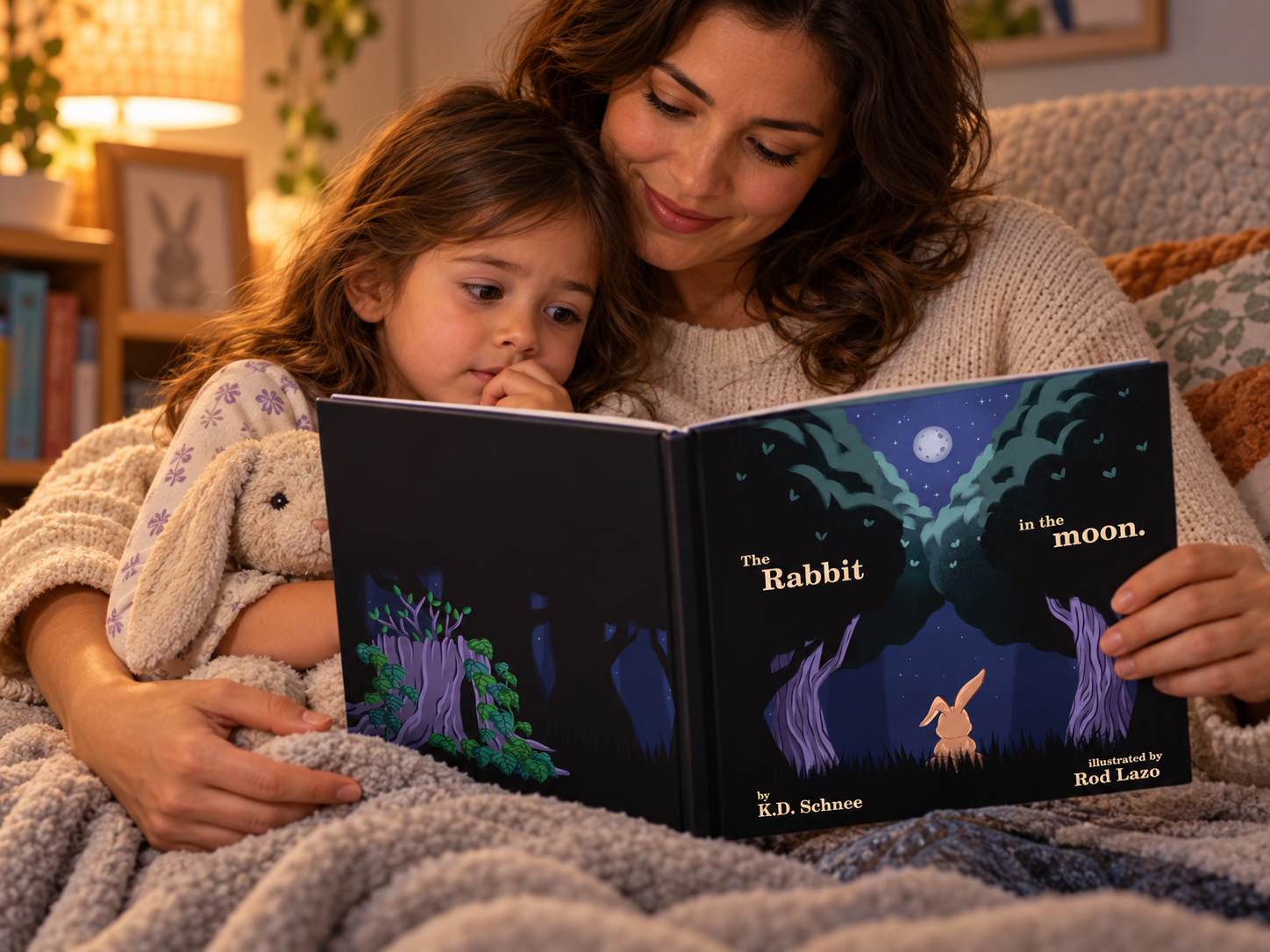
Yabbit gives hesitant children a character who understands the pause before action, helping families talk about courage without requiring fear to disappear first.
A Picture Book Can Create Useful Distance
Children do not always want to discuss themselves directly, especially when they suspect the conversation is about something adults want them to change. A story creates a little breathing room.
Instead of asking, “Why wouldn't you join the class today?” a parent can wonder why Yabbit hesitated. Instead of immediately discussing the child's own fear, they can talk about what Snail did, whether Yabbit seemed ready, or what counted as a brave step in the story.
Sometimes the child will make the connection to their own experience. Sometimes they will not, and the reading still has value as a story.
That distinction is important because The Rabbit in the Moon should not become homework disguised as bedtime reading. Children deserve to enjoy Yabbit before they are asked to learn from him.
When Hesitation Deserves More Attention
Hesitation is common, and some children naturally need more time than others to approach unfamiliar situations. The concern becomes different when fear or avoidance is persistent, intense, or begins significantly interfering with ordinary childhood activities. A child who cannot attend school, play outside, sleep, participate in age-appropriate activities, separate from caregivers, or function comfortably because of fear may need more support than a parenting strategy or picture book can provide.
The American Academy of Pediatrics recommends seeking professional guidance when fears become extreme, persistent, or disruptive to daily life. A pediatrician can help families determine whether the behavior falls within ordinary development or whether assessment by a qualified mental-health professional would be useful.
Yabbit can give families language for hesitation. He is not a substitute for professional care when a child needs it.
An Authoritative Resource for Parents
For a useful overview of how temperament affects the way children respond to new experiences, the American Academy of Pediatrics' HealthyChildren.org resource “Understanding Your Child's Temperament: Why It's Important”explains approach and withdrawal, adaptability, sensitivity, and the slow-to-warm temperament. It also emphasizes adjusting expectations and introducing new experiences gradually rather than treating temperament differences as misbehavior.
For parents concerned that hesitation has become persistent anxiety or severe avoidance, HealthyChildren.org also provides guidance on childhood fears and when additional professional support may be appropriate.
Buy The Rabbit in the Moon
The Rabbit in the Moon was written for children who understand the pause before the first step. Yabbit wants to move forward, but he can also imagine reasons to stay exactly where he is. With Snail beside him, he discovers that courage does not require becoming a different kind of rabbit; it can begin with one manageable move even while uncertainty is still present.
For children who watch before joining, stall before unfamiliar activities, say “I can't” before beginning, or simply need more time to warm up, Yabbit offers recognition before instruction. The message is not “Stop being afraid.” It is that hesitation and courage can exist in the same child, at the same moment, and one small brave hop can still move the story forward.
Frequently Asked Questions About Children Who Hesitate
Why does my child want to try something and then refuse when the time comes?
Wanting an experience and feeling ready to begin it are not always the same thing. As the activity becomes immediate, uncertainty, fear of mistakes, separation, unfamiliar people, or simply needing more time to adjust can become more noticeable.
Is hesitation a sign of anxiety in children?
Sometimes anxiety contributes to hesitation, but hesitation by itself is not an anxiety diagnosis. Temperament, unfamiliarity, fear of being wrong, developmental stage, previous experiences, and the particular situation can all affect how quickly a child approaches something new.
What is a slow-to-warm-up child?
“Slow to warm up” is a broad temperament description for children who tend to approach unfamiliar people or situations cautiously and need more time to become comfortable. The American Academy of Pediatrics notes that these children often become more accepting once a new person or environment becomes familiar.
Should I push my hesitant child to participate?
Pressure and ridicule are unlikely to make fear more manageable, but automatically allowing avoidance every time can also become unhelpful when anxiety is driving the pattern. A more useful approach is often to acknowledge the discomfort, maintain realistic expectations, and look for an appropriately small next step.
Why does my child always say “I can't” before trying?
“I can't” can mean several different things, including “I don't know what will happen,” “I'm afraid I'll get it wrong,” “I don't want people watching me,” or “this feels too big.” Instead of debating the words immediately, it can help to find out what part of the beginning feels hardest.
How can The Rabbit in the Moon help a hesitant child?
Yabbit gives children a character who experiences hesitation rather than skipping directly to confidence. The story can help families talk about the pause before action and introduce the idea that courage can begin with a small step without promising that fear will disappear first.
When should I worry about my child's hesitation?
Consider speaking with your child's pediatrician when fear or avoidance is persistent, unusually intense, worsening, or significantly interfering with school, friendships, sleep, family life, or ordinary age-appropriate activities. Professional guidance is especially important when the child's world is becoming progressively smaller because of what they are avoiding.
Final Thought
A hesitant child is not necessarily a child who lacks courage. Sometimes they are a child who notices uncertainty quickly, needs longer to understand a situation, worries about getting something wrong, or experiences the first step as much larger than it appears from the outside.
That is why the goal should not be to erase hesitation from a child's personality. The more useful goal is to understand what the pause is communicating, support the child without shaming them, and help the beginning become manageable enough that they can discover something for themselves.
Yabbit's story begins in that exact space. He hesitates. Then the story continues.