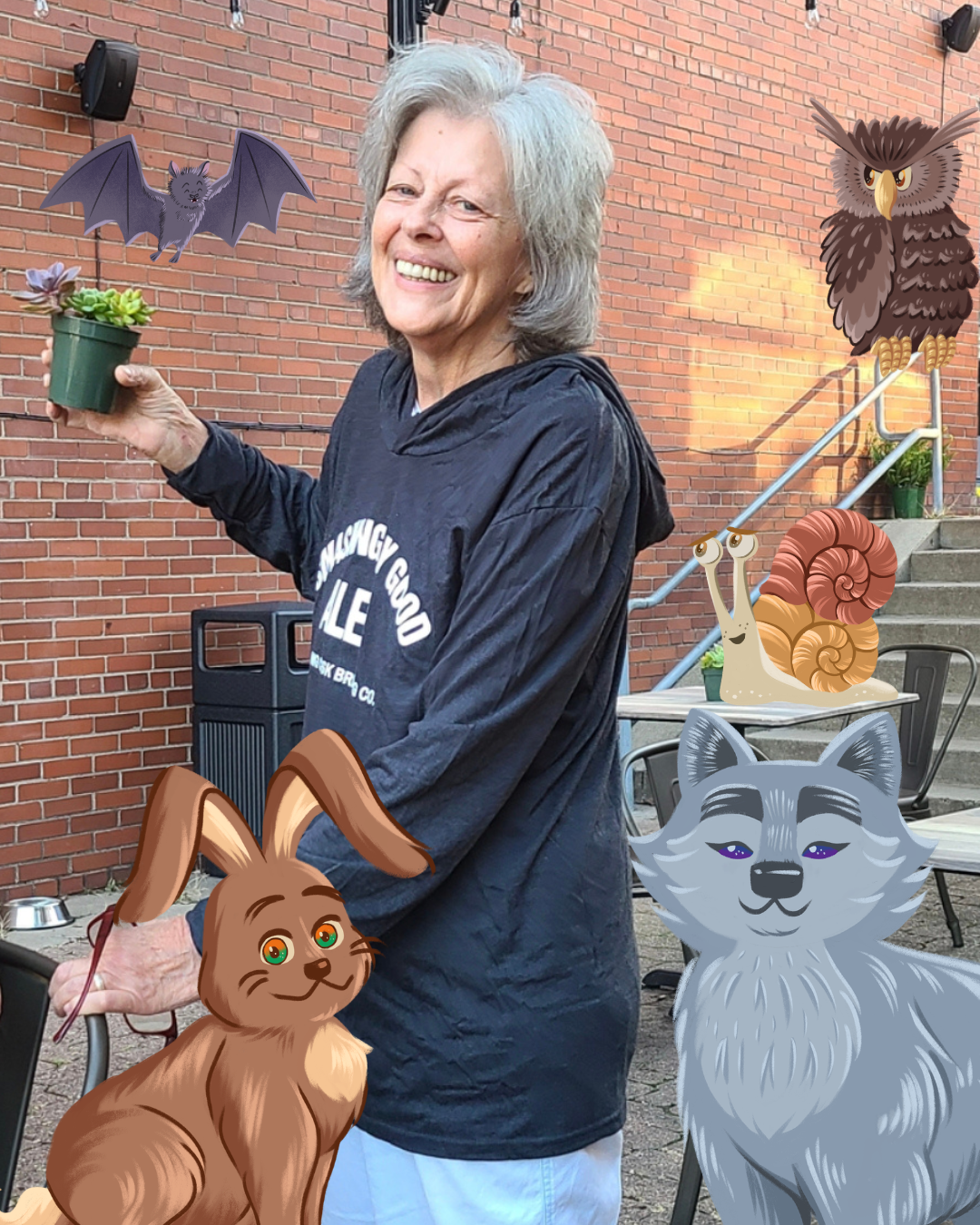
Barbara Bedner, who first imagined Yabbit the Rabbit, pictured with the characters from The Rabbit in the Moon, the children’s story inspired by her “No yeah-buts” response to childhood hesitation.
Some characters begin with a sketch, a plot, or the search for the perfect name. Yabbit the Rabbit began much closer to home, with a phrase my mother, Barbara Bedner, used whenever I hesitated, resisted something, or tried to talk my way out of doing what was in front of me.
My response was often some variation of, “Yeah, but…” My mother had heard enough of those responses to develop an answer of her own: “No yeah-buts.” Over time, that familiar exchange gave her the idea for a little rabbit who always seemed to have a “yeah, but” ready whenever something difficult, uncomfortable, or uncertain appeared.
Years later, that rabbit became Yabbit, the central character in The Rabbit in the Moon. The name began as a family joke, but the feeling underneath it turned out to be much bigger. Yabbit represents a moment almost every child encounters eventually: wanting to move forward while simultaneously searching for a reason not to begin.
What Does Yabbit Mean?
The name Yabbit grew out of the words “yeah, but.” Whenever I resisted something as a child, particularly something that felt uncomfortable or uncertain, “yeah, but” gave me a way to explain why I should not have to do it yet. My mother eventually turned that habit into the idea of Yabbit Rabbit, a little rabbit whose hesitation sounded remarkably familiar.
That history still defines what Yabbit means today. Yabbit represents the moment when a child wants to try but begins backing away as the experience becomes real. He is the child who was excited about soccer when everyone was talking about it at home but becomes uncertain when practice begins, or the child who wants to attend the birthday party until it is time to walk through the door. He is also the child who knows an answer but does not raise a hand, wants to join the other children but stays close to a parent, or says “I can’t” before discovering whether they actually can.
The important part of Yabbit’s meaning is that hesitation is not treated as a character flaw. Yabbit is not a nickname for a weak child, a difficult child, or a child who needs to toughen up. He gives a recognizable shape to the complicated space between wanting to do something and feeling ready to do it.
That distinction became much more meaningful to me as I grew older. Children can genuinely want an experience and still become frightened by the moment of beginning. The two feelings are not contradictory, and understanding that tension changes the way an adult can respond.
Yabbit gives that tension a name without turning it into an identity.
Who Created Yabbit the Rabbit?
My mother, Barbara Bedner, first imagined Yabbit the Rabbit. She was raising two children while managing a busy career, and she had little interest in letting every ordinary request turn into a courtroom argument with me serving as defense counsel.
Whenever I hesitated or resisted, I could usually find a reason. Sometimes the reason was legitimate, sometimes it was creative, and sometimes it was simply the fastest available exit from something I no longer wanted to face. Whatever form it took, the introduction was remarkably consistent: “Yeah, but…”
My mother began playing with the idea of a rabbit who did the same thing. Instead of creating the traditional bold children’s character who races toward every adventure, she imagined one who hesitated. Her rabbit worried, stalled, and found reasons that something might not be a good idea after all.
There was something unusually perceptive in that character, even before either of us fully understood it. Children’s stories have plenty of fearless heroes. My mother had imagined a hero who might need a little time before he could become heroic.
That difference eventually became the reason I wanted Yabbit to exist.
I Was the Original “Yeah, But” Kid
The character was funny because there was truth behind him. I frequently loved the idea of doing something new until the new thing stopped being an idea and became an actual event on the calendar.
Sports were a good example. I wanted to play on a traveling baseball team and was excited enough to try out, but after making the team, my enthusiasm became much more complicated. Summer sports camps sounded exciting when we discussed them at home. When departure day arrived and the bags were packed, however, excitement could quickly turn into a search for an escape route.
That pattern is easy to misread from the outside. An adult might reasonably wonder how a child can spend weeks asking to participate in something and then suddenly refuse to go. From inside the experience, there is no contradiction at all. Imagining yourself doing something happens in safety. Beginning requires you to cross the distance between imagination and reality.
For some children, that distance barely registers. For others, it can feel enormous.
I was often one of the latter.
The Childhood Experience That Taught Me Something About Courage
One memory from childhood became especially important to the way I eventually understood Yabbit. I had signed up to attend a weeklong sports camp at Loras College in Dubuque, Iowa, with several friends. The idea had sounded wonderful until we arrived and the parents were supposed to leave.
At that point, I wanted out.
My friends were there, the camp was something I had chosen, and nothing terrible had happened. None of those facts made the feeling disappear. The prospect of my mother driving away had suddenly made the entire experience seem different from the one I had imagined.
What she did next stayed with me. She did not embarrass me in front of my friends, tell me that I was being ridiculous, or insist that because we had driven all that way I was going to stay whether I liked it or not. She took me aside and told me that if I truly did not want to stay, I did not have to. She also offered to remain nearby for another hour so I could see how I felt.
That hour changed the size of the decision. I was no longer being asked to summon enough courage for an entire week away from home. I only had to stay a little longer and see what happened.
By the end of the hour, I was ready for her to leave. I told her I wanted to stay and that I would see her at the end of the week.
Looking back, I can see why that experience remained with me long after the camp itself faded into childhood memory. My mother did not make the fear disappear, and she did not demand that I become fearless. She made the beginning smaller until I could manage it myself.
Years later, I would have a name for that kind of beginning: a Tiny Brave Hop.
How Yabbit Went From an Idea to a Children’s Book
For a long time, Yabbit existed more as a possibility than a finished story. After college, I finally decided that I should try to write the book my mother had been encouraging me to create. I walked to the beach with a notebook and pen and managed to write one line: “Yabbit the Rabbit had a bad habit.”
Then I discovered something that every writer eventually learns. Having an idea for a book and knowing how to write that book are entirely different things.
At the time, I had not yet found my own relationship with Yabbit. The character belonged emotionally to my mother because she had imagined him, while I was still trying to figure out what the story meant to me. I registered the Yabbit domain after moving to Chicago in 2004 and continued thinking about the idea, but thinking about a story is much easier than writing one.
In 2007, my mother came across a children’s book illustrator and urged me again to finally move forward. My attention was elsewhere, and once again I did not finish the story. Yabbit remained with us, patiently waiting while life became crowded with other things.
I used to think of those years simply as delay. I see them differently now. I had not yet understood the character deeply enough to write the book he eventually needed.
The idea survived because it carried something true.
Why Yabbit Could Never Be a Fearless Hero
When I eventually understood what I wanted The Rabbit in the Moon to say, one decision became essential: Yabbit could not suddenly turn into the fearless rabbit.
If he did, the children who most needed him would lose him.
The value of Yabbit is that he understands hesitation from the inside. He knows what it feels like when something seems manageable from a distance and much larger when it is directly in front of you. His courage has meaning precisely because uncertainty does not disappear first.
That is also why Snail is so important to Yabbit’s world. Snail can be steady, persistent, and supportive without taking Yabbit’s journey away from him. Support helps Yabbit move, but Yabbit still has to make the movement himself.
For me, that became a much more useful picture of childhood courage than the idea that bravery means charging confidently toward whatever scares you. Courage can happen while the doubt is still present. A child can need reassurance and still be courageous, just as a child can pause, watch, ask for help, or begin with a much smaller step than the adults around them expected.
Yabbit is not interesting because he stops being hesitant. He is interesting because hesitation does not get the final word.
How Yabbit Led to the Tiny Brave Hop Method
As The Rabbit in the Moon took shape, I realized that the idea behind Yabbit had applications far beyond the story itself. Parents encounter these moments constantly. A child stalls at the classroom entrance, refuses to join an activity they asked to attend, avoids a difficult page of homework, will not taste the unfamiliar food, or decides they suddenly hate something they were excited about yesterday.
The instinctive adult response is often to make the encouragement bigger. We offer a longer speech, more reassurance, or some version of “You can do it.” Sometimes that works. At other times, the child is not lacking encouragement at all; the first step simply feels too large.
The Tiny Brave Hop Method grew from a different question: instead of asking how we can make a child feel completely ready, what if we ask how we can make the beginning manageable?
That does not mean removing every challenge or letting avoidance make every decision. It means recognizing that courage can be built in increments. A child who cannot walk into the group may be able to stand beside it. A child who cannot read the whole page may be able to read the first sentence. A child who cannot imagine staying for the entire activity may be willing to stay for ten minutes and reassess.
If you want the practical parent framework that grew from Yabbit’s story, I explain it in depth in How to Help Your Child Take Tiny Brave Hops.
The method came after the character, but emotionally they belong to the same idea. We do not have to wait for fear to disappear before movement becomes possible.
Why the Meaning of Yabbit Still Matters
The original “yeah, but” exchange happened in one family, but the pattern behind it is nearly universal. Most children will eventually encounter something they want to do and discover that wanting it is not quite enough to make beginning easy.
The setting might be school, sports, friendships, bedtime, reading, a performance, a new food, a new sibling, a mistake, or a room full of unfamiliar people. The details change as children grow, but the basic emotional negotiation remains recognizable: part of the child leans forward while another part looks for the exit.
Yabbit gives families a way to talk about that moment without turning hesitation into something shameful. A parent can recognize the “yeah, but” without mocking it and still help the child consider what comes next. The goal is not to create children who never hesitate. Childhood contains too many genuinely new experiences for that to be realistic.
The goal is to help children discover that hesitation and movement can coexist.
That is the idea at the center of The Rabbit in the Moon, but it is also why Yabbit has become larger than the title character of one book. He represents a recognizable part of childhood and, if we are willing to admit it, a recognizable part of adulthood too. Most of us still have a “yeah, but” voice somewhere inside us. We simply become more sophisticated at explaining it.
The Story Behind KD Schnee and Yabbit
Yabbit began with my mother, but finishing the character required me to find my own reason for carrying him forward. What had once been a funny childhood habit gradually became a way for me to think more carefully about beginnings, hesitation, encouragement, and the difference between helping someone move forward and simply pushing them.
That perspective now shapes the Parent Resources articles I write as well as the stories I want to tell. I am a children’s author, not a psychologist, and I do not believe a picture book should pretend to replace the expertise children sometimes need. What stories can do exceptionally well, however, is give children a character who makes an internal feeling visible and give families language they can return to later.
If you would like to learn more about my background, my work as KD Schnee, and how The Rabbit in the Mooneventually became part of a larger mission around hesitant children and brave beginnings, visit: https://www.yabbitrabbit.com/about
Yabbit’s story began with Barbara Bedner, but its purpose continues every time a child recognizes something of themselves in a rabbit who is not quite ready yet.
Watch the Origin Story
The written story explains where Yabbit came from, but there is another version of the origin that can be experienced more personally. I also tell the story of Yabbit, my mother, and the long road behind The Rabbit in the Moon in the Yabbit origin documentary on YouTube.
Watching the story adds another layer to the history because Yabbit was never created as a branding exercise or a character developed around a market category. He began inside a relationship between a mother and her son, and everything that followed grew from there.
Buy The Rabbit in the Moon
If your child sometimes wants to try but freezes when the moment arrives, The Rabbit in the Moon was created for that emotional territory. Yabbit does not teach children that bravery means never being nervous; his journey gives them a character who hesitates and still discovers that he can move forward.
For parents, grandparents, teachers, and caregivers, my hope is that the book leaves behind more than a pleasant read-aloud. I hope it gives families language they can use when the next “yeah, but” moment arrives and reminds a child that a beginning does not have to be enormous to count.
Courage is not being fearless. It is taking one small, brave hop forward.
Frequently Asked Questions About Yabbit the Rabbit
What does Yabbit mean?
Yabbit grew from the phrase “yeah, but,” which I frequently used as a child when I hesitated, resisted something, or wanted a reason not to begin. My mother, Barbara Bedner, would answer, “No yeah-buts,” and eventually imagined a rabbit whose hesitation worked the same way. Today, Yabbit represents the moment when a child wants to move forward but fear, uncertainty, or self-doubt makes beginning difficult.
Who created Yabbit the Rabbit?
Yabbit the Rabbit was first imagined by my mother, Barbara Bedner. The character grew from our repeated childhood exchanges around my tendency to answer challenges with “Yeah, but…” and eventually became the central character of The Rabbit in the Moon.
Why is the character called Yabbit the Rabbit?
The name evolved naturally from the sound and repetition of “yeah, but.” What began as a playful family phrase became an unusually fitting name for a rabbit whose defining struggle is hesitation, because Yabbit is often caught between the desire to participate and the reasons his worried mind can find for holding back.
Is Yabbit only for anxious or sensitive children?
No. Hesitation is a normal human experience, and children who are confident in many areas can still freeze in a particular situation. Yabbit is meant for any child who encounters a moment when something they want to do suddenly feels harder once it is time to begin.
What does Yabbit teach children about courage?
Yabbit helps children see that courage does not require fear to disappear first. His story treats hesitation as something that can be understood and moved through, showing that a child can still take a meaningful step while feeling uncertain.
What is a Tiny Brave Hop?
A Tiny Brave Hop is a manageable first step toward something that feels difficult. Instead of demanding that a child conquer the entire challenge at once, the idea is to make the beginning small enough to approach while still allowing the child to experience genuine movement and accomplishment.
How is Yabbit connected to The Rabbit in the Moon?
Yabbit is the hesitant rabbit at the heart of The Rabbit in the Moon. The book takes the emotional idea behind his name and turns it into a story in which hesitation is not the end of the journey, allowing children to see that bravery can begin before confidence has fully arrived.