When a child says, “I can’t,” many adults hear a fixed belief. They hear refusal. Defeat. Negativity. A mindset problem.
But in my experience, “I can’t” is usually not the deepest truth. It is often a child’s fastest available language for overwhelm.
It can mean:
This feels too big.
I don’t know what to do first.
I’m afraid of getting it wrong.
I don’t want to feel embarrassed.
I’m not ready to be watched while I struggle.
That distinction matters.
Because if we misread “I can’t” as laziness or defiance, we respond with pressure. And pressure tends to make hesitant children dig in deeper. But if we hear “I can’t” as a child standing too close to discomfort, uncertainty, or fear, we respond differently. We get wiser. Calmer. More useful.
That is where the real shift begins. For hesitant children, the goal is not to force a leap from fear to confidence. The goal is to help them move from “I can’t” to “I can try.”
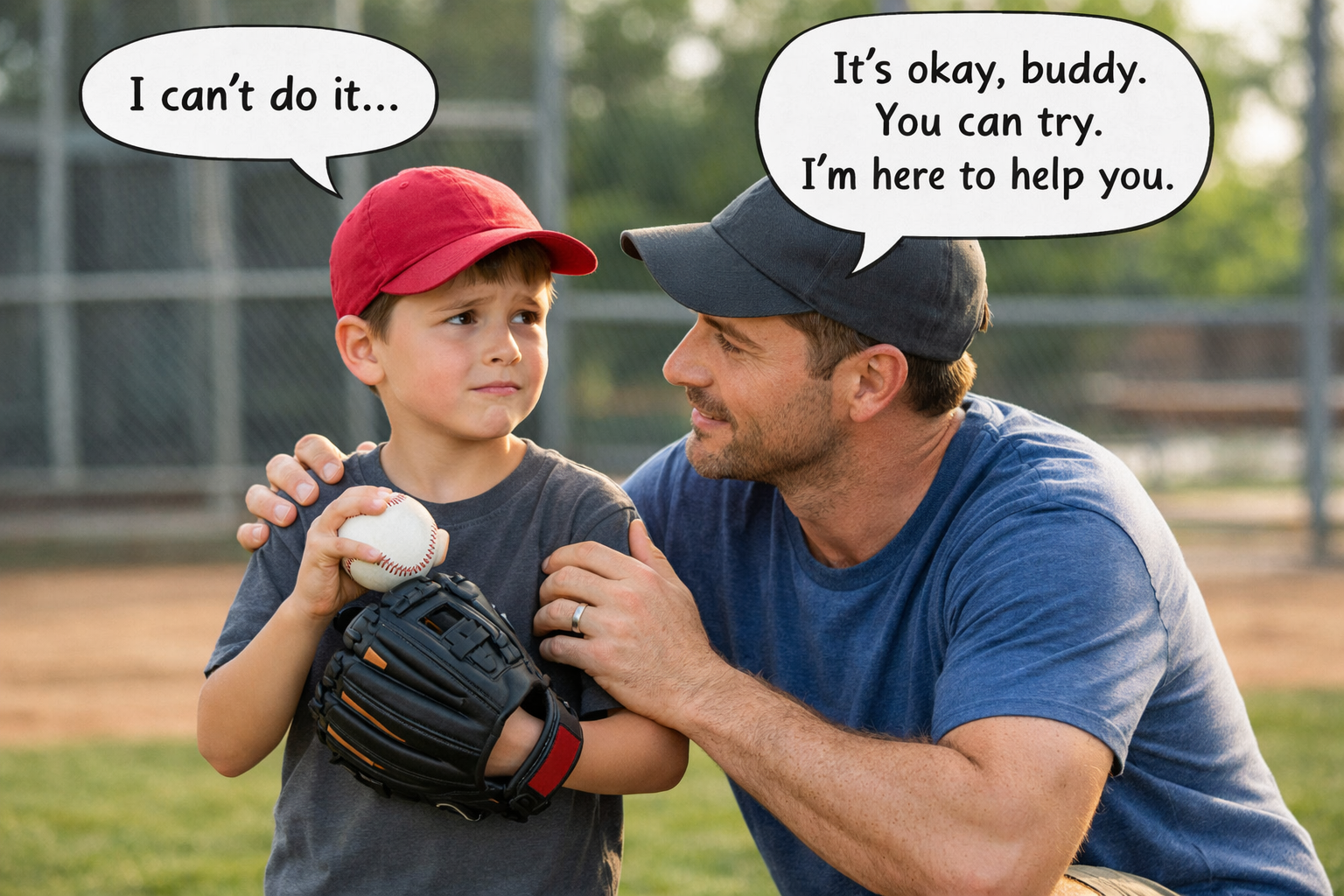
For hesitant children, bravery often begins as a sentence before it becomes an action.
Why “I can’t” is rarely the whole story
Children often use absolute language when their nervous system is overloaded. They say “I can’t” because they do not yet have the words for what is happening underneath. They may not know how to say, “I’m worried I’ll fail,” or “I don’t know how to start,” or “This feels bigger than I expected.”
So the sentence comes out short and final.
“I can’t.”
That is why I always encourage parents to look past the phrase and ask a better question: What is my child protecting themselves from right now?
Sometimes it is fear of making a mistake.
Sometimes it is fear of being seen struggling.
Sometimes it is a perfectionistic belief that if they cannot do it well, they should not begin at all.
Sometimes it is simply the emotional size of the moment.
If you want the deeper child-development lens on why hesitation happens in the first place, this is the best companion post to read next: https://www.yabbitrabbit.com/parent-resources/psychology-of-hesitation-in-children-yabbit-the-rabbit
Why “I can try” is a better bridge than “Just do it”
A lot of adult language jumps too far ahead.
We say:
“You can do it.”
“Don’t be scared.”
“Just try.”
“It’s easy.”
The problem is that a hesitant child often knows it does not feel easy. So the language misses them. Instead of calming the moment, it makes them feel more alone inside it.
“I can try” works better because it is honest.
It does not demand certainty.
It does not pretend fear is gone.
It does not ask the child to become instantly confident.
It simply opens the door to movement. That is a powerful shift.
“I can’t” shuts the door before the child even begins. “I can try” leaves the door cracked open.
For many kids, that is the whole game.
What mindset shifting actually looks like in real life
Parents often hear the phrase “growth mindset” and think it means praise.
It does not. Real mindset work is not telling children they are amazing. It is teaching them how to relate to effort, mistakes, discomfort, and starting.
For hesitant children, mindset shifting sounds more like this:
Instead of: “I can’t do this.”
Try: “This feels hard, but I can try one part.”
Instead of: “I’m bad at this.”
Try: “I’m still learning this.”
Instead of: “I messed it up.”
Try: “That part didn’t work yet.”
Instead of: “I’m not brave.”
Try: “I can do one brave thing.”
Notice what changes here. We move the child away from identity and toward process. Away from finality and toward motion. Away from self-judgment and toward experimentation.
That is how building resilience in kids actually begins. Not with a giant speech. With better language at the exact moment the child wants to shut down.
The mistake parents make when trying to build confidence
Many parents want to hand a child confidence before the child has any evidence. That is understandable. It is also backwards. Confidence usually does not come first.
First comes the attempt.
Then comes survival.
Then comes evidence.
Then confidence starts to grow.
This is why hesitant child strategies have to begin with smaller asks, not bigger encouragement.
If the task is too large, the child keeps collecting evidence that they shut down. But if the step is small enough to complete, they begin collecting a different kind of evidence:
I started.
I stayed with it.
I did not do it perfectly, but I did something.
I can come back tomorrow.
That is a far more durable path to confidence than empty reassurance.
Why growth mindset books help when lectures do not
Children do not always absorb mindset language when it comes straight at them. They absorb it more naturally through story.
That is one reason growth mindset books can be so powerful. A child may resist a direct lesson about bravery, but lean all the way into a character who struggles, hesitates, and still moves forward.
Stories lower defensiveness. They give children distance from their own fear. They let them recognize themselves without feeling cornered. And they give families shared language that can be reused later, when the real moment arrives.
That is one of the reasons Yabbit matters.
Yabbit is not fearless. He is not the child who charges ahead without a second thought. He is the child many families recognize immediately, the one who pauses at the edge of something important because the moment feels too big.
What makes his journey useful is not that fear disappears. It is that the story helps children see that bravery does not require certainty. It requires a beginning.
That is the emotional move from “I can’t” to “I can try.”
How to respond when your child says “I can’t”
When a child says “I can’t,” the adult’s job is not to argue the sentence out of existence. It is to translate it.
You might say:
“It sounds like this feels hard right now.”
That lowers shame.
“You do not have to do all of it. What is one part you can try?”
That shrinks the task.
“You don’t need to be sure. You just need a first move.”
That lowers the pressure to feel ready.
“Trying counts, even if it feels wobbly.”
That protects effort from perfectionism.
This is where language becomes strategy. The right sentence can turn a dead-end moment into a starting point.
And if your child’s “I can’t” is really being driven by fear of failure or perfectionism, this is the best companion post to pair with it:https://www.yabbitrabbit.com/parent-resources/perfectionism-in-kids-why-they-wont-start-shrink-the-stakes
The goal is not to erase hesitation
This matters. I am not interested in teaching children to perform confidence. I am interested in helping them build a healthier relationship with uncertainty.
A hesitant child does not need to become a different child. They need better tools for staying with the moment instead of fleeing it.
That is a more respectful goal, and a more realistic one. Because courage is not the absence of hesitation. It is what happens when hesitation no longer gets the final word.
And for many children, that shift begins with one sentence:
“I can try.”
Invest in your child’s emotional growth
If your child often says “I can’t” before they begin, The Rabbit in the Moon was written for those moments.
It helps children feel seen without being labeled, and it gives families a calmer, more usable language for brave beginnings, tiny first moves, and emotional growth that feels possible.
If the story helps your family, one honest review can also help another parent find the right book at the right time.
FAQs
What does “I can’t” usually mean in a hesitant child?
Often, it means the child feels overwhelmed, unsure, afraid of failure, or unsure how to begin. It is usually more about emotional overload than the child’s true ability.
How can I help my child move from “I can’t” to “I can try”?
Start by lowering pressure, naming what feels hard, and shrinking the task into one doable first move. Children shift more easily when the goal is a start, not instant success.
What are the best hesitant child strategies?
The best hesitant child strategies usually include emotional validation, smaller first steps, calmer language, less pressure, and repeated opportunities to practice trying without shame.
Are growth mindset books really helpful for kids?
Yes. Growth mindset books help children see characters struggle, recover, and continue. That can be easier for kids to absorb than direct advice because stories feel safer and less confrontational.
How do you build resilience in kids without pushing too hard?
You build resilience by helping children survive manageable hard moments, not by overwhelming them. Small reps, emotionally safe support, and process-based language build much stronger resilience over time.
Is The Rabbit in the Moon a good book for hesitant children?
Yes. It is especially helpful for children who pause, avoid, or feel unsure before trying. Yabbit reflects that emotional reality honestly and gives children a gentler path into bravery.