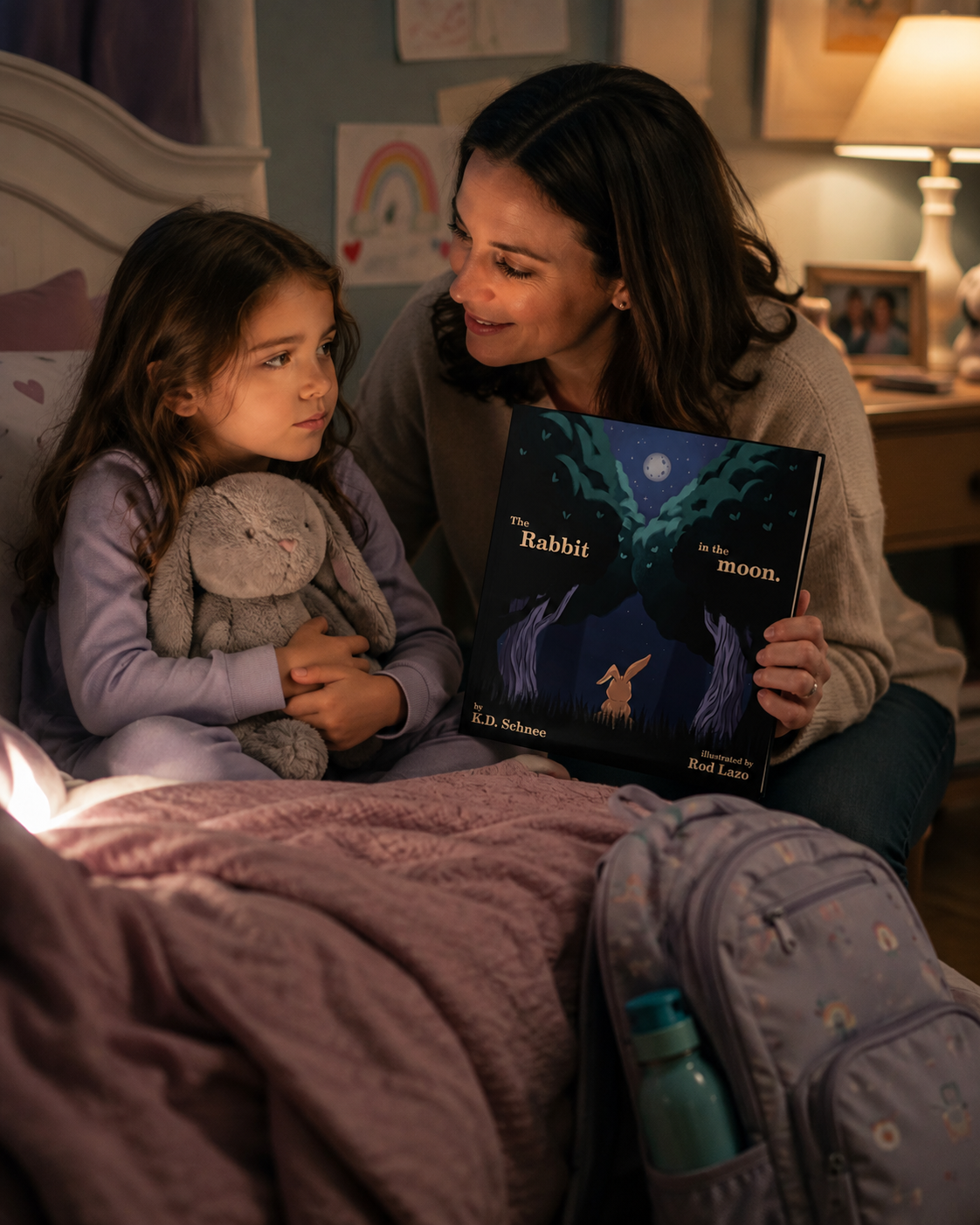
For some children, back-to-school courage begins before the classroom, in the quiet moment when the backpack is packed and the worry arrives.
The best back-to-school books for hesitant kids help children feel safe before they feel ready.
That is the heart of it. A hesitant child may want to go back to school and still freeze when the moment gets close. They may like their teacher, miss their friends, enjoy learning, and still feel stuck the night before, beside the backpack, at drop-off, near the classroom door, or when everyone else seems to know what to do.
That child does not need a book that simply says, “School is fun.” They need a story that understands the threshold.
The Rabbit in the Moon was created for children who pause before they begin. Yabbit is not fearless. He hesitates. He feels the size of the journey before him. Snail stays steady beside him. Together, they help children understand that courage does not have to be a giant leap into the school year. It can begin with one tiny brave hop.
Why back-to-school can feel so big for hesitant kids
Back-to-school is not one transition. It is a stack of transitions wearing one backpack.
A child may be leaving summer rhythm, later mornings, familiar routines, extra family time, or the emotional safety of home. They may be returning to a classroom, a teacher, a group, a schedule, a lunchroom, a playground, a bathroom, a desk, a circle-time rug, and a long list of small expectations that adults barely notice.
For a hesitant child, those small expectations can feel enormous.
Walk in. Say goodbye. Hang up the backpack. Find the seat. Join the group. Raise a hand. Try the work. Make a mistake. Ask for help. Find someone to play with. Keep going until pickup.
Adults may see a school day. A hesitant child may see a hundred beginnings lined up like dominoes.
That is why back-to-school worry often shows up in strange little ways. A child may say they do not want to go. They may ask repeated questions. They may become clingy, silly, angry, quiet, or suddenly unable to do something they handled last week. They may complain about socks, breakfast, shoes, or the unbearable tragedy of the wrong water bottle.
The surface problem may look small. The threshold underneath may feel huge.
What should back-to-school books do for hesitant children?
Back-to-school books for hesitant children should make the first step feel smaller. That is the job.
A useful book does not have to explain every part of school. It does not have to promise that the day will be perfect. It does not have to turn every child into a confident backpack-wearing sunbeam by page twelve.
It should help the child recognize the feeling, see a character face something uncertain, notice support, and imagine one small way forward.
The best back-to-school books for hesitant kids do not shame the pause. They do not make fear look silly. They do not rush the child from worry to excitement so quickly that the emotional arc feels fake. Instead, they say, in story form, “This feeling makes sense, and it does not have to stop you.”
That is why The Rabbit in the Moon belongs in this conversation.
It is not a traditional first-day-of-school book. Yabbit does not pack a lunchbox or meet a teacher. But emotionally, the book lives in the exact place many back-to-school worries begin: the moment before the child starts.
That is where hesitant children need the most help.
Why The Rabbit in the Moon is different from a generic back-to-school book
Many back-to-school books focus on the classroom itself: the teacher, the supplies, the schedule, the bus, the friends, the first day.
Those books can be helpful. Children often need familiarity, especially when a new school year is coming. But some children need something underneath the school details. They need help with the feeling before the first step.
The Rabbit in the Moon works differently because it is not trying to sell school as exciting. It is trying to make courage feel possible.
Yabbit gives children a character who understands hesitation from the inside. He does not leap forward with instant confidence. He pauses, worries, and needs support before continuing. Snail brings steadiness without pressure. That combination matters because hesitant children do not always need more excitement. They often need calm, patience, and a smaller beginning.
For the child who freezes at the school threshold, the most useful phrase may not be, “School will be great.” It may be: “This feels like a Yabbit moment. What is one tiny brave hop?”
That question makes the day smaller. Smaller can be the beginning of safer.
The night before school: when worry starts early
For many hesitant children, school worry begins the night before.
The backpack is packed. The clothes are chosen. The lunchbox is waiting. Everyone says tomorrow will be a big day, and suddenly the child’s imagination starts unpacking every possible problem. What if I do not know where to go? What if nobody plays with me? What if I miss you? What if I make a mistake? What if the teacher asks me something? What if the day feels too long?
The night before school is not the time for a giant motivational speech.
A child who is already worried may not be able to absorb a long explanation about how wonderful school will be. They may need calm, repetition, and one simple story they can hold.
This is a good moment for The Rabbit in the Moon because the book lets children sit beside hesitation without being swallowed by it. Yabbit’s moonlit world gives the feeling a shape. The story says, gently, that something can feel big and still be entered one small step at a time.
A parent might read the book and say: “Tomorrow might feel big in the beginning. We do not have to solve the whole day tonight. What is one tiny brave hop for the morning?”
That might be putting on shoes. Carrying the backpack. Walking to the car. Holding a parent’s hand to the door.
The plan should be small enough that the child can picture it.
The backpack by the door: making school feel real but manageable
A packed backpack can make school feel real.
For some children, that is exciting. For others, it is the moment the worry becomes visible. The backpack is no longer an object. It is a tiny suitcase full of expectations.
This is where parents can use story to lower the emotional temperature. Instead of making the backpack a symbol of pressure, make it part of a simple routine.
“Your backpack is ready. Your book is ready. Your first step is ready.”
A hesitant child often benefits from knowing what comes first. Not the whole school day. Not every subject. Not the entire schedule from arrival to pickup. Just the first few steps.
Put on shoes. Carry backpack. Walk to car. Say the goodbye phrase. Enter the classroom.
If the child needs more emotional support, place The Rabbit in the Moon near the backpack the night before or read it beside the packed bag. The visual pairing matters. The book becomes part of the transition, not a separate bedtime island.
You are telling the child: we know this feels big, and we have a story for big beginnings. That is a very different message from “There is nothing to worry about.”
Drop-off: the hardest little doorway
Drop-off can be the hardest part of returning to school.
Not because the child hates school, and not because the parent has done something wrong. Drop-off is hard because it asks the child to separate, enter, trust, and begin all at once. That is a lot of emotional work for one doorway.
A hesitant child may cling, cry, bargain, freeze, or suddenly ask one hundred urgent questions about lunch. The parent may feel embarrassed, rushed, guilty, or tempted to overexplain. Everyone’s nervous system starts doing jazz.
This is where shorter language helps.
Try:
“This is the hard goodbye part.”
“You are safe, and your teacher is your helper.”
“I will come back after school.”
“We are doing one tiny brave hop.”
“This is a Yabbit moment.”
The goal is not to make the child instantly happy. The goal is to make the next step clear and supported. For more direct scripts around school refusal, separation, and transition moments, read: https://www.yabbitrabbit.com/parent-resources/big-transitions-what-to-say-when-child-wont-go
A book cannot do the drop-off for you. But a familiar story can give you language that holds steady when the morning gets wobbly.
The classroom door: helping children cross the threshold
Some children are fine once they are inside.
That sentence is familiar to many parents and teachers. The child struggles at the edge, but once the day begins, they settle. The trouble is not the entire school experience. The trouble is the threshold.
The classroom door asks a child to move from one world to another. Parent to teacher. Home to school. Private feelings to public expectations. Familiar summer rhythm to classroom structure.
For hesitant kids, threshold moments are often where courage gets stuck.
The Rabbit in the Moon helps because it gives children a way to understand the pause before movement. Yabbit’s hesitation is not treated as failure. It is the emotional place where the story begins to matter.
A parent or teacher can say: “You do not have to feel ready for the whole day. What is the first tiny brave hop?”
That first hop might be walking to the rug, putting the backpack away, saying hello to the teacher, standing inside the room for ten seconds, or choosing a seat. Adults sometimes want children to feel confident before they enter. But confidence often grows after the first small step, not before it.
The doorway is where the hop matters.
Joining the group: when everyone else seems to know what to do
Back-to-school worry is not only about academics.
For many children, the social part feels bigger than the schoolwork. The group already playing. The lunch table already noisy. The rug already full. The friend pair already paired. The game already moving. The child may want to join and still have no idea how to enter.
This is one of the most important places to make bravery smaller.
“Go make friends” is too big.
“Say hello to one child” is smaller.
“Ask what they are playing” is smaller.
“Stand nearby and watch first” is smaller.
“Join for one part” is smaller.
Yabbit helps here because he does not model explosive social confidence. He models a quieter kind of courage. Snail helps because he shows that steady presence matters. A hesitant child can look at that relationship and understand that support does not have to be loud to be real.
A parent might say before school: “If recess feels big, you do not have to join everything. Your tiny brave hop can be standing near one game or saying hello to one person.”
That is concrete. The child can picture it. Children need brave steps they can picture.
Making mistakes: why school confidence often breaks here
Back-to-school season brings fresh starts, but it also brings fresh chances to feel embarrassed.
A child may worry about getting the answer wrong, writing a letter backward, not knowing the routine, forgetting supplies, being called on, losing a paper, spilling lunch, or doing something while other children watch.
For a perfectionistic or hesitant child, the fear of mistakes can become the real reason school feels hard. They may say they do not like school, but underneath they may be thinking, “What if I get it wrong?”
This is why confidence-building books need emotional honesty. A child does not need to be told that mistakes are fine in a breezy tone if mistakes do not feel fine to them. They need a story that shows effort, wobble, support, and continuation.
The Rabbit in the Moon helps because Yabbit’s courage is not about perfect performance. It is about continuing when the journey feels big. That message transfers beautifully to the classroom.
A parent or teacher can say: “You do not have to get the whole page right. What is one tiny brave hop into the work?”
The answer might be writing the first word, trying one problem, asking for help, or starting with the part the child understands. Trying one part can be a real act of courage.
Asking for help: a school skill hesitant children need
Some children would rather sit stuck than ask for help.
That may look like defiance or daydreaming, but often it is fear. They may worry that asking for help means they are not smart, that the teacher will be annoyed, or that other children will notice. They may not know how to ask, when to ask, or what words to use.
Back-to-school books can help by making help-seeking feel normal.
The Rabbit in the Moon does this through Snail’s presence. Snail is not there to rescue Yabbit from every hard thing. He is there as steady support. That distinction matters. The story does not tell children they must do everything alone to be brave. It shows that support and courage can live in the same moment.
Before school, parents can practice small help-seeking scripts:
“Can you help me start?”
“I do not understand this part.”
“Can I watch first?”
“Can you show me the first step?”
“I need a minute.”
These are tiny brave hops too. A child who asks for help is not failing school courage. They are practicing it.
The Tiny Brave Hop Method for back-to-school mornings
The Tiny Brave Hop Method helps back-to-school mornings because it keeps the focus on the next doable step, not the entire day waiting ahead.
When a child is overwhelmed, it is natural for adults to start explaining everything. We talk through the schedule, remind them of the teacher’s name, describe pickup, reassure them about lunch, mention friends, and try to solve every worry before anyone has even found the shoes. We mean well, but for a hesitant child, all that information can make the day feel even bigger.
A tiny brave hop brings the moment back down to size. Instead of asking, “How do we get through the whole school day?” ask, “What is the next small step?”
The night before, that might be choosing clothes. In the morning, it might be putting on shoes. In the car, it might be holding the backpack. At drop-off, it might be stepping onto the sidewalk. In the classroom, it might be saying hello to the teacher, sitting on the rug, writing the first word, or standing near one child before joining the group.
The hop should be small enough that your child can picture it. That is what makes it useful. You are not asking them to conquer the whole school day at once. You are helping them begin.
For a deeper guide to using tiny brave steps with hesitant children, read: https://www.yabbitrabbit.com/parent-resources/how-to-help-your-child-take-tiny-brave-hops
Small does not mean weak. Small is often how the child enters.
How parents can use The Rabbit in the Moon before school starts
Read The Rabbit in the Moon before the first hard morning arrives.
That is important. If the child is already crying at the school door, the book may not land in the same way. The feeling is already loud. The story works best when it has become familiar ahead of time.
Read it during a calm bedtime. Read it on the couch the week before school. Read it beside the backpack. Read it after visiting the classroom. Let the child enjoy the story before you use it as a tool.
Then ask one gentle question:
“What felt big for Yabbit?”
Or:
“Who helped him keep going?”
Or:
“What was one tiny brave hop?”
Do not turn the book into a lecture. Let it breathe. Children can feel when a story has been turned into adult strategy with a dust jacket.
Later, when school worry shows up, borrow the language naturally. “This feels like a Yabbit moment.” That is often enough to open the door.
What parents should not say about back-to-school worry
Try not to dismiss the worry, even when the worry seems small from the outside. Phrases like “There’s nothing to worry about,” “You’ll be fine,” “Don’t be silly,” “Everyone else is going,” or “You loved school last year” usually come from love, fatigue, or the very real need to get everyone out the door. But to a hesitant child, those words can feel like the adult is stepping over the feeling instead of noticing it.
A better place to begin is connection, then clarity. You might say, “I believe this feels big,” and then bring the morning back to the next step: “First, we put on shoes.” If your child needs a little control, offer a tiny choice: “Do you want your blue shoes or your gray shoes?”
This keeps the worry from running the morning, but it also keeps the child from feeling ashamed for having it. That is the balance we are looking for.
What teachers should know about hesitant kids returning to school
Hesitant children may need a softer doorway into the school year. That does not mean lowering expectations forever. It means understanding that the first step may need to be smaller, clearer, and more supported.
A teacher can help by using warm, predictable language:
“You can watch first.”
“Try one part.”
“Ask me for help if you get stuck.”
“You do not have to know everything on the first day.”
“In our classroom, tiny brave hops count.”
This language helps hesitant children without singling them out. It also builds a classroom culture where courage is not only loud participation. Courage can be asking for help, trying again, saying one word, entering after a hard goodbye, or beginning before confidence arrives.
The Rabbit in the Moon can work well as an early-year classroom read-aloud because it gives the class shared language for hesitation, support, and first steps. Yabbit becomes a way to talk about the start of school without putting one child under the spotlight.
That is exactly what a good back-to-school book should do.
Why this book is especially useful for the child who wants to go but freezes
Some children do not refuse school because they dislike school. They freeze because the first step feels too big.
That child is easy to misunderstand. Adults may say, “But you like school,” or “You know your teacher,” or “You had fun last year.” All of that may be true, and the child may still feel stuck at the threshold.
The Rabbit in the Moon helps because it separates fear from identity. Yabbit is not a “scared kid” as a fixed label. He is a character facing a moment that feels large. That is an important difference.
Children need to know that hesitation is not who they are. It is something they can move through with support.
The story gives them a model: pause, feel, receive steadiness, take one small step. That is a useful pattern for returning to school because back-to-school season is full of beginnings.
The child does not have to become fearless by Monday. They can begin with one small hop.
How to build a back-to-school book stack for a hesitant child
A strong back-to-school book stack should not only include books about school.
That may sound strange, but the emotional need is bigger than the setting. A hesitant child returning to school may need a book about goodbye, a book about joining, a book about mistakes, a book about asking for help, a book about routines, and a courage book for the moment before beginning.
The Rabbit in the Moon belongs in that courage-book role.
It helps children understand the feeling underneath many school worries. The classroom may change. The teacher may change. The routine may change. The social group may change. But the emotional moment is familiar: something feels big, and the child needs a way to start.
A good back-to-school shelf might include one literal first-day book, one separation book, one friendship book, one mistake book, and one Yabbit book.
That gives the child several doorways into the same season. Sometimes the right school book is not the one with a school bus on the cover. Sometimes it is the one that helps the child take the first step.
When should parents seek more support?
Back-to-school worry is common, but persistent or intense distress deserves attention.
If your child’s school worry causes repeated refusal, frequent stomachaches or headaches, sleep disruption, panic, intense separation distress, major family disruption, or a pattern of missing school, talk with your pediatrician, teacher, school counselor, or a qualified child mental health professional.
Getting help does not mean you failed. It means the child may need more support around the transition than a book or a morning script can provide on its own.
A story can still be part of the support. It can give language. It can make the first step smaller. It can help parents, teachers, and counselors talk with the child in a calmer way.
But books should not have to carry every backpack alone. Sometimes the tiny brave hop is asking for help.
Why The Rabbit in the Moon belongs in back-to-school season
The Rabbit in the Moon belongs in back-to-school season because returning to school is not only about supplies, schedules, and first-day photos. It is about courage. The quiet kind.
The kind that happens in a child’s bedroom the night before. The kind that stands beside a packed backpack. The kind that walks to the car. The kind that holds a parent’s hand near the school door. The kind that joins the group slowly. The kind that makes a mistake and tries one more line. The kind that asks for help instead of hiding.
Yabbit was created for those moments.
He helps children feel seen in the pause before beginning. Snail helps them understand that steadiness matters. The tiny brave hop gives families and teachers language they can use when back-to-school worry becomes too big for a simple “You’ll be fine.”
That is why The Rabbit in the Moon is not just a bedtime book during back-to-school season. It is a threshold book. A story for the child standing at the edge of the new school year, needing courage to become small enough to try.
Buy the Book
If your child is nervous about returning to school, freezes at the classroom threshold, struggles with drop-off, fears mistakes, or needs the first step to feel smaller, The Rabbit in the Moon belongs on your back-to-school shelf.
Yabbit is not fearless. He pauses. He worries. He feels the size of the journey before him. Snail brings steadiness, persistence, and quiet support. Together, they help children understand that courage does not have to arrive all at once. It can begin with one tiny brave hop.
For parents, grandparents, teachers, counselors, and caregivers, The Rabbit in the Moon offers more than a bedtime story. It gives children language for hesitation, support, uncertainty, and brave little beginnings.
It is a meaningful investment in your child’s emotional growth and a gentle story to return to when school mornings, new routines, and big beginnings feel too large.
External Resource
For more parent guidance on back-to-school anxiety, Child Mind Institute offers a helpful overview here: https://childmind.org/article/back-school-anxiety/
FAQs
What are the best back-to-school books for hesitant kids?
The best back-to-school books for hesitant kids are stories that help children feel seen, name what feels hard, and imagine one small first step. Look for books about school worry, drop-off, friendship, mistakes, asking for help, and courage.
Is The Rabbit in the Moon a back-to-school book?
The Rabbit in the Moon is not a traditional first-day-of-school book, but it is a strong back-to-school book for hesitant children because it helps with the emotional moment before beginning. Yabbit shows hesitation, Snail shows steady support, and the story makes courage feel smaller.
How can I help my child who freezes at school drop-off?
Use short, steady language. Say, “This is the hard goodbye part,” or “We are doing one tiny brave hop.” Keep the goodbye predictable, offer one small choice, and work with the teacher if your child needs a calmer handoff.
What should I read the night before school starts?
Choose a calming story that helps your child feel safe, not overstimulated. The Rabbit in the Moon works well because it gives children a gentle way to think about fear, support, and one small brave step before the new day begins.
What does one tiny brave hop mean for school?
One tiny brave hop means the smallest brave school step your child can take. It might be putting on shoes, carrying the backpack, walking to the classroom door, saying hello to the teacher, sitting on the rug, asking for help, or trying one part of the work.
Should back-to-school books be about school directly?
Not always. Some children need literal school books, but hesitant children may also need courage books, separation books, friendship books, and books about trying again. The emotional problem may be the beginning, not the school building itself.
When should I get help for back-to-school anxiety?
Seek support if school worry causes repeated refusal, panic, frequent physical complaints, sleep disruption, major distress, or a pattern of missing school. A pediatrician, school counselor, teacher, or qualified mental health professional can help you understand what your child needs.