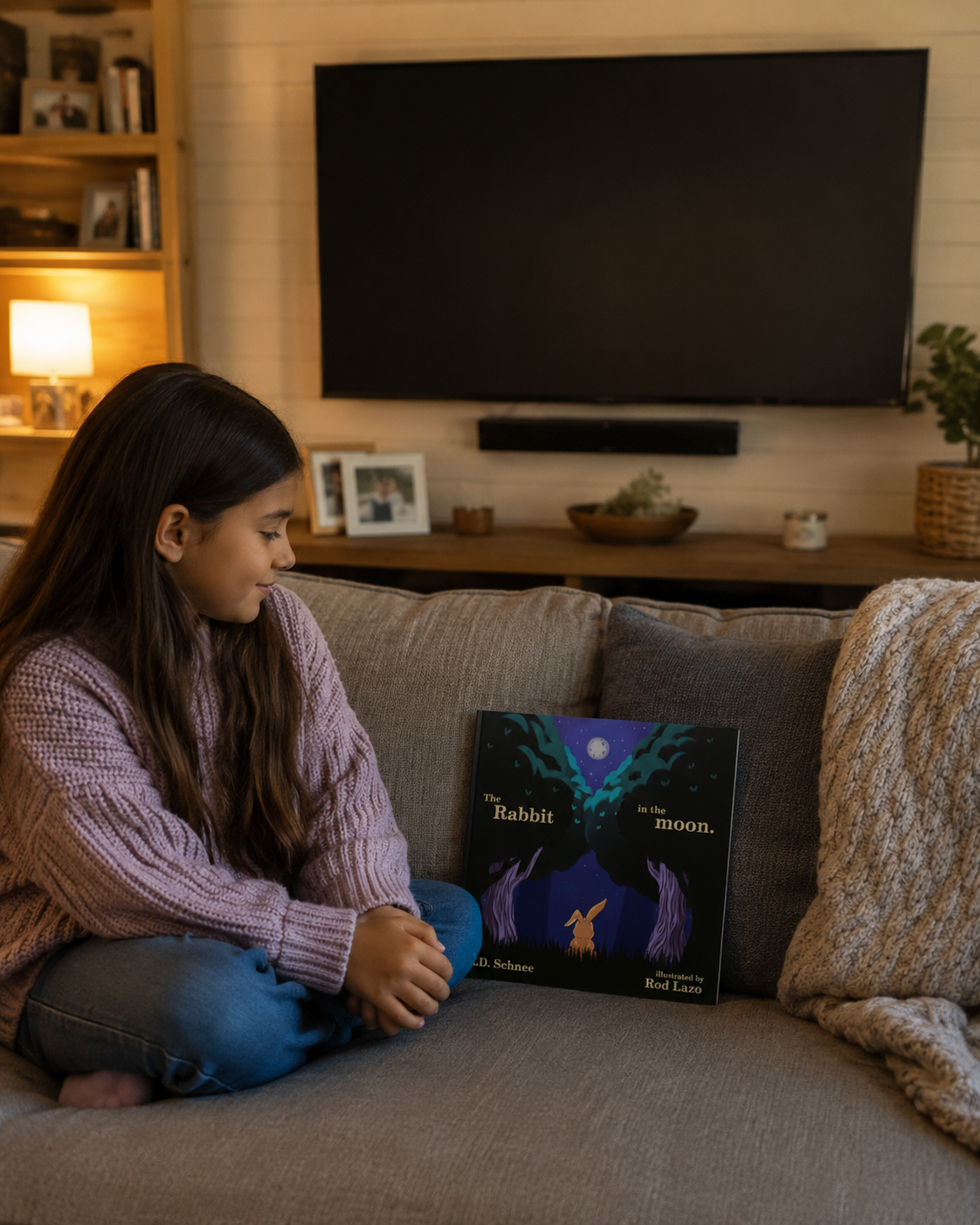
Books do not have to compete with screens by being louder. They can win attention by becoming warmer, closer, and easier to choose.
The best way to balance screen time and reading for kids is to make books part of the daily rhythm before screens take over the room.
That is the answer I would give parents first.
This does not mean screens are evil, or that every family needs to become a cabin of candlelit monks. Screens are part of modern life. Children use them for entertainment, learning, communication, music, games, and sometimes a badly needed parent pause. The goal is not panic. The goal is balance.
For children ages 3 to 8, books need protected space because reading grows through repetition, closeness, attention, and emotional connection. A child is more likely to choose books when books are visible, enjoyable, easy to reach, read aloud often, and connected to family routines that feel good.
The question is not, “How do I make screens disappear?” The better question is, “How do I make books easier to return to?”
Why does screen time compete so strongly with reading?
Screen time competes with reading because screens are designed to be easy to start and hard to stop.
A book asks a child to enter slowly. A screen enters the child’s attention immediately. Bright color, motion, sound, fast pacing, quick rewards, and endless next videos can make a quiet book feel like it is whispering from another room while a parade marches through the kitchen.
That does not mean children are lazy. It means screens are built for capture.
Books work differently. They do not grab attention the same way. They invite it. They ask for a little patience at the beginning. They often need an adult’s voice, a comfortable place, a child’s curiosity, and a few quiet minutes before the story begins to glow.
This is why the balance matters. If screens always get the easiest time slot and books only get the exhausted crumbs at the end of the day, books start at a disadvantage. Reading does not need to be louder than screens. It needs a better doorway.
For many families, that doorway is a small routine. Not a dramatic overhaul. A repeated invitation.
Should parents treat screens as the enemy?
No. Treating screens as the enemy usually makes the whole house more tense.
Children can feel when adults are anxious about screens. If every screen conversation becomes a battle, reading can accidentally become the punishment that follows. “Turn that off and go read” may be reasonable in the moment, but if a child hears it often enough, books begin to sound like the vegetable after the digital dessert.
That is not the relationship we want children to have with reading.
A better approach is to make screens one part of family life, not the center of it. Screens can have boundaries. Books can have rituals. Play can have space. Bedtime can have softness. The house can say, through its routines, “We enjoy many things here, and books are one of the things we come back to.”
The tone matters. Reading should feel like connection, not correction.
A child who believes books are only what happens after screens are taken away will rarely reach for them with joy. A child who experiences books as warmth, story, comfort, laughter, courage, and closeness has a much better chance of returning.
What is the simplest screen-time and reading rule?
The simplest rule is this: place reading before the easiest screen moment. That might mean one picture book before cartoons in the morning.
One story before the tablet on a weekend. Ten minutes of reading before a show after school. A bedtime book before any evening screen, or no screens in the bedroom so the book gets the last word of the day.
This works because once screens begin, it is harder for many children to shift back into the slower pace of reading. The brain has already been handed fireworks. Asking it to enjoy a quiet page afterward can feel like asking a marching band to tiptoe.
Reading first gives books a fair chance.
It also keeps reading from becoming a punishment. The message is not, “You lost screen time, so now you must read.” The message is, “In our family, stories come before screens at this part of the day.”
That small difference changes the emotional climate. A routine is easier to accept than a sudden rescue mission.
How can families create a screen-free reading routine?
Start with one screen-free pocket of the day.
Do not begin by trying to renovate the entire family schedule with a whistle and a laminated chart. Most families do better with one small anchor. Choose a moment that already has a natural pause: after breakfast, before school, after bath, before bed, before weekend cartoons, or after dinner.
Then make the routine simple enough to repeat.
Choose one book. Sit in one familiar place. Read for five to ten minutes. Let the child choose between two options. Keep the screen out of reach, not because the book needs a bodyguard, but because attention is easier when the brightest object in the room is not waiting to win.
A screen-free reading routine might sound like:
“First story, then show.”
Or:
“Books live before bedtime.”
Or:
“After dinner, we read one small thing together.”
The routine should feel calm. It should not require a perfect parent, a perfect child, or a house that looks like a catalog where nobody owns markers. It only needs to happen often enough that the child starts to trust it.
How do you get a child to choose books instead of screens?
You make books easier to choose.
That sounds almost too simple, but it is where many homes accidentally tilt toward screens. The remote is visible. The tablet is charged. The favorite app is one tap away. The books are on a shelf, spine-out, crowded between old board books and a craft kit missing half its moons.
Children choose what the environment offers.
Place a few books where your child actually lives: near the couch, beside the bed, in the car, next to the breakfast table, in a basket by a cozy chair. Face a few covers outward. Rotate books so the same three tired titles are not doing all the emotional labor.
Choice also matters. Let your child pick from a small set. Too many books can overwhelm. No choice can feel like an assignment. Three good options are often enough.
You might say:
“Do you want the funny book, the brave book, or the bedtime book?”
That gives the child ownership without making the decision too big. The goal is not to make books compete with screens by becoming screens. The goal is to make books feel close enough to choose.
Why read-alouds matter even when screens are available
Read-alouds matter because they give children something screens cannot fully replace: a person they love bringing the story to life beside them.
The voice matters. The pause matters. The child’s question matters. The shared laugh matters. The page turn matters. The moment after the book closes matters too, when the story is still in the room and nobody has clicked away.
For children ages 3 to 8, reading aloud builds more than literacy. It builds attention, language, memory, emotional understanding, and connection. It also teaches children that books are not only objects for school. They are part of family life.
A screen may entertain a child. Sometimes it may even teach a child. But a read-aloud gives the child attention inside a relationship.
That is a different kind of nourishment.
This does not mean every read-aloud has to be perfect. Children wiggle. Parents get tired. Someone interrupts. The dog barks. The book is upside down for half a page. It still counts.
A warm, imperfect read-aloud is better than a perfect plan that never happens.
How can picture books help kids shift away from screens?
Picture books help children shift away from screens because they still give the child something visual, but at a slower, more relational pace.
This is important. A child who loves screens may not be rejecting stories. They may be drawn to image, movement, color, sound, character, and emotion. Picture books also have image, character, color, and emotion, but they invite the child to slow down and participate.
The child can point. Ask. Predict. Notice. Laugh. Turn the page. Study a face. Return to a favorite spread. Pause long enough to understand what a character feels.
That slower pace is not a weakness. It is the point.
Picture books help children practice attention without making attention feel like a chore. They also let parents and children talk about feelings in a way screens often move past too quickly.
For a deeper guide to choosing books children actually want to pick up and return to, read:
https://www.yabbitrabbit.com/parent-resources/how-to-choose-illustrated-childrens-books-child-will-read
The right picture book does not scold the child away from screens. It gives them another world worth entering.
What should parents do when a child says books are boring?
Believe the feeling before correcting it.
“Books are boring” may mean many things. It may mean the child has not found the right books yet. It may mean reading feels like work. It may mean the adult asks too many questions. It may mean screens have trained the child to expect faster stimulation. It may mean the child is tired, frustrated, or worried they will not read well.
Try not to answer with a lecture about why reading matters. The child already knows this is the adult-approved answer. That does not make books feel more appealing.
Try saying:
“Let’s just look at the pictures.”
Or:
“You choose one page.”
Or:
“I’ll read, you just listen.”
Or:
“Let’s find a book that feels less like homework.”
For some children, the tiny brave hop back to books is not reading a whole story. It is opening the cover. Looking at one page. Laughing at one illustration. Hearing one paragraph. Sitting near the book without being asked to perform.
Small beginnings are still beginnings.
How do you balance screens and reading without daily battles?
Make the plan predictable before the child is already deep inside the screen.
Many screen-time battles happen because the rule arrives after the child is immersed. The show is on, the game is moving, the video has another video waiting, and suddenly the adult announces that reading should now happen. That is a hard emotional turn for a young child.
A better approach is to set the rhythm before screen time begins.
You might say:
“After this one episode, we are reading one book.”
Or:
“Screens are after storytime today.”
Or:
“When the timer ends, we will choose the bedtime book.”
Keep the language short and steady. Long explanations can turn into negotiation confetti.
It also helps to make the next activity physically ready. Book on the couch. Blanket nearby. Lights softer. Parent available. The transition is easier when the book is not an abstract idea but a visible next step.
Children do better when they can see what comes next. A book waiting in the room is more powerful than a parent shouting “Go read!” from the kitchen.
What is a healthy screen-time boundary for reading families?
A healthy screen-time boundary protects the things your family values most.
For a reading family, that means screens should not crowd out sleep, outdoor play, conversation, movement, schoolwork, family connection, or books. The exact boundary may look different from home to home. Some families need weekday screen limits. Some need screen-free bedrooms. Some need no screens before school. Some need a reading-first rule before entertainment media.
The best boundary is clear, repeatable, and connected to a positive alternative.
A boundary without an alternative can feel like a locked door. A boundary with a book, game, walk, bath, snack, drawing pad, or read-aloud feels more like a turn in the path.
Try framing it this way:
“We are making room for books.”
Not:
“Screens are ruining everything.”
That matters because children do not need adult panic poured into their routines. They need calm structure. Screens can have a place. Books need a place too.
Balance is not built by fear. It is built by repeated choices.
How can bedtime help restore reading?
Bedtime is one of the best places to protect reading because the body is already moving toward quiet.
Screens, especially fast-moving or emotionally exciting content, can make that transition harder for many children. A book creates a different kind of ending. It gives the day a soft landing. It lets the child hear a familiar voice, revisit a story, and move from stimulation toward connection.
This does not mean every bedtime has to be dreamy. Some nights are chaos in pajamas. Some nights, everyone is tired. Some nights, the book is short because the day has been long. That still counts.
A bedtime reading rhythm might be: Bath. Pajamas. Two book choices. One story. One small goodnight phrase.
If your child resists, make the book smaller. One page. One spread. One familiar favorite. The habit matters more than the length.
For hesitant or anxious children, bedtime books can also help name the feeling they carried all day. A story like The Rabbit in the Moon can give children a gentle way to revisit courage, fear, support, and one tiny brave hop before sleep.
That is a very different ending than one more screen.
How does The Rabbit in the Moon help books win back attention?
The Rabbit in the Moon helps books win back attention because it gives children something screens often do not: a slow emotional journey they can share with an adult and return to again.
Yabbit’s story is not built on speed. It is built on feeling. The child notices the moon, the colors, the hesitation, the journey, Snail’s steadiness, and the brave little movement forward. The book invites a child to linger.
That matters in a screen-heavy home.
A child who is used to quick stimulation may need books that are visually inviting, emotionally clear, and meaningful enough to reread. The Rabbit in the Moon was created to give children that kind of experience: beauty first, then feeling, then language they can carry into real life.
The phrase “one tiny brave hop” also helps with the transition back to reading. If a child resists turning off the screen, the parent does not need to demand a whole reading session. They can say:
“What is one tiny brave hop back to the book?”
Maybe the hop is sitting on the couch. Maybe it is choosing the book. Maybe it is reading the first page together.
That is how books re-enter the room.
How can parents use the Tiny Brave Hop Method for screen transitions?
The Tiny Brave Hop Method works well for screen transitions because it makes the shift feel less abrupt. When a child turns off a screen, they are not always being defiant if they resist. The screen has been holding their attention, and when it ends, they may suddenly feel disappointed, unsettled, or unsure what to do next.
A tiny brave hop gives the child one clear action to move toward. Instead of saying, “Stop watching and go read,” try making the next step smaller: put the tablet on the charger, carry the book to the couch, choose between two stories, look at the cover, read one page, point to one picture, or sit beside you for five minutes. Those steps may sound small, but small is exactly what makes them usable in the moment.
For a deeper guide to helping children begin hard things with small brave steps, read: https://www.yabbitrabbit.com/parent-resources/how-to-help-your-child-take-tiny-brave-hops
The goal is not to make your child love every transition. The goal is to make the next step visible enough to try, because that is where change begins.
Should parents use reading as a reward for less screen time?
Be careful with turning reading into a reward or replacement that feels like a chore. Reading can absolutely be part of a healthy screen routine, but if the message becomes, “You finished screen time, so now you have to read,” books can start to feel like the responsible but unloved vegetable on the family plate.
A better approach is to make reading feel like connection. Try language such as, “Let’s read our bedtime book,” “Choose our couch story,” “This is our book before Saturday cartoons,” or “Bring Yabbit and we’ll read together.” Those phrases may seem small, but children notice the difference. Reading should not feel like the opposite of fun. It should feel like one of the ways your family settles, laughs, talks, and comes back together.
Screens often win because they offer pleasure quickly. Books need pleasure too, even if it is quieter: a parent’s voice, a favorite page, a child’s laugh, a familiar ending, or a character who starts to feel like a friend. Books should feel like something your child gets to return to, not something they are assigned because the screen went away.
What if screens are already a big problem in the house?
Start smaller than your frustration wants you to start.
When screens feel out of control, it is tempting to declare a grand new order for the household. No screens. New rules. New charts. New consequences. Everyone must now read under gentle lamplight while a kettle whispers in the distance.
The ambition is understandable. It usually lasts twelve minutes.
A more realistic first step is to choose one screen-heavy moment and replace part of it with a book routine. Not the whole day. One moment. Maybe the first fifteen minutes after school become snack and book before screens. Maybe bedtime becomes screen-free. Maybe weekend mornings begin with one story before cartoons.
Make the change visible and predictable. Do it long enough for the child to trust that this is the new rhythm, not a random adult storm.
You can also involve your child. “We are making more room for books. Which book should live on the couch this week?” That gives the child a role instead of only a restriction.
How can parents model a better balance?
Children notice adult screen habits too.
This is uncomfortable, but useful. If parents are always scrolling while asking children to read, the message gets wobbly. Children may not say it politely, but they can sense when adults are asking them to do something the adults are not practicing.
Modeling does not require perfection. It can be as simple as putting your phone down during storytime, reading your own book for a few minutes, keeping a book beside your bed, or saying, “I’m going to read instead of scroll for a bit.”
That last sentence is powerful because it makes the choice visible.
Children learn that adults also practice attention. Adults also return to books. Adults also need boundaries with screens. This makes the family culture feel shared rather than imposed from above.
You can even make it playful:
“Everyone choose something quiet for ten minutes.”
Your child might choose a picture book. You might choose a novel, newspaper, cookbook, or magazine. The point is not literary grandeur. The point is showing that reading belongs to the whole family.
Not just the child.
What should parents avoid when replacing screens with books?
Avoid making books carry too much emotional pressure.
A child who has just lost screen time may not be ready for a deep, meaningful, character-building classic that requires a full family discussion and three reflective questions. That is a lot to place on one couch.
Start with inviting books. Funny books. Beautiful books. Comfort books. Books with strong covers. Books the child already likes. Books that ask for five minutes, not a contract.
Avoid saying, “You used to love reading,” in a disappointed voice. That may be true, but it can make the child feel accused. Try, “Let’s find a book that feels good again.”
Avoid comparing books and screens as if books must always be morally superior. Children know screens are fun. Pretending otherwise makes adults sound suspicious. Instead, help children experience that books offer a different kind of pleasure: slower, warmer, more personal, and easier to carry into imagination.
Books do not have to beat screens at being screens. They have to be books. That is enough.
How can teachers support reading in screen-heavy homes?
Teachers can help by giving families simple, realistic routines.
Not every family has the same time, resources, energy, or confidence around reading. A teacher who says “read every night for twenty minutes” may be giving good advice, but some families need a smaller doorway. “Read one page,” “talk about one picture,” or “let your child choose one book this week” may be more usable.
Teachers can also remind families that read-alouds still count, even when children are learning to read independently. Looking at illustrations counts. Rereading counts. Listening counts. Talking about a story counts.
For screen-heavy homes, sending home a small book routine can help:
“One book before one show.”
“One library book in the backpack.”
“One bedtime page.”
“One weekend read-aloud.”
Teachers and parents do not need to fight screens with guilt. They can help books become part of the child’s daily rhythm again.
Small routines travel better than big lectures.
What is a simple family plan for screen time and reading?
A simple family plan should answer four questions.
When do screens happen?
When do books happen?
Where are screens not allowed?
Where do books live?
That is enough to begin.
For example, a family might decide: no screens at bedtime, one book before weekend cartoons, books in the family room basket, tablets charge in the kitchen, and each child chooses one library book each week. Another family might choose screen-free mornings, a ten-minute read-aloud after dinner, and audiobooks in the car.
There is no one perfect plan for every household.
The point is to make the plan visible and repeatable. Children do better when the rules feel steady.
Parents do better when they are not inventing new screen boundaries while tired, annoyed, and standing in front of a glowing rectangle that has already won the first round. A family media plan should protect what matters. Books should be one of those protected things.
How do you know if the balance is improving?
You know the balance is improving when books begin to reappear naturally.
Your child chooses a book without being told. They ask for the same story again. They look at a cover on the couch. They talk about a character. They tolerate the screen turning off with less battle. They accept one page. They bring a book to bed. They use a story phrase in real life.
Those are small signs, but they matter.
Do not measure success only by minutes. Measure return. Is the child returning to books? Is storytime less tense? Is the home making reading easier to choose? Is the child discovering that books offer comfort, humor, courage, beauty, or closeness?
That is real progress.
The goal is not to create a screen-free museum child who only reads in wool socks beside a window. The goal is to raise a child who knows how to enjoy screens without losing books, attention, imagination, and shared storytime along the way.
Balance has texture. It is not perfect. It is practiced.
Why books still matter in a screen-heavy world
Books still matter because children need slow attention, shared language, emotional practice, and stories that ask something different from them.
A screen often gives the child a finished world. A book invites the child to help build the world. The child supplies the voice, the pause, the fear, the question, the memory, the prediction, and the feeling. When a parent reads with them, the story becomes shared construction.
That is why picture books remain powerful.
They give children images to study, words to hear, feelings to notice, and characters to carry. They help children understand courage, worry, kindness, loss, friendship, mistakes, bedtime, and beginnings in a form that does not rush away.
For children growing up surrounded by screens, books are not old-fashioned. They are a different kind of attention. And children still need that.
Buy the Book
If your family is trying to make more room for books, storytime, emotional language, and calmer routines, The Rabbit in the Moon belongs on your shelf.
Yabbit is not fearless. He pauses. He worries. He feels the size of the journey before him. Snail brings steadiness, persistence, and quiet support. Together, they help children understand that courage does not have to arrive all at once. It can begin with one tiny brave hop.
For parents, grandparents, teachers, counselors, and caregivers, The Rabbit in the Moon offers more than a bedtime read-aloud. It gives children language for hesitation, support, uncertainty, and brave little beginnings.
It is a meaningful investment in your child’s emotional growth and a story families can return to when screens are loud, attention feels scattered, or the next small step back to books needs to feel inviting again.
External Resource
For practical guidance on setting healthy media boundaries that fit your family, the American Academy of Pediatrics offers a Family Media Plan here: https://www.healthychildren.org/English/family-life/Media/Pages/How-to-Make-a-Family-Media-Use-Plan.aspx
FAQs
How do you balance screen time and reading for kids?
Balance screen time and reading by creating a predictable routine where books have protected space. Try reading before screens, keeping books visible, making bedtime screen-free, and choosing books your child actually wants to hear again.
Should I make my child read before screen time?
Reading before screen time can work well when it feels like a family rhythm, not a punishment. A simple rule such as “one story before one show” helps books get attention before screens take over.
How do I get my child interested in books again?
Start with low-pressure books that match your child’s interests. Let them choose between two or three options, look at pictures first, reread old favorites, and begin with short read-alouds rather than demanding long independent reading.
Are screens bad for children’s reading habits?
Screens are not automatically bad, but they can crowd out reading when they take over the easiest parts of the day. Children still need time for books, conversation, sleep, play, and shared attention with adults.
What is a good screen-free bedtime routine?
A good screen-free bedtime routine might include pajamas, two book choices, one read-aloud, and a familiar goodnight phrase. Keep it simple and repeatable so your child learns that books help the day settle.
Can picture books compete with screens?
Picture books can compete with screens when they are visible, inviting, emotionally meaningful, and shared with an adult. They offer a different kind of attention: slower, warmer, and more connected.
Is The Rabbit in the Moon a good book for reducing screen time at bedtime?
Yes. The Rabbit in the Moon is a strong bedtime read-aloud for families trying to make more room for books. Its moonlit story, emotional language, and tiny brave hop message give children a gentle reason to return to the page.