How to Choose Illustrated Children’s Books Your Child Will Actually Want to Read
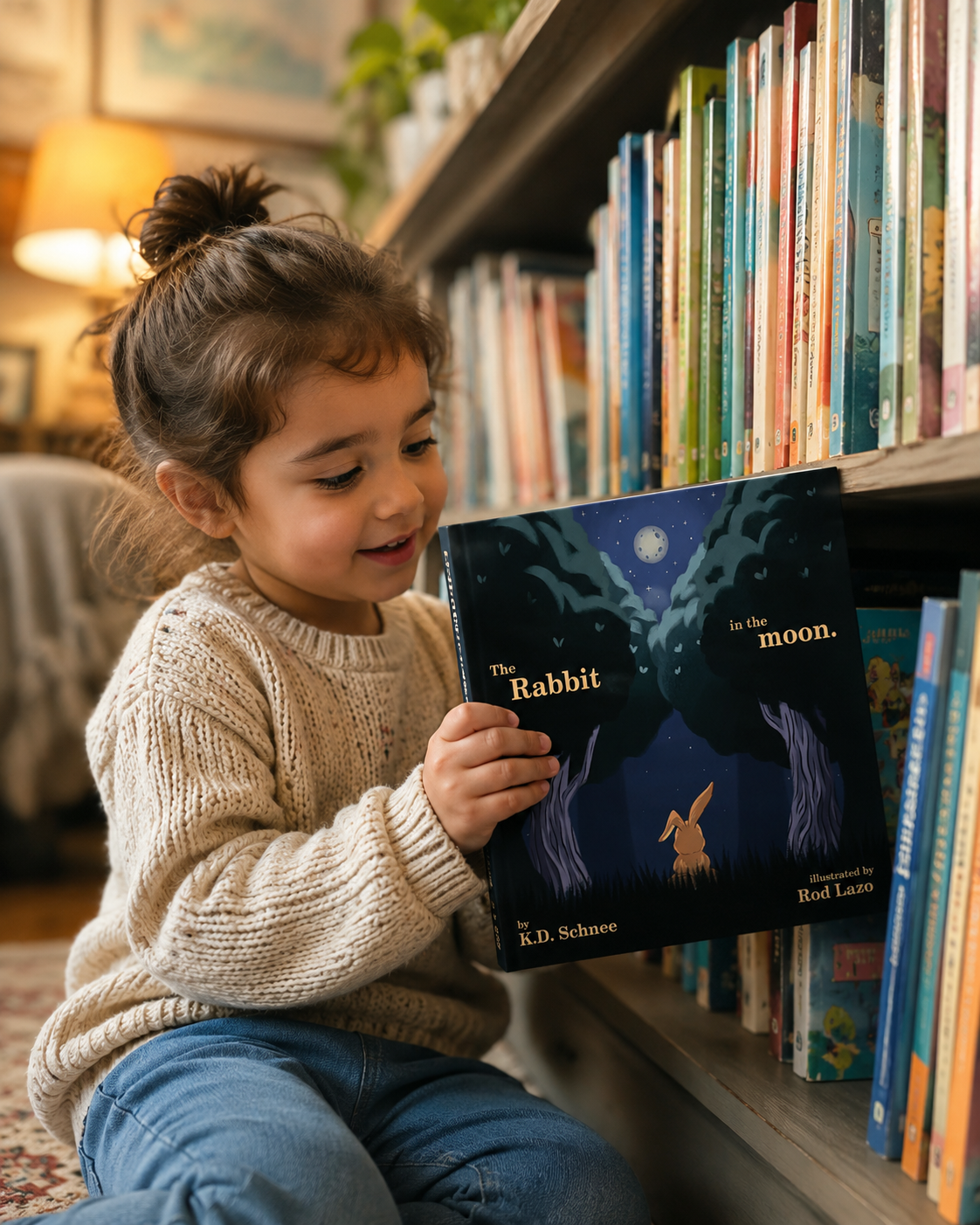
The right illustrated book does not just look beautiful on a shelf. It makes a child want to enter the story.
The best illustrated children’s books are the ones your child wants to look at, talk about, return to, and read again.
That is the answer I would give parents first.
A good illustrated book for children ages 3 to 8 should have more than pretty pictures. It should have artwork that invites attention, a character your child can care about, language that feels good when read aloud, and enough emotional meaning for the story to matter after the book closes.
Children usually do not choose books the way adults do. They may be pulled in by a face, a color, a moon, a funny animal, a strange detail in the corner, or a character who seems to feel something they recognize.
That first pull matters. If a child does not want to enter the book, the lesson inside it never gets a chance to do its quiet work.
Why do some illustrated children’s books get read again and others get ignored?
Some books get read again because they give the child a reason to come back.
That reason might be funny. It might be emotional. It might be visual. It might be the rhythm of the words, the comfort of the ending, the character’s expression, or the small mystery of a page the child wants to study again. Children return to books that give them something to notice, feel, repeat, or claim as their own.
Other books may look beautiful at first glance but never become part of the child’s reading life. Sometimes the art is decorative but not meaningful. Sometimes the story is too thin. Sometimes the language is awkward to read aloud. Sometimes the book teaches a lesson so loudly that the child feels managed instead of invited.
A book your child will actually read usually has a small spark inside it. The child wants to know what happens. They want to point to something. They want the voice again. They want the page turn. They want to revisit the feeling without having to explain why.
That is what parents should look for. Not just beauty. Return.
What makes an illustrated children’s book inviting?
An inviting illustrated children’s book gives the child an easy doorway into the story.
That doorway might be a character with a clear feeling, a warm setting, a funny visual detail, a strong first page, or an illustration that makes the child pause. Children often decide very quickly whether a book feels interesting to them. The cover, color, character, and first few pages all matter because they tell the child, “There is something here for you.”
For children ages 3 to 8, the best illustrated books often give both immediate pleasure and deeper meaning. A younger child may love the animal, the moon, the colors, or the repeated phrase. An older child may start to understand the emotional arc, the courage, the mistake, the friendship, or the fear underneath the story.
That layered quality is important. It lets the book grow with the child instead of being outgrown after three bedtime rounds and one juice spill.
A good test is simple: when you open the book, does your child lean in? That lean may be small, but it tells you something. The book has begun to work.
Should parents choose by reading level or interest?
Parents should consider reading level, but interest is often what gets the book opened.
Reading level matters more when a child is reading independently. For read-aloud picture books, a child can often enjoy language, ideas, and emotional themes that are richer than what they could decode alone. That is one reason illustrated books remain valuable even after a child starts learning to read.
Interest is the hook. Reading level is the fit. Emotional relevance is what makes the book stay.
A child who loves animals may enter a story through a rabbit, snail, owl, bat, or wolf. A child who worries may enter through a character who hesitates. A child who loves visual detail may enter through a moonlit forest or a page full of hidden clues. A child who resists books may need a cover that feels less like homework and more like an invitation.
For hesitant or reluctant readers, I would not begin with the question, “Is this book impressive?” I would begin with, “Will my child want to come closer?” That is the first victory.
How do illustrations help children want to read?
Illustrations help children want to read because pictures give them something to understand before the words are fully in charge.
A child may not be ready to read the sentence, but they can read a face. They can read a shadow. They can read closeness, distance, color, movement, and surprise. They can notice when a character looks worried, proud, unsure, silly, brave, or alone.
This gives children confidence. They are not passive while the adult reads. They are reading too, just in a different language. The picture lets them participate before they can decode every word.
That matters for children who are still building literacy skills. It also matters for children who are anxious, hesitant, or perfectionistic. A child who feels pressure around reading may relax when the book gives them many ways in: look, point, predict, laugh, ask, notice, remember.
The artwork should not simply decorate the text. It should help carry the story.
That is why illustrated books can be so powerful. They let a child feel smart inside the book before they are technically fluent.
What should parents notice in the artwork?
Parents should notice whether the artwork creates curiosity, emotion, and movement.
Does the cover make the child want to pick it up? Do the characters have expressions a child can read? Do the illustrations help explain what is happening? Are there details to revisit? Do the colors support the feeling of the story? Does the art make the child ask questions?
The best illustrations do more than look polished. They help a child understand the story’s emotional weather. A warm page may feel safe. A darker page may feel uncertain. A character standing alone may feel hesitant. A character staying close may feel supportive.
In The Rabbit in the Moon, the illustrations were designed to help children read feeling before they have perfect words for it. The colors, shadows, expressions, and moonlit setting help show Yabbit’s hesitation and Snail’s steadiness. The art gives children a way to notice the feeling before they are asked to name it.
For a deeper look at how illustrations help children understand feelings, read: https://www.yabbitrabbit.com/parent-resources/rabbit-in-the-moon-illustrations-help-children-read-feelings
That is the kind of artwork I trust: beautiful enough to invite the child in, meaningful enough to help them stay.
How can you tell if a book is too busy?
A book may be too busy if your child cannot find the story inside the page.
Some children love visual abundance. They enjoy looking for hidden objects, following tiny side characters, and discovering new details every time. Other children feel overwhelmed when every page is crowded with color, motion, jokes, labels, and visual noise.
The question is not whether busy art is good or bad. The question is whether it helps your child enter the story.
If your child flips pages quickly, seems restless, or cannot tell where to look, the book may be too visually loud for this moment. If your child keeps pointing, laughing, searching, or returning to the same spread, the detail may be working.
For anxious or hesitant children, visual clarity can be especially helpful. They may need artwork that gives them a steady emotional path. Too much clutter can make the book feel like another task to manage.
I usually look for illustrations that have both richness and rest. The page should invite attention without grabbing the child by the collar.
A good picture book knows where to let the eye land.
What makes a child want to reread a book?
Children reread books because repetition gives them comfort, mastery, and pleasure.
Adults sometimes think rereading means the child is stuck. Usually, it means the child is working. They are learning the rhythm. They are remembering the page turns. They are predicting what comes next. They are practicing language. They are returning to an emotional moment that still matters to them.
A book with high reread value often has memorable language, expressive illustrations, a character worth caring about, and one central idea the child can hold. The story does not need to be complicated. It needs to feel alive each time it is read.
This is especially true for children who are cautious. A familiar book lets them enter without fear of surprise. They know the path, which makes the experience feel safer. Over time, that safety can let them notice more.
The first time, they may love the moon.
The fifth time, they may notice Yabbit’s face.
The tenth time, they may say, “He was brave.”
That is why rereading matters.
How do you choose books for a child who says they do not like reading?
For a child who says they do not like reading, choose books that lower pressure and raise curiosity.
Do not start with the book you think they should appreciate. Start with the book that gives them a reason to care. That may mean humor, animals, adventure, visual surprise, a familiar worry, a beautiful cover, a favorite subject, or a character who feels like them.
A child who resists reading may not dislike stories. They may dislike being corrected. They may dislike sitting still. They may dislike books that feel too hard, too slow, too babyish, or too obviously educational. They may also have learned that reading is where adults measure them.
An illustrated book can soften that.
Instead of saying, “Read this,” try, “Look at this page with me.” Instead of asking the child to perform, ask what they notice. Instead of pushing a full book, begin with one spread.
The goal is to rebuild the child’s sense that books are places to enter, not tests to pass. A parent script might be:
“Let’s just look at the pictures first.”
That sentence can open a locked little gate.
What role does the cover play?
The cover matters because it is the first invitation.
Adults may say not to judge a book by its cover, but children absolutely do, and honestly, so do most adults in bookstores when nobody is watching. The cover tells the child what kind of world is waiting. Is it funny? Soft? Magical? Loud? Calm? Strange? Safe? Beautiful? Silly? Brave?
A strong cover should make the child curious. It should give them a character, mood, or question. It should not need to explain everything, but it should offer enough for a child to want to open the book.
For children ages 3 to 8, the cover often becomes part of the memory. They recognize it from across the room. They find it on the shelf. They point to it in a bookstore. They ask for it at bedtime because the cover has become a little doorway.
That is one reason the real cover of The Rabbit in the Moon matters in your child’s hands. The moon, Yabbit, the dark trees, and the nighttime world create a clear emotional promise. This is a story about something quiet, big, and brave.
That promise should be visible before page one.
How important is read-aloud language?
Read-aloud language is one of the most important parts of choosing an illustrated children’s book.
A book may look wonderful, but if the language is clunky in the mouth, the child feels it. Read-aloud books need rhythm, clarity, and movement. They do not all need to rhyme, but they should sound intentional when spoken.
Children often remember the music of a book before they remember the meaning. They remember a repeated phrase, a funny sentence, a soft ending, or the way a parent’s voice changes at a certain moment. That sound becomes part of the attachment.
This is why I care about language in picture books. The words should not merely label what the pictures already show. They should work with the illustrations, leaving room for the child to notice and feel.
A good test is to read one page out loud before buying. If you stumble constantly, feel bored by the sentence, or cannot imagine wanting to read it ten times, your child may feel that too.
A picture book has to live in the room. Not just on the page.
How do you choose illustrated books for ages 3 to 8?
Choose by stage, not just age.
A three-year-old may need strong visual clarity, repetition, animals, warmth, and emotional simplicity. A four- or five-year-old may enjoy richer story patterns, bigger feelings, humor, and questions. A six- to eight-year-old may still love picture books, but they may need more layered themes, more interesting language, and stories that respect their growing inner life.
Do not retire illustrated books too early.
Many adults rush children away from picture books once they can read simple text independently. That is a mistake. Early readers are useful for decoding practice, but picture books do a different job. They can carry more complex feelings, more beautiful language, and more visual meaning than a child may be ready to read alone.
An illustrated book can meet a child’s emotional age and reading age at the same time.
For children who hesitate, worry, or resist new things, picture books can be especially useful because they do not demand that the child explain everything first. They offer story, color, character, and closeness before analysis.
That is often the right order.
How can parents choose books in a bookstore or library?
In a bookstore or library, give your child a small amount of choice.
Too many options can overwhelm a young child. Too few options can make the book feel assigned. I would choose three or four books that fit your values, then let your child have a real opinion.
You might say:
“Which cover makes you want to open it?”
“Which character do you want to know more about?”
“Which page do you want to look at again?”
“Does this feel like a bedtime book, a funny book, or a brave book?”
That last question is helpful because it teaches children that books can do different jobs. Some books are for laughter. Some are for comfort. Some are for courage. Some are for learning. Some are for a hard feeling that needs a softer place to land.
If your child chooses a book you do not understand, be curious before saying no. Children often choose books for reasons adults miss. A small illustration, a familiar fear, a color, a funny animal, or a tiny detail may be doing the inviting.
Follow the thread when you can.
What should parents avoid when choosing books?
Avoid choosing only books that teach an obvious lesson.
Children need meaningful books, but they also need books that feel like stories. If every book is designed to improve them, reading can begin to feel like another adult agenda with a laminated smile.
A good illustrated book may teach courage, kindness, persistence, empathy, emotional language, or resilience, but the story should come first. The child should care about the character before being asked to absorb the message.
Also avoid buying only what is popular. Popular books can be wonderful, but your child is not an algorithm. The right book for your child may be quieter, stranger, gentler, funnier, or more emotionally specific than the title everyone is sharing.
Avoid judging the book only by page count too. A picture book’s value is not measured by how many pages you can get through before bedtime. Its value is in how often your child returns, what language the family borrows, and whether the book helps with real moments.
The best books are not always the loudest books.
Sometimes the right book is the one that waits patiently on the shelf until your child is ready.
How do illustrated books help hesitant children?
Illustrated books help hesitant children because they make feelings visible without putting the child on trial.
A hesitant child may not say, “I am afraid to start because I might fail.” They may say, “I don’t want to.” They may freeze, stall, avoid, or get upset over something that looks unrelated. The feeling is real, but the language has not arrived yet.
An illustrated story gives that feeling a face.
The child can look at Yabbit and see a character who pauses before something big. They can look at Snail and see steady support. They can look at the moonlit path and understand that the journey feels uncertain. None of that requires the child to explain themselves perfectly.
This is why a book like The Rabbit in the Moon can help beyond bedtime. It gives families a phrase for the moment before beginning:
“This feels like a Yabbit moment.”
“What is one tiny brave hop?”
Those words do not shame the child. They make the start smaller. That is exactly what hesitant children often need.
How do you know if an illustrated book is worth buying?
An illustrated book is worth buying when it gives your child something they will use, not only something they will view once.
That use may be emotional, relational, imaginative, or practical. The book may become part of bedtime. It may become the story your child asks for after a hard day. It may give your family a phrase you use before school, a new activity, a doctor visit, or a moment of fear.
Look for books that have reread value, emotional clarity, strong illustrations, good read-aloud language, and a character your child can remember. A book does not have to be perfect in every category, but it should be strong enough in at least one area to earn its place on the shelf.
For a fuller parent guide to value, craft, and rereadability, read: https://www.yabbitrabbit.com/parent-resources/what-makes-picture-book-worth-buying
That question matters because families are not just buying paper. They are buying shared time, language, comfort, imagination, and sometimes one small tool for a real child’s real feeling.
When a book does that, it is more than decoration. It is part of the family’s story kit.
What is a simple checklist for choosing illustrated children’s books?
Before buying or borrowing an illustrated children’s book, ask a few practical questions.
Does my child want to open it?
Is there a character my child can care about?
Do the illustrations help tell the story?
Does the language sound good when read aloud?
Is there something worth noticing again?
Does the book match my child’s age, stage, attention, and feelings?
Does it give us something useful, such as laughter, comfort, courage, curiosity, or language?
You do not need every book to answer yes to every question. Some books are silly and temporary, and that is fine. Childhood needs little nonsense lanterns too. But when you are choosing books to keep, gift, or return to often, the checklist helps.
The strongest illustrated books do not only impress adults. They invite children. That is the point.
Why The Rabbit in the Moon was created as an illustrated book children can return to
The Rabbit in the Moon was created as an illustrated story because Yabbit’s journey needed to be felt, not just explained.
A child can be told that courage means trying even when something feels hard. But a child may understand it more deeply when they see Yabbit pause under the moon, feel the night grow around him, notice Snail still moving, and watch the journey continue one small step at a time.
That is the kind of story I believe children return to. Not because it lectures them. Because it gives them an image they can carry.
For a young child, The Rabbit in the Moon may be a bedtime story with animals, rhythm, color, and moonlight. For an older child, it may become a story about hesitation, support, persistence, and the brave moment before trying. For a parent or teacher, it becomes language: one tiny brave hop.
That is what a good illustrated children’s book can do. It meets the child first through beauty. Then it stays because the feeling is true.
Buy the Book
If you are looking for an illustrated children’s book your child will want to read, reread, and remember, The Rabbit in the Moon belongs on your shelf.
Yabbit gives children a character who hesitates without being shamed. Snail brings steadiness, persistence, and quiet support. The illustrations use color, expression, atmosphere, and moonlit emotion to help children understand that courage does not have to arrive all at once. It can begin with one tiny brave hop.
For parents, grandparents, teachers, counselors, and caregivers, The Rabbit in the Moon offers more than a beautiful read-aloud. It gives children language for fear, hesitation, support, persistence, and brave little beginnings.
It is a meaningful investment in your child’s emotional growth and a story families can return to when the next step feels too big.
External Resource
For a broader literacy perspective on choosing books, reading motivation, and helping children connect with stories, Reading Rockets offers helpful parent and teacher resources here: https://www.readingrockets.org/books-and-authors/choosing-and-using-kids-books
FAQs
How do I choose illustrated children’s books my child will actually read?
Choose illustrated children’s books that match your child’s interests, age, emotional stage, and attention span. Look for inviting artwork, a memorable character, strong read-aloud language, and a story your child wants to revisit.
What makes an illustrated children’s book engaging?
An engaging illustrated children’s book gives children something to notice, feel, predict, or talk about. Strong illustrations should help tell the story, not simply decorate the page.
Are illustrated books good for reluctant readers?
Yes. Illustrated books can help reluctant readers because pictures lower pressure and give children another way into the story. A child can look, point, notice, predict, and connect before reading every word independently.
Should I let my child choose their own books?
Yes, within a thoughtful set of options. Children are more likely to engage with books that connect to their interests, curiosity, humor, feelings, or favorite characters. Parent guidance still matters, but real choice helps.
How do illustrations help children understand a story?
Illustrations help children understand character, setting, emotion, action, and meaning. Children can often read facial expressions, color, body language, and visual details before they can explain the full feeling in words.
Is The Rabbit in the Moon a good illustrated book for hesitant children?
Yes. The Rabbit in the Moon is a strong illustrated book for hesitant children because Yabbit gives hesitation a face, Snail shows steady support, and the story helps children understand courage as one tiny brave hop forward.
What age is best for illustrated picture books?
Illustrated picture books are especially powerful for children ages 3 to 8, but they can remain useful beyond that. Younger children may love the art and rhythm, while older children can understand deeper emotional themes, character choices, and story meaning.