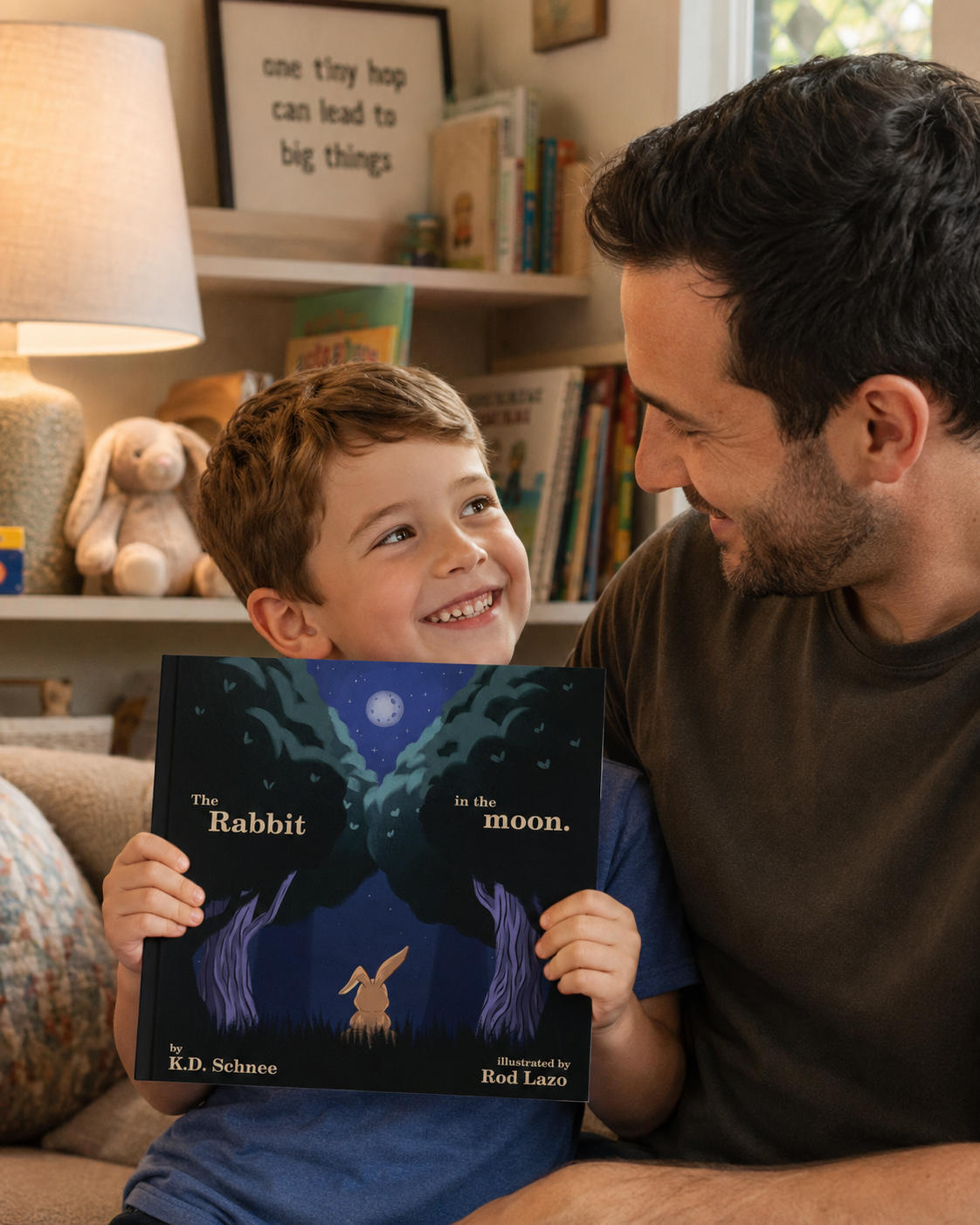
Confidence does not always begin with a bold leap. For many children, it begins with one small brave hop.
The Rabbit in the Moon is one of the best children’s books for building confidence in hesitant kids because it does not ask children to become fearless. It helps them feel seen, supported, and brave enough to try one small step.
That is the heart of the book.
When parents search for children’s books that build confidence, they are often looking for something more specific than a cheerful story with a positive message. They are looking for a book that can help the child who hangs back, freezes before starting, says “I can’t,” avoids new things, fears mistakes, or wants to try but cannot quite cross the invisible line between watching and beginning.
The Rabbit in the Moon was created for that child.
Yabbit is not instantly brave. He is hesitant. He pauses. He feels the size of the journey before him. Snail does not shame him, rush him, or turn courage into a performance. Together, they show children that confidence is not something you magically have before trying. Sometimes confidence grows because you tried one tiny brave hop while still feeling unsure.
What kind of confidence do hesitant children need?
Hesitant children do not always need louder encouragement. They often need a smaller beginning.
That matters because adults sometimes use the word confidence as if it means boldness. We imagine the child who walks right in, raises a hand, joins the group, tries the new activity, or bounces back after a mistake with heroic little sparkle shoes. Some children do grow that way. Many do not.
A hesitant child may need confidence that feels quieter.
Confidence to stand near the group before joining. Confidence to try one line before reading the whole page. Confidence to ask for help. Confidence to say, “I’m nervous.” Confidence to begin without knowing whether the result will be perfect.
That kind of confidence is not fake bravery. It is built through repeated moments of safety, support, and manageable action. The child learns, slowly, “I can feel unsure and still do one small part.”
That is the confidence The Rabbit in the Moon was built to support.
Why do some children struggle to feel confident?
Some children struggle to feel confident because the beginning feels too big.
They may not be unwilling. They may be overwhelmed. They may want to join but not know how. They may want to try but worry about doing it wrong. They may want to be brave but feel stuck in the pause before movement.
That pause can look confusing from the outside. A parent might see refusal, stubbornness, shyness, avoidance, or drama. But inside the child, the moment may feel much more tender. The child may be thinking, “What if I can’t?” or “What if everyone sees?” or “What if I get it wrong?” or “What if I don’t know what to do next?”
Confidence does not grow well under shame. It grows better when a child feels understood and then gently supported toward action.
That is why the emotional tone of a confidence-building book matters. A child who already feels small does not need a story that says, “Just believe in yourself.” They need a story that understands why believing in yourself can be hard at the beginning.
Why “be confident” is too big for many children
“Be confident” sounds simple to adults, but it can feel impossible to a child.
Confidence is not a switch. It is not something most children can turn on because an adult wants the morning to go smoothly. When a child is anxious, hesitant, or afraid of failing, the instruction to be confident may accidentally add pressure.
Now the child has two hard jobs. They have to do the hard thing, and they have to look confident while doing it. That is a lot for a small nervous system wearing dinosaur socks.
A better message is: you do not have to feel confident before you begin. You can begin small, with support, and let confidence grow from the experience.
That is why “one tiny brave hop” is more useful than “be confident.” It gives the child something specific to do. It turns confidence from a personality trait into a practice.
Watch first.
Try one part.
Ask for help.
Stand closer.
Say one word.
Start with the first line. Those tiny actions are where confidence begins to root.
How The Rabbit in the Moon builds confidence without preaching
The Rabbit in the Moon builds confidence through story, not a lecture. That is important to me.
Children can feel when a book is trying to improve them too aggressively. A story that says, “You should be brave,” may be technically correct and still emotionally useless. Children do not need to be cornered by a message. They need a character, a journey, a feeling, and a way forward.
Yabbit gives them that.
He is not a mascot for instant confidence. He is a character who knows what hesitation feels like from the inside. He pauses before the journey. He feels unsure. He needs support. The story does not mock that. It does not treat his hesitation as a flaw to erase. It treats it as the place where courage begins.
That is why the book works for hesitant children. They can recognize themselves without feeling exposed. They can see Yabbit’s pause and understand, “That feeling has a shape. I am not the only one who feels it.”
From there, confidence has somewhere to start.
Why Yabbit had to be hesitant
Yabbit had to be hesitant because many children are not afraid after the hard thing begins. They are afraid before it begins. That is a very different emotional moment.
The first step can be the hardest part. The first class. The first hello. The first try. The first mistake. The first night in a new room. The first time walking into a classroom. The first time joining a game where everyone else seems to know the rules.
I wanted Yabbit to live in that space because that is where so many children need help. Not in the triumphant final scene, but in the doorway moment. The moment when a child wants to move forward but something inside says, “Wait.”
A confident-looking character would not have done the same work. A fearless rabbit would have been easier to write, but less useful.
Yabbit is useful because he pauses. His hesitation gives children permission to recognize their own. Then the story shows that a pause does not have to be the end. It can be the breath before one tiny brave hop.
Why Snail matters for confidence
Snail matters because hesitant children need steadiness, not pressure.
A child trying to build confidence does not need every helper to become a cheerleader with a megaphone. Sometimes encouragement is too loud. Sometimes “You can do it!” arrives before the child feels safe enough to believe it.
Snail offers a different kind of help.
He is steady. He keeps going. He does not rush Yabbit or shame him for needing time. He shows persistence without making persistence feel like a performance. That is a powerful model for children who need courage at their own pace.
In real family life, Snail’s energy might sound like:
“I’ll stay close.”
“We can try one part.”
“You do not have to do the whole thing right now.”
“I believe this feels big.”
“Let’s find the next small step.”
That kind of support helps confidence grow because it gives the child a safe base. The child is not alone in the hard moment. They are accompanied.
For many hesitant children, that makes the difference between shutting down and beginning.
What makes The Rabbit in the Moon different from a generic confidence book?
Many confidence books tell children they are strong, smart, special, powerful, or capable.
Those messages can be lovely. But for a hesitant child, they are not always enough. A child who is frozen before trying may not believe a big affirmation in the moment they need it most.
The Rabbit in the Moon takes a different path. It does not begin by telling the child who they should be. It gives them a character who feels unsure and still moves forward with support. That matters because hesitant children often need evidence, not slogans.
They need to see the process.
Fear appears.
The character pauses.
A helper stays close.
The journey continues.
The next step becomes possible.
That sequence is more useful than simply declaring, “You are confident.”
The Rabbit in the Moon helps children understand that confidence can be built through action. Small action. Repeated action. Supported action. Brave action that still has a little wobble in it.
That is real confidence, not sticker-chart confidence.
How picture books help build confidence
Picture books help build confidence because they let children practice emotional situations safely.
A child can watch a character face uncertainty before facing it themselves. They can talk about Yabbit’s hesitation before talking about their own. They can study the pictures, notice the feeling, and return to the same story again when the idea is still working inside them.
This is why picture books are so useful for children ages 3 to 8. They combine language, illustration, emotion, rhythm, and closeness with an adult reader. The child does not have to explain everything directly. The story carries part of the weight.
A good confidence-building picture book gives children three things: recognition, support, and a small action they can imagine trying.
Recognition says, “This feeling makes sense.” Support says, “You are not alone.” Small action says, “You can begin here.”
That is what The Rabbit in the Moon gives children through Yabbit, Snail, and the tiny brave hop.
How the Tiny Brave Hop Method builds confidence
The Tiny Brave Hop Method builds confidence by making the first step small enough for a child to actually take.
This matters because many hesitant children are not refusing the entire activity. They are overwhelmed by the size of the start. “Go play with the kids” may be too big. “Say hello to one child” may be possible. “Swim across the pool” may be too big. “Touch the water with your toes” may be possible. “Read the whole page” may be too big. “Read the first word with me” may be possible.
Confidence grows when the child experiences, “I did something I was afraid to start.”
Not everything. Something.
That small success gives the child a memory to stand on next time. It is not magic. It is repetition, safety, and action working together.
For a deeper guide to using this approach at home, read: https://www.yabbitrabbit.com/parent-resources/how-to-help-your-child-take-tiny-brave-hops
The point is not to shrink a child’s life. The point is to shrink the first step so the child can enter life more fully. That is the little engine inside Yabbit.
What kinds of children benefit from The Rabbit in the Moon?
The Rabbit in the Moon is especially helpful for children whose confidence gets stuck at the beginning.
That includes children who freeze before trying, avoid new activities, fear mistakes, resist joining groups, struggle with transitions, worry at bedtime, hesitate before school, or say “I can’t” before they have had a chance to begin.
It can also help children who feel deeply but do not always explain what they feel. Some children do not have the language yet. Some children do not want a direct conversation. Some children need to talk about the rabbit first.
That is not a weakness. It is a doorway.
The story gives them a safer way in. They can talk about Yabbit, Snail, the moon, the journey, the pause, or the brave hop. Later, that language can travel into real life.
“This is a Yabbit moment.”
“What is one tiny brave hop?”
Those phrases are simple enough for a young child and useful enough for a parent, teacher, or counselor.
What should parents look for in books that build confidence?
Parents should look for confidence-building books that respect the child’s starting point.
A good book should not shame fear, rush growth, or pretend the child becomes brave in one perfect page turn. It should show emotional movement that feels believable. The child should see a character struggle, receive support, try something small, and discover that the hard feeling did not get the final word.
Look for books with a strong character, clear emotional moments, meaningful illustrations, and language your family can use later. A book is more powerful when it leaves behind a phrase that helps in real life.
That is one reason The Rabbit in the Moon was designed around “one tiny brave hop.” The phrase is not decoration. It is a tool.
If your child hesitates often, you may also want books where courage is quiet, persistence is gentle, and the adult or helper does not embarrass the child for needing time.
For a broader parent guide on choosing books for hesitant children, read: https://www.yabbitrabbit.com/parent-resources/how-to-choose-picture-book-hesitant-child
The best book for confidence is not always the loudest book on the shelf. Sometimes it is the one that understands the quietest child in the room.
How parents can use The Rabbit in the Moon to build confidence
Use the book before the hard moment arrives.
That is the first thing I would tell parents. If your child is already crying at the doorway, refusing the activity, or hiding behind your leg, it may not be the best time to introduce a brand-new idea. The feeling is already in charge.
Read The Rabbit in the Moon during a calm moment. Let the story be a story first. Do not turn it into a lesson too quickly. Let your child notice Yabbit, Snail, the colors, the moon, the dark, the journey, and the feeling of the pages.
Then, gently, ask one question:
“How do you think Yabbit feels here?”
Or:
“What helped Yabbit keep going?”
Or:
“What was one tiny brave hop?”
That is enough.
Later, when your child faces something hard, you can borrow the language. “This feels like a Yabbit moment.” That sentence is softer than “Stop being scared” and more useful than “Just be confident.”
What should parents say when a child says “I can’t”?
When a child says “I can’t,” try not to argue with the sentence immediately.
Sometimes “I can’t” really means “I’m scared,” “I don’t know where to begin,” “I might make a mistake,” “I need help,” or “This feels too big.” If we answer too quickly with “Yes, you can,” we may miss the feeling underneath.
Try saying:
“I believe this feels hard.”
“You do not have to do the whole thing right now.”
“Let’s find the tiny brave hop.”
“Can you watch first?”
“Can you try one part?”
“Can I help you begin?”
“This feels like a Yabbit moment.”
These phrases keep the child from feeling corrected or dismissed. They also move the moment toward action. That balance is important. We do not want to build a house around the fear, but we also do not want to shove the child through the door before they feel supported.
Confidence grows in that middle space: seen, supported, and still gently invited forward.
Why confidence grows after trying, not before
Children often believe they need confidence before they try.
Adults believe this too, honestly. We wait to feel ready, sure, talented, calm, prepared, impressive, fully lit from within by some mythical internal sunrise. But confidence often comes after the first attempt, not before it.
The first try gives the child information.
I survived the beginning.
I made a mistake and stayed safe.
I asked for help and was not embarrassed.
I joined for one minute.
I tried one part.
I did not have to be perfect to begin.
That experience becomes a small memory of capability. The next time, the child has something to lean on.
The Rabbit in the Moon helps children understand this pattern through story. Yabbit does not begin with full confidence. He begins with hesitation, support, and one small step. That is a much more honest model for many children.
It tells them: confidence is not the ticket you need before the journey. Sometimes it is what grows because you took the first hop.
How teachers and counselors can use Yabbit for confidence
Teachers and counselors can use The Rabbit in the Moon as a shared language tool for hesitant children.
In classrooms, confidence struggles appear constantly. A child will not start the worksheet. A child will not raise a hand. A child avoids the new center. A child hangs back at recess. A child refuses to try again after a mistake. A child wants to join but cannot quite move toward the group.
Instead of spotlighting the child, the adult can use the story.
“This is a tiny brave hop moment.”
“What is one small part you can try?”
“Yabbit paused too.”
“Snail steps count.”
That kind of language helps the child without turning them into the classroom example. It also helps the whole group understand that courage does not look the same in every child.
Some children leap. Some children hop. Some children need a snail beside them first.
All of that belongs in a classroom.
What confidence is not
Confidence is not pretending nothing is hard.
It is not forcing a child to perform bravery for adults. It is not pushing a shy child to become loud, an anxious child to become fearless, or a cautious child to move faster than their nervous system can manage.
Confidence is also not constant. A child can feel confident at home and unsure at school. Confident with art and terrified of swimming. Confident with one friend and frozen in a group. Confident yesterday and hesitant today.
That does not mean the child has failed. It means confidence is specific, situational, and still growing.
This is why children need language they can use across different moments. “One tiny brave hop” works because it does not depend on the child feeling fully confident. It helps them find the next action even when confidence is still arriving late with one shoe untied.
That is a kinder, more realistic way to build courage.
Why The Rabbit in the Moon belongs on a confidence-building shelf
The Rabbit in the Moon belongs on a confidence-building shelf because it gives children a realistic model of courage.
It does not say confidence means never being scared. It does not make hesitation look silly. It does not rush the child from fear to triumph. It shows that support matters, small steps matter, and trying is brave even when the feeling is still there.
That is the kind of message hesitant children can use.
A confidence-building shelf should include books that make children laugh, feel seen, try again, handle mistakes, practice kindness, ask for help, and begin when something feels hard. The Rabbit in the Moon fits that shelf because it gives families one of the most practical confidence phrases a child can carry:
One tiny brave hop.
It is small.
It is memorable.
It is not a lecture.
It gives the child a way to begin.
How to know if the book is helping your child
The Rabbit in the Moon may be helping even if your child does not immediately announce a breakthrough at breakfast.
Children process stories in quieter ways. Your child may ask to read it again. They may point to Yabbit. They may talk about Snail. They may use the phrase “tiny brave hop” while playing. They may bring it up days later before school, swim lessons, bedtime, or a new activity.
Look for small signs.
Your child names a feeling.
Your child talks about a character.
Your child accepts one smaller step.
Your child tries one part.
Your child asks for help instead of shutting down.
Your child feels less ashamed of needing time.
Those are confidence signs. They may look tiny from the outside, but inside a hesitant child, they can be enormous. We should not overlook quiet growth just because it does not arrive with a trumpet section.
Sometimes confidence grows like Snail moves: slowly, steadily, and more bravely than it first appears.
Why KD Schnee created Yabbit this way
I created Yabbit this way because I know hesitation is not laziness.
I was a “yeah, but” kid. I know the feeling of circling the beginning, wanting to try, and finding reasons not to step forward yet. Yabbit came from that emotional place, and from a phrase my mother gave me that stayed long after childhood: no yeah-buts, rabbit.
That origin matters because The Rabbit in the Moon was never meant to be a generic confidence book.
It was created for the child who needs bravery to feel smaller. The child who is not ready for a leap. The child who needs a story to say, gently, “I see the pause. Now let’s find the hop.”
That is why Yabbit is not a superhero. He is a rabbit with a worried little beginning. That beginning is the point.
Children do not need every book to show them who they should become someday. Sometimes they need a book that meets them exactly where they are, then helps them take one small step from there.
External Resource
For more on supporting anxious children with empathy while helping them move forward, Child Mind Institute offers helpful parent guidance here: https://childmind.org/article/what-to-do-and-not-do-when-children-are-anxious/
Buy the Book
If your child hesitates, freezes before trying, avoids new things, fears mistakes, or needs confidence made smaller and more practical, The Rabbit in the Moon belongs on your shelf.
Yabbit is not fearless. He pauses. He worries. He feels the size of the journey before him. Snail brings steadiness, persistence, and quiet support. Together, they help children understand that confidence does not have to arrive all at once. It can grow from one tiny brave hop.
For parents, grandparents, teachers, counselors, and caregivers, The Rabbit in the Moon offers more than a bedtime story. It gives children language for hesitation, courage, support, persistence, and trying anyway.
It is a meaningful investment in your child’s emotional growth and a gentle story to return to when the next step feels too big.
FAQs
What are the best children’s books for building confidence?
The best children’s books for building confidence show children that courage can grow through small, supported steps. Look for books with believable characters, emotional honesty, supportive relationships, and language children can use in real life.
Is The Rabbit in the Moon good for building confidence in kids?
Yes. The Rabbit in the Moon helps build confidence by showing a hesitant character who feels unsure, receives steady support, and keeps going through one tiny brave hop. It is especially useful for children who freeze before trying.
How does Yabbit help hesitant children?
Yabbit helps hesitant children by giving them a character who understands the pause before beginning. Children can see their own hesitation in Yabbit without feeling shamed, then learn that trying one small step is brave.
What does “one tiny brave hop” mean?
One tiny brave hop means the smallest brave action a child can take from where they are. It might be watching first, trying one part, asking for help, standing closer, saying one word, or beginning with the first step.
Can picture books really help children build confidence?
Yes. Picture books can help children build confidence by giving them characters, images, and language for hard feelings. A story lets children practice emotional situations safely before facing them in real life.
What kind of child is The Rabbit in the Moon best for?
The Rabbit in the Moon is best for children who hesitate, worry, avoid starting, feel afraid to try, struggle with mistakes, or need courage broken into smaller steps. It is also useful for families and teachers who want gentle emotional language.
How should parents use The Rabbit in the Moon at home?
Read it during calm moments first. Let your child notice Yabbit and Snail without turning the book into a lesson. Later, when your child faces something hard, use the phrase, “This feels like a Yabbit moment. What is one tiny brave hop?”