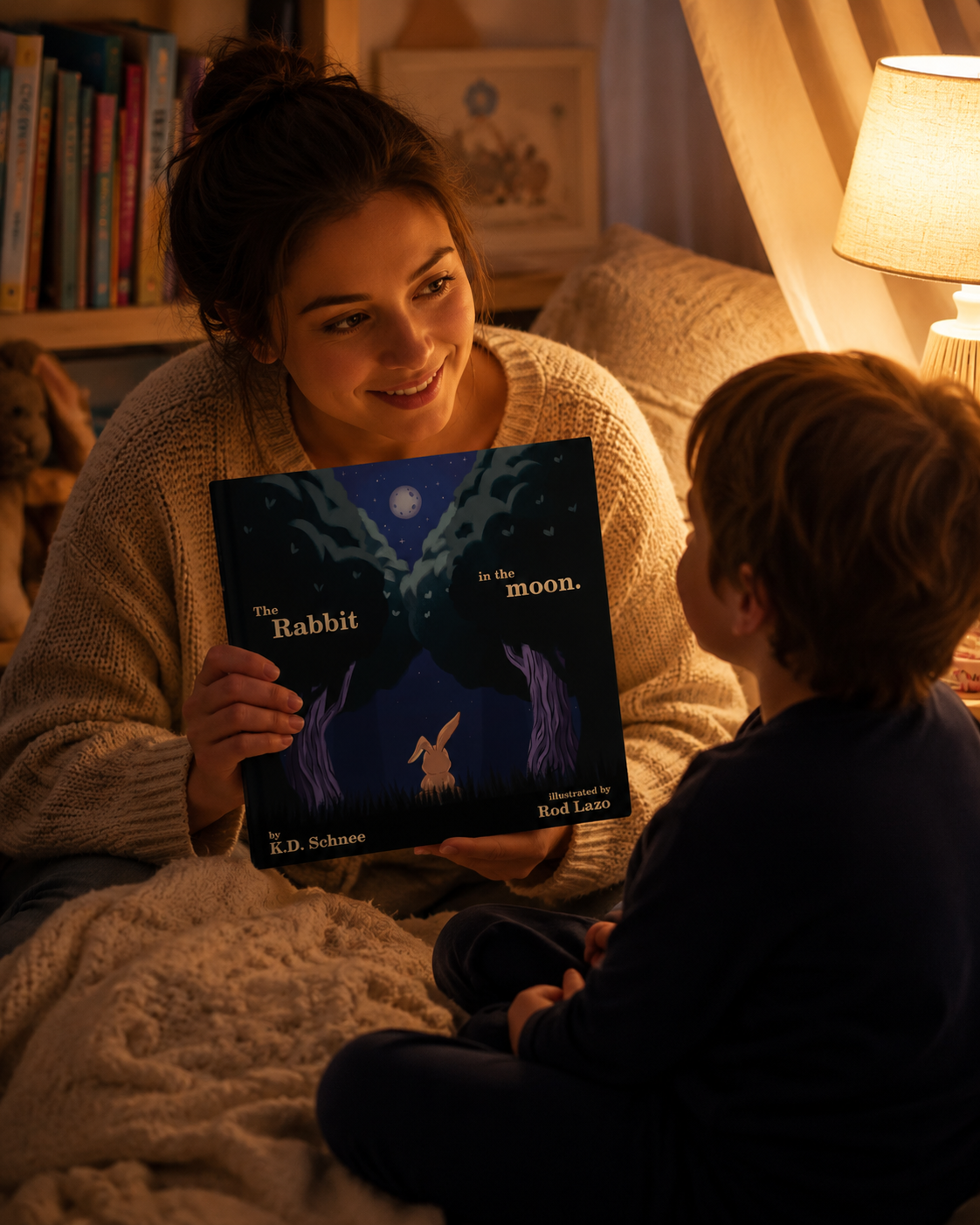
Good reading habits begin when books feel like connection, not another thing a child has to perform.
Good reading habits in kids develop when reading becomes small, repeatable, enjoyable, and connected to family life.
That is the answer I would give parents first. A child does not become a reader because one adult announces, with fresh optimism and a library tote bag, that reading is now important. A child develops a reading habit when books are easy to reach, read aloud often, connected to warm moments, chosen with the child’s interests in mind, and allowed to be reread without apology.
For children ages 3 to 8, reading habits should not begin with pressure. They should begin with rhythm. A story after breakfast. A picture book before bed. A library visit on Saturday. A book in the car. A familiar character waiting beside the pillow. A parent who says, “Let’s just read one page,” and means it.
That is how books become part of the house. Not as decoration. As a living routine.
What does a good reading habit look like for a child?
A good reading habit for a child is not always a child sitting alone in perfect silence with a book open for thirty minutes.
That image is lovely, but it is not the starting point for many children. For young children, a reading habit may look like crawling into a parent’s lap for the same bedtime book again. It may look like pointing to a picture and asking a question. It may look like laughing at one page, memorizing one sentence, carrying a book into the car, or asking to hear a story while still brushing crumbs from their pajamas.
A good reading habit is a relationship with books that feels familiar, safe, and worth returning to.
For some children, the habit begins with read-alouds. For others, it begins with pictures. For a hesitant child, it may begin with a book that helps them feel seen. For a child who resists reading, it may begin with the adult removing the pressure to “read correctly” and returning to the pleasure of story.
The early goal is not to create a tiny scholar in slippers. The goal is to help the child believe books belong to them.
Why do some kids resist reading?
Some children resist reading because reading has started to feel like work, correction, or performance.
That can happen quietly. A child is asked to sound out words before they are ready. They are corrected too often. They are given books that are too hard, too dull, too babyish, or too disconnected from what they care about. They are asked comprehension questions before they have had a chance to enjoy the story. Over time, reading becomes one more place where the child can fail in public.
Other children resist because the habit was never made easy. Books are not visible. Storytime happens only when everyone has leftover energy. The child is allowed to choose from too many options and gets overwhelmed, or from too few options and feels controlled. Screens are instant, loud, and always waiting, while books require a small beginning.
For hesitant children, that beginning can feel surprisingly big. That is why I like to think of reading habits through the Tiny Brave Hop Method. Instead of asking, “How do I get my child to become a reader?” begin smaller: “What is one tiny reading step we can repeat without a fight?”
One page counts.
One poem counts.
One picture walk counts.
One bedtime book counts.
The habit begins where the child can begin.
How often should parents read with children?
Most families do better with a small daily rhythm than with a large, heroic plan that collapses by Thursday.
If you can read together every day, wonderful. If your life is in a season where every day is hard, aim for a rhythm that is predictable enough for your child to trust. The point is not perfection. The point is return.
For many families, bedtime is the easiest anchor because the day already needs a landing place. For others, morning works better. Some children are too tired at night and do better with a book after breakfast, after school, or before a nap. The best reading routine is the one your real family can actually keep.
Start small. Ten minutes can be enough. One book can be enough. A familiar story can be enough. A parent reading while the child wiggles, builds with blocks, or holds a stuffed animal can still count.
Reading habits are not built only in postcard moments with perfect lighting. They are built in ordinary rooms, with tired adults, restless children, and books that somehow keep finding their way back into someone’s hands.
How do you make reading part of family life?
Make books visible, reachable, and normal.
A child is more likely to read when books are not hidden away like formal dishes. Put a few in a basket near the couch. Keep one by the bed. Leave one in the car. Let the cover face out sometimes. Rotate a few books so the shelf feels fresh without becoming a mountain.
Children notice what the home makes easy.
If the remote is always visible and the books are always tucked away, the house has already made a suggestion. That does not mean screens are the villain wearing a cape. It means books need a fair chance to be seen.
You can also build reading into existing family moments. Read while waiting for dinner to finish. Read one page before school. Keep a library book in the backpack. Let a grandparent read over FaceTime. Read after a bath. Read before a doctor visit. Read after a hard day when words are too tangled and a story can do the softer work.
The best family reading routines do not feel like an added chore. They attach themselves to life.
Should children choose their own books?
Yes, children should have some real choice in what they read, but parents can still guide the shelf.
Choice matters because children are more likely to return to books that feel personally interesting. A child may choose a book because of a dragon, a moon, a truck, a joke, a color, a rabbit, a spooky tree, a silly title, or one small illustration an adult barely notices. That choice is not random to the child. It is the doorway they found.
The parent’s job is to make the doorway safe and rich.
Instead of handing your child the entire bookstore, offer three good options. You might say, “Do you want the funny book, the brave book, or the bedtime book?” That gives the child ownership without making them drown in choices.
There will also be times when you choose the book because you know what your child needs. If your child is afraid of the dark, facing a new school routine, worried about a mistake, or hesitating before something hard, you may choose a story that helps with that feeling. The child does not need to control every book choice. But they should feel that reading includes their taste, their curiosity, and their voice.
A child who gets to choose books learns that books are not only assigned. They are discovered.
Why does rereading matter?
Rereading is one of the clearest signs that a book is doing its job.
Adults often want novelty. Children often want return. When a child asks for the same book again, they are not stuck. They are building memory, language, comfort, prediction, rhythm, and mastery. They know what is coming, and that knowing feels good.
For children ages 3 to 8, rereading can be especially powerful. The first reading may be about the pictures. The second may be about the character. The fifth may be about the funny line. The tenth may be when the child finally says, “He was scared,” or “She tried again,” or “That was brave.”
A book becomes part of a child’s inner furniture through repetition.
This is also why a meaningful picture book should have reread value. If a book is only interesting once, it may entertain for a night. If a book keeps offering comfort, laughter, beauty, language, or emotional recognition, it becomes part of the child’s reading life.
Parents do not have to pretend they are thrilled to read the same book forever. We are human beings, not enchanted audiobook machines. But when a child returns to a story, something important is happening. The book has become familiar enough to hold them.
How can parents make reading enjoyable instead of pressured?
Keep reading warm.
That sounds simple, but it is easy to lose. Parents care deeply about their children’s development, and that care can sneak into storytime wearing heavy boots. Suddenly the book becomes a test. What color is that? What do you think will happen? What letter is this? What did the character learn? Can you sound this out? Are you listening?
Those questions can be useful in small doses, but too many can make reading feel like a tiny oral exam with illustrations.
Try letting the story breathe. Read the page. Pause when your child points. Laugh when something is funny. Let them interrupt. Let them ask the question that has nothing to do with your planned educational moment. Follow the child’s attention when you can.
One good question is better than twelve.
You might ask, “What do you notice?” or “How do you think Yabbit feels here?” or “What helped?” Then keep reading. The goal is not to squeeze every drop of instruction from the book. The goal is to let the child experience the story deeply enough that they want to come back.
Enjoyment is not extra. It is the soil the habit grows in.
What if my child only wants silly books?
Let silly books count.
A child who loves silly books is still building a relationship with reading. Humor lowers pressure. It gives children a reason to turn the page. It teaches rhythm, timing, surprise, expression, and shared attention. It also reminds adults that children are not miniature productivity projects.
A strong reading life needs more than one kind of book. It needs funny books, comfort books, bedtime books, courage books, feeling books, fact books, picture books, early readers, poetry, and books that are simply strange in the way childhood often is.
If your child only wants silly books, use that as a beginning. Add one book beside it, not instead of it. You might read the funny book first and the courage book second. Or let your child choose one and you choose one. Over time, the shelf can widen without turning reading into a battle.
The goal is not to make every book serious. The goal is to make books welcome. A child who learns that books can make them laugh is already learning that books have something to offer.
How can picture books build reading habits?
Picture books build reading habits because they invite children through words, pictures, rhythm, emotion, and closeness all at once.
A child does not have to decode every word to participate. They can read the pictures. They can notice a face, point to a shadow, remember a repeated phrase, predict a page turn, or ask why a character looks unsure. This makes picture books especially helpful for children who are still learning to read independently or who feel pressure around reading.
Picture books also give families a shared emotional language. The story does not stay on the page. A child may remember Yabbit when they hesitate. They may remember Snail when they need to keep going. They may remember one tiny brave hop when the beginning feels too large.
That kind of book supports both reading and real life.
For a practical guide to reading picture books in a way that helps the story stay with your child, read: https://www.yabbitrabbit.com/parent-resources/how-to-read-picture-book-with-your-child
A good picture book does more than teach a child to love books. It teaches a child that stories can help.
How do you build a home shelf that supports reading habits?
Build a shelf that gives your child reasons to return.
A home shelf should not be only educational. It should not be only beautiful. It should not be only seasonal. A good child’s shelf has range: books for laughter, bedtime, comfort, courage, feelings, curiosity, family moments, school worries, mistakes, and wonder.
When a child can find the right book for the right moment, reading becomes useful. The shelf starts to feel alive.
A child might reach for one book when they are tired, another when they want to laugh, another when they feel scared, and another when they are curious about the world. That range helps reading become a habit because books are connected to real needs, not only to adult expectations.
Parents and grandparents can support this by buying fewer random books and more purposeful books. Ask, “What job does this book do for the child?” Maybe it helps with bedtime. Maybe it helps with courage. Maybe it builds language. Maybe it becomes the silly favorite that saves a rainy afternoon from turning feral.
For more on building a balanced shelf, read: https://www.yabbitrabbit.com/parent-resources/how-to-build-childrens-book-collection
The habit grows faster when the shelf feels like it belongs to the child’s actual life.
What is a simple reading routine for busy families?
A simple reading routine should be easy enough to keep on ordinary days.
Here is one I like:
One visible book.
One predictable time.
One small choice.
One warm read-aloud.
One gentle connection after.
That might look like this: after pajamas, your child chooses between two books. You read one. You ask one question or make one comment. Then you close the book and say something small, such as, “I liked reading that with you.”
That is enough.
If bedtime is chaotic, move the routine earlier. If your child resists sitting still, let them hold a stuffed animal, lie on the floor, or turn the pages. If the book is too long, read part of it. If everyone is exhausted, read one page and call that the tiny brave hop of the evening.
Consistency does not mean doing the full ceremony every time. It means returning to the pattern often enough that the child trusts it. A reading habit should be sturdy, not brittle. If it breaks every time life gets busy, the routine is too complicated.
How can parents model reading without making it a performance?
Let your child see that reading belongs to adults too.
Children notice what adults actually do. If they never see books, magazines, recipes, newspapers, library bags, audiobooks, or printed words being used with interest, reading may look like something adults require of children but do not enjoy themselves.
Modeling does not have to be dramatic. You do not need to sit in a velvet chair announcing, “Observe me, child, as I engage with literature.” You can simply read your own book nearby. Talk about a story you liked. Look up a recipe. Read a sign. Bring books home from the library. Let your child see you choosing words for pleasure and usefulness.
You can also model rereading. “I loved this book when I was younger,” is a powerful sentence. It tells a child that books can travel through a life. They are not only school objects. They can become memories.
KD Schnee’s own love of story grew from nightly read-alouds and the books that stayed with him. That kind of memory matters. Many adults can still remember the books someone read to them before they could read alone.
A reading habit is often inherited through warmth. Not instruction alone.
What should parents avoid when trying to build reading habits?
Avoid turning every reading moment into a measurement.
There is a time for reading practice, decoding, fluency, school assignments, and skill-building. Those things matter. But if every book becomes a performance space, many children will start avoiding books the way they avoid itchy sweaters and suspicious casseroles.
Try not to punish with reading, bribe too heavily for reading, or make reading feel like the opposite of fun. Be careful with phrases like “You have to read before you can play,” if the tone makes books sound like the vegetable and everything else like dessert. Children are very good at noticing which activities adults frame as medicine.
Also avoid correcting constantly during read-alouds. If the child is reading to you and gets stuck, help gently. If you are reading to the child, let them enjoy being carried by the story. Children need both practice and pleasure, but they are not the same thing.
A home reading habit grows best when books are associated with closeness, curiosity, humor, rest, and meaning. Not pressure with a bookmark.
How can teachers support reading habits at home?
Teachers can support reading habits by making reading feel doable for families.
Not every family has the same schedule, resources, language background, or confidence with books. A teacher who sends home a simple, warm message can make a difference: read anything you can, talk about one picture, let your child choose, reread favorites, and keep it joyful.
Classroom book bags, library days, short book recommendation notes, and read-aloud suggestions can help parents who want to build the habit but do not know where to begin. Teachers can also remind families that picture books still matter even when children start decoding words.
For hesitant children, teachers can suggest books that support courage, feelings, transitions, and trying again. That connects school reading to emotional growth, not just reading logs.
A good teacher message might be: “Your child does not have to read perfectly for the reading habit to grow. Shared reading counts. Looking at pictures counts. Talking about the story counts. Rereading counts.”
That kind of message lowers pressure and gives families a doorway.
How does The Rabbit in the Moon fit a family reading habit?
The Rabbit in the Moon fits a family reading habit because it works as both a bedtime story and a shared emotional tool.
A child may first come to the book for the moon, Yabbit, Snail, the rhythm, the colors, or the closeness of being read to. Over time, the story can become something more. It can give families language for hesitation, fear, support, persistence, and trying anyway.
That is the kind of book that helps a reading habit last.
A family may read The Rabbit in the Moon at bedtime, then borrow its language the next morning before school. A teacher may read it during circle time, then use “tiny brave hop” when a child is afraid to start. A parent may reach for it after a hard day because the child does not need a lecture. They need a story that understands the pause before courage.
When a book becomes useful outside storytime, it earns a deeper place in the routine.
That is what I want Yabbit to do for families. Not simply sit beautifully on a shelf, though I care about beauty too. I want the book to become part of the language families reach for when the next step feels too big.
What if the habit fades?
It will. That is normal.
Families get busy. Children go through phases. Screens get loud. Schedules change. Holidays scramble routines. A child who loved books in March may resist them in April because childhood is a moving target wearing mismatched socks.
Do not treat a fading habit as failure. Treat it as a restart.
Choose one small anchor again. One bedtime book. One library visit. One basket near the couch. One parent-child reading moment after dinner. One story your child used to love. One new book with a cover that pulls them closer.
Reading habits are built by returning.
That is also a good lesson for children. We do not have to do things perfectly for them to matter. We come back. We begin again. We take one small step toward the life we want.
In Yabbit language, we take one tiny brave hop back to the book.
What is the best way to help a child become a lifelong reader?
The best way to help a child become a lifelong reader is to make books feel connected to love, choice, usefulness, and joy.
Skills matter. Reading practice matters. School support matters. But children are more likely to return to books when books have met them kindly. A child who has laughed with books, rested with books, chosen books, reread books, and used books to understand feelings has a stronger foundation than a child who only associates reading with being corrected.
A lifelong reading habit begins with many small memories.
The lap. The voice. The favorite page. The funny line. The moon on the cover. The book waiting by the bed. The parent who read even when tired. The teacher who made one story feel like a room the whole class could enter.
That is the quiet magic of reading habits. They are not built in one grand campaign. They are built in small returns.
Buy the Book
If you are building a family reading habit around stories that offer comfort, courage, emotional language, and meaningful reread value, The Rabbit in the Moon belongs on your shelf.
Yabbit is not fearless. He pauses. He worries. He feels the size of the journey before him. Snail brings steadiness, persistence, and quiet support. Together, they help children understand that courage does not have to arrive all at once. It can begin with one tiny brave hop.
For parents, teachers, grandparents, caregivers, and counselors, The Rabbit in the Moon offers more than a bedtime read-aloud. It gives children language for hesitation, support, uncertainty, and brave little beginnings.
It is a meaningful investment in your child’s emotional growth and a story families can return to when reading, bedtime, school, or trying something new needs to feel smaller and safer.
External Resource
For practical parent guidance on reading aloud, building a routine, and helping children enjoy books at home, Reading Rockets offers helpful resources here: https://www.readingrockets.org/literacy-home/reading-your-child
FAQs
How do you develop good reading habits in kids?
Develop good reading habits by making books visible, reading aloud regularly, letting children choose some books, rereading favorites, and keeping storytime warm instead of pressured. Small, repeatable routines work better than large plans that are hard to keep.
How long should children read each day?
For young children, consistency matters more than a perfect number of minutes. Even a short daily read-aloud can help build the habit. Start with one book, one chapter, or ten minutes, then build from there as the child’s attention grows.
What if my child does not like reading?
Start with low-pressure books that match your child’s interests. Let them look at pictures, choose between a few options, listen to you read aloud, or begin with one page. A child who resists reading may need books to feel enjoyable again before the habit can grow.
Does rereading the same book help children?
Yes. Rereading helps children build memory, language, prediction, comfort, confidence, and mastery. A child asking for the same book again is often deepening their relationship with the story, not wasting time.
Are picture books good for developing reading habits?
Yes. Picture books are excellent for developing reading habits because children can engage through words, illustrations, rhythm, character, and emotion. They are especially helpful for children ages 3 to 8 and for children who are not yet confident independent readers.
How can I make bedtime reading a habit?
Keep it simple. Put a few books near the bed, let your child choose between two options, read one story, and repeat the rhythm most nights. If bedtime is too tired, move reading earlier in the evening.
Is The Rabbit in the Moon good for a family reading routine?
Yes. The Rabbit in the Moon is a strong choice for a family reading routine because it works as a bedtime story, a courage book, and a source of emotional language. Yabbit and Snail help children understand hesitation, support, and one tiny brave hop forward.