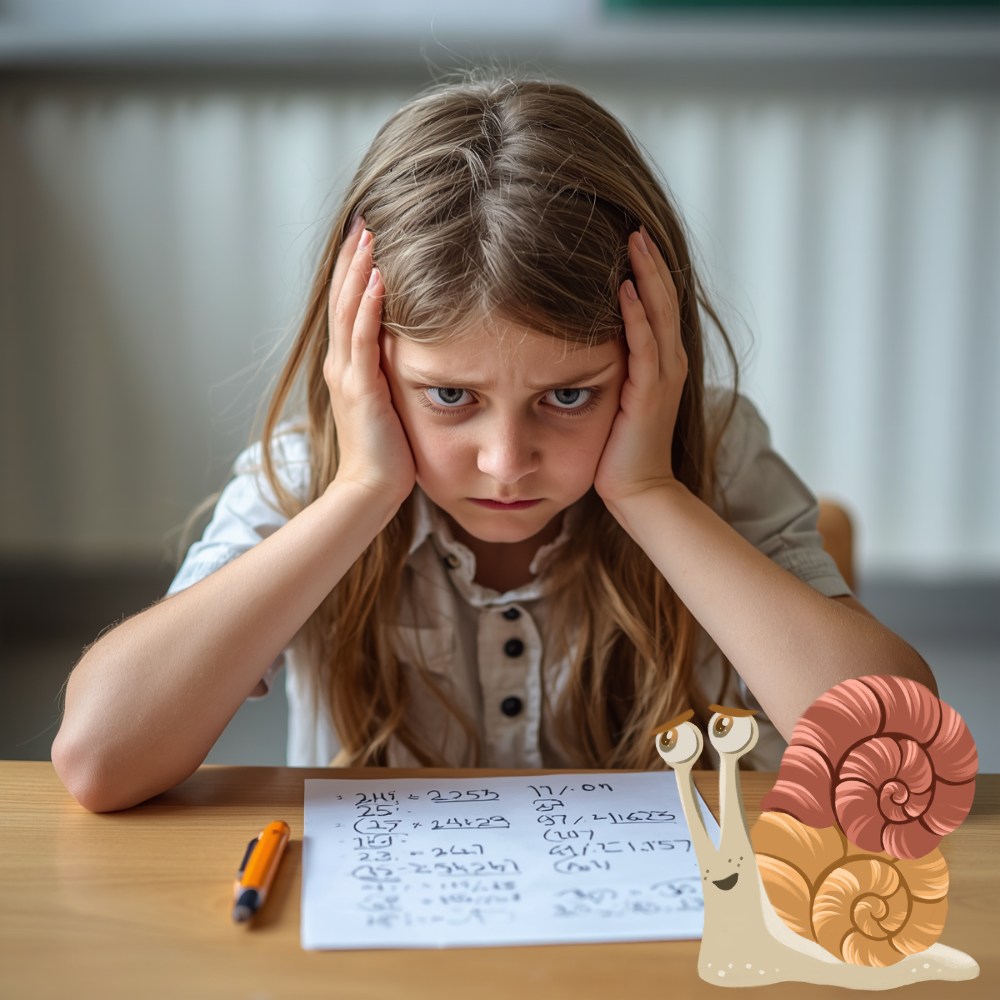
Some children understand the material. They know the spelling word in the car. They can solve the math problem at the kitchen table.
They read the passage correctly the night before. They can explain the answer when no one is watching. Then the test begins.
The room feels too quiet. The clock feels too loud. The pencil suddenly feels strange in their hand. The answer that was there a minute ago disappears behind a wall of pressure.
From the outside, adults may think, “But you knew this.”
From the inside, the child may be thinking something very different:
What if I get it wrong?
What if I forget everything?
What if everyone finishes before me?
What if my teacher is disappointed?
What if this proves I’m not good at this?
That is the part we need to take seriously. Test anxiety is not always about the test. Sometimes it is about being measured.
Being watched. Being wrong where someone can see it. Feeling that a single page of questions somehow decides something larger about who you are.
A good book can help because it gives the fear a shape outside the child’s own body. The pressure belongs to a character first. The mistake, the worry, the freeze, the hard restart, it all happens safely on the page.
And for many children, that is where the work begins.
If your child freezes during tests, do not begin with “try harder.” Begin by making pressure feel smaller.
Why test anxiety feels so big to some children
Test anxiety can look confusing. A child may study and still panic. They may know the answer and still leave it blank.
They may rush because they want the test over. They may redo the same answer again and again because nothing feels safe enough to submit.
That does not mean the child is lazy. It does not mean they are careless. It does not mean they are being dramatic.
It often means the child’s nervous system has started treating the test like a threat. And once that happens, access changes. Memory feels harder to reach. Flexible thinking narrows.
The child may become more focused on avoiding embarrassment than solving the problem in front of them. This is why test anxiety often overlaps with perfectionism.
A child who is deeply afraid of being wrong may not simply be worried about one grade. They may be worried that the mistake says something about them. That is a heavy thing for a small person to carry into a classroom.
If your child struggles with mistakes in many settings, not only schoolwork, this companion post may help:
https://www.yabbitrabbit.com/parent-resources/picture-books-perfectionism-making-mistakes-kids
What the best books for test anxiety actually give a child
The best books for kids with test anxiety do not simply chant, “You can do it.” That can be kind, but it is often not enough.
A child who freezes under pressure needs more than encouragement. They need stories that help them understand what pressure does, how mistakes feel, and how a brave first step can be smaller than the whole test.
The best books on this shelf offer:
A safer relationship with mistakes
The child learns that being wrong is not the same as being bad.
A smaller doorway into effort
Instead of “do the whole test,” the focus becomes “read the first question,” “write one answer,” or “take one breath.”
A way to separate performance from identity
A test is something a child takes. It is not who the child is.
A model for returning after panic
The most important moment is often not the anxiety itself. It is what happens after.
Language parents can borrow later
Good stories give families phrases they can use before school, during homework, and after a hard day.
That is the shelf we are building here. Not a shelf for perfect students. A shelf for children who need school pressure to feel human again.
The books I would put on this shelf first
This list is for the child who knows more than they can show when the pressure arrives.
The child who freezes when the paper lands on the desk.
The child who erases until the page looks tired.
The child who melts down over a spelling quiz.
The child who says, “I’m bad at this,” after one hard question.
The child who needs courage before confidence.
1. The Rabbit in the Moon
KD Schnee
The Rabbit in the Moon belongs on this shelf because test anxiety often begins before the first question.
It begins in the pause. That quiet, loaded moment when a child sees the challenge ahead and feels their whole body hesitate.
Yabbit understands that moment.
He is not fearless. He does not charge forward pretending everything is easy. He feels the size of the task. He wonders if he can do it. He pauses at the edge of something that matters.
That makes him deeply useful for children who freeze under school pressure. A child with test anxiety may not need another adult saying, “Don’t worry.” They may need a story that says, “Of course this feels big. Let’s make the next step small enough to take.”
Snail is essential here too. Snail is persistent and determined. He balances Yabbit’s hesitation without shaming it. He helps the journey continue, not by forcing Yabbit to become fearless, but by showing that steady movement still counts.
For a child who freezes before a test, that is the lesson: courage does not have to look confident. Sometimes courage is reading the first question. Sometimes it is writing the answer you are not 100 percent sure about. Sometimes it is trying while your stomach still feels fluttery.
Best for: children who freeze before trying, kids who need pressure made smaller, families who want language for hesitation, school anxiety, and tiny brave hops.
2. Wilma Jean the Worry Machine
Julia Cook, illustrated by Anita DuFalla
Wilma Jean worries about almost everything, which makes this book useful for children whose test anxiety is part of a larger worry pattern.
The book helps children separate worries they can control from worries they cannot. That is especially helpful around tests because anxious children often try to control everything: the grade, the teacher’s reaction, the timing, the possibility of mistakes, what other kids are doing, and what the result might mean.
No child can carry all of that.
Wilma Jean the Worry Machine gives parents and teachers a concrete way to talk about worry without making the child feel strange for having it.
Best for: children who worry across school situations, kids who need practical language for anxiety, early elementary readers.
3. What Do You Do With a Problem?
Kobi Yamada, illustrated by Mae Besom
Tests can start to feel like problems children do not want to face.
The hard worksheet. The spelling quiz. The math page. The reading passage. The grade that might come back with red marks.
What Do You Do With a Problem? gives children a visual way to understand avoidance. The problem grows when it is ignored. It follows the child. It becomes scarier in the imagination than it may be in real life.
That is exactly how test anxiety can work. A child may not only be afraid of the quiz. They may be afraid of the story they have built around the quiz.
This book helps children see that turning toward the problem can reveal something different from what fear predicted.
Best for: children who avoid schoolwork, kids who dread hard tasks, families talking about facing pressure one step at a time.
4. The Girl Who Never Made Mistakes
Mark Pett and Gary Rubinstein
This is a strong book for children whose test anxiety comes from the need to be right.
Beatrice Bottomwell has never made a mistake. At first, that sounds wonderful. But the more the story unfolds, the more children can see the trap: when everyone expects you to be perfect, every new challenge becomes risky.
That is very close to what some anxious students feel.
If a child has built part of their identity around being smart, careful, advanced, responsible, or “the one who gets things right,” then a test can feel threatening. Not because they do not care, but because they care so much.
This book helps loosen that pressure with humor.
It lets children imagine a life where making a mistake does not ruin them.
Best for: perfectionist children, high-achieving worriers, kids afraid of embarrassment, early elementary students.
5. Beautiful Oops!
Barney Saltzberg
Beautiful Oops! is not a school-testing book, but it belongs here because many test-anxious children need a new relationship with mistakes.
The book shows children that a tear, spill, smudge, or wrong mark does not have to be the end of the page. Something new can happen next.
For a child who panics over wrong answers, this is a powerful emotional pattern to practice. A mistake is not a trapdoor.
It is information. It is a mark. It is something you can respond to.
This book is especially good for younger children because it does not over-explain resilience. It shows it.
Best for: preschool and early elementary children, children who erase or restart repeatedly, kids who need mistake tolerance.
6. Ish
Peter H. Reynolds
Ish is one of the best books for children whose confidence has been bruised by criticism.
Ramon loves to draw until someone laughs at his work. After that, the joy disappears. His drawings no longer feel safe because they might be judged.
That emotional pattern shows up in school too.
A child may stop raising their hand after one wrong answer. They may panic during tests because they remember the sting of being corrected. They may decide they are “bad at math” or “bad at reading” after a few painful moments.
The word “ish” gives children breathing room. Not perfect. Not exact. Not finished. Still worth trying.
That is a helpful idea for tests too. Sometimes the first answer is answer-ish. The first sentence is sentence-ish. The first attempt is attempt-ish.
And that can be enough to keep going.
Best for: children sensitive to criticism, kids afraid of being judged, children who need permission to try imperfectly.
7. The Dot
Peter H. Reynolds
The Dot is a book about starting when you believe you cannot.
That makes it extremely useful for test anxiety because anxious children often freeze at the beginning. The blank page becomes the scariest part. The first question feels like a locked door.
In The Dot, Vashti does not begin with brilliance. She begins with a mark.
That is the lesson. A child does not need to feel confident before making the first move. They need the first move to be small enough to survive.
Before a test, that might mean:
Read the first question.
Circle one word you know.
Write your name.
Answer the easiest problem first.
Put a tiny dot next to the question you want to come back to.
The Dot gives adults a beautiful reminder: small starts are not small to the child who is stuck.
Best for: children who freeze at the start, kids who say “I can’t,” teachers introducing first-step thinking.
8. The Most Magnificent Thing
Ashley Spires
This book captures the frustration of trying to make something work and having it fail again and again.
That matters for test anxiety because some children interpret struggle as proof they are not capable. If the answer does not come quickly, they panic. If the problem is confusing, they shut down. If the first try is wrong, they decide the whole thing is hopeless.
The Most Magnificent Thing shows a child working through anger, disappointment, a break, and a return. That sequence is important.
Some anxious children need permission to pause without quitting. They need to learn that frustration can be part of thinking, not evidence that thinking has failed.
Best for: children who melt down during hard work, kids who need a break-and-return model, STEM learners, perfectionist problem-solvers.
9. Jabari Tries
Gaia Cornwall
Jabari Tries is another strong story for children who become discouraged when a plan does not work right away.
Jabari wants to make something fly. He tries, adjusts, feels frustrated, and receives support without having the hard part removed for him. That balance matters.
Children with test anxiety often need adults nearby, but they also need to feel their own agency return. We do not want to rescue them from every hard question. We want to help them stay present long enough to try one next move.
This book models persistence without pretending persistence is always cheerful.
Best for: children who need help returning after frustration, kids learning problem-solving, families practicing calm support.
10. What Do You Do With a Chance?
Kobi Yamada, illustrated by Mae Besom
For some children, a test feels like a chance to be wrong, not a chance to show what they know.
That is a painful reversal.
What Do You Do With a Chance? helps children think about risk in a softer way. A chance can be missed. It can be scary. It can feel uncertain. But it can also become something that changes what the child believes is possible.
This book is useful for children who avoid opportunities because the possibility of failure feels too loud.
A spelling bee. A classroom answer. A timed test. A new reading group. A math challenge.
All of those moments ask a child to take a chance. This story helps make that chance feel less like a threat.
Best for: children who avoid opportunities, kids afraid to raise their hand, school performance anxiety, older picture book readers.
11. After the Fall
Dan Santat
After the Fall is an excellent book for children whose anxiety began after something went wrong.
Maybe they failed a quiz. Maybe they blanked during a presentation. Maybe they got called on and did not know the answer. Maybe they made a mistake and someone laughed.
Afterward, the child may become more careful. More avoidant. More afraid of the next time.
That is what this book handles beautifully. Humpty Dumpty survives the fall, but fear changes his life. The story gives children a way to understand how one painful experience can shrink what they are willing to do.
And then it shows return. Not instant confidence. Return.
That distinction is exactly what many test-anxious children need.
Best for: children avoiding after embarrassment, kids who had one bad test experience, conversations about rebuilding courage.
12. The Koala Who Could
Rachel Bright, illustrated by Jim Field
This book is not specifically about school, but it is useful for children who cling to certainty.
Kevin likes things predictable and safe. Change feels frightening. Letting go feels impossible. That emotional pattern is often present in children with test anxiety.
A test introduces uncertainty.
What questions will be on it?
Will I remember?
Will I finish?
Will it be hard?
Will I know what to do?
The Koala Who Could helps children see that staying safe can sometimes become its own kind of stuck. It is playful and gentle enough for younger children, but the emotional idea is real.
Sometimes growth asks us to loosen our grip.
Best for: children who need predictability, anxious kids, younger readers, conversations about trying something uncertain.
How to read these books with a child who has test anxiety
A child with test anxiety does not need every book to become a lesson about tests. That will make the book feel like homework wearing a costume.
Read the story first. Let it be a story. Let your child notice what they notice.
Then, later, use the character as a doorway.
Ask about the character, not your child first.
“What do you think made him freeze?”
Name the pressure gently.
“She really wanted to get it right. That can feel heavy.”
Notice recovery more than outcome.
“He got stuck, but he found one next step.”
Connect it lightly to school.
“Sometimes tests can feel like that too.”
Keep the next action small.
“What would be one tiny brave hop before a quiz?”
That phrase, one tiny brave hop, is important because it changes the size of the ask.
We are not asking the child to become calm forever.
We are asking for one small movement toward the task.
What to say before a test
The morning of a test is not the time for a long speech. Your child does not need a seminar in resilience while they are trying to put on their shoes. They need a few words that lower the pressure.
Try these:
“A test shows what you know today. It does not decide who you are.”
“You do not have to feel calm to begin.”
“Read the first question. That is the first brave hop.”
“If your brain gets stuck, pause and find one thing you do know.”
“Your job is not to be perfect. Your job is to stay with it.”
The goal is not to promise that everything will go well. The goal is to remind your child that they can handle the first moment, then the next one. That is how courage works in real life. Not as a lightning bolt. More like a small lantern being carried through a hallway.
What to say after a hard test
The way adults respond after a hard test can either reduce anxiety or deepen it. If the first question is, “What grade did you get?” the child may learn that performance is the whole story.
Try starting somewhere else.
“What part felt hardest?”
“Did your brain get stuck anywhere?”
“Was there one moment when you kept going even though it felt hard?”
“What helped even a little?”
“What should we practice differently next time?”
This keeps the conversation focused on process, recovery, and support.
Of course grades matter. Skills matter. Preparation matters.
But a child who is anxious about tests usually does not need more proof that tests matter. They already know. That is the problem.
They need proof that a test can matter without becoming a verdict.
How parents can make school pressure feel smaller
Books help, but they work best when the home environment supports the same message. Here are a few ways to lower the emotional stakes around tests:
Practice under gentle pressure.
Do one or two questions with a timer, not twenty. Let the child experience mild pressure without drowning in it.
Separate the child from the score.
Say, “This score gives us information,” not “You did great” only when the score is high.
Praise brave behavior specifically.
“You went back to the hard question.”
“You checked your work once and stopped.”
“You started even though you were nervous.”
Let mistakes become data.
Ask, “What is this mistake teaching us?” before asking, “Why did you get this wrong?”
Avoid surprise pressure when possible.
Some children do better when they know what to expect: test format, timing, number of questions, or what to do if they get stuck.
Use first-move language.
If your child freezes before schoolwork, this companion guide gives you a simple script:
https://www.yabbitrabbit.com/parent-resources/when-your-child-freezes-before-trying-first-move-script
Small changes in adult language can change the emotional weather around school.
Not instantly. Not magically.
But slowly, the child begins to learn: I can feel pressure and still move.
Why The Rabbit in the Moon belongs in a test anxiety book stack
The Rabbit in the Moon is not a book about a classroom test. It is about the moment before courage. That is why it belongs here.
Test anxiety often lives in that exact moment: before the answer, before the spelling word, before the first question, before the child knows whether they will get it right.
Yabbit gives children a character who knows hesitation from the inside. He is not broken because he pauses. He is not weak because he worries. He is not disqualified from the journey because he needs courage to arrive in smaller pieces.
Snail brings the balance.
Snail is persistent and determined, but he does not replace Yabbit. He helps the journey keep moving. That is what many anxious children need from the adults around them too: not pressure, not rescue, but steady companionship that makes the next step feel possible.
For a child with test anxiety, that message matters.
You can be nervous and still begin.
You can be unsure and still try.
You can take one tiny brave hop before you feel ready.
That is often where confidence starts.
Yabbit the Rabbit in an investment in your child’s emotional growth
If your child freezes before tests, avoids schoolwork, worries about getting things wrong, or feels overwhelmed by pressure, The Rabbit in the Moon belongs on your shelf.
Yabbit does not begin as a fearless character. He hesitates. He worries. He needs time. But with Snail’s steady persistence beside him, he learns that courage does not have to arrive all at once.
It can begin with one tiny brave hop.
For parents, teachers, and counselors, The Rabbit in the Moon offers more than a bedtime story. It gives children language for hesitation, pressure, persistence, and the brave first moves that help hard things feel possible.
FAQs
What are the best books for kids with test anxiety?
The best books for kids with test anxiety are books that help children understand worry, pressure, mistakes, and the courage to begin. Strong choices include The Rabbit in the Moon, Wilma Jean the Worry Machine, What Do You Do With a Problem?, The Girl Who Never Made Mistakes, Beautiful Oops!, Ish, The Dot, Jabari Tries, and After the Fall. The best book depends on whether your child’s anxiety is mostly about mistakes, pressure, embarrassment, perfectionism, or freezing before starting.
How can books help a child with test anxiety?
Books help because they let children see anxiety safely through a character. Instead of being put on the spot, the child can watch someone else freeze, worry, make a mistake, recover, or try again. That emotional distance makes it easier to talk about pressure and practice coping language before the next test arrives.
What should I say when my child freezes during a test or quiz?
Before the test, give your child a small first move. You might say, “Read the first question first,” or “Find one thing you do know.” Avoid asking them to feel calm before beginning. Many children need to learn that they can start while still nervous.
Is test anxiety connected to perfectionism?
Often, yes. Some children feel anxious during tests because being wrong feels unsafe. They may worry that a mistake means they are not smart, not prepared, or disappointing someone. Helping a child build mistake tolerance can reduce the pressure they feel around tests.
Should I tell my child tests do not matter?
Usually, no. Children know tests matter, especially once school begins treating them as important. A better message is: “This test matters, but it does not decide who you are.” That helps children take school seriously without turning the test into a measure of their worth.
Is The Rabbit in the Moon a book about test anxiety?
The Rabbit in the Moon is not specifically about classroom test anxiety, but it is highly relevant for children who freeze under pressure. Yabbit’s story helps children understand hesitation, fear, and tiny brave steps. For a child who gets stuck before a test, that emotional language can be very useful.
When should I get extra help for my child’s test anxiety?
Consider extra support if test anxiety causes frequent stomachaches, panic, school refusal, sleep problems, major meltdowns, or a pattern of avoiding schoolwork. A teacher, school counselor, pediatrician, or child therapist can help you understand whether your child needs additional support beyond books and at-home strategies.