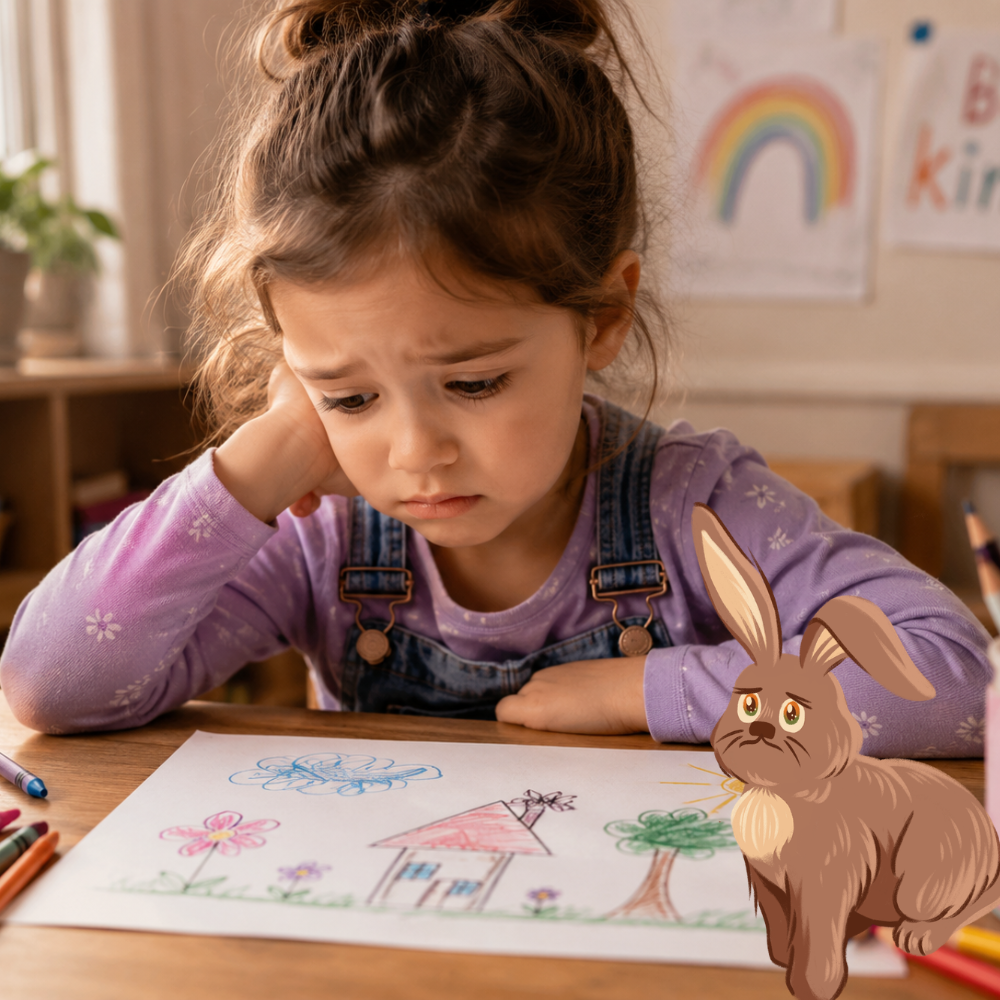
Some children need to know that a mistake is not the end of the story. It is often where bravery begins.
Some children do not quit because they are lazy. They quit because the page is not turning out the way it looked in their head.
They freeze because the answer might be wrong. They crumple the drawing because one line went sideways. They melt down over a misspelled word, a missed basket, a crooked letter, a puzzle piece that will not fit, or a correction that lands too close to the heart.
From the outside, it can look dramatic. From the inside, it may feel like danger.
That is what many adults misunderstand about perfectionism in children. It is not always about wanting praise or being the best. Sometimes perfectionism is a child’s way of trying to avoid shame, embarrassment, disappointment, or the terrible feeling of being seen while still learning.
And once we understand that, we stop asking, “Why are you making such a big deal?” We start asking a better question: What would help this child feel safe enough to be imperfect? That is where the right picture book can do something quietly powerful.
A good story gives a child distance. The mistake belongs to the character first. The crooked drawing, the failed invention, the embarrassing moment, the hard restart, the not-yet-good-enough attempt, it all happens on the page before it has to happen in real life.
The child can watch. The child can laugh. The child can soften. The child can see that imperfection is not proof that something is wrong with them.
It is proof that they are in the middle of learning. If your child avoids, erases, tears up work, shuts down, or says “I’m bad at this” after one mistake, choose books that make imperfection feel emotionally safe before you ask for more effort.
Quick Answer: Best Picture Books About Perfectionism and Making Mistakes
The best picture books about perfectionism and making mistakes help children see that an error is not proof they failed. It is part of learning, practicing, and trying again.
For perfectionist kids, the most helpful stories do not simply say, “Mistakes are okay.” They show a character living through the uncomfortable feeling of getting something wrong and discovering that the story can keep going.
A good book can help children separate who they are from what happened. The goal is not to make mistakes feel wonderful. The goal is to make mistakes feel survivable.
Why perfectionism can make mistakes feel enormous
Perfectionism in children often hides inside ordinary moments. A worksheet. A drawing. A sport. A board game. A piano lesson. A class presentation. A new skill. A simple request to “just try.”
But for the child, the stakes may not feel simple. A mistake can feel like exposure. A correction can feel like criticism. Starting can feel risky because once they begin, everyone can see what they cannot do yet.
That is why some perfectionist children avoid the task before it starts. Refusal can become protection. “I don’t want to” may really mean, “I don’t want to feel bad at this.”
If your child’s perfectionism shows up as refusal to begin, this practical companion guide may help: https://www.yabbitrabbit.com/parent-resources/perfectionism-in-kids-why-they-wont-start-shrink-the-stakes
This post is slightly different.
Here, we are not only looking at what to say in the moment. We are building the story shelf around the child. We are giving them characters who make mistakes, survive them, grow from them, laugh through them, and sometimes discover that the “wrong” mark was not wrong at all.
What the best mistake books actually teach
The best picture books about perfectionism do not simply say, “Mistakes are good.” That is too clean. Too easy. Too far away from the child who is furious because their drawing does not look right.
Better books teach something more honest.
A mistake can become part of the work.
Not every error ruins the page. Sometimes it changes the page.
Trying badly is still trying.
A first attempt is allowed to look like a first attempt.
Being corrected does not mean being rejected.
Children need to feel the difference between “this needs work” and “you are not good enough.”
Frustration is not failure.
It is often the sound the brain makes while building a new pathway.
You can be disappointed and still continue.
This is one of the most important emotional skills a child can learn.
That is the shelf we are building here. Not a shelf for perfect children. A shelf for children who are learning how to stay with themselves when the work gets messy.
The picture books I would put on this shelf first
This list is for the child who wants to get it right so badly that getting it wrong feels unbearable.
The child who over-erases.
The child who says, “I can’t,” before they have enough evidence.
The child who would rather not try than be seen trying imperfectly.
The child who needs a story to lower the emotional temperature around mistakes.
1. The Rabbit in the Moon
KD Schnee
The Rabbit in the Moon belongs on this shelf because perfectionism is often a cousin of hesitation.
Yabbit the Rabbit is not a character who charges forward without worry. He pauses. He wonders. He feels the size of the task before him. He knows what it is like to stand at the edge of something meaningful and not feel ready yet.
That matters for perfectionist children. Many of them are not trying to be difficult. They are trying to avoid the feeling of doing something wrong, disappointing someone, or discovering they are not as capable as they hoped. Before a mistake ever happens, they are already living inside the fear of it.
Yabbit gives that child a character they can recognize without feeling named too directly. The character Snail matters just as much. Snail is persistent and determined.
He does not erase Yabbit’s hesitation. He balances it. He keeps the journey moving without turning Yabbit into a different character. That is exactly the kind of emotional model perfectionist children need: not pressure to become fearless, but companionship that helps the next step feel possible.
Best for: children who hesitate before trying, kids who need courage to begin, families who want language for fear, uncertainty, and tiny brave hops.
2. The Girl Who Never Made Mistakes
Mark Pett and Gary Rubinstein
This is one of the clearest picture books for children who feel trapped by being “the one who gets things right.”
Beatrice Bottomwell has never made a mistake. That sounds impressive until you realize how much pressure comes with it. The story gives children a funny, memorable way to see that a perfect record can become its own cage.
For perfectionist kids, this book opens an important conversation: when everyone expects you to get it right, trying anything uncertain can start to feel impossible. The power of the book is not that it shames perfectionism. It shows the relief that can come when a child discovers that a mistake does not destroy them.
Best for: children who put pressure on themselves, kids afraid of embarrassment, early elementary readers who need humor around mistakes.
3. Beautiful Oops!
Barney Saltzberg
Beautiful Oops! is a wonderful book for children who need to see mistakes transformed, not just forgiven.
A tear, a spill, a smudge, a bend, none of these has to be the end. The book turns accidents into creative possibilities, which makes it especially useful for children who panic when art or writing does not go as planned.
This is a strong choice because it is tactile and concrete. A young child does not have to understand a long speech about resilience. They can see the page change in front of them.
For a child who thinks one wrong mark ruins everything, this book says something better: keep looking. There may still be something here.
Best for: preschool and early elementary children, art anxiety, creative perfectionism, children who tear up or abandon work after small mistakes.
4. The Book of Mistakes
Corinna Luyken
The Book of Mistakes is one of the most beautiful books on this topic because it treats mistakes as part of creation.
Not decoration. Not a motivational slogan. Part of the making.
The story begins with marks that seem wrong, then slowly reveals how those marks can become something larger, stranger, and more alive than the original plan. That is a powerful idea for a perfectionist child. It loosens the grip of the “right way.”
This book is especially helpful for children who need quiet, visual reassurance rather than loud encouragement. Some kids do not need to be told, “It’s fine.” They need to see how imperfection can become part of the art.
Best for: sensitive perfectionists, artistic children, visual thinkers, children who need a calmer story about mistakes.
5. Ish
Peter H. Reynolds
Ish is a small book with a big message.
Ramon loves to draw until someone laughs at his work. Suddenly, drawing no longer feels safe. That moment matters because many perfectionist children are carrying a memory just like it. A comment, a laugh, a correction, a comparison, something that made trying feel exposed.
The word “ish” gives children a way out of exactness. A tree-ish drawing. A house-ish drawing. A feeling-ish attempt.
That tiny shift can be freeing. It tells a child the work does not have to match the perfect picture in their mind to be worth making.
Best for: children discouraged by criticism, kids who say their work is “bad,” young artists, children who need permission to make imperfect attempts.
6. The Dot
Peter H. Reynolds
The Dot is a classic for children who believe they cannot begin.
Vashti says she cannot draw. Her teacher does not argue her into confidence. She gives her a small, almost ridiculously simple first move: make a mark and see where it takes you.
That is why the book is so useful. Perfectionist children often get stuck because the whole task feels too large. The Dot shrinks the beginning. It does not ask for mastery. It asks for one mark.
For parents and teachers, that is the lesson worth carrying beyond the book. When a child cannot start, make the first step smaller.
Best for: children who say “I can’t,” reluctant artists, classroom read-alouds, first-step confidence.
7. The Most Magnificent Thing
Ashley Spires
This book understands the frustration of a child whose idea is clearer than their ability to execute it.
That is a perfectionist trap many adults forget. The child can imagine what they want to make. They can feel the gap between the vision and the result. That gap becomes unbearable.
The Most Magnificent Thing gives children a character who tries, fails, gets angry, walks away, and returns with a little more perspective. That emotional sequence is valuable because it does not pretend frustration disappears instantly.
Sometimes the bravest thing a child can do is pause without quitting completely.
Best for: inventive children, kids who melt down when projects go wrong, STEM and maker spaces, children learning to take breaks and return.
8. Jabari Tries
Gaia Cornwall
Jabari Tries is excellent for children who are learning that persistence is not always smooth.
Jabari wants to build something that works, but his first attempts do not go the way he hopes. The book makes room for effort, frustration, problem-solving, and support without turning the story into a lecture.
It is especially helpful because it shows that trying again does not mean pretending you are not upset. Children are allowed to feel frustrated. They are also allowed to keep going after the feeling passes.
That combination matters. Perfectionist children often think the presence of frustration means they should stop. This book helps them see frustration as part of the work, not a verdict on their ability.
Best for: children who quit when plans fail, kids who like building and experimenting, families practicing persistence.
9. Rosie Revere, Engineer
Andrea Beaty, illustrated by David Roberts
Rosie Revere, Engineer is a strong book for children who hide their ideas because they are afraid those ideas will not work.
Rosie creates inventions in secret after an embarrassing moment makes her afraid to be seen trying. That is painfully familiar for many perfectionist kids. They may still want to create, perform, draw, build, or answer, but only if they can avoid the risk of public failure.
The book reframes failure as information. It helps children see that an invention that flops is not proof the inventor is bad. It is part of the engineering.
That lesson travels well beyond building machines.
Best for: children afraid to share their ideas, STEM learners, kids who feel embarrassed after mistakes, classroom conversations about persistence.
10. A Perfectly Messed-Up Story
Patrick McDonnell
This book is playful, clever, and useful for children who want everything to stay neat and controlled.
The story keeps getting interrupted by messes. Jelly, fingerprints, chaos on the page. The character does not like it, which is exactly why the book works. Children get to watch someone struggle with imperfection in a funny, low-stakes way.
For a child who becomes rigid when things do not go as expected, humor can open a door that direct advice cannot. Sometimes the safest way to talk about mess is to laugh with a character who also hates it at first.
Best for: younger children, kids bothered by mess or disruption, read-alouds that make mistakes feel lighter.
11. What Do You Do With a Problem?
Kobi Yamada, illustrated by Mae Besom
This book is not only about mistakes, but it belongs on this shelf because perfectionist children often experience mistakes as problems that grow larger the longer they avoid them.
The story gives children a visual way to understand avoidance. The problem follows the child. It changes size. It becomes harder to ignore. Eventually, facing it reveals something unexpected.
For perfectionist children, this can help with the emotional aftermath of a mistake: the unfinished worksheet, the hard conversation, the correction, the thing they do not want to look at again.
Some mistakes need repair. Some need another try. Some simply need to be faced long enough to lose their power.
Best for: anxious children, children avoiding a difficult task, kids who worry after something goes wrong.
12. After the Fall
Dan Santat
After the Fall is a beautiful book for children who are afraid to try again after something painful or embarrassing happens.
Humpty Dumpty survives the fall, but he is not the same afterward. He becomes careful. Avoidant. Limited by fear. That makes the story especially useful for children whose perfectionism intensified after one bad moment.
Maybe they were laughed at. Maybe they lost. Maybe they made a mistake in front of the class. Maybe they tried something and felt the sting of not being good yet.
This book helps children see that healing is not instant, but return is possible. If your child is specifically afraid to try again after a hard experience, this companion list may be a better next read:
https://www.yabbitrabbit.com/parent-resources/books-for-kids-afraid-to-try-again-after-failing
Best for: children recovering from embarrassment, kids avoiding after a setback, older picture book readers, conversations about fear after failure.
How to read these books with a perfectionist child
The way you read the book matters almost as much as the book itself.
A perfectionist child is usually quick to detect a lesson. If every story becomes a disguised speech about their behavior, they may shut the door before the book can do its quiet work.
So read first. Let the story breathe. Let the character be the character.
Then, when there is space, ask questions that do not corner your child.
Use the character as the doorway.
“What do you think made her want to stop?”
Name the pressure without diagnosing your child.
“That looked like a lot of pressure to get it right.”
Notice the recovery, not only the result.
“He got frustrated, took a break, and came back. That was the brave part.”
Keep the next step very small.
“What would be one tiny brave hop for this character?”
Do not rush to make the mistake positive.
Some mistakes feel bad. Children need room to feel disappointed before they can learn from them.
That last point is important. Adults sometimes move too quickly to, “Mistakes help us learn.” It is true, but timing matters. If a child is still embarrassed or angry, that phrase can sound like we are skipping over their pain.
Try this instead:
“That did not turn out how you wanted. I get why that feels frustrating. We can stay with it for one small step.”
That kind of language lowers the heat. It tells the child they are not in trouble for being upset, and they are not trapped by the upset either.
What to say when your child melts down over a mistake
In the moment, a perfectionist child usually does not need a big lesson. They need emotional steadiness. Here are a few phrases that help without adding pressure:
Instead of: “It’s not a big deal.”
Try: “It feels big right now. I’m here.”
Instead of: “Just erase it.”
Try: “Let’s take one breath before we decide what to do next.”
Instead of: “You’re being too hard on yourself.”
Try: “That voice in your head is getting really loud.”
Instead of: “Everyone makes mistakes.”
Try: “This is a mistake moment. We can make the next step smaller.”
Instead of: “Try again.”
Try: “Do you want to fix one part, start a new version, or take a short break first?”
The goal is not to rescue your child from every uncomfortable feeling. The goal is to help them stay connected to themselves while the feeling moves through.
That is how mistake tolerance grows. Not through shame. Not through pressure. Not through pretending the child should already know better.
Through repeated moments of: I made a mistake, I felt the feeling, and I was still safe enough to continue.
Why The Rabbit in the Moon belongs in a perfectionism book stack
The Rabbit in the Moon is not a book about drawing a crooked line or failing a test. Its connection to perfectionism is deeper.
It is about the emotional moment before action. The pause. The worry. The size of the task. The fear that forward might be too much.
That is where perfectionist children often get stuck.
Before the mistake. Before the attempt. Before anyone can say, “You did fine.”
Yabbit helps children see that hesitation is not the same as weakness. Snail helps them see that persistence can be steady, patient, and kind without turning into pressure. Together, they offer a model many perfectionist children need: you do not have to feel fearless to begin.
You only need one small brave step. That is why this story fits beautifully beside books about mistakes, creativity, problem-solving, and trying again. Because underneath perfectionism is often a child asking a very human question:
Will I still be okay if I do not get this right? A good picture book helps answer yes without making the child feel small for asking.
Yabbit the Rabbit is an investment in your child’s emotional growth
If your child hesitates, freezes, avoids starting, or feels overwhelmed by the possibility of getting something wrong, The Rabbit in the Moon belongs on your shelf.
Yabbit is not fearless. He worries. He pauses. He needs time. But with Snail’s persistence beside him, he learns that courage does not have to arrive all at once. It can begin with one tiny brave hop.
For parents, teachers, and counselors, The Rabbit in the Moon offers more than a bedtime story. It gives children language for hesitation, fear, persistence, and the emotional bravery of beginning before everything feels perfect.
FAQs
What are the best picture books about perfectionism for kids?
Some of the best picture books about perfectionism for kids include The Girl Who Never Made Mistakes, Beautiful Oops!, The Book of Mistakes, Ish, The Dot, The Most Magnificent Thing, Rosie Revere, Engineer, and The Rabbit in the Moon. The strongest books do not simply tell children to stop worrying. They show characters living through mistakes, frustration, embarrassment, and imperfect first tries in a way that feels safe and relatable.
How can picture books help a perfectionist child?
Picture books help perfectionist children by giving them emotional distance. Instead of talking directly about their mistake, the child can watch a character struggle with imperfection first. That makes it easier to talk about trying, frustration, correction, and recovery without making the child feel exposed.
What should I say when my child gets upset over mistakes?
Start by validating the size of the feeling before giving advice. You might say, “It feels big right now. I’m here,” or “This is a mistake moment. We can make the next step smaller.” Perfectionist children often need calm before coaching. Once they feel steadier, they can choose whether to fix one part, try a new version, or take a short break and return.
Are perfectionism and anxiety connected in children?
They can be connected. Some children avoid mistakes because being wrong makes them feel embarrassed, unsafe, or out of control. Perfectionism can become a way of managing anxiety: if everything is perfect, nothing bad can happen. The problem is that children then begin avoiding anything they cannot do well immediately.
What is the difference between fear of failure and perfectionism?
Fear of failure often shows up after a child imagines or remembers something going badly. Perfectionism can show up before, during, and after the task because the child feels pressure for the work to be right, clean, impressive, or mistake-free. A child who fears failure may avoid trying again. A perfectionist child may struggle to begin, continue, or tolerate correction because imperfection itself feels threatening.
Is The Rabbit in the Moon a book about making mistakes?
The Rabbit in the Moon is a picture book about hesitation, courage, persistence, and tiny brave steps. It is not only about mistakes, but it helps children who are afraid to begin because it speaks to the emotional moment before action. For perfectionist children, that moment matters. Yabbit shows that feeling unsure does not mean you cannot move forward.
How do I help my child become less afraid of being wrong?
Help your child practice being imperfect in small, low-pressure ways. Read books where characters make mistakes and recover. Model your own mistakes out loud. Praise recovery more than performance. Say things like, “You stayed with it,” “You fixed one part,” or “You tried before you knew how it would turn out.” Over time, children learn that being wrong is not a disaster. It is part of becoming capable.