For some children, making friends does not begin with boldness. It begins with feeling safe enough to take one small step closer.
Some children do not dislike other children. They watch them closely. They laugh from the edge of the room.
They want to join the game, but their body does not move yet. They want to answer the question, but the words stay tucked away. They want a friend, but the first step toward friendship feels strangely enormous.
That is the part adults can miss.
A shy child may not need a lecture about being friendly. They may not need to be pushed into the group, announced to the room, or told, “Just go play.” They may need a smaller doorway.
That is where the right picture book can help.
Picture books about making friends give children a safe way to practice social courage before they have to use it in real life. The story does not stare at them. It does not demand eye contact. It lets them watch another character feel left out, nervous, unseen, hopeful, brave, awkward, or quietly ready.
And sometimes that is enough to begin. If your child hangs back, start with books that make joining feel possible, not books that make shyness feel like a problem to fix.
Why making friends can feel hard for shy kids
Friendship looks simple from the outside. Walk over. Say hello. Ask to play. But for a shy, anxious, or hesitant child, that tiny social step may carry a whole storm inside it.
What if they say no?
What if I do it wrong?
What if everyone looks at me?
What if I do not know what to say next?
What if I try and feel embarrassed?
A child may want connection and still freeze at the edge of it. That does not mean they are rude, unfriendly, or not trying. It may mean the social moment feels too big to enter all at once.
That distinction matters. Shyness, anxiety, and hesitation can look similar from across the playground, but they are not always the same. If you want a deeper guide to telling those patterns apart, I would start here: https://www.yabbitrabbit.com/parent-resources/shy-anxious-or-hesitant-how-to-tell-the-difference
The goal is not to turn every shy child into the loudest child in the room. The goal is to help them feel safe enough to move toward connection in a way that still feels like them.
What good friendship books give a shy child
The best picture books about making friends do more than say, “Be kind.” That matters, of course. But shy children often need something more specific. They need stories that show:
You can be quiet and still belong.
A child does not have to become louder to become connected.
Friendship can begin small.
A look, a shared toy, one question, one invitation, one moment of staying nearby can matter.
Being different does not make you unfriendable.
Many children hang back because they believe something about them will not fit.
Rejection, awkwardness, and uncertainty are survivable.
Friendship is not always instant. A story can help children tolerate the in-between.
Joining in is a skill, not a personality test.
Some children need practice entering play, reading social cues, waiting, asking, recovering, and trying again.
This is where books become more than entertainment. They become rehearsal spaces.
The picture books I would put on this shelf first
This is not just a list of books about friendship. This is a shelf for the child who wants to join but does not know how yet. The child who hovers near the game. The child who watches other kids before stepping in. The child who needs friendship to feel less like a leap and more like one small brave hop.
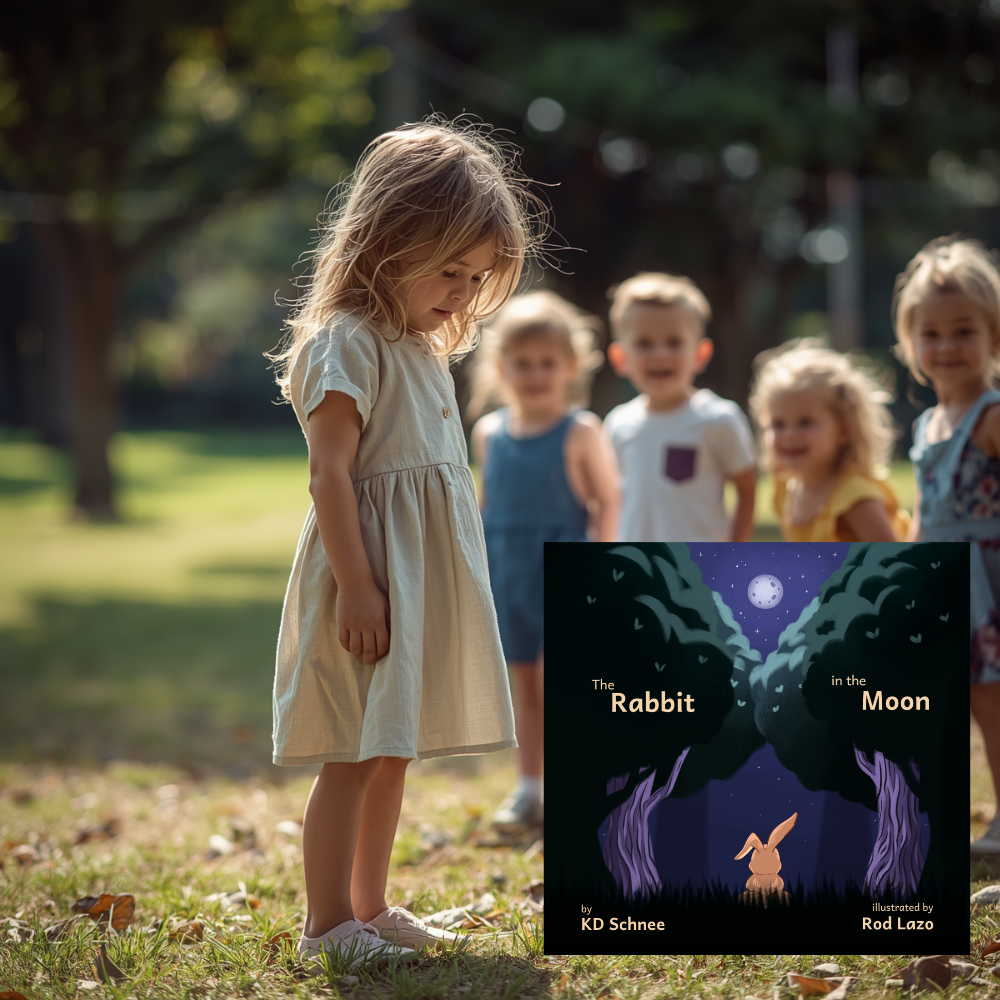
1. The Rabbit in the Moon
KD Schnee
The Rabbit in the Moon belongs on this shelf for a specific kind of child: the child who hesitates before moving toward something meaningful.
Yabbit the Rabbit is not a loud, fearless hero. He is cautious. He wonders. He worries. He pauses at the edge of the task ahead. That emotional truth matters for shy kids because many of them know exactly what it feels like to want to move forward while something inside says, “Not yet.”
What makes the story especially useful for friendship and social courage is the relationship between Yabbit and Snail. Snail is persistent and determined. He does not erase Yabbit’s hesitation.
He balances it. He keeps going. He helps the journey continue without making Yabbit feel broken for needing time.
That is a powerful model for children who hang back socially. The book does not tell a child, “Stop being shy.” It gives them a softer, more usable idea: you can feel unsure and still take the next tiny brave step.
Best for: children who freeze before joining, children who need courage to feel smaller, families who want emotional language for hesitation, fear, and trying.
2. The Day You Begin
Jacqueline Woodson, illustrated by Rafael López
This is one of the strongest picture books for children who feel different when they enter a room.
The Day You Begin understands the quiet bravery of showing up when you are not sure you belong. It is especially helpful for children entering a new classroom, new group, new neighborhood, or social setting where everyone else seems to know the rhythm already.
For shy kids, the value is not that the book makes belonging look easy. It does not. It honors the moment before connection, when a child feels separate and unsure.
Then it shows how one honest piece of yourself can become the beginning of a bridge.
Best for: new-school nerves, children who feel different, classroom belonging, children who need courage to share a little of themselves.
3. The Invisible Boy
Trudy Ludwig, illustrated by Patrice Barton
Some shy children are not disruptive. They are overlooked.
The Invisible Boy gives language to that kind of quiet loneliness. Brian is not the child causing a scene. He is the child others do not fully notice until kindness, attention, and inclusion begin to change the room.
This is an excellent read for both shy children and the children around them. It helps quiet kids feel seen, but it also helps peers understand how small acts of inclusion can matter.
That double purpose makes it especially useful in classrooms.
Best for: children who feel left out, classroom empathy, quiet children, friendship conversations about noticing others.
4. Gustavo, the Shy Ghost
Flavia Z. Drago
Gustavo wants friends, but being seen is hard.
That emotional setup is perfect for shy children because the book does not treat shyness as a flaw. Gustavo has interests, talents, feelings, and a real desire for connection. The challenge is not that he lacks value. The challenge is that sharing himself with others feels scary.
This is exactly the inner world many shy children carry. The story helps children understand that friendship often begins when we let others see one small true part of us.
Best for: shy preschoolers and early elementary children, Halloween-season read-alouds, children who want friendship but struggle to step forward.
5. A Friend for Henry
Jenn Bailey, illustrated by Mika Song
A Friend for Henry is especially useful for children who like clarity. Some children struggle socially not because they do not want friends, but because friendship can feel unpredictable. What counts as playing together? How do you ask? What happens if someone does not respond the way you hoped?
This book gives children a thoughtful look at the search for a friend who fits. It can be especially helpful for children who prefer clear rules, direct communication, or quieter forms of play.
It also gives adults a chance to talk about a deeply important idea: friendship is not about being liked by everyone. Sometimes it is about finding someone whose way of being meets yours.
Best for: children who prefer predictable social rules, children who struggle with flexible play, neurodivergent children, quieter friendship conversations.
6. Strictly No Elephants
Lisa Mantchev, illustrated by Taeeun Yoo
This is a wonderful book about exclusion, belonging, and making room. For shy kids, the most valuable part is that friendship does not depend on being exactly like everyone else. The story gives children a warm, concrete way to understand what it feels like to be left out, and what it means to create a more welcoming circle.
It is also a useful classroom read because it moves beyond “make friends” into a bigger question: what kind of friend group are we creating?
Best for: conversations about inclusion, children who feel different, classrooms, children learning how to welcome others.
7. Be a Friend
Salina Yoon
Some children communicate differently. Be a Friend is a lovely choice for children who may not express themselves in the expected way. It shows that connection can grow when someone is willing to notice, accept, and respond to another child’s unique way of being.
For shy children, this book can be reassuring because it does not demand instant verbal confidence. It makes room for quieter expression.
That matters. Not every child begins friendship with a big introduction. Some begin with a drawing, a shared interest, a gesture, a glance, or simply staying close enough to be included.
Best for: quiet children, creative children, children who communicate in less obvious ways, empathy-building read-alouds.
8. Can I Play Too?
Mo Willems
This Elephant & Piggie book is simple, funny, and more useful than it first appears.
“Can I play too?” is one of the most important social questions a child can learn, but for shy kids, it can feel enormous. This book gives children a playful way to see the awkwardness and flexibility of joining a game.
It also shows that friendship requires adjustment. The group may need to change the game so someone else can join. That is a valuable lesson for the child asking to enter and the children already playing.
Best for: preschool and early elementary children, children practicing play-entry language, read-alouds about flexibility and inclusion.
9. Neville
Norton Juster, illustrated by G. Brian Karas
Neville is a clever book about moving somewhere new and finding a way to connect.
A child in a new neighborhood feels lonely and uncertain. Then, through one unusual act, he begins drawing other children toward him. What works so well here is that the story does not require a polished social performance.
The child finds an entry point. That is often what shy kids need.
Not a grand speech. Not a sudden personality change. Just one small action that makes connection possible.
Best for: moving, new neighborhoods, new schools, children who need an unexpected doorway into friendship.
10. The Name Jar
Yangsook Choi
The Name Jar is a beautiful book about identity, belonging, and the pressure to fit in.
For shy children, especially children entering a new classroom or culture, making friends can become tangled with a deeper question: will people accept me as I am?
This book gives families and classrooms a strong way to talk about names, identity, difference, and the courage it takes to be known truthfully.
It is not only a friendship book. It is a belonging book. And for many shy kids, belonging is the real question underneath friendship.
Best for: new school transitions, identity conversations, children worried about standing out, classrooms building respect.
11. Llama Llama Time to Share
Anna Dewdney
Friendship is not only about meeting someone. It is about learning how to be with someone.
Llama Llama Time to Share is useful for younger children because it explores one of the first friendship problems many kids face: sharing. The emotions are familiar, the conflict is simple, and the lesson is concrete enough for preschoolers.
For shy children, this can help because social play often becomes easier when the expectations are clear. Sharing, taking turns, and recovering from small conflicts are all part of friendship.
Best for: toddlers and preschoolers, early playdates, sharing struggles, children learning first friendship skills.
12. Enemy Pie
Derek Munson, illustrated by Tara Calahan King
Enemy Pie is a strong choice for slightly older picture book readers because it deals with assumptions.
Children sometimes decide another child is not a possible friend before they really know them. Other times, a child may be afraid someone will reject them and protect themselves by pulling away first.
This book opens the door to that conversation without becoming heavy.
It helps children see that friendship can grow when we spend real time with someone, not just when we trust our first nervous story about them.
Best for: early elementary children, conflict repair, assumptions, children learning to reconsider another child.
13. The Boy Who Grew Flowers
Jen Wojtowicz, illustrated by Steve Adams
This is a tender choice for children who feel unusual, quiet, or set apart.
The Boy Who Grew Flowers gives children a story where difference is not something to hide. It becomes part of beauty, kindness, and connection. For shy children, that message can land deeply because many are not simply afraid of other kids. They are afraid of being seen and then judged.
This book helps soften that fear. It suggests that the parts of us that feel strange may become the very parts that help us connect.
Best for: children who feel different, quiet romantics, emotionally rich read-alouds, conversations about kindness and being seen.
How to read these books with a shy child
A friendship book can help, but only if the adult does not turn the story into a performance review. Try not to finish the book and immediately ask, “So what are you going to do tomorrow at recess?”
That can make the child feel cornered. Instead, keep the conversation low-pressure.
Use the character first.
“What do you think he wanted to do, even though he felt nervous?”
Name the feeling without pinning it on your child.
“She looked like she wanted to join, but her body stayed back.”
Make the next step small.
“What would be one tiny way she could move closer?”
Let silence be part of the conversation.
Some children process quietly. A child who says nothing during the book may bring it up three days later in the car.
Borrow language later.
At the playground, you might say, “This looks like one of those tiny brave hop moments.” That is often more useful than, “Go make a friend.”
If your child struggles with first steps in many areas, not only friendship, this guide pairs naturally with the idea above:
https://www.yabbitrabbit.com/parent-resources/how-to-help-your-child-take-tiny-brave-hops
What to say when your child wants to join but freezes
The moment itself matters.
A shy child at the edge of a group is often already working hard. Their nervous system may be scanning the game, the faces, the rules, the risk, the possible embarrassment, and the unknown. “Just go play” may sound simple to us, but to them it can feel like being asked to jump into deep water.
Try language that lowers pressure.
Instead of: “Go ask them to play.”
Try: “Let’s watch for one minute and see what game they’re playing.”
Instead of: “Don’t be shy.”
Try: “Your body is taking a little time to feel ready.”
Instead of: “You have to join in.”
Try: “Do you want your first step to be standing closer, waving, or asking what they’re playing?”
Instead of: “See? That wasn’t hard.”
Try: “You took a brave step even though it felt big.”
That last sentence matters. Shy kids often hear praise only when they become more outgoing. But the real win may have happened earlier, when they stayed nearby instead of leaving, when they looked up, when they answered one question, when they tried again after an awkward start.
Courage can be quiet and still count.
Why The Rabbit in the Moon belongs in a friendship book stack
The Rabbit in the Moon is not a playground manual. It does not give children a memorized script for asking someone to play. That is not its job.
Its strength is deeper than that. It helps children understand the emotional space before action. The pause. The worry. The “what if.” The moment when a child wants to move forward but needs courage to feel small enough to use.
That is exactly where many shy children live before friendship begins.
Yabbit’s hesitation gives children a character they can recognize without feeling exposed. Snail’s persistence gives them a model of steady companionship. Their journey gives families a way to talk about bravery that does not depend on being fearless, loud, or instantly ready.
For the child who stands at the edge of the group, that matters. Because making friends is not always one big social leap. Sometimes it is one tiny brave hop toward another child.
Yabbit the Rabbit is an Investment in a Child’s Emotional Growth
If you are looking for a picture book that helps shy, anxious, or hesitant children understand courage in a way they can actually use, The Rabbit in the Moon belongs on your shelf.
Yabbit does not begin as the bravest character in the story. He hesitates. He worries. He needs time. But with Snail’s determination beside him, he learns that courage can begin with one small step forward.
For families, teachers, and counselors, the book offers more than a bedtime story. It gives children language for fear, hesitation, friendship, and trying again.
The Rabbit in the Moon is a meaningful investment in your child’s emotional growth.
FAQs
What are the best picture books about making friends for shy kids?
The best picture books about making friends for shy kids are stories that make connection feel possible without shaming the child for needing time. The Rabbit in the Moon, The Day You Begin, The Invisible Boy, Gustavo, the Shy Ghost, A Friend for Henry, Strictly No Elephants, Be a Friend, and Can I Play Too? are all strong choices because they help children think about belonging, courage, inclusion, and small social steps.
How can picture books help a shy child make friends?
Picture books let shy children practice social situations safely. A child can watch a character feel nervous, left out, different, or unsure without being put on the spot. That emotional distance makes it easier to talk about joining in, asking to play, sharing, and trying again.
Should I push my shy child to make friends?
Pushing often backfires if the child already feels overwhelmed. A better approach is to lower the size of the step. Instead of demanding that your child join immediately, help them watch first, stand closer, wave, answer one question, or choose one small way to participate. The goal is not pressure. The goal is supported practice.
What should I say when my child is afraid to join a group?
Try saying, “Your body is taking a little time to feel ready,” or “Let’s find one tiny brave step.” This gives your child emotional safety and a path forward. It also avoids making shyness sound like something bad or embarrassing.
Is The Rabbit in the Moon a book about friendship?
The Rabbit in the Moon is a picture book about courage, hesitation, emotional growth, and tiny brave steps. It also works beautifully in friendship conversations because Yabbit’s journey with Snail shows children that courage often grows through connection. Snail does not replace Yabbit’s bravery. He helps balance Yabbit’s hesitation so the next step feels possible.
What age are friendship picture books best for?
Friendship picture books are especially useful for preschool through early elementary ages, though older children can still benefit from emotionally rich read-alouds. Younger children may need concrete stories about sharing and joining play. Older children may connect more with books about belonging, identity, exclusion, and being seen.
What if my child wants friends but keeps hanging back?
That is common. Wanting friendship and feeling ready for friendship are not always the same thing. Start by noticing the desire underneath the hesitation. Then help your child take one small step toward connection. A wave, a shared toy, standing nearby, or asking one simple question can be a real beginning.