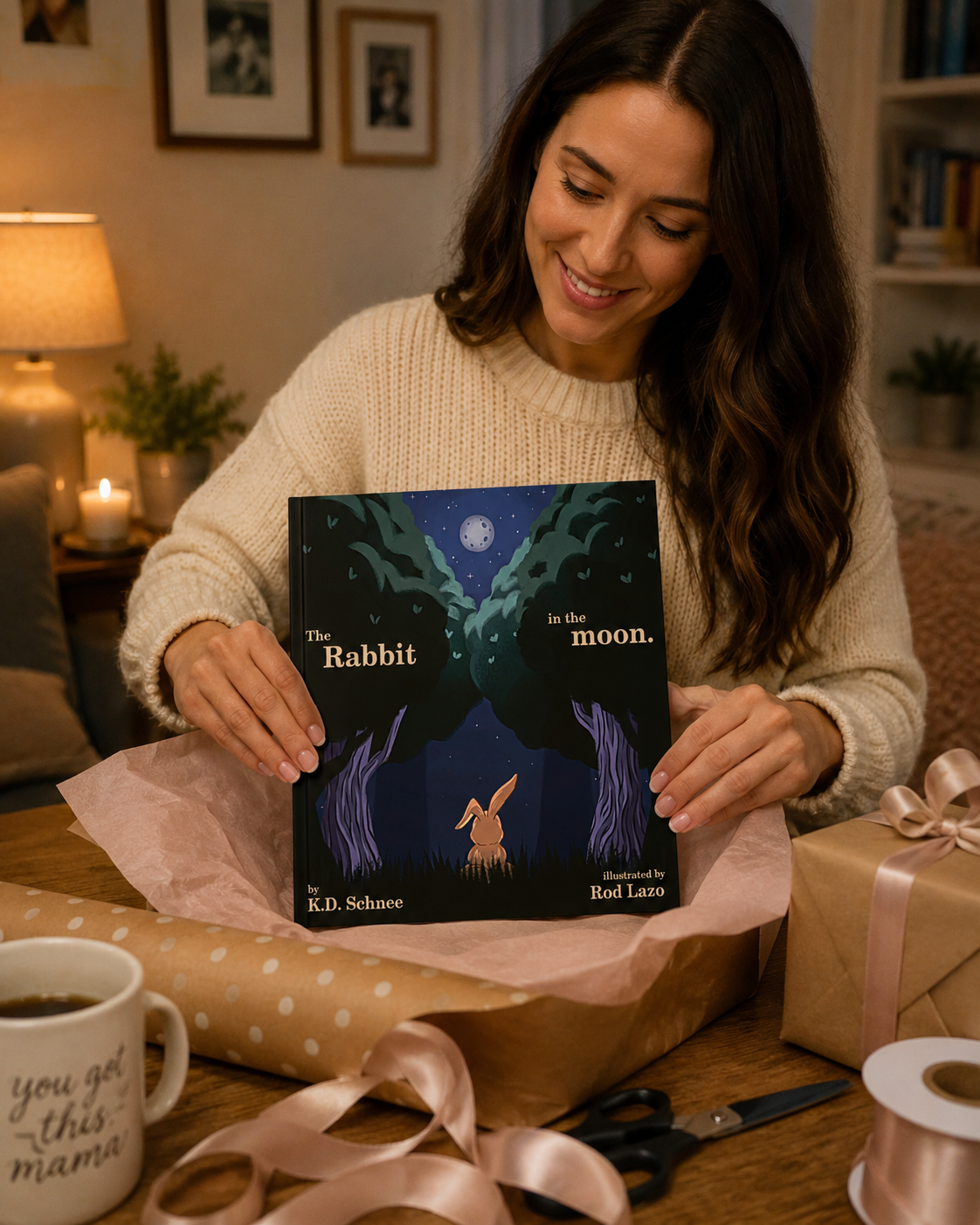
The best children’s book gifts are not just opened once. They become part of bedtime, family language, and the moments children return to when they need a story.
The best gift books for children are the ones that keep mattering after the wrapping paper is gone. A good children’s book gift gives a child more than something to own. It gives them a story to hear again, a character to remember, and a little piece of language the family can use long after the gift is opened.
That is what makes books different from so many other gifts.
A toy may get a burst of attention and then disappear into a bin with three missing pieces and a mysterious plastic wheel nobody can identify. A good book has a different life. It can sit beside a bed, travel in a backpack, get read by a grandparent, become part of a classroom shelf, or return during a hard week when a child needs the comfort of something familiar.
As the creator of Yabbit the Rabbit and The Rabbit in the Moon, I think the best children’s books are not chosen only because they look beautiful or have a strong message. They are chosen because they meet a child somewhere real. They help with bedtime, worry, confidence, friendship, separation, mistakes, courage, grief, or simply the need to feel close to someone who loves them.
That is the kind of gift that lasts.
What makes a children’s book a good gift?
A good children’s book gift should feel personal, useful, and worth rereading.
That does not mean it has to be expensive or fancy. It means the book should have a reason to belong to that child. Maybe it fits their age. Maybe it matches something they love. Maybe it helps with a feeling they are learning to understand. Maybe it gives the family a story they can read at bedtime. Maybe it is the kind of book a child will grow into instead of out of after one week.
A strong gift book usually has a few qualities in common: memorable characters, beautiful or engaging illustrations, language that sounds good aloud, emotional clarity, and enough depth to reward rereading. It should not feel like a lecture wearing a dust jacket. Children can detect that faster than adults think.
The best gift books give the child pleasure first. The meaning follows because the story is strong enough to carry it.
Why picture books make especially meaningful gifts
Picture books make excellent gifts because they are shared experiences, not just objects.
A picture book invites someone to sit beside a child and enter the story together. The child hears a voice they know. They notices details in the artwork. They asks questions, points at a page, laughs at the same line again, or quietly returns to a feeling the story helped them understand. That kind of reading is personal in a way many gifts are not.
Picture books also work across a wider age range than people assume. Toddlers may connect with the pictures and rhythm. Preschoolers may follow the emotional shape of the story. Kindergarteners and early elementary children may notice deeper details, character choices, and themes they were not ready for the first time. A good picture book can grow with a child because the child brings more to it each year.
That is one reason The Rabbit in the Moon was created as a richly illustrated picture book. Yabbit’s hesitation, Snail’s steadiness, the moonlit journey, and the phrase “one tiny brave hop” give children several ways into the story, even before they can explain every feeling in words.
Choose a book for the child, not the adult’s bookshelf fantasy
Adults sometimes choose children’s books based on what they think a child should like.
That is understandable. We want to give beautiful books. We want the gift to feel thoughtful. We may have fond memories of a classic from childhood or want to give a book with a meaningful lesson. But the best book gifts usually begin with the actual child in front of us.
Is the child funny, cautious, dreamy, active, sensitive, curious, stubborn, quiet, theatrical, easily worried, or always asking questions? Do they love animals, space, trucks, sports, art, bedtime stories, silly voices, magical worlds, friendship stories, or books with very little text? Are they drawn to bold pictures or soft ones? Do they like stories that move quickly, or do they enjoy lingering over the artwork?
A book gift becomes stronger when it feels chosen for that child, not for an imaginary child who calmly reads in a sunbeam while never asking for snacks.
This is especially important for hesitant children. If a child often freezes before trying, avoids new situations, worries about mistakes, or needs time to begin, a book about courage may be more than a sweet gift. It may become a tool the family actually uses.
The best gift books help with real family moments
The most meaningful children’s book gifts often help with moments families are already living through.
A bedtime book helps when nights feel long. A separation book helps when goodbyes are hard. A friendship book helps when joining the group feels scary. A mistake book helps when a child melts down over getting something wrong. A courage book helps when a child wants to try but cannot quite begin.
That is the emotional lane where The Rabbit in the Moon belongs.
Yabbit is not a fearless character bouncing through life with tiny motivational fireworks. He hesitates. He pauses. He feels the size of the journey before him. Snail brings steadiness and support. The story helps children understand that courage is not being fearless. It is taking one small brave hop forward when something feels big.
For parents, grandparents, teachers, godparents, aunts, uncles, and family friends, that makes the book more than a nice object. It gives the child and the adults around them a shared phrase they can use later.
“This feels like a Yabbit moment.”
“What is one tiny brave hop?”
A gift book becomes more powerful when it leaves language behind.
What kinds of children’s books make the best gifts?
The best children’s book gifts usually fall into a few helpful categories.
Some books are comfort books. These are the stories children want at bedtime, when they are tired, sick, sad, or needing closeness. Some books are laugh books. They give families the pure oxygen of silliness. Some books are wonder books, full of beautiful illustrations, nature, adventure, imagination, or ideas that make a child lean closer. Some books are courage books, helping children face fear, mistakes, school, separation, grief, change, or new beginnings.
A strong children’s bookshelf needs all of these.
When choosing a gift, it helps to think less about finding “the best book” in some universal sense and more about choosing the right job for the gift. Are you giving a bedtime anchor? A birthday keepsake? A first-day-of-school support? A book for a child who worries? A classroom read-aloud? A holiday gift that still feels meaningful in February?
A gift book does not need to do everything. It needs to do one meaningful thing well.
For a deeper guide to building a balanced shelf for children, read: https://www.yabbitrabbit.com/parent-resources/how-to-build-childrens-book-collection
Why The Rabbit in the Moon makes a meaningful children’s book gift
The Rabbit in the Moon makes a meaningful children’s book gift because it gives families a beautiful story and a practical emotional language at the same time.
The book was created for children who hesitate at the beginning. Those children are everywhere. They hesitate before school, sports, reading, bedtime, new activities, making friends, asking for help, or trying again after a mistake. They may want to participate, but the first step feels too big.
Yabbit gives that feeling a character. Snail gives the child a model of steady support. The story gives families a way to talk about courage without turning it into a lecture. That is why The Rabbit in the Moon works well as a gift for toddlers, preschoolers, kindergarteners, early elementary children, and the adults who read with them.
It is also the kind of book that can be given with a note.
“For the moments when the first step feels big.”
“For one tiny brave hop.”
“For bedtime, courage, and all the beginnings ahead.”
A book becomes more memorable when the giver explains why it was chosen.
What should grandparents look for in gift books?
Grandparents often want to give something that feels lasting.
A children’s book is one of the best ways to do that because it can become part of the child’s actual life. It may be read during sleepovers, kept on a bedside table, signed with a short inscription, or remembered years later because it was always “the book Grandma gave me” or “the book Grandpa read in that voice.”
When grandparents choose gift books, I would look for three things: a story the child can enjoy now, a message the family will appreciate, and a physical book that feels worthy of keeping. Children may not understand “keepsake” when they open the gift, but families do. A meaningful picture book can become part of the household memory.
This is a natural place for The Rabbit in the Moon. It gives grandparents a gift that is gentle, beautiful, emotionally useful, and easy to connect to real childhood moments. It is not a noisy gift. It does not need batteries. It does not blink at anyone from the corner of the room. It simply waits to be read.
There is something lovely about that.
What should parents look for in gift books?
Parents should look for books they will not dread reading again.
This is not a small detail. Children reread books. They ask for the same story again and again because repetition builds comfort, memory, language, and mastery. If a book is poorly written, visually chaotic, or annoying after two reads, it may not survive bedtime with dignity.
A good gift book should sound good aloud. The words should have rhythm, warmth, humor, beauty, or emotional honesty. The illustrations should give the child something to notice beyond the first reading. The message should be meaningful without trapping the child in a lecture.
Parents should also think about usefulness. Will this book help during a real family moment? Will it calm bedtime, support a transition, encourage a hesitant child, build emotional language, or simply create closeness on the couch?
A gift book does not have to be serious to be meaningful. But it should have enough substance to return to.
For a fuller guide on judging whether a picture book is worth buying, read: https://www.yabbitrabbit.com/parent-resources/what-makes-picture-book-worth-buying
What should teachers look for in gift books?
Teachers need books that can hold a group.
That is different from choosing only for one child. A classroom gift book should have clear emotional stakes, strong illustrations, read-aloud strength, and enough room for conversation. It should give children something to notice and teachers something useful to ask without turning the story into a worksheet.
A good classroom gift book can support the culture of the room. It can help children talk about kindness, courage, patience, persistence, friendship, grief, fear, mistakes, or trying again. It can also become shared language for the class.
The Rabbit in the Moon works well in this setting because Yabbit’s hesitation is not rare. Many children know what it feels like to pause before joining, starting, reading aloud, raising a hand, or trying something hard. When a classroom has language for that moment, the teacher does not have to single out one child. The whole class can understand that tiny brave hops count.
That is a useful book to place on a shelf.
How to choose gift books by age
Age matters, but it should not be the only guide.
For toddlers, look for books with strong visual appeal, rhythm, repetition, warmth, and enough simplicity to hold attention. For preschoolers, look for stories with clear emotions, memorable characters, and illustrations they can explore. For kindergarteners and early elementary children, look for books with deeper emotional arcs, richer language, and themes they can connect to real life.
Still, children do not develop in tidy little age boxes. A four-year-old may sit with a longer story if the illustrations pull them in. A seven-year-old may still need picture books because the emotional work is right for them. A hesitant eight-year-old may understand a story about courage more deeply than they did at five.
That is why emotionally rich picture books make strong gifts. They are not disposable. The same book can mean different things at different ages.
The best question is not only, “Is this book for the child’s age?”
It is also, “Is this book for the child’s stage?”
When is a children’s book the right gift?
A children’s book is the right gift when you want to give something that can become part of a child’s routine, memory, or emotional life.
Books work beautifully for birthdays, holidays, baby showers, preschool graduations, kindergarten starts, teacher gifts, classroom donations, bedtime baskets, travel gifts, new sibling gifts, and “I saw this and thought of you” gifts. They also work when a child is going through something: moving, starting school, feeling nervous, struggling with bedtime, learning to read, grieving, or trying to build confidence.
The best gift books do not have to announce themselves loudly. They often become meaningful slowly. A child hears the story once, then again, then begins to ask for it. A phrase becomes familiar. A character becomes a friend. A parent reaches for the book during a hard moment because it says something the family already needs.
That is the quiet magic of a well-chosen book. It keeps opening.
What to write inside a children’s book gift
A short inscription can turn a children’s book into a keepsake.
It does not need to be fancy. In fact, the best inscriptions are usually simple and specific. Write the child’s name, the date, and one sentence about why you chose the book. That gives the gift a little root system. Years later, the child or parent can open the cover and remember who gave it and why.
For a book like The Rabbit in the Moon, you might write:
“For the moments when one tiny brave hop is enough.”
“May this story remind you that courage can be small.”
“For bedtime, big feelings, and brave little beginnings.”
“Whenever the first step feels hard, remember Yabbit.”
“Read this when the world feels big and the next step feels small.”
An inscription should feel like a hand on the shoulder, not a greeting card trying to win an award. Keep it honest. Keep it warm. Let the book do the rest.
What makes a book gift feel personal?
A book gift feels personal when the giver has clearly thought about the child.
That can mean choosing a story because of the child’s interests, temperament, age, current stage, or family moment. It can also mean pairing the book with something small: pajamas for a bedtime book, a stuffed animal for a comfort book, colored pencils for an art book, a library card holder for a new reader, or a handwritten note for the parent.
But the book itself should still be the center.
Avoid choosing books only because they are popular. Popular books can be wonderful, but popularity is not the same as fit. A book that speaks to a child’s real life will often matter more than the book everyone else is buying.
For a hesitant child, The Rabbit in the Moon can feel personal because it quietly says, “I see the part of you that needs time to begin.” That is a powerful message to place inside a gift.
Why meaningful books last longer than trend gifts
Trend gifts have their place. Children enjoy the toy of the moment, the character of the season, the shiny thing with seventeen sounds and one tiny screw that vanishes immediately. There is nothing wrong with fun.
But meaningful books age differently.
A good children’s book can move from bedtime to bookshelf to classroom to memory. It can be reread during different seasons of childhood. It can be given to a sibling. It can sit quietly until the day a child needs exactly that story. It can become part of a family’s emotional vocabulary.
That is why I believe in giving children books with real story underneath them. Not books that only instruct. Not books that only decorate. Books that help a child feel, wonder, laugh, understand, and try.
The best gift book is not just the one that gets opened. It is the one that gets returned to.
Buy the Book
If you are looking for a meaningful gift book for a child who hesitates, worries, resists new things, struggles with bedtime, fears mistakes, or needs courage to feel smaller, The Rabbit in the Moon belongs on your list.
Yabbit is not fearless. He pauses before the journey. Snail brings steadiness, patience, and quiet support. Together, they help children understand that courage does not have to arrive all at once. It can begin with one tiny brave hop.
For parents, grandparents, teachers, counselors, and gift-givers, The Rabbit in the Moon is more than a beautiful picture book. It gives children language for hesitation, support, and trying one small step when the beginning feels too big.
It is a story to read aloud, return to, and remember.
External Resource
For more guidance on choosing books that match a child’s age, interests, and reading experience, Reading Rockets offers this helpful guide:
https://www.readingrockets.org/topics/childrens-books/articles/selecting-books-your-child-finding-just-right-books
FAQs
What are the best gift books for children?
The best gift books for children are books that match the child’s age, interests, and stage of development while offering something worth rereading. Strong picture books, bedtime books, courage books, funny books, and emotionally meaningful stories often make excellent gifts.
Are picture books good gifts for older children?
Yes. Picture books can be meaningful gifts for older children because they often carry deeper themes through artwork, language, and emotional storytelling. A seven- or eight-year-old may understand a picture book about courage, friendship, worry, or mistakes more deeply than a younger child.
What makes The Rabbit in the Moon a good gift book?
The Rabbit in the Moon is a strong gift book because it is visually rich, emotionally useful, and built around a message children can use in real life: courage can begin with one tiny brave hop. It is especially meaningful for hesitant, anxious, or sensitive children.
What should I write inside a children’s book gift?
Write the child’s name, the date, and one short sentence about why you chose the book. For example: “For the moments when one tiny brave hop is enough,” or “May this story remind you that courage can be small.”
What kind of book should grandparents give children?
Grandparents should look for books that feel lasting, warm, and connected to the child’s life. Bedtime stories, beautifully illustrated picture books, courage books, and books with a personal inscription often become keepsakes.
How do I choose a book gift for a child I do not know well?
Choose a book with broad emotional appeal, strong illustrations, and a read-aloud quality families can enjoy together. Books about courage, bedtime, friendship, kindness, wonder, or trying new things are usually safer choices than narrow-interest books.
Is a book a good birthday or holiday gift for a child?
Yes. A book can be an excellent birthday or holiday gift because it lasts beyond the day it is opened. The best children’s book gifts become part of bedtime, family routines, classroom shelves, and the child’s emotional memory.