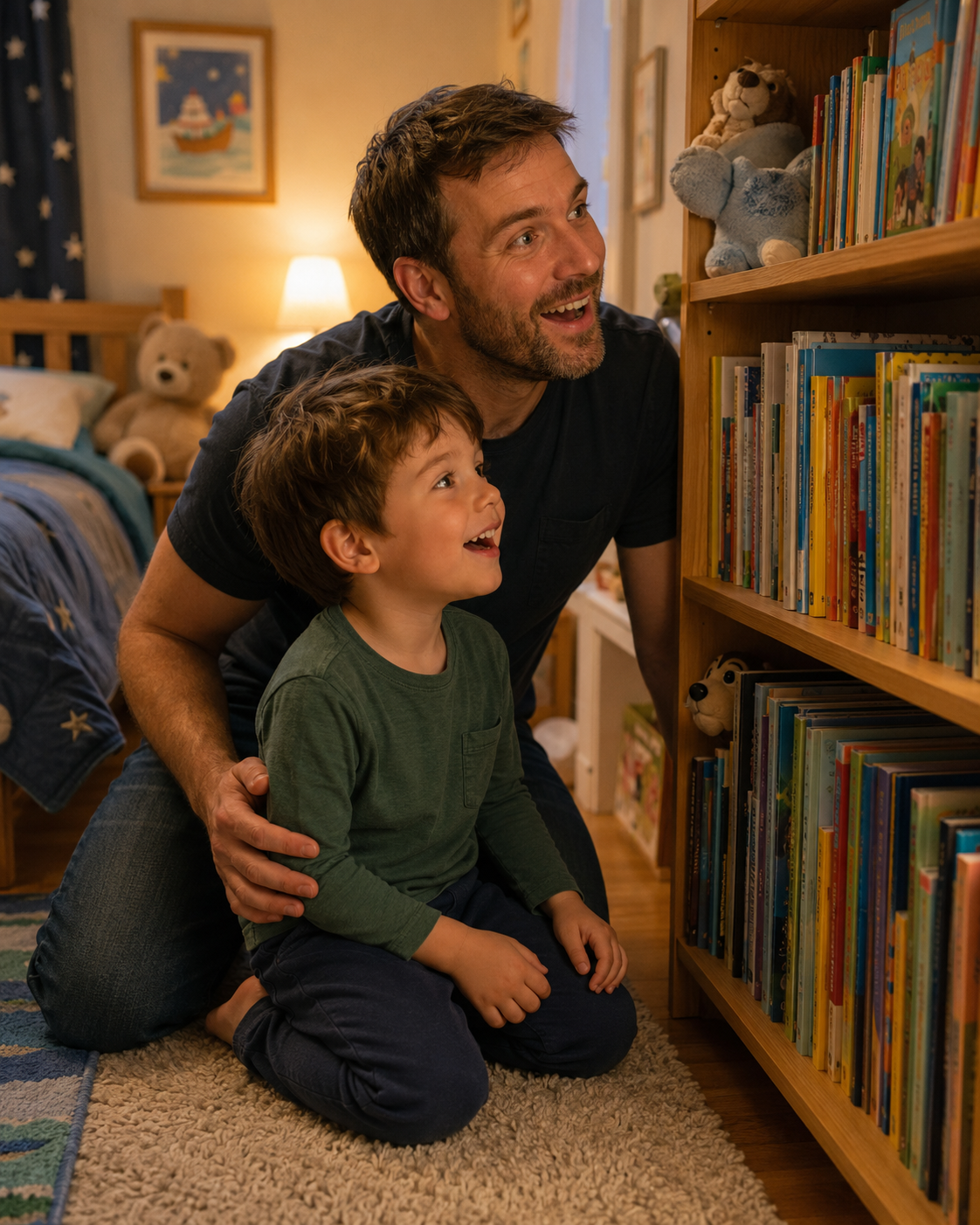
A child’s bookshelf should not only look beautiful. It should help with bedtime, feelings, laughter, courage, and the real moments childhood brings to the door.
A children’s book collection grows with your child when it includes books that do different jobs.
For children ages 3 to 8, a strong picture-book shelf should include comfort books, funny books, bedtime books, feeling books, courage books, classic books, modern books, and books that help with real family moments like separation, mistakes, fear, friendship, disappointment, and trying something new.
That is the simple answer.
A good collection is not built by buying whatever is popular, pretty, or discounted that week. It is built by asking, “What does my child need stories to help with right now, and what might they need next?”
Some books make a child laugh. Some help them calm down. Some give them words for feelings. Some become the story you reach for before a hard goodbye, a new classroom, a first practice, or bedtime when the dark feels bigger than usual.
The best children’s book collection is not a museum shelf. It is a working shelf.
What does it mean for a book collection to grow with your child?
A children’s book collection grows with your child when the books remain useful as your child’s language, feelings, questions, fears, humor, and courage change.
A three-year-old may love a book because of the animal, the moon, the rhythm, or the repeated phrase. A five-year-old may return to that same book because the character feels worried or brave. A seven-year-old may understand the deeper idea that courage does not mean feeling fearless. It means beginning anyway.
That is why I do not think parents should build a shelf only by age.
Age matters, but stage matters more. A child’s reading life is not a straight staircase. It is more like a room they keep rearranging. Some books are outgrown quickly. Others stay because they keep offering something new.
A book that grows with a child usually has more than one layer. It has a story young children can feel, artwork they can study, language they can remember, and emotional meaning older children can talk about. Those are the books that survive the great bookshelf migration from “cute” to “keepsake.”
Why should parents build a balanced picture-book shelf?
A balanced picture-book shelf gives children different kinds of support.
A child does not need every book to teach the same lesson. If every book is serious, the shelf gets heavy. If every book is silly, the shelf may not help when feelings get loud. If every book is a bedtime book, the collection may not support school, friendship, courage, or mistakes. If every book is a classic, the child may miss modern emotional language. If every book is modern, the family may miss the comfort of stories that have carried children for generations.
Balance matters.
A strong children’s book collection should help a child laugh, settle, wonder, name feelings, ask questions, build language, imagine courage, and return to stories when real life gets bumpy.
For parents, grandparents, caregivers, and teachers, that kind of shelf becomes practical. You are no longer standing in front of the books at 8:12 p.m. hoping one of them magically knows what to do. You start to know which books help your child calm down, which books make them laugh, which books open a conversation, and which books gently say, “This hard feeling is not the whole story.”
That is the shelf you want.
What comfort books should every child have?
Every child needs comfort books.
A comfort book is the story your child wants when they are tired, sick, overwhelmed, clingy, sad, or simply done with being a small person in a very large world. Comfort books often have rhythm, warmth, repetition, familiar routines, soft endings, and a feeling that everything can come down safely.
These books do not need to solve a problem. Their job is to help the child feel held.
A comfort book might be the same bedtime story read for the seventy-third time. It might be a board book that feels too young on paper but still soothes your child after a hard day. It might be a story with a parent, animal, blanket, moon, home, or return. The important thing is not whether the book impresses an adult. The important thing is whether your child’s body softens when the book begins.
For ages 3 to 8, comfort books still matter. Older children may not ask for comfort in the same way, but they still need it. Sometimes a familiar picture book can say what a child is too proud, tired, or tangled up to say.
A good comfort book is not babyish. It is a small emotional shelter.
Why do funny books belong in a child’s collection?
Funny books belong on the shelf because laughter is part of emotional health.
A child’s book collection should not become a row of tiny self-improvement manuals with animals on the cover. Children need books that are ridiculous, surprising, strange, noisy, clever, and wildly unserious. They need stories that let them laugh with you.
Humor builds connection. It lowers pressure. It gives children relief. It also helps reluctant readers and hesitant children enter books without feeling like every story is trying to fix them.
For a child who worries, freezes, or resists trying, funny books can be a gentle doorway. Laughter says, “You are safe here.” Once the child feels safe with books, they may be more willing to enter stories that carry deeper feelings too.
A balanced shelf should have books that make your child laugh so hard they interrupt the reading. That interruption is not a failure. It is proof the book has reached them.
A shelf with no funny books is a little too well-behaved for childhood.
What are feeling books, and why do they matter?
Feeling books help children recognize, name, and understand emotions.
These are books about worry, anger, sadness, disappointment, jealousy, fear, loneliness, frustration, embarrassment, and the strange little soup of feelings children carry before they know what to call it.
A good feeling book does not simply label emotions. It gives a feeling a story.
That matters because children often feel before they can explain. A child may not say, “I am anxious about joining the group because I might do it wrong.” They may say, “I don’t want to.” They may freeze. They may get silly. They may get angry. They may refuse the whole thing.
Feeling books give parents and teachers a softer way in. You can say, “That character looks unsure,” instead of “Why are you acting scared?” You can ask, “What do you think helped him?” instead of turning the child into a tiny courtroom witness.
The best feeling books help children feel seen without feeling exposed. For simple ways to use picture books to build feeling language at home or in the classroom, read: https://www.yabbitrabbit.com/parent-resources/emotional-literacy-activities-for-picture-books
What are courage books?
Courage books help children face something that feels hard.
That may be a new classroom, bedtime, a first lesson, a group of children already playing, a mistake, a performance, a goodbye, a disappointment, or the first step into something unknown.
The important thing is that courage books should not pretend fear disappears.
That is the mistake many adults make when talking about bravery. We make courage sound like a costume children are supposed to put on. But real courage for children is usually smaller. It is standing at the edge of the pool. It is touching the uniform. It is watching first. It is trying one part. It is asking for help. It is walking to the door even if they still feel nervous.
That is the Tiny Brave Hop Method in bookshelf form.
A courage book should help a child imagine one manageable next step. Not a heroic leap. Not instant confidence. One small brave hop forward.
The Rabbit in the Moon belongs in this category because Yabbit is not fearless. He hesitates, worries, pauses, and still learns to begin. Snail brings steady persistence beside him. Together, they give children a picture of courage that feels possible instead of performative.
That is what a courage book should do.
Why should a shelf include bedtime books?
Bedtime books are not only for sleep.
They help the day land.
At night, children are often tired, overstimulated, full of questions, and less able to manage feelings that seemed smaller during the afternoon. The room darkens. The house quiets. Separation can feel sharper. Imagination begins doing unpaid overtime.
A good bedtime book gives the child a familiar path from activity into rest. It creates rhythm. It creates closeness. It gives the adult a softer role than “please brush your teeth for the love of all moonlit creatures.”
For ages 3 to 8, bedtime books can help with routine, separation, nighttime anxiety, and emotional repair. The best ones are not always sleepy in a dull way. They may be tender, funny, beautiful, rhythmic, or quietly brave. What matters is that the child feels safer after reading them.
A bedtime book collection should include at least a few stories your child returns to when the night feels bigger than the room.
For more on why nightly reading supports children emotionally and mentally, read: https://www.yabbitrabbit.com/parent-resources/6-powerful-mental-benefits-of-reading-to-children-every-night
Why do classic books and modern books both belong?
A strong children’s book collection should include both classic and modern picture books.
Classic books often bring rhythm, familiarity, simplicity, and a kind of family memory. They may be stories parents or grandparents remember from their own childhood. That gives them emotional weight beyond the page. When a grandparent reads a beloved classic to a child, the book is not only a book. It is a little time machine with a spine.
Modern picture books bring something equally important. They often carry newer emotional language, broader representation, more direct support for feelings, and stories that reflect the world children are living in now. They may speak more clearly about anxiety, kindness, mistakes, identity, difference, courage, sensory needs, or social-emotional growth.
You do not have to choose between old and new. A child benefits from both.
The classics give a child roots. Modern books give a child mirrors, windows, and words for the world they are actually navigating.
A growing collection should have both kinds of light.
What are real-moment books?
Real-moment books are the ones you reach for when something specific is happening.
These books help with a situation your child is living through right now. Starting school. Moving. A new sibling. Friendship trouble. Death of a pet. Divorce. A hard goodbye. Fear of the dark. A hospital visit. A first recital. Losing a game. Being afraid to try again after failing.
Real-moment books are practical, but they should still be beautiful.
The danger with problem-solving books is that they can become too obvious. They may talk at the child instead of telling a story. A good real-moment book gives the child emotional distance. It lets them watch a character experience something similar without feeling put under a spotlight.
For parents, these books can be lifesavers. Not because they fix everything, but because they give you language when your own words are tired.
A simple script might be:
“This is a book for the feeling before something new.”
Or:
“This is a book for when goodbye feels too big.”
Or:
“This is a book for when trying again feels hard.”
That kind of language helps children understand that books can meet real life. They are not only entertainment. They are companions.
How many books does a child actually need?
A child does not need hundreds of books to have a meaningful collection.
A thoughtful shelf can begin with a small number of books that do different jobs. One comfort book. One funny book. One bedtime book. One courage book. One feeling book. One classic. One modern favorite. One book for a real family moment.
That is enough to begin.
The goal is not to build the most impressive shelf. The goal is to build a useful one. A crowded shelf full of books nobody reads is less valuable than a smaller shelf your child returns to again and again.
A good question for parents, grandparents, and gift buyers is this: “What job is this book doing on the child’s shelf?”
If the answer is clear, the book probably belongs.
If the answer is only “it was on sale” or “the cover was cute,” it may still be fine. Some lovely books enter the house that way. But over time, the best collections become more intentional.
You start buying fewer random books and more books with a purpose.
How should grandparents and gift buyers choose books?
Grandparents and gift buyers can build a child’s collection in a beautiful way, especially when they think beyond the newest bestseller display.
The best gift books are not always the loudest ones in the store. They are the ones a child can return to, talk about, grow into, or connect with a real moment in their life.
Before buying, ask one simple question: “What kind of book would help this child right now?”
If the child is starting school, choose a transition or courage book. If the child is struggling with big feelings, choose a feeling book. If the child loves to laugh, choose a funny book. If bedtime is hard, choose a calming bedtime story. If the child has everything, choose a keepsake-quality book with emotional depth.
You can even write a note inside the book explaining why you chose it.
“I picked this because every child needs a story that helps them feel brave.”
That turns a gift into a message. A book given with intention can become part of a child’s memory long after the wrapping paper vanishes into household legend.
How can teachers use a classroom book collection differently?
Teachers need book collections that work for groups.
A classroom shelf should include books that support transitions, belonging, friendship, kindness, courage, frustration, mistakes, waiting, listening, and trying again. These are not abstract themes in a classroom. They happen every day before lunch.
For teachers of children ages 3 to 8, picture books can create shared language for the whole group. A class can talk about what a character felt, what helped, what made the moment harder, and what a small next step could be.
This works especially well for hesitant children because it removes the spotlight.
Instead of saying, “You need to be brave,” a teacher can say, “This is a tiny brave hop moment.” The child is not being singled out. The class already knows the language. The story did the groundwork.
That is why I think every early childhood and early elementary classroom needs courage books and feeling books alongside alphabet books, seasonal books, nonfiction books, and funny read-alouds.
Children are not only learning letters. They are learning how to be people together.
What is a simple bookshelf formula for ages 3 to 8?
A balanced children’s book collection for ages 3 to 8 should include books for comfort, laughter, bedtime, feelings, courage, language, imagination, values, and real-life moments.
That sentence is useful because it gives parents a quick way to audit the shelf.
Look at your child’s books and ask: do we have books that make us laugh? Do we have books that calm the room? Do we have books that help with big feelings? Do we have books about courage? Do we have books that invite questions? Do we have books that feel beautiful enough to keep? Do we have books that help with the season our child is in right now?
You do not need a perfect mix. You need a living mix.
A child’s collection should change as the child changes. Books can rotate in and out. Some can stay forever. Some can be donated when they no longer serve. Some can be kept because they are stitched to memory even if nobody reads them every week.
A child’s bookshelf is allowed to grow up slowly. So is the child.
How does The Rabbit in the Moon fit into a growing collection?
The Rabbit in the Moon fits into a growing children’s book collection as a courage book, a bedtime book, a feeling book, and a real-moment book for children who hesitate before trying.
That is why it belongs on a thoughtful shelf.
Yabbit gives children a character who pauses before something big. Snail gives them steady persistence. The story helps families talk about fear, uncertainty, support, and courage without turning the child into the problem.
For a three-year-old, the book may be about animals, moonlight, rhythm, and closeness. For a five-year-old, it may become a way to talk about worry before school or bedtime. For a seven- or eight-year-old, it may become a story about trying again, facing embarrassment, and understanding that brave does not mean fearless.
That is what it means for a picture book to grow with a child. It offers one thing at first, then more later.
The Rabbit in the Moon is not meant to be a hard sell on the shelf. It is meant to be a story families can reach for when beginning feels hard and the next step needs to become smaller.
One tiny brave hop is not only a message. It is a tool.
How do you know a book belongs on your child’s shelf?
A book belongs on your child’s shelf if it gives your child something worth returning to.
That might be laughter. Calm. Language. Courage. Comfort. Beauty. Curiosity. A phrase. A feeling. A memory. A moment of connection with you.
Not every book has to do everything. In fact, it should not. One book may be the silly one. One may be the bedtime one. One may be the brave-start book. One may be the book your child reaches for when they want to sit close and say nothing at all.
That variety is the strength of the collection. The best children’s book collection does not ask every book to be perfect. It asks the shelf to be balanced.
When the shelf has balance, parents have options. Children have places to go. Teachers have language to borrow. Grandparents have gifts with meaning.
And a child begins to understand something quietly powerful: there is probably a story for this feeling too.
Buy the Book
If you are building a children’s book collection that supports emotional growth, courage, and meaningful read-aloud connection, The Rabbit in the Moon belongs on your shelf.
Yabbit is a hesitant rabbit who feels the size of a difficult journey before he begins. Snail brings steadiness, persistence, and quiet support. Together, they help children understand that courage does not have to arrive all at once. It can begin with one tiny brave hop.
For parents, grandparents, caregivers, teachers, and counselors, The Rabbit in the Moon works as a bedtime story, a courage book, a feeling book, and a real-moment book for children who pause before trying.
It is a meaningful investment in your child’s emotional growth and a story families can return to when the next step feels too big.
FAQs
What books should be in a children’s book collection?
A children’s book collection should include comfort books, funny books, bedtime books, feeling books, courage books, classic books, modern books, and books that help with real family moments. A balanced shelf gives children different kinds of support as they grow.
How do I build a picture-book shelf for ages 3 to 8?
Start with books that match your child’s stage and feelings. Choose stories that support language, laughter, comfort, bedtime, friendship, courage, mistakes, and emotional growth. The best shelf grows as your child’s needs change.
How many children’s books does a family need?
A family does not need hundreds of books. A small, thoughtful collection can be very powerful if the books do different jobs and children return to them often. Quality, usefulness, and reread value matter more than the total number.
What makes a picture book worth keeping?
A picture book is worth keeping when a child returns to it, remembers it, talks about it, or uses its language in real life. Books that build connection, comfort, emotional language, courage, or family memory often earn a permanent place on the shelf.
What are courage books for children?
Courage books are stories that help children face fear, hesitation, uncertainty, or new experiences. The best courage books do not pretend fear disappears. They show children how to take one small brave step while the feeling is still there.
Is The Rabbit in the Moon a good book for a child’s home library?
Yes. The Rabbit in the Moon is a strong addition to a child’s home library because it works as a bedtime book, courage book, feeling book, and real-moment book for children who hesitate before trying. It gives families usable language through Yabbit, Snail, and the idea of one tiny brave hop.
What is a good children’s book gift?
A good children’s book gift is one that matches the child’s age, stage, interests, and current emotional needs. For a more meaningful gift, choose a book that helps with laughter, comfort, courage, bedtime, feelings, or a real life transition the child is facing.