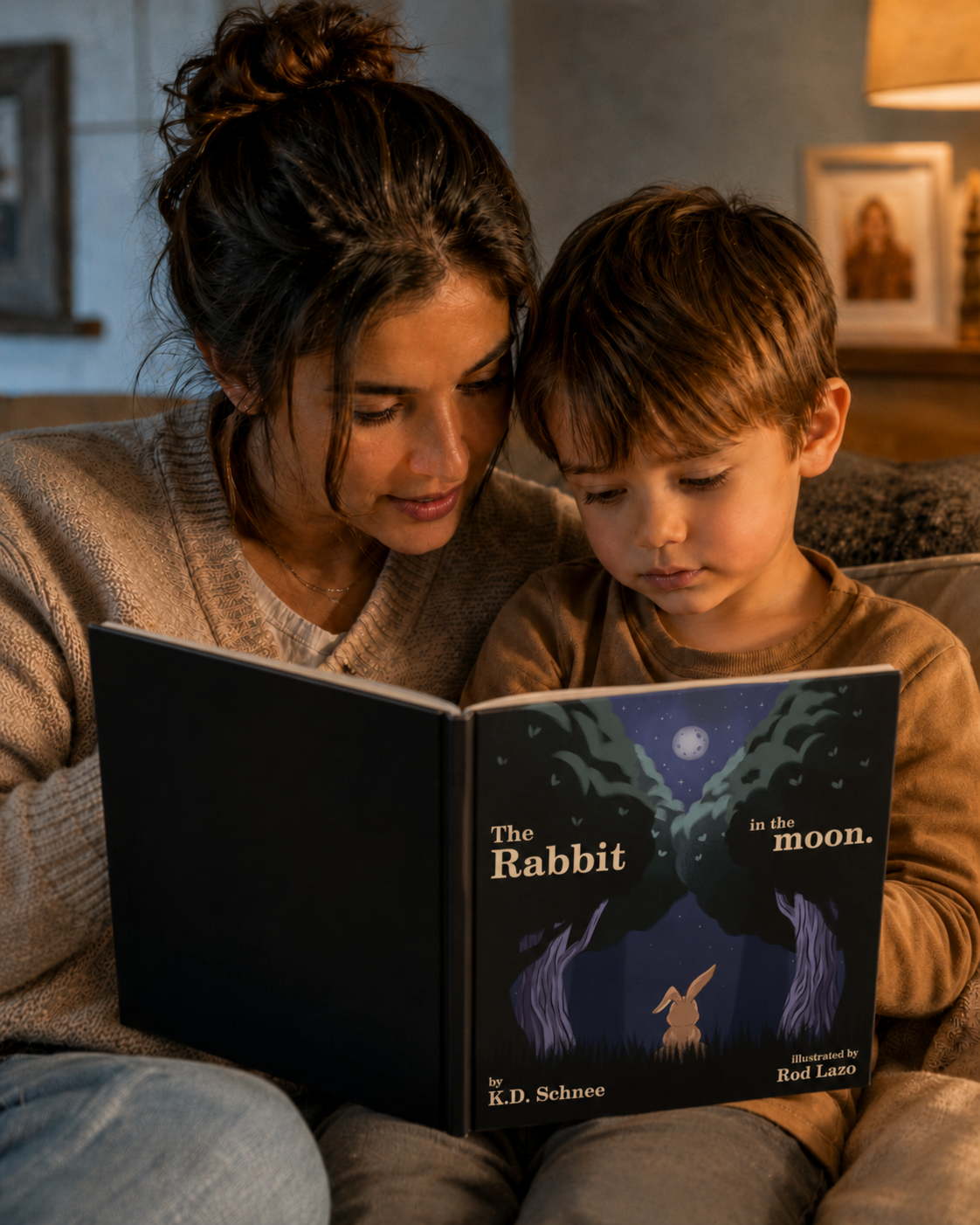
The goal is not to read perfectly. The goal is to help the story become something your child can carry.
A picture book does not end when you close the cover.
At least, the best ones do not.
A meaningful picture book follows a child into the next hard moment. It shows up at bedtime, at the classroom door, before swim lessons, after a mistake, during a quiet worry, or in that tiny pause before trying something new. It becomes a phrase your child remembers. A character they recognize. A feeling they can finally point to.
That does not happen because a parent reads the book like a professional narrator. It happens because the adult makes the story feel safe enough to enter.
Parents sometimes put too much pressure on themselves during storytime. They think they need funny voices, perfect pacing, a lesson plan, and the patience of a woodland saint. You do not. Your child does not need a performance. Your child needs your presence.
Reading a picture book well is not about turning every page into a teaching moment. It is about knowing when to pause, when to point, when to ask one gentle question, and when to simply let the story breathe.
That is how the story stays with them.
Start by slowing down
Most adults read picture books faster than children experience them.
We see the words and move forward. Children see the whole page. They notice the character’s face, the color of the sky, the strange little object in the corner, the shadow, the distance between characters, the page turn, the moon, the expression, the change.
They are reading more than words. So the first strategy is simple: slow down.
Let your child look before you rush to explain. Let the page sit for a moment. Give the illustrations a chance to do their work. Some of the most important emotional information in a picture book is not always in the sentence. It may be in the character’s eyes, posture, size, or surroundings.
In The Rabbit in the Moon, Yabbit’s hesitation is not only told through words. It is visible. The color changes. The night deepens. Snail’s steady presence matters. The journey begins to feel bigger, and children can sense that before they can explain it.
If you move too quickly, your child may miss the quiet feeling of the page. A pause is not empty space. It is where noticing begins.
Point before you explain
Pointing is underrated.
A simple point to a character’s face can open more emotional understanding than a long explanation. You might point to Yabbit and say, “Look at his eyes here.” Or, “His body looks a little still.” Or, “Snail is close by.”
That is enough.
Children do not always need us to name the whole feeling immediately. Sometimes they need us to help them notice the clue. When you point, you are teaching your child how to read the emotional world of a story. You are showing them that faces, bodies, distance, and color all carry meaning.
This matters because children use those same skills in real life.
They learn to notice when someone looks nervous. They learn to notice when a friend is standing apart. They learn to notice when their own body feels tight, frozen, wiggly, or unsure. A picture book gives them a safe place to practice that noticing.
The key is not to overdo it.
Point once. Let your child respond. If they say nothing, that is fine. Silence does not mean nothing is happening. Children often absorb meaning quietly before they are ready to give it back in words.
Ask gentle questions, not quiz questions
There is a big difference between a question that opens a story and a question that turns storytime into homework with pajamas on.
Children can feel the difference.
A quiz question usually has one right answer. “What color is that?” “How many trees are there?” “What happened first?” Those questions can be useful sometimes, especially for language and memory, but they are not always the best questions for emotional connection.
A gentle question gives the child room.
Try questions like:
“What do you notice?”
“How do you think Yabbit feels here?”
“Does this page feel calm or worried?”
“Who is helping?”
“What changed from the last page?”
“What do you think one tiny brave hop would be?”
Those questions invite the child into the story instead of testing whether they understood it correctly.
The goal is not to interrogate the book until it gives up its secrets. The goal is to help your child practice noticing feelings, choices, and small changes. One thoughtful question is usually better than ten rapid-fire questions.
If your child gives an unexpected answer, follow it. Children often see something adults miss. That is part of the beauty of reading together.
Notice character feelings before connecting them to your child
This is one of the most important things I would tell parents.
Start with the character.
If a child is hesitant, anxious, frustrated, embarrassed, or afraid, it can feel too direct when an adult immediately says, “Do you feel like that too?” The child may shut down. They may say no. They may feel exposed.
The character gives you distance.
You can say, “Yabbit looks unsure here.” That is safer than saying, “You get scared like that.” You can say, “This part feels hard for him.” That is softer than saying, “This is what happened to you yesterday.” You can say, “Snail keeps going slowly.” That is gentler than saying, “You need to keep going.”
Distance is not avoidance.
Distance is what allows many children to approach a feeling without feeling trapped by it.
Once your child is comfortable talking about the character, they may eventually connect the story to themselves. They may say, “I felt like that at school,” or “That was like when I didn’t want to go in,” or “I needed a tiny brave hop.”
Let that connection come naturally when you can.
The story should open the door, not push the child through it.
Let the illustrations carry emotional language
Picture books are powerful because illustrations can say what a child may not yet know how to say.
A child might not understand the word hesitation, but they can see Yabbit pause. A child might not understand persistence, but they can see Snail continuing. A child might not understand emotional safety, but they can see that a character is not alone.
This is why I believe parents should spend time with the pictures, not only the text.
Ask your child what the colors feel like. Notice whether the page feels open or crowded, light or dark, calm or uncertain. Talk about where the characters are standing. Talk about who is close, who is alone, who is looking forward, and who is looking back.
You do not have to make this complicated.
You might simply say, “The night feels bigger here.” Or, “Yabbit looks smaller on this page.” Or, “Snail is still with him.”
Those little observations build emotional language.
They help children understand that feelings can be seen, named, and shared. They also help children realize that bravery does not always look like a huge dramatic leap. Sometimes it looks like a worried rabbit standing still for a moment while a steady snail stays nearby.
That is a child-sized image of courage.
For more simple ways to use picture books to help children name feelings, read: https://www.yabbitrabbit.com/parent-resources/emotional-literacy-activities-for-picture-books
Do not rush to the lesson
Parents love their children. Because of that, we sometimes try to extract the lesson too quickly.
We finish a page and want to say, “See? That is why you should be brave.” Or, “That is why you should keep trying.” Or, “That is what I was telling you yesterday.”
I understand the instinct. But if we rush to the lesson, we can accidentally make the child feel managed instead of moved.
The story needs room to work. Children often absorb meaning through feeling before they can turn it into language. They may want to hear the same book several times before they talk about what it means. They may remember one image before they remember the message. They may carry the character quietly for a while.
Let that happen.
A picture book does not need to end with a speech from the adult. Sometimes the strongest ending is a quiet sentence: “I liked how Yabbit kept going.” Or, “Snail was steady.” Or, “That was a tiny brave hop.”
Then close the book. Trust the story.
Connect the book to real life later, not always in the moment
Sometimes the best time to use a picture book is not during the reading. It is the next day.
When your child is standing near the edge of the pool, frozen at the classroom door, avoiding a new activity, or getting upset after a mistake, you can gently bring the story back.
“This feels like a Yabbit moment.”
“What would one tiny brave hop be?”
“Who can be steady like Snail right now?”
That is where the book becomes practical.
You are not lecturing. You are borrowing shared language from a story your child already knows. The phrase carries warmth because it comes from the book, not from a correction. It feels less like an adult command and more like a small familiar bridge.
That is why I care so much about giving families usable language.
A story that stays with a child gives the family words for moments that used to feel too big. It helps parents respond with more calm. It helps children feel less alone inside the feeling. It turns courage into something small enough to try.
Read the same book again without apologizing for it
If your child asks for the same picture book again and again, that does not mean you are failing to provide variety.
It means the book is doing something.
Children return to books for many reasons. They like the rhythm. They like knowing what comes next. They like the comfort of the familiar. They are still working through the feeling. They want to master the language. They want to hear the phrase again. They want the same safe ending.
Repetition is one way children digest a story.
Adults often want novelty. Children often want return. A familiar book gives them a place where they know the path. That can be especially helpful for hesitant children, who may feel braver when they can anticipate what comes next.
If The Rabbit in the Moon becomes a repeat read, let it.
Your child may be returning to Yabbit’s pause, Snail’s steadiness, the moonlit journey, or the feeling that courage can begin small. They may not tell you that directly. They may simply say, “Again.”
Again can be a very intelligent request.
Match your reading style to your child’s mood
Not every storytime needs the same energy.
Some nights, your child may want a lively read-aloud with voices and laughter. Other nights, they may need calm pacing, a softer voice, and fewer questions. Some children love to talk during books. Others need to listen quietly. Some children like pointing. Others like holding the book. Some need movement while listening.
The best reading strategy is the one that meets the child in front of you.
If your child is tired, do less. If your child is curious, ask more. If your child is overwhelmed, let the story be simple. If your child is chatty, follow the conversation for a while. The point is not to force a perfect reading method onto every night.
The point is connection.
A picture book should feel like a place your child wants to enter, not another task they have to complete correctly. When reading becomes too controlled, the story can lose its softness. When it becomes too loose, the child may drift away. The balance changes from night to night.
That is normal. Parents do not need a script. They need attention.
Use one phrase your child can carry
After you finish a meaningful picture book, choose one phrase that can live beyond storytime.
Not a whole lecture. Not a summary. One phrase.
For The Rabbit in the Moon, that phrase might be:
“One tiny brave hop.”
That phrase works because it is small. It does not demand that a child become instantly confident. It does not erase fear. It does not pretend the moment is easy. It simply gives the child a next step.
That is what good emotional language does.
It makes the next moment more possible.
A child who hears “be brave” may not know what to do. A child who hears “one tiny brave hop” can begin to imagine something smaller. Stand near the group. Try one word. Touch the water. Walk to the door. Take one breath. Ask for help. Try the first line.
The phrase turns the story into a tool.
That is one reason picture books matter so much. They can give children language that is gentle enough to remember and practical enough to use.
Make room for the child’s interpretation
Children do not always take from a book what adults expect them to take. That is not a problem.
A parent may think the book is about courage. The child may be fascinated by Snail. A teacher may focus on persistence. A child may notice the moon. An adult may want to talk about fear. A child may ask why Yabbit looks small on the page.
Follow that.
When children are allowed to notice freely, they become more active readers. They begin to trust their own attention. They learn that books are not only things adults explain. Books are places they can explore.
This is especially important for children who hesitate. A hesitant child may already feel corrected often. They may hear a lot of “come on,” “try it,” “don’t worry,” and “you’re fine.” Storytime can become one place where they are not rushed into the adult’s interpretation.
Let them lead sometimes.
The conversation may wander. That is fine. A wandering conversation can still build language, connection, and emotional understanding.
Keep storytime from becoming therapy
Picture books can support emotional growth, but bedtime should not feel like a counseling appointment with stuffed animals.
Children need stories to remain stories.
That means the adult’s job is to guide lightly. Notice a feeling. Ask one gentle question. Connect the story to real life when it helps. Then let the child enjoy the book. Let the rhythm, art, character, and ending do their work.
If every page becomes a deep emotional excavation, your child may start avoiding the book. Nobody wants to be analyzed when they are trying to hear about a rabbit and a snail.
The emotional power of a picture book is often quiet. It does not need to be squeezed.
Use the story as an opening, not a spotlight. If your child wants to talk, talk. If your child wants to listen, let them listen. If your child wants the same page again, return to it. If your child closes the book and says nothing, the story may still be doing its work inside them.
Trust that.
Why The Rabbit in the Moon works as an emotional-language tool
The Rabbit in the Moon gives families a gentle way to talk about hesitation, fear, persistence, support, and courage.
Yabbit is not fearless. He pauses. He feels the size of what is ahead. He gives children a character who reflects the moment before trying. Snail brings steadiness and persistence without pressure. Together, they show that courage does not have to arrive all at once.
It can begin with one tiny brave hop.
That makes the book useful because many children do not know how to explain the pause before action. They may not say, “I want to try, but I feel overwhelmed.” They may say no. They may stall. They may cling. They may freeze. They may get frustrated.
Yabbit gives that pause a face. Snail gives that pause support. The story gives families language.
That is exactly what a strong picture book can do. It can take a feeling that once lived in silence and make it easier to notice, name, and carry.
A simple way to read The Rabbit in the Moon with your child
When reading The Rabbit in the Moon, begin by letting your child look at the page.
Do not rush the first question. Let them enter the world. Let them notice Yabbit, Snail, the moon, the colors, the darkening sky, the feeling of the scene.
Then choose one small thing to notice.
“Yabbit looks unsure here.”
“Snail is still moving.”
“This page feels darker.”
“The moon feels far away.”
After that, ask one gentle question.
“What do you think Yabbit is feeling?”
“What do you think helps him keep going?”
“What would one tiny brave hop be here?”
Then keep reading.
You do not have to pause on every page. You do not have to explain the whole message. The goal is to let the book become part of your child’s emotional vocabulary slowly.
Later, when real life feels hard, bring it back softly.
“This feels like a Yabbit moment. What is one tiny brave hop?”
That is how a picture book stays with a child.
Not because it was explained perfectly.
Because it became useful.
Why reading together matters beyond the book
Reading together gives children more than literacy.
It gives them connection, attention, memory, imagination, emotional language, and the comfort of a familiar voice. It helps them practice listening and wondering. It gives them a safe place to meet hard feelings before those feelings arrive in real life.
For hesitant children, that matters deeply.
A child who struggles to begin may need repeated experiences of safe beginnings. Opening a book is one of them. Entering a story is one of them. Watching a character face something hard and continue is one of them.
Those little rehearsals add up.
A bedtime story will not solve every hard moment. It is not supposed to. But it can give a child a steadier inner picture. It can give a parent a gentler phrase. It can make courage feel less like a demand and more like a doorway.
For more on why nightly reading supports children emotionally and mentally, read: https://www.yabbitrabbit.com/parent-resources/6-powerful-mental-benefits-of-reading-to-children-every-night
Buy the Book
If you are looking for a picture book that helps children carry emotional language into real life, The Rabbit in the Moon belongs on your shelf.
Yabbit gives children a character who hesitates without being shamed. Snail brings steadiness, persistence, and quiet support. Together, they help children understand that courage does not have to arrive all at once. It can begin with one tiny brave hop.
For parents, teachers, grandparents, and counselors, The Rabbit in the Moon offers more than a bedtime story. It gives children language for fear, hesitation, support, persistence, and brave little beginnings.
The Rabbit in the Moon is a meaningful investment in your child’s emotional growth.
FAQs
How should I read a picture book with my child?
Read slowly, let your child look at the illustrations, point to important details, ask gentle questions, and give the story room to breathe. You do not need to perform perfectly. The goal is connection and meaning.
What questions should parents ask during picture books?
Ask open, gentle questions like “What do you notice?” “How do you think the character feels?” “Who is helping?” or “What changed on this page?” Avoid making storytime feel like a quiz.
How can picture books help children understand feelings?
Picture books help children see feelings through characters, facial expressions, color, body language, and story events. Children can talk about a character’s feeling before they are ready to talk directly about their own.
How do I use The Rabbit in the Moon with a hesitant child?
Notice Yabbit’s hesitation, Snail’s steadiness, and the idea of one tiny brave hop. Later, when your child hesitates in real life, gently say, “This feels like a Yabbit moment. What would one tiny brave hop be?”
Should I stop and explain every page?
No. Too much explanation can make storytime feel heavy. Pause only when it feels natural. One thoughtful observation or question is usually enough.
Why does my child want the same picture book again and again?
Repetition helps children feel safe, understand language, remember story structure, and process emotions. A repeated book may be helping your child master a feeling or phrase they still need.
Can reading picture books help with emotional growth?
Yes. Picture books can help children name feelings, understand choices, build empathy, imagine courage, and borrow language for real-life moments. The best stories stay with children after the book closes.