The best values-based picture books do not hand children a lesson. They let children feel the lesson through story.
Children do not usually fall in love with a book because it teaches a value. They fall in love with a character.
That is where I would begin.
Parents want books that help raise good humans. That instinct is beautiful. We want our children to be kind, brave, honest, persistent, empathetic, responsible, and able to recover when life does not go their way. We want stories that support what we are already trying to teach at home.
But children can smell a lecture from across the room.
A picture book that marches onto the page waving a moral lesson too loudly often loses the child before the message ever lands. The child may hear the words, but they do not feel the story. And if they do not feel the story, they are much less likely to carry it into real life.
The strongest picture books that teach values do something quieter and more powerful. They let children watch a character face a moment. The character wants something. Fears something. Chooses something. Avoids something. Tries something. Makes a mistake. Keeps going. Repairs. Helps. Begins again.
That is how values become real to children. Not as rules floating above the story. As choices made inside the story.
Values are absorbed better when they are lived by a character
A child may understand “be kind” as a phrase, but kindness becomes more meaningful when they see a character notice someone left out and make room for them. A child may hear “don’t give up,” but persistence becomes more believable when they see a small character continue after the path gets hard. A child may be told “be brave,” but courage becomes more useful when they see someone feel afraid and still take one small step.
That difference matters.
Values are not only ideas. They are behaviors under pressure. Kindness matters when someone is excluded. Courage matters when something feels scary. Honesty matters when telling the truth costs something. Persistence matters when quitting would be easier. Self-kindness matters when a child makes a mistake and wants to disappear into the floorboards.
A good picture book gives children a safe way to practice watching those moments.
The child is not being accused. They are not being corrected. They are not being put on the spot. They are sitting beside an adult, looking at a character, and slowly beginning to understand what a value looks like when it has to move.
That is why story is stronger than sermon.
The first test: does the story come before the lesson?
When I choose a picture book that teaches values, I ask one question first: would this still be a good story if I removed the lesson?
If the answer is no, the book may feel preachy.
A strong values-based picture book should still have a character, a problem, a feeling, and movement. It should not feel like a list of correct behaviors wearing a costume. Children need to care what happens. They need to feel the tension. They need to recognize something human in the character’s struggle.
That does not mean every picture book needs a complicated plot. Some of the best children’s books are simple. But simple is not the same as thin.
A simple story can still carry emotional truth.
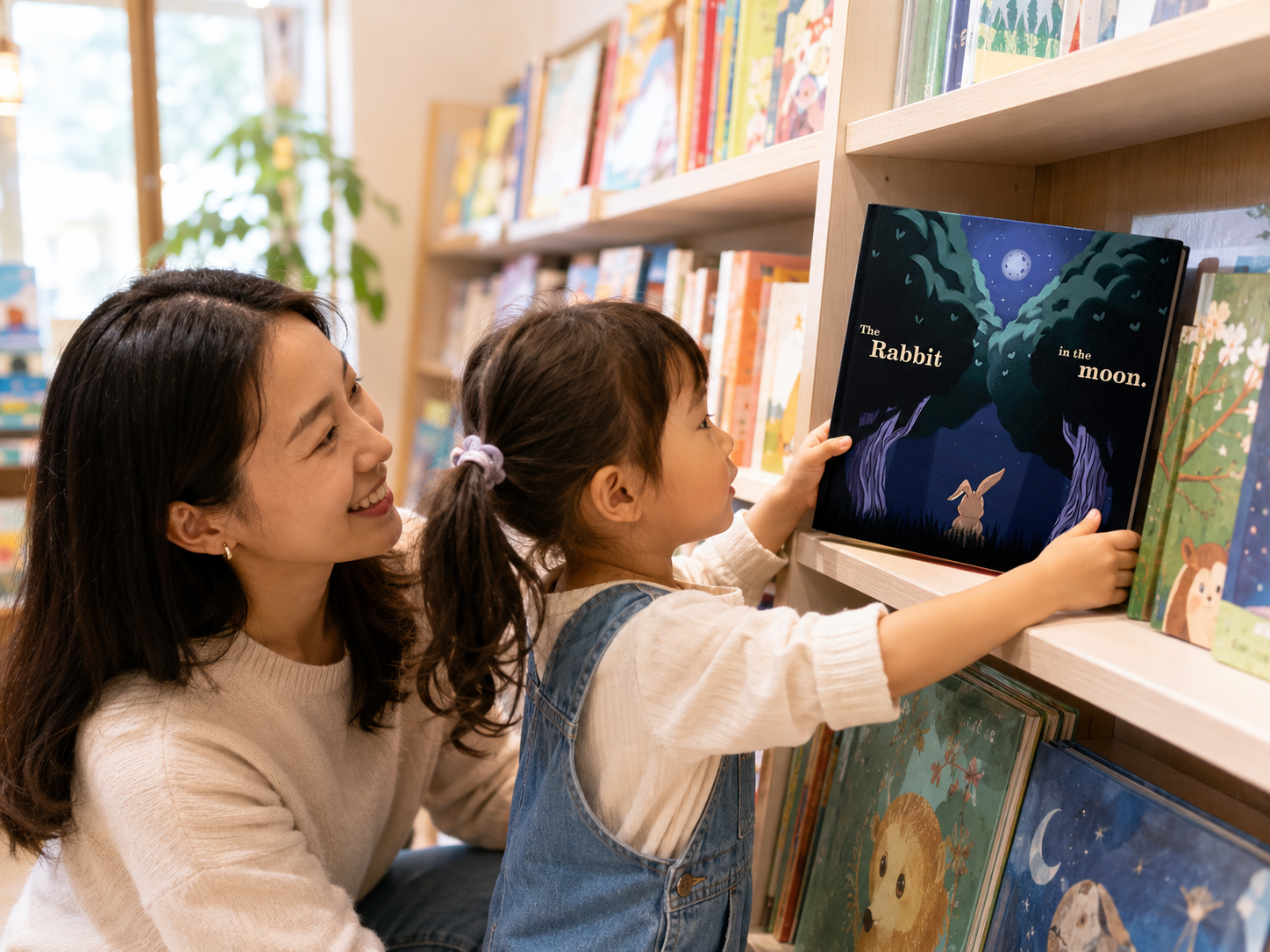
In The Rabbit in the Moon, the value is courage, but the book does not begin by announcing, “Today we will learn to be brave.” Yabbit is faced with something that feels enormous. He hesitates. Snail keeps the journey moving with steady persistence. The night grows bigger. The task still matters. The first step has to become small enough to try.
That is story doing the work. The value is there, but it is inside the character’s experience.
Look for books where the value costs something
A value becomes meaningful when it is not easy.
Kindness is easy when everyone is already being kind. Courage is easy when nothing feels scary. Persistence is easy when the task is fun. Honesty is easy when there is no consequence. Patience is easy when we are not waiting for something we desperately want.
Children understand this more than adults sometimes realize.
They know that values are harder in real life. They know it is hard to share the toy they love. They know it is hard to say sorry when they feel embarrassed. They know it is hard to join a group when they are worried everyone will look at them. They know it is hard to try again after missing the shot, spelling the word wrong, or freezing in front of the class.
So a good picture book should let the value cost something.
Not in a dramatic, adult-sized way. In a child-sized way.
The character should have to choose. Pause. Feel something. Lose something. Risk something. Try something before they are fully ready.
That is where the child begins to understand the value. Not as a poster on the wall. As a tiny brave hop.
Choose books that respect the child’s feelings
Some books try to teach values by making the child’s feeling look wrong.
That is not the approach I trust.
A child who hesitates does not need a story that makes hesitation look silly. A child who struggles with mistakes does not need a story that shames imperfection. A child who feels afraid does not need a story that treats fear as something weak children have and strong children outgrow.
The best values-based picture books respect the feeling underneath the behavior.
They understand that a child may refuse because something feels too big. They may avoid because they are worried about failing. They may cling because separation feels unsafe. They may quit because disappointment feels unbearable. They may get angry because shame arrived before language did.
A good story helps the child feel seen before it asks the child to grow. That order matters.
If a book skips straight to the value without honoring the feeling, it may sound correct to the adult but miss the child entirely. Children need to recognize themselves without feeling exposed. That is one reason animal characters can be so powerful. A rabbit, snail, owl, wolf, bat, or loon can carry a feeling gently enough for the child to look at it.
Yabbit gives children hesitation without shame. That is why he works.
Look for values that are shown through action
A picture book does not need to name the value twenty times. In fact, it is often stronger when it does not.
Children can see kindness when a character notices. They can see empathy when a character listens. They can see responsibility when a character tries to make something right. They can see courage when a character begins while still unsure. They can see persistence when a character keeps going after the first path does not work.
Action makes the value visible. This is especially important for younger children, who may not fully understand abstract words like integrity, resilience, empathy, or perseverance. Those words matter, but they become much easier to understand when attached to something a character does.
Instead of asking whether the book says “be kind,” ask whether kindness happens on the page.
Instead of asking whether the book says “be brave,” ask whether courage is made visible in a way your child can understand.
In The Rabbit in the Moon, courage is not presented as a personality trait. Yabbit is not brave because he is naturally fearless. He is brave because he feels something hard and still moves toward what matters. Snail’s persistence is not announced as a moral lesson. It is shown through steady movement.
That is the difference between teaching and preaching.
Choose books that give your family usable language
One of the best signs of a values-based picture book is that it gives your family language you can use later.
A phrase.
A character.
A question.
A tiny shorthand that helps in a real moment.
This matters because children often need help after the book closes. A story may be read at bedtime, but the value shows up the next day at school, on the playground, at the pool, in the classroom, at a birthday party, or before a new activity.
If the book has done its job, you can return to it gently.
“That feels like a Yabbit moment.”
“What would one tiny brave hop be?”
“Who could be steady like Snail right now?”
Those phrases are not lectures. They are bridges. They help the child connect the story to real life without making the child feel trapped under a lesson.
That is what I look for in a picture book that teaches values. I want the story to leave something useful behind. Not just a moral. A language the family can actually use.
Beware of books that reward perfection instead of growth
Some books appear to teach good values, but underneath the surface they are really rewarding perfection.
The brave child becomes fearless. The kind child never feels jealous. The honest child never struggles. The persistent child never gets tired. The “good” child always makes the right choice quickly and receives praise for being exactly what adults wanted.
That is not very helpful for real children.
Real children are still practicing. They are uneven. They want to be kind and still snatch the toy. They want to be brave and still freeze. They want to be honest and still worry about getting in trouble. They want to keep going and still feel like quitting when the puzzle, homework, sport, friendship, or goodbye feels too hard.
The best picture books leave room for growth. They do not show values as something children either have or do not have. They show values as something children practice.
That is the heartbeat of The Rabbit in the Moon. Courage is not a trophy Yabbit wins because he stopped being hesitant. Courage is something he practices while hesitation is still present. Snail’s persistence does not erase the hard feeling. It helps the journey continue.
That is a much kinder model for children.
The value should match your child’s real-life season
When choosing picture books that teach values, start with the season your child is actually in.
If your child is struggling to join other children, look for books about kindness, friendship, empathy, and social courage. If your child gives up quickly, look for stories about persistence and problem-solving. If your child is hard on themselves after mistakes, look for books about self-kindness, imperfection, and trying again. If bedtime is difficult, look for books that teach emotional safety, trust, and calm bravery.
Do not choose values in the abstract. Choose the value your child needs language for right now.
That does not mean turning the book into a tool with no beauty. Children still deserve wonder. They still deserve humor, surprise, rhythm, rich artwork, and story. But a well-chosen picture book can meet a real family moment and help everyone talk about it more gently.
That is where the right book becomes more than a purchase. It becomes part of the family’s emotional vocabulary.
Values should be taught with warmth, not pressure
Parents sometimes worry that if they do not make the lesson obvious, the child will miss it. I understand that instinct. But children are often absorbing far more than they are saying out loud.
A child may not finish a book and announce, “I now understand persistence as a long-term character trait.” Thank goodness. That would be a strange bedtime.
More often, the value works quietly.
The child asks for the book again. They point to the character. They remember the phrase. They bring it up days later when you least expect it. They use the language slightly wrong, then gradually use it more clearly. They connect the story to a hard moment in their own life.
That is how story works.
Warmth gives the value room to land. Pressure makes the child brace.
If every read-aloud becomes a lesson check, the child may begin to protect themselves from the book. Let the story breathe. Ask one gentle question. Notice one moment. Then let the child keep the story in their own way.
A value carried willingly will travel farther than one delivered by force.
Why persistence matters in a values-based picture book
Persistence is one of the most important values a child can learn, but it is often misunderstood.
Adults sometimes treat persistence as pushing harder. But for children, persistence often has to begin much smaller. It can mean staying with a puzzle for one more try. Walking back into the classroom after a hard morning. Trying one more letter. Standing near the group before joining. Taking a breath instead of quitting.
That is why Snail matters so much in The Rabbit in the Moon.
Snail does not turn persistence into noise. He is steady. Determined. Patient. He keeps moving toward what matters, but he does not shame Yabbit for hesitating. That balance is important because children need persistence without pressure.
A child who is already overwhelmed does not need someone shouting, “Keep going!” from the sidelines of their nervous system. They need a model of steady movement that feels possible.
Snail gives them that. For a deeper look at this value, read: https://www.yabbitrabbit.com/parent-resources/what-snail-teaches-kids-about-persistence
Why self-kindness belongs beside courage
When people talk about values, they often focus on how children treat others.
That matters. Kindness, empathy, honesty, and responsibility are essential. But I also believe children need values that shape how they treat themselves.
Self-kindness is one of those values.
A child who is cruel to themselves after every mistake will struggle to be brave. A child who believes one failure means they are bad at something may stop trying. A child who feels ashamed for being afraid may hide the fear instead of working through it.
That is why self-kindness belongs beside courage.
It does not make children soft. It makes trying safer. It gives them a way to recover. It teaches them that a hard moment does not have to become an identity.
In The Rabbit in the Moon, Yabbit is not mocked for his hesitation. The story does not say, “What is wrong with you?” It gives him room to feel what he feels, and then it helps him begin.
That is the kind of bravery I trust for children. The kind that does not require them to be unkind to themselves first. For more on this connection, read: https://www.yabbitrabbit.com/parent-resources/why-self-kindness-is-the-first-step-to-bravery-for-hesitant-kids
A simple checklist for choosing picture books that teach values
When you are choosing a picture book that teaches values, ask yourself a few simple questions.
Does the story come before the lesson?
Does the character actually face a choice?
Is the value shown through action, not just explained?
Does the book respect the child’s feelings?
Does it leave room for mistakes, hesitation, and growth?
Does it give your family language you can use later?
Does the child want to return to it?
That last question matters more than we sometimes admit.
A book can have the right message and still fail if the child does not want to hear it again. The strongest values-based books are not only correct. They are alive. They have rhythm, feeling, character, and beauty. They earn their place on the shelf because the child comes back.
That is the goal. Not a perfect lesson. A story worth returning to.
Why The Rabbit in the Moon teaches values without preaching
The Rabbit in the Moon teaches courage, persistence, support, and self-kindness, but it does not do it by lecturing children. It does it through Yabbit and Snail.
Yabbit is the child who pauses before something big. Snail is the steady companion who keeps the journey moving. Together, they show that courage is not the absence of fear. It is the choice to take one tiny brave hop while the feeling is still there.
That is a value children can use.
They can use it at bedtime. At school. At camp. At the pool. Before a sport. Before a performance. Before a new friendship. Before trying again after disappointment.
The story gives children a way to understand that being brave does not mean becoming someone else. It means beginning from where they are.
That is why I believe values-based picture books should feel human, not heavy. The best ones do not stand above the child with a lesson. They sit beside the child with a story.
Buy the Book
If you are looking for a picture book that teaches courage, persistence, emotional growth, and self-kindness without preaching, The Rabbit in the Moon belongs on your shelf.
Yabbit is not fearless. He pauses. He worries. He feels the size of the journey before he begins. Snail brings steadiness, persistence, and quiet support. Together, they help children understand that courage does not have to arrive all at once. It can begin with one tiny brave hop.
For parents, teachers, grandparents, and counselors, The Rabbit in the Moon offers more than a bedtime story. It gives children language for hesitation, fear, support, persistence, and brave little beginnings.
The Rabbit in the Moon is a meaningful investment in your child’s emotional growth.
FAQs
What are picture books that teach values?
Picture books that teach values are stories that help children understand qualities like courage, kindness, persistence, empathy, honesty, responsibility, and self-kindness. The best ones teach through character and story instead of direct lectures.
How do I choose a picture book that teaches values without preaching?
Look for a strong story first. The value should appear through the character’s choices, actions, mistakes, and growth. If the book feels more like a lecture than a story, children may resist the message.
What values can children learn from picture books?
Children can learn courage, kindness, empathy, patience, honesty, responsibility, persistence, forgiveness, self-kindness, and resilience through picture books. Stories make these values easier to understand because children can see them in action.
Why do stories teach values better than lectures?
Stories give children emotional distance. A child can watch a character struggle, choose, repair, or try again without feeling personally accused. That makes it easier for the child to absorb the value and talk about it later.
Is The Rabbit in the Moon a book that teaches values?
Yes. The Rabbit in the Moon teaches courage, persistence, support, and self-kindness through Yabbit’s hesitation and Snail’s steady determination. It does not preach bravery. It shows children that courage can begin with one tiny brave hop.
What is a good picture book for teaching persistence?
The Rabbit in the Moon is a strong choice for teaching persistence because Snail models steady movement without pressure. He helps balance Yabbit’s hesitation and shows children that continuing can be patient, quiet, and kind.
How can parents talk about values after reading a picture book?
Keep the conversation gentle. Ask simple questions like, “What choice did the character make?” “What felt hard?” or “What would one tiny brave hop look like?” You do not need to turn the book into a lesson. One thoughtful question is enough.