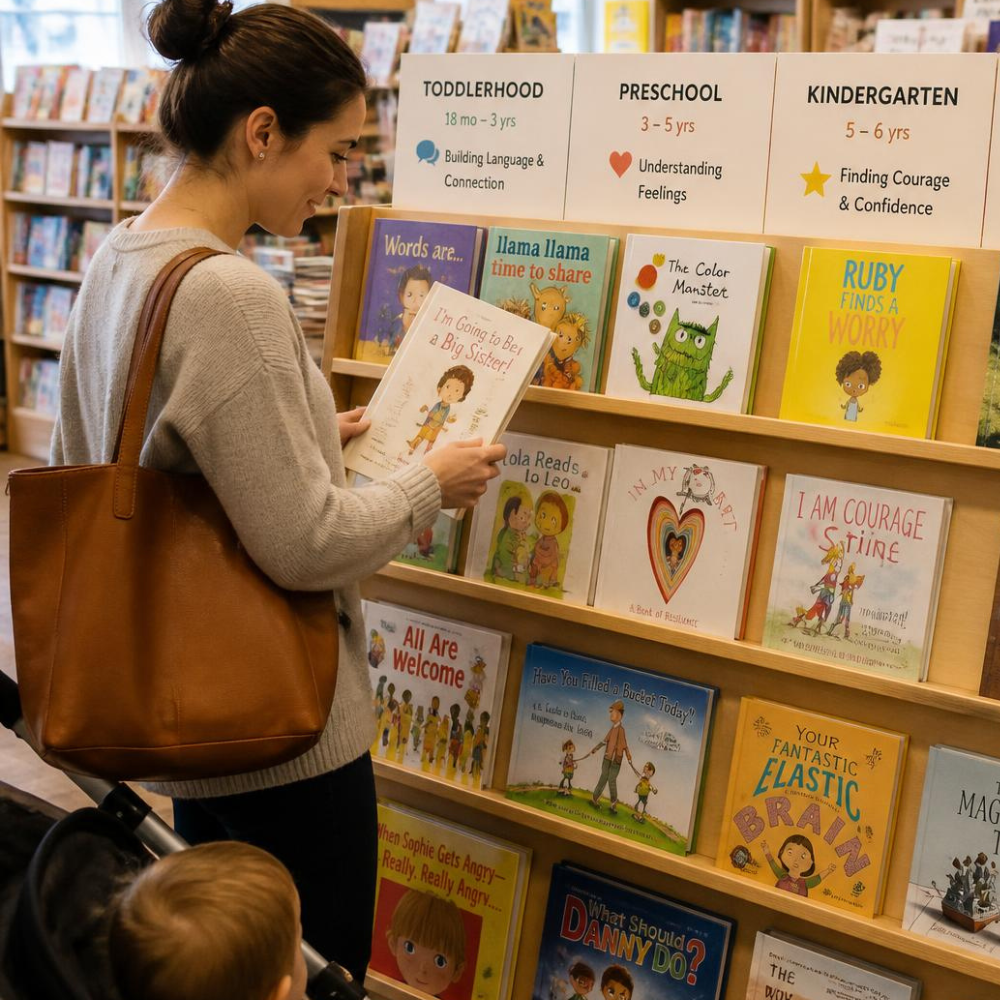
The right picture book is not only about age. It is about what your child is ready to understand, feel, and carry into real life.
The best picture book for your child is not always the one with the right number on the back cover.
Age matters. Of course it does. A two-year-old and an eight-year-old are not entering a story in the same way. Their attention, language, humor, fears, questions, and emotional world are different. A book that feels perfect for one child may be too crowded, too quiet, too silly, too abstract, or too thin for another.
But age is only the starting point.
When I think about choosing picture books for children, I think less about a rigid age label and more about what the child needs the story to do. Does the child need rhythm and repetition? Do they need help naming feelings? Do they need bedtime safety? Do they need a character who makes hesitation feel normal? Do they need a story that respects their growing mind and gives them something worth talking about after the final page?
That is the better question.
A good picture book meets a child at the intersection of age, stage, and feeling. It understands that a child is not just learning words. They are learning the world. They are learning how to separate, join, try, lose, wait, wonder, apologize, begin again, and be brave when something feels bigger than they expected.
That is why picture books still matter so much from ages 3 through 8.
They are not just little books for little people. The best ones are emotional tools disguised as stories.
Age guides are helpful, but your child is the real guide
Age ranges on children’s books are useful, but they should not become a cage.
A publisher may suggest a book for ages 3–7, 4–8, or 2–6. That tells you something about the vocabulary, length, theme, and expected attention span. It gives you a practical starting point when you are standing in a bookstore, scrolling online, or choosing a gift.
But your child may not live neatly inside that number.
Some three-year-olds can sit through long stories if the rhythm pulls them in. Some six-year-olds still need the comfort of a familiar bedtime book that feels younger on paper but deeply safe in real life. Some eight-year-olds can handle emotionally layered picture books that adults underestimate because the book has illustrations.
Children are uneven in the most human way.
A child may be advanced in vocabulary but tender in separation. A child may be reading independently but still need a read-aloud story about fear. A child may seem confident at school but fall apart at bedtime. A child may be old enough for early readers but still need picture books to help them understand feelings.
That is why I would never choose a book by age alone.
Choose by age, yes. But also choose by emotional readiness, attention, interest, and the moment your child is living through right now.
Picture books for ages 2–3: rhythm, naming, comfort, and closeness
For ages 2–3, picture books are often about entry.
Children at this stage are still learning how books work. They are learning to turn pages, follow images, hear rhythm, recognize repetition, point, name, predict, and return to a favorite story again and again. They may not sit perfectly still, and that is fine. A two-year-old listening while half-sitting, half-crawling, and occasionally trying to become furniture is still learning.
At this age, the best picture books often have clear images, musical language, repetition, simple emotional moments, and a strong read-aloud rhythm. The child may not understand every sentence, but they can feel the shape of the story. They can hear the pattern. They can notice the face. They can say the repeated phrase before you do.
That matters because repetition creates safety.
For a very young child, a familiar book becomes a small room they know how to enter. They know what is coming. They know the page they love. They know when the animal appears, when the moon rises, when the parent voice changes, when the story settles.
This is also a powerful age for beginning emotional language. A toddler or young preschooler may not be able to explain worry, disappointment, fear, or hesitation, but they can begin to notice happy, sad, scared, tired, mad, brave, and unsure. The pictures help. The adult’s voice helps. The story gives the feeling a name without turning the child into the lesson.
That is why emotionally gentle picture books can be so useful at this stage. A child does not need a lecture about courage. They need a character to look at, a feeling to recognize, and an adult beside them helping the story feel safe.
For a deeper guide to how Yabbit the Rabbit and The Rabbit in the Moon supports this age, this companion post may help: https://www.yabbitrabbit.com/parent-resources/best-picture-book-for-3-year-olds-rabbit-in-the-moon
What to look for at ages 2–3
At this age, look for books that feel welcoming before they feel impressive.
The story should be easy to enter. The illustrations should be clear enough for a young child to study. The language should invite the ear. Rhyme, repetition, animal characters, bedtime images, familiar routines, and simple emotional arcs all work well here.
I also like books that give parents a phrase they can use later.
A child this young may not retell an entire story, but they may borrow one phrase. They may remember a character. They may point to a page and say, “scared,” or “moon,” or “again.” That is not small. That is the beginning of story becoming language.
For hesitant children, ages 2–3 can also be when parents start noticing the first patterns. The child may cling before a new place, resist transitions, freeze near a group, or say no before they have words for what feels hard. Picture books can help those moments feel less confusing.
The goal is not to push confidence too early.
The goal is to create emotional safety and simple language. At this age, that may be enough.
Picture books for ages 4–5: feelings, friendship, trying, and first brave steps
Ages 4–5 are rich picture-book years.
Children at this stage are asking more questions. They are beginning to understand cause and effect more deeply. They are noticing friendships, rules, fairness, mistakes, fear, and other people’s feelings. Many are entering preschool, pre-K, kindergarten, sports, birthday parties, classes, performances, or other social settings that ask them to try things in front of others.
That is a lot.
This is often the age when hesitation becomes more visible because the child is being asked to begin more often. Walk into school. Say hello. Share. Wait. Join the game. Try the activity. Raise a hand. Let the parent leave. Sleep in their own bed. Try again after getting it wrong.
A child may want to do these things and still freeze.
That is why picture books for ages 4–5 should do more than entertain. They should help children recognize real emotional moments. They should show characters facing uncertainty, making mistakes, repairing friendships, asking for help, and taking small steps forward.
A good book at this age gives children a way to talk about what happened without feeling accused.
Instead of asking, “Why wouldn’t you join the class?” a parent can say, “That felt like a Yabbit moment.” Instead of turning every hard moment into a correction, the story becomes shared language. The child is not the problem. The feeling is something you can look at together.
That is the kind of picture-book work I care about most.
What to look for at ages 4–5
For ages 4–5, look for books with a clear story arc and emotional usefulness.
The child is old enough for a character to want something, struggle with something, and change in some way. The plot does not have to be complicated, but it should give the child something to follow. This is a wonderful age for stories about courage, friendship, separation, bedtime worry, sharing, mistakes, frustration, and trying something new.
The illustrations still matter enormously. Children at this age often read faces before they read feelings out loud. They notice who is standing apart. They notice whether a character looks worried. They notice whether the dark feels scary or beautiful. They notice who helps.
A strong picture book gives them those visual clues.
The language can also become slightly richer. Children this age enjoy rhythm, humor, surprise, and repeated phrases, but they can also handle deeper emotional ideas if the book carries them gently. That is the key. The book should respect the child’s feelings without making the story too heavy.
For hesitant children, I would look for stories that make bravery feel smaller.
Not fearless. Not perfect. Not instant. Smaller.
A story that shows one first step can be far more useful than a story that demands a total transformation.
Picture books for ages 6–8: deeper themes, resilience, and conversation
Ages 6–8 are where many adults make a mistake.
They assume picture books are finished.
The child is reading. The child is in school. The child may have early readers, chapter books, homework, spelling lists, and a growing sense of independence. So picture books can start to look like something from an earlier shelf.
I think that is a mistake.
Picture books can become more powerful at this age because children are now able to understand more of what the story is doing. They can notice irony, emotional conflict, social tension, disappointment, embarrassment, perseverance, and character change. They can talk about why someone acted a certain way. They can connect the story to school, friends, sports, mistakes, and their own worries.
At ages 6–8, picture books can carry big emotional ideas in a form that still feels safe.
That is especially important for children who worry, hesitate, or feel things deeply. An older child may not want to be talked to like a baby, but they also may not be ready for long explanations about anxiety, confidence, perfectionism, or social pressure. A strong picture book can meet them in the middle.
It can be beautiful enough to respect them, short enough not to overwhelm them, and deep enough to stay with them.
That is why I continue to believe picture books matter for early elementary children. Not because the child cannot read something longer, but because the picture-book form can hold emotional meaning in a very efficient, memorable way.
For more on why older children still benefit from picture books, read: https://www.yabbitrabbit.com/parent-resources/best-picture-books-for-older-children-7-8-year-olds
What to look for at ages 6–8
For ages 6–8, look for picture books with emotional depth.
The child can handle more nuance now. They can understand that a character may want something and fear it at the same time. They can understand that a mistake is not the same as failure. They can understand that courage may be quiet. They can understand that a friend can help without fixing everything.
This is a strong age for books about resilience, friendship, embarrassment, anxiety, grief, difference, identity, fairness, kindness, perseverance, and trying again. The best stories do not preach. They give the child something to think about.
At this age, a picture book should also invite conversation after the reading. Not a quiz. Not a moral lecture. A real conversation.
You might ask, “What part felt true?” or “Why do you think the character stopped?” or “What would have made that moment easier?” These questions let children practice reflection without feeling cornered.
This is also the age when children may be reading independently but still need adult read-alouds. That is not a step backward. It is one of the best ways to give them language and emotional complexity beyond what they may choose or decode on their own.
An early reader helps a child practice reading.
A strong picture book helps a child practice understanding.
They need both.
Why emotional stage matters as much as reading level
Reading level tells you what words a child may be able to decode.
It does not tell you what feelings a child is ready to face.
A child may read fluently and still struggle with separation. A child may decode simple chapter books and still freeze before trying something new. A child may be bright, verbal, and funny, but melt down when they make a mistake. Another child may not yet read independently but may understand a story’s emotional meaning with surprising depth.
That is why parents should not choose books only by reading level.
Choose by life moment too.
Is your child starting school? Choose stories about transitions, courage, and safe separation. Is your child avoiding sports or activities because they are afraid of failing? Choose stories where trying matters more than winning. Is your child struggling with friendship? Choose books that show joining, repair, kindness, and social courage. Is bedtime the hard part? Choose stories that make night feel softer and less enormous.
The best book is often the one that meets the feeling your child is carrying right now.
That feeling may not fit neatly into an age category.
Why The Rabbit in the Moon can work across ages 3–8
The Rabbit in the Moon was written for children ages 3–8 because hesitation does not belong to only one age.
A toddler may hesitate before separating from a parent. A preschooler may hesitate before joining a group. A kindergartener may hesitate at the classroom door. A six-year-old may hesitate before trying again after a mistake. A seven- or eight-year-old may hesitate because they understand embarrassment more clearly now.
The form changes.
The feeling remains familiar.
That is why Yabbit can meet children at different stages. Younger children may connect first with the animal character, the moon, the rhythm, the colors, and the feeling of the journey. Older children may understand more of the emotional meaning: Yabbit wants to continue, but something inside him pauses. Snail is steady. The task feels big. Courage does not appear all at once.
A two-year-old may simply feel the comfort of the read-aloud.
A four-year-old may point to Yabbit and say he looks scared.
A six-year-old may understand the idea of one tiny brave hop.
An eight-year-old may connect the story to a real moment when beginning felt hard.
That is the beauty of an emotionally layered picture book. It can give different gifts at different ages.
The role of the adult changes by age
The adult’s role in storytime changes as the child grows.
With a toddler, the adult may do most of the carrying. You read, point, name, repeat, and let the child wander in and out of attention. The child learns that books are warm, safe, and worth returning to.
With a preschooler, the adult begins inviting more noticing. You might ask one gentle question, connect a feeling to a character, or let the child finish a repeated phrase. The child begins to understand that stories can help name what happens inside.
With an early elementary child, the adult can open deeper conversation. You can talk about why a character hesitated, what helped, what did not help, and how the story connects to real life. The child may not need you to explain the whole thing, but they still benefit from your presence.
That is why picture books are not just about the child.
They are about the relationship around the book.
A parent, grandparent, teacher, or counselor can use the same story differently depending on the child’s age and emotional readiness. The book stays the same. The conversation grows.
How to choose a picture book by stage, not just age
When choosing a picture book, I would start with three simple questions.
First, what is my child learning developmentally right now? Maybe they are learning language, independence, friendship, patience, school routines, empathy, or how to handle mistakes.
Second, what feeling is showing up most often? Maybe it is worry, frustration, hesitation, disappointment, jealousy, loneliness, fear of the dark, or fear of failing.
Third, what kind of reading experience would help? Maybe the child needs comfort. Maybe they need humor. Maybe they need repetition. Maybe they need a character who understands them. Maybe they need a story with enough depth to make them talk afterward.
Those questions are more useful than chasing a perfect age label.
A book does not have to solve the entire problem. It just needs to open a small door.
That small door might be language. It might be connection. It might be laughter. It might be one sentence your child remembers later when the moment gets hard.
That is what a good picture book can do.
A simple age-by-age guide for parents
For ages 2–3, choose books with rhythm, repetition, clear images, emotional simplicity, and comfort. Look for stories that help your child name basic feelings and enjoy the closeness of being read to.
For ages 4–5, choose books with stronger story arcs, social situations, bedtime safety, trying, friendship, mistakes, and first brave steps. Look for books that give your child language for real moments without making the story feel like a lesson.
For ages 6–8, choose books with emotional depth, richer themes, humor, resilience, conversation potential, and visual storytelling that respects the child’s growing mind. Do not abandon picture books just because your child is beginning to read independently.
Across all ages, choose books your child wants to return to.
A book that gets reread is not failing to offer novelty. It is becoming part of the child’s inner furniture. It is building familiarity, language, memory, and emotional safety one return at a time.
That is the shelf you want.
Not just books that look impressive to adults, but books that quietly help your child grow.
Buy the Book
If you are looking for a picture book that can grow with your child from toddlerhood through early elementary years, The Rabbit in the Moon belongs on your shelf.
Yabbit the Rabbit gives children a character who hesitates without being shamed. Snail brings steadiness, persistence, and quiet support. Together, they help children understand that courage does not have to arrive all at once. It can begin with one tiny brave hop.
For younger children, the book offers rhythm, color, animal characters, and emotional safety. For preschool and kindergarten children, it gives language for hesitation, fear, support, and trying. For older children, it opens deeper conversations about courage, persistence, and the hard moment before the first step.
The Rabbit in the Moon is more than a bedtime story. It is a meaningful investment in your child’s emotional growth.
FAQs
How do I choose a picture book by age?
Start with the age range, but do not stop there. Look at your child’s attention span, language level, emotional stage, interests, and current life moments. The right picture book should feel readable, meaningful, and emotionally appropriate for your child.
What picture books are best for ages 2–3?
For ages 2–3, look for picture books with rhythm, repetition, clear illustrations, simple emotions, familiar routines, animals, bedtime comfort, and language your child can begin to repeat or recognize.
What picture books are best for ages 4–5?
For ages 4–5, look for books about feelings, friendship, separation, trying new things, mistakes, bedtime worry, and first brave steps. Children this age often benefit from stories that help them name what feels hard.
Are picture books still good for 6-, 7-, and 8-year-olds?
Yes. Picture books can still be very valuable for early elementary children. Older children can understand deeper themes, richer emotional conflict, humor, resilience, and conversation in picture books, even if they are also reading independently.
Should I choose picture books based on reading level or emotional stage?
Use both, but emotional stage matters more than many parents realize. A child may be able to read simple books independently and still need picture books that help with worry, mistakes, friendship, separation, or courage.
What age is The Rabbit in the Moon best for?
The Rabbit in the Moon is designed for children ages 2–8 and adult read-alouds. Younger children may connect with the rhythm, animals, colors, and comfort. Older children may connect more deeply with Yabbit’s hesitation, Snail’s persistence, and the idea of one tiny brave hop.
How do I know if a picture book is too young for my child?
A book is probably too young if your child is consistently bored, the emotional idea feels too simple, or there is nothing to talk about after reading. But do not dismiss a book just because it has fewer words or illustrations. Some picture books carry deep emotional meaning in a simple form.