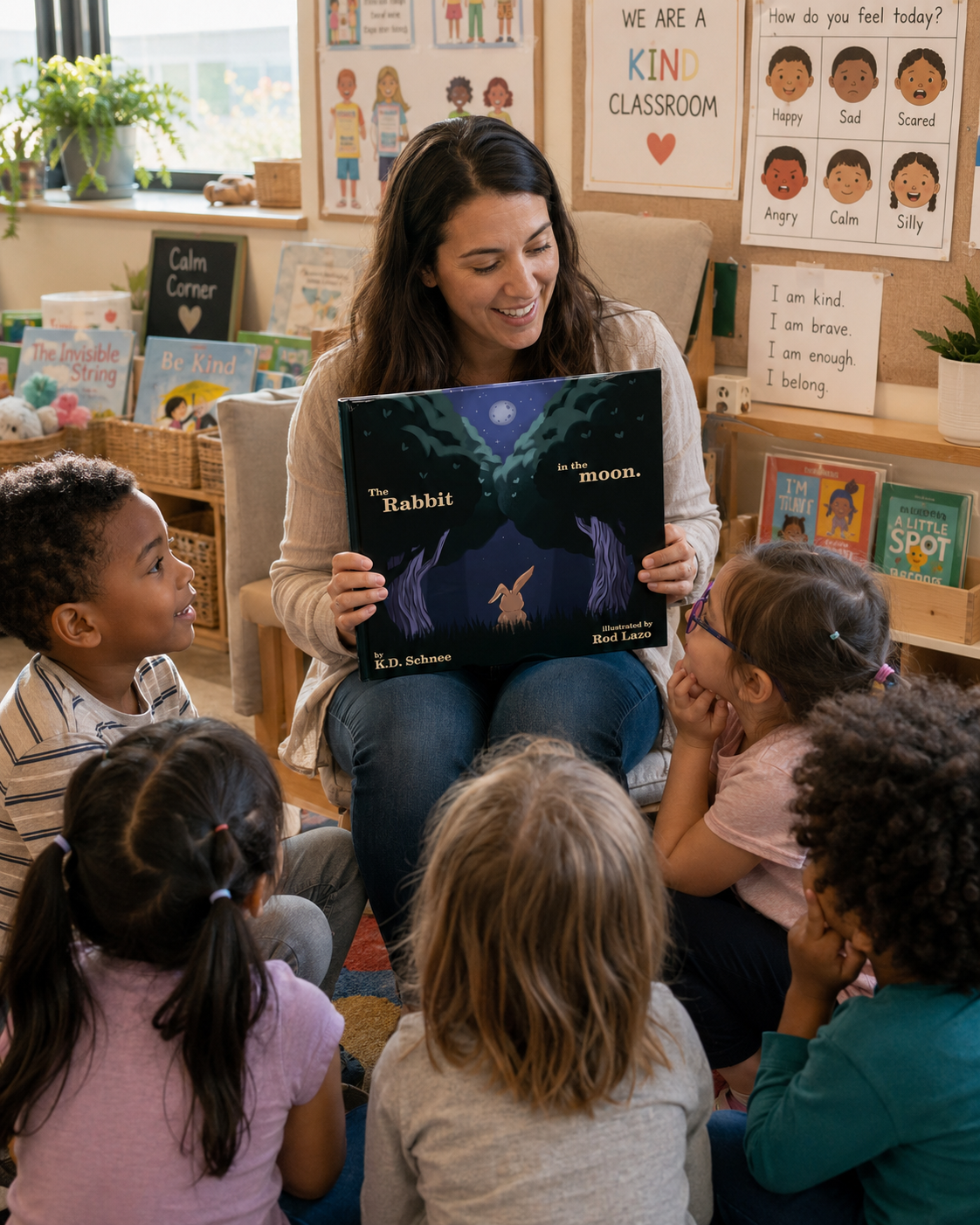
The best classroom picture books do not just fill read-aloud time. They give children language they can use after the book closes.
The best picture books for classroom read-alouds are stories teachers can use more than once: books that hold attention, build emotional language, support SEL, create discussion, and help children practice real classroom skills like courage, empathy, persistence, asking for help, and trying again.
That is the simple answer.
A strong classroom picture book should not feel like a worksheet in costume. It should be a real story first. Children need a character to care about, a feeling to recognize, a problem to follow, and a moment they can talk about afterward.
The best classroom books give the whole group shared language.
After the read-aloud, the teacher can say, “What was the character feeling?” or “What helped them take the next step?” or “What tiny brave hop could we try today?” Suddenly the book is not only a story. It becomes part of the classroom’s emotional vocabulary.
That is why picture books still matter so much in classrooms. They help children learn how to be people together.
What makes a picture book good for the classroom?
A good classroom picture book does several jobs at once.
It holds children’s attention. It gives the teacher something meaningful to pause on. It creates discussion without needing a complicated lesson plan. It supports language, listening, social-emotional learning, and classroom community. It also leaves behind a phrase or idea students can use later.
That last piece matters.
The best classroom picture books do not disappear when the book closes. They come back during cleanup, group work, recess, writing time, morning meeting, transitions, and hard little moments when a child freezes, grabs, quits, worries, or says, “I can’t.”
A classroom book becomes powerful when it gives the teacher language that feels warm instead of corrective.
Instead of saying, “Stop being afraid,” a teacher can say, “This looks like a tiny brave hop moment.”
Instead of saying, “Try harder,” a teacher can say, “What is one small part you can try?”
Instead of saying, “Calm down,” a teacher can ask, “What feeling is visiting right now?”
Those phrases work because the story already planted them.
Why do picture books work so well for SEL?
Picture books work well for SEL because children can watch a character feel, choose, struggle, repair, and grow from a safe distance. That distance is important.
A child may not want to say, “I was scared to join the game.” But they may talk about a character who stood at the edge of the group. A child may not want to admit, “I hate making mistakes.” But they may notice when a character crumples a drawing, hides a paper, or refuses to try again.
Picture books let children look at feelings without being put under a spotlight. This is especially useful in a classroom, where children are learning not only letters and numbers, but also waiting, sharing, listening, apologizing, joining, helping, asking, trying, failing, and trying again.
A good SEL picture book gives children a shared story for those moments. It helps the teacher talk about courage, kindness, empathy, persistence, disappointment, self-kindness, and emotional regulation without turning the classroom into a lecture hall with crayons.
The story does the gentler work first. Then the teacher can guide the conversation.
What should teachers look for in classroom read-aloud books?
Teachers should look for picture books with strong read-aloud rhythm, clear emotional moments, meaningful illustrations, and a natural discussion path.
A book may be beautiful, but if it is hard to read aloud to a group, it may not work well during circle time or morning meeting. Classroom read-alouds need pacing. They need language that lands. They need page turns that hold attention. They need enough emotional clarity for children to follow, but enough depth that the book still gives the teacher something to talk about.
Look for books with one strong classroom use.
A book about courage.
A book about kindness.
A book about mistakes.
A book about asking for help.
A book about joining in.
A book about big feelings.
A book about persistence.
A book about change.
A book about being different.
A book about trying again.
The best classroom shelves are not built from random favorites alone. They are built from books that each do a clear job for the children in the room.
What are the best picture books for classroom community?
The best picture books for classroom community help students see themselves as part of a group.
A classroom is not just a room full of individual children. It is a small society with pencils, snack crumbs, big feelings, and twenty different nervous systems trying to share space.
Books can help with that. A classroom-community picture book might help children welcome someone new, notice someone left out, understand different personalities, practice kindness, repair after conflict, or see that belonging does not require every child to act the same way.
For hesitant children, this matters deeply.
Not every child enters a classroom loudly. Some children watch first. Some children need time before speaking. Some children hang back until the group feels safe. Some children want to join but cannot find the doorway.
A good classroom picture book makes room for those children too. It tells the group, quietly and repeatedly, that courage, kindness, and belonging can look different from child to child.
What are the best picture books for hesitant students?
The best picture books for hesitant students are stories that do not shame the pause before trying. That pause is where many children live.
A hesitant student may freeze before answering a question, avoid raising a hand, refuse to start a worksheet, hang back from a group activity, struggle with transitions, or say “I don’t know how” before the teacher has finished giving directions.
From the outside, hesitation can look like refusal. Inside the child, it may feel like fear, overwhelm, perfectionism, uncertainty, or the sense that the first step is too big. That is why The Rabbit in the Moon works so naturally in classrooms.
Yabbit gives children a character for the pause before beginning. He is not fearless. He hesitates. He worries. He feels the size of what is ahead. Snail brings steadiness and persistence without shaming him. Together, they show children that courage does not have to be loud or instant.
It can begin with one tiny brave hop. That is classroom-useful language. A teacher can return to it all week.
How can teachers use The Rabbit in the Moon in the classroom?
Teachers can use The Rabbit in the Moon as a classroom read-aloud for courage, hesitation, emotional language, persistence, and SEL.
The book works best when it is not treated as a one-time story. It should become shared language.
Before reading, ask:
“What does it feel like when something seems too big to start?”
Let students answer with child-sized language: tight tummy, quiet voice, shaky hands, hiding, saying no, needing help, or wanting to watch first.
During reading, pause two or three times.
Ask:
“How do you think Yabbit feels here?”
“Who is helping?”
“What changed on this page?”
“What might be one tiny brave hop?”
After reading, bring the idea back into the room. Ask students to think of a classroom moment that can feel too big: walking in after a hard morning, trying a new math problem, reading out loud, joining a game, asking for help, saying sorry, or starting writing.
Then ask:
“What would one tiny brave hop be?”
That question is simple enough for young children and useful enough for teachers.
What is a simple classroom lesson plan for The Rabbit in the Moon?
Here is a low-prep lesson teachers can use with preschool, kindergarten, first grade, or early elementary students.
Before reading:
Write or say: “Sometimes something feels too big to start.”
Ask students to show with their hands or faces what “too big” might feel like. Keep it light. This is not a feelings interrogation. It is a doorway.
During reading:
Pause when Yabbit hesitates. Ask, “What do you notice?” Let children talk about his body, face, the colors, the scene, or Snail’s presence.
Pause again when the journey continues. Ask, “What is helping Yabbit keep going?”
After reading:
Draw two columns on the board.
Big Feeling
Tiny Brave Hop
Under Big Feeling, write examples students know: nervous, shy, frustrated, scared, embarrassed, unsure, left out, worried.
Under Tiny Brave Hop, write small actions: watch first, try one part, ask for help, take a breath, say one word, stand closer, try again, hold a friend’s hand, start with the first line.
Then say:
“In our classroom, a tiny brave hop counts.”
That is the lesson. Small enough to remember. Useful enough to repeat.
How can picture books help with school worry?
Picture books can help with school worry because they make classroom fear visible without making one child the focus.
A child worried about school may struggle with the classroom door, drop-off, group work, mistakes, tests, loud rooms, new routines, or joining other children. A story lets the teacher or parent talk about those feelings through a character first.
That is safer for many children.
A teacher can say, “The character looks unsure,” instead of “You are anxious.” A parent can say, “This feels like a Yabbit moment,” instead of “Don’t be nervous.” The difference is not just wording. It changes the emotional temperature.
If school worry is the main issue, this companion guide can help parents and teachers choose books for classroom entry, drop-off, mistakes, separation, and the first brave step: https://www.yabbitrabbit.com/parent-resources/picture-books-kids-worried-about-school
A good school-worry book does not simply say school is fun. It helps the child find the first step into school when school feels big.
How can teachers use picture books for emotional literacy?
Teachers can use picture books for emotional literacy by helping children notice feelings, name them, and connect them to choices.
Start with what children can see.
“What does the character’s face show?”
“What is happening with their body?”
“Does this page feel calm, worried, lonely, brave, or frustrated?”
“Who is helping?”
“What did the character do next?”
These questions help children read more than words. They learn to read expression, posture, distance, color, and action. That matters because emotional literacy begins with noticing.
The goal is not to make children memorize feeling words like vocabulary flashcards with tiny frowny faces. The goal is to help children understand that feelings have signals, stories, choices, and support.
For more picture-book activities that help children notice and name feelings, read: https://www.yabbitrabbit.com/parent-resources/emotional-literacy-activities-for-picture-books
Picture books are especially useful because they let the whole class practice emotional language together. No one child has to be the lesson. The character carries the feeling first.
What picture books belong in a classroom library?
A strong classroom library should include books that do different jobs.
Teachers need funny books, calming books, courage books, friendship books, mistake books, transition books, feeling books, kindness books, identity books, classic books, modern books, and books children can return to when the classroom day gets wobbly.
A classroom shelf should not be built only around seasons or holidays. Children need stories for the emotional seasons too.
The first-week-of-school season.
The mistake season.
The missing-home season.
The “nobody played with me” season.
The “I can’t do this” season.
The “I want to try but I’m scared” season.
The “my body is full of thunder” season.
The books teachers keep within reach are often the books that help with those moments. A good classroom library gives the teacher options. Not every child needs the same story on the same day.
How many classroom picture books does a teacher need?
A teacher does not need hundreds of picture books to create a strong classroom read-aloud culture.
A small, intentional set of books can be powerful if each book has a clear job.
Start with a few categories: courage, kindness, mistakes, friendship, feelings, transitions, persistence, identity, humor, and calm. Add books slowly as you see what your students need.
The question is not, “How many books are on the shelf?” The better question is, “Can this shelf meet the emotional and learning moments that actually happen in this room?”
If a book helps students talk about feelings, return to a classroom phrase, solve a social problem, try again after a mistake, or feel safe enough to participate, it earns its place.
A classroom library is not decoration. It is infrastructure. A tiny city of paper bridges.
How do picture books support different learners?
Picture books can support different learners because they offer meaning through words, pictures, rhythm, expression, and discussion.
Some children connect first through the illustrations. Some follow the sound of the language. Some notice character feelings. Some need repetition. Some need a teacher’s question. Some need to hear the story more than once before they are ready to talk.
That is one reason picture books are so useful in early classrooms.
They are not only for children who can already read independently. They are for children who are still learning how stories work, how feelings work, how language works, and how a group conversation works.
Design choices matter too. Clear typography, good spacing, strong contrast, readable page design, and emotionally readable illustrations all help a picture book serve a classroom.
This is one reason I chose Andika for The Rabbit in the Moon. I wanted the book to feel beautiful, but also clear and approachable for children, parents, teachers, and emerging readers.
A classroom book should welcome children into the page. Not make them fight the page to get in.
How can teachers make a read-aloud more meaningful?
Teachers can make a read-aloud more meaningful by choosing one goal and one question. One goal keeps the lesson from becoming mushy.
Maybe the goal is courage. Or kindness. Or asking for help. Or trying again. Or noticing feelings. Or joining a group.
One question keeps the conversation from becoming too scattered.
Try:
“What was the character feeling?”
“What helped?”
“What changed?”
“What choice did the character make?”
“What would one tiny brave hop be?”
That is enough.
Children do not need every read-aloud to become a twenty-minute analysis. Sometimes one question, asked well, gives the story room to echo through the rest of the day.
The strongest classroom read-alouds often feel simple from the outside. Inside the children, something is quietly getting named.
What should classroom picture books avoid?
Classroom picture books should avoid preaching, shaming, or solving the emotional problem too quickly. Children know when a book is trying to force a lesson through the front door wearing a papier-mâché hat. They may sit politely, but the story will not stay.
A strong classroom book lets the value live inside the character’s experience.
Courage should be shown through action. Kindness should happen on the page. Persistence should be visible. Empathy should be felt. Mistakes should be survivable. Feelings should be respected before the character grows.
This matters because children do not need stories that make them feel corrected from the rug. They need stories that help them recognize themselves, understand others, and practice one small next step.
That is the difference between a book that teaches and a book that lectures. The classroom can feel the difference.
Why The Rabbit in the Moon belongs in classroom libraries
The Rabbit in the Moon belongs in classroom libraries because it gives teachers a gentle, repeatable way to talk about courage, hesitation, persistence, and emotional growth.
Yabbit is useful because many students know the feeling of wanting to begin but freezing at the start. Snail is useful because he models steady movement without pressure. The tiny brave hop is useful because it turns courage into something children can actually try.
For teachers, that matters. A classroom is full of tiny brave hop moments.
A child tries the first word.
A child raises a hand.
A child walks into the room after a hard goodbye.
A child joins a game.
A child asks for help.
A child tries again after a mistake.
A child says, “I’m sorry.”
A child starts the page.
Those moments are small to adults, but not always small to children. The Rabbit in the Moon gives those moments a name.
That is why it works as a classroom read-aloud, a SEL book, a courage book, and a story teachers can return to when the room needs language softer than “try harder.”
Buy the Book
If you are building a classroom library with picture books that support SEL, courage, emotional language, and real classroom moments, The Rabbit in the Moon belongs on your shelf.
Yabbit is not fearless. He pauses. He worries. He feels the size of the journey before him. Snail brings steadiness, persistence, and quiet support. Together, they help children understand that courage does not have to arrive all at once. It can begin with one tiny brave hop.
For teachers, counselors, parents, grandparents, and caregivers, The Rabbit in the Moon offers more than a read-aloud. It gives children language for hesitation, support, persistence, uncertainty, and brave little beginnings.
It is a meaningful investment in your classroom’s emotional language and your students’ confidence to try, fail, and grow.
FAQs
What are the best picture books for classroom read-alouds?
The best picture books for classroom read-alouds hold attention, create discussion, support social-emotional learning, and give students language they can use later. Look for books about courage, kindness, feelings, mistakes, persistence, friendship, and classroom community.
What makes a picture book good for SEL?
A good SEL picture book lets children watch a character feel, choose, struggle, repair, or grow. It should teach through story, not lecture. The best SEL books give children repeatable language for real moments.
How can teachers use The Rabbit in the Moon in the classroom?
Teachers can use The Rabbit in the Moon to talk about hesitation, courage, persistence, and trying again. After reading, ask students, “What felt big for Yabbit?” and “What was one tiny brave hop?”
Is The Rabbit in the Moon good for kindergarten or early elementary classrooms?
Yes. The Rabbit in the Moon is a strong read-aloud for kindergarten and early elementary classrooms because it uses story, illustration, rhyme, and character to help children understand courage as one small brave step forward.
What picture books help hesitant students?
Picture books that help hesitant students usually show a character who feels unsure, receives support, and takes one small step. The best books do not shame hesitation. They help children see that courage can begin before confidence arrives.
How often should teachers use picture books for SEL?
Teachers can use picture books for SEL throughout the week, especially during morning meeting, transitions, conflict repair, writing prompts, and classroom discussions. Repeated language from one strong book can become part of classroom culture.
What should students learn from a classroom picture book?
Students can learn emotional vocabulary, empathy, courage, problem-solving, persistence, kindness, and how to talk about hard moments. A strong classroom picture book helps children understand themselves and each other.