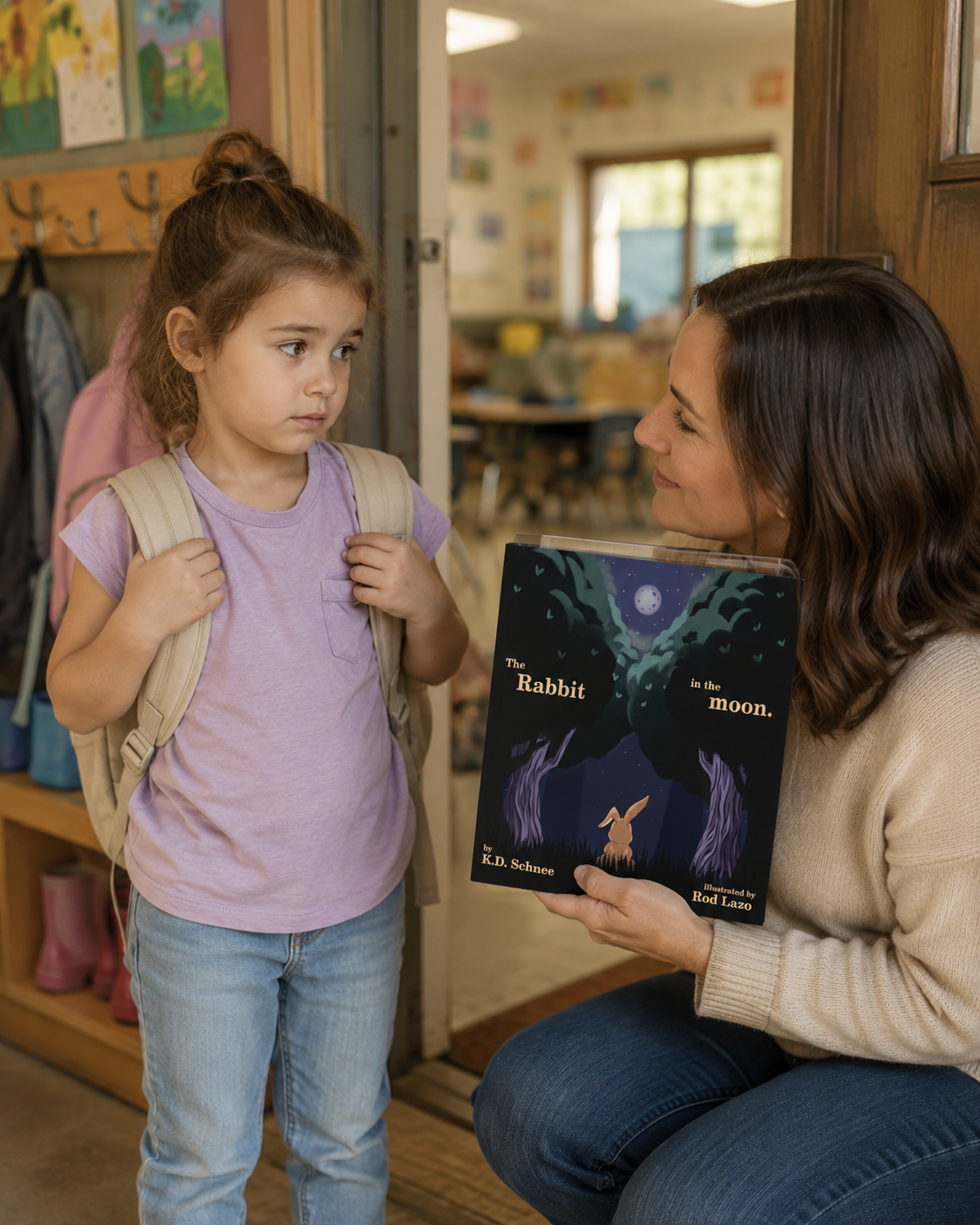
School worry often lives in the moment before entry. The right story can help that first step feel smaller.
The best picture books for kids worried about school help children name what feels hard, feel understood, and imagine one small brave step into the school day.
That is the simple answer.
A child who worries about school may not need another cheerful book that says school is wonderful. They may need a story that understands the hallway, the drop-off, the classroom door, the new routine, the group already playing, the mistake they might make, or the moment when everyone else seems to know what to do.
A helpful school-worry book should not shame the child for hesitating. It should make the worry easier to see, easier to name, and easier to move through.
For some children, the tiny brave hop is walking to the classroom door. For others, it is saying hello to one child, sitting on the rug, trying the first worksheet problem, asking the teacher for help, or watching first before joining.
School courage does not always look loud. Sometimes it looks like one small step forward with a very full backpack of feelings.
Why do some kids worry about school?
Children worry about school for many different reasons.
Some children worry about separating from a parent. Some worry about making mistakes. Some worry they will not know what to do. Some worry about loud classrooms, social groups, new teachers, hard work, lunchrooms, bathrooms, tests, being called on, or not having someone to play with.
For hesitant children, school can feel especially big because it asks them to begin again every morning.
Walk in.
Join the group.
Follow the routine.
Answer the question.
Try the activity.
Make a friend.
Make a mistake where other people might see.
That is a lot for a young child. Adults may see a school building. A child may see a hundred small beginnings stacked on top of each other like tiny chairs in a too-tall pile.
That is why school worry often appears as refusal, silence, stomachaches, clinginess, tears, irritation, sudden tiredness, or “I don’t want to go.” The child may not have the words to explain the exact worry. They only know the beginning feels too big.
A good picture book can help the family find the words.
What should picture books for school worry do?
Picture books for kids worried about school should make the school feeling smaller and more understandable. The goal is not to convince a child that school is perfect. The goal is to help them feel safer entering it.
A strong school-worry book should do at least one of these jobs: help the child name the worry, show a character who feels unsure, make the first step less overwhelming, provide a comforting routine, or give the family language to use later.
The best ones do not rush the child from fear to confidence in one page. They show the middle.
That middle matters because many children are not refusing school because they hate learning. They may be stuck in the moment before starting. They may want to go in, but their body says no. They may want a friend, but joining feels impossible. They may want to try, but the possibility of doing it wrong makes the whole day feel dangerous.
A useful book lets the child see that moment without feeling embarrassed by it. That is where story becomes practical.
What kind of school worry is your child carrying?
Before choosing a school-worry book, try to identify the specific school moment that feels hard.
Is the hard part saying goodbye?
Is it walking into the room?
Is it not knowing the routine?
Is it being called on?
Is it making friends?
Is it lunch, recess, gym, art, music, or a loud hallway?
Is it tests, mistakes, or work that feels too hard?
Is it the fear that something bad will happen while you are apart?
The more specific you can be, the better the book match will be.
A child with separation worry may need a book about goodbye and return. A child with perfectionism may need a book about mistakes. A child with social hesitation may need a story about joining without pressure. A child who freezes at the classroom door may need a courage book that makes the first step smaller.
That is why “school anxiety” is not one single thing. It is often a bundle of smaller worries wearing one backpack.
A good parent question is: “What part of school feels biggest to my child?” That answer tells you what kind of book to choose.
Are first-day-of-school books enough?
First-day-of-school books can help, but they are not always enough.
Many first-day books focus on excitement, new friends, classroom fun, school supplies, teachers, routines, and the general idea that school can be a good place. Those books can be useful, especially for children who need familiarity before a new experience.
But some children need more than a sunny preview. They need a book that understands worry.
A child who freezes at drop-off may not be helped by a book where the character skips happily into school after one cheerful page. A child who fears mistakes may need a story that honors the pressure of trying. A child who hangs back at recess may need a book about social courage, not just the first day.
The best school books for worried children do not pretend the worry is a misunderstanding.
They respect it.
They show that school can be good and still feel hard at the beginning. They help children understand that feeling unsure does not mean they cannot go in. It means they may need a smaller step into the day.
That is a very different message.
What books help with school drop-off anxiety?
For school drop-off anxiety, choose books that focus on safe separation, predictable return, and the child’s first step after goodbye.
A child struggling at drop-off may not be worried about the entire school day. They may be stuck at the moment of separation. The parent leaves. The room changes. The child feels the distance. The body reacts.
In that moment, logic often arrives late wearing mismatched socks.
A book can help by giving the child a story to practice before the real goodbye. The character may feel nervous when someone leaves, learn the routine, find a helper, or discover that goodbye is not the end of connection.
For children who resist school, this companion guide offers parent scripts for the transition moment itself: https://www.yabbitrabbit.com/parent-resources/big-transitions-what-to-say-when-child-wont-go
A school drop-off book should give parents language that is short, warm, and repeatable.
“I will come back after rest time.”
“Your teacher is your helper while I am away.”
“This is the hard goodbye part.”
“You can feel unsure and still take one tiny brave hop.”
That last line matters because some children need to know they do not have to feel calm before they begin. They can begin with support.
What books help kids afraid to make mistakes at school?
For children who worry about mistakes, choose books that make imperfection feel safe.
School often asks children to try in public. Write the letter. Solve the problem. Draw the picture. Read the word. Raise the hand. Join the game. Answer the question. Try again.
For some children, that feels exciting. For others, it feels like walking into a spotlight while carrying a glass bowl full of bees.
A mistake-focused school book should not simply say, “Mistakes are how we learn.” That is true, but it can feel thin to a child whose body is already bracing against embarrassment.
A better story shows a character making a mistake, surviving the feeling, receiving support, and discovering that the mistake did not erase their worth.
This matters because fear of mistakes can look like laziness from the outside. The child may avoid homework, stall before writing, refuse to try, or say, “I can’t,” before the first line begins. But underneath, the child may be protecting themselves from shame.
A good book helps parents say, “The first try does not have to be perfect. What is one tiny brave hop into the work?”
That might mean writing one word, trying one problem, reading one sentence, or asking for help. Small starts are powerful for children who feel trapped by the idea of doing it wrong.
What books help kids who worry about tests or school performance?
For test anxiety or performance worry, choose books that separate effort from outcome.
A child with test anxiety may worry about grades, speed, teacher approval, parent disappointment, embarrassment, or what the result means about who they are. Even young children can start believing that getting something wrong means being wrong.
That is a heavy little suitcase. Books for school performance worry should help children understand that pressure can make thinking harder, that mistakes are part of learning, and that courage can mean beginning even before confidence shows up.
A good story may show a character who worries before a challenge, tries one part, gets help, or learns that the result is not the whole identity.
For a child who worries about schoolwork, a script might be:
“You do not have to finish the whole mountain right now. Let’s find the first pebble.”
Or:
“This is not a ‘prove yourself’ moment. This is a ‘try one part’ moment.”
For a deeper book-guide lane around tests and school pressure, read: https://www.yabbitrabbit.com/parent-resources/best-books-kids-test-anxiety
The larger message is this: school performance matters, but it should never become the measure of a child’s courage or worth.
What books help kids who are scared to join the group?
For children who worry about joining, choose books about social courage.
Some children do not struggle with the school building. They struggle with the group.
The group already playing.
The rug already full.
The lunch table already noisy.
The friend pair already paired.
The game already moving.
For a hesitant child, joining can feel like stepping onto a spinning carousel while everyone else has secret instructions.
A helpful book should show that joining does not have to happen all at once. The child may watch first, stand near, say one word, choose one kind child, ask to help, or join for one small part.
This is where the Tiny Brave Hop Method becomes very practical. The goal is not “go make five friends.” That is too big.
The goal might be “say hello to one child” or “stand near the game for two minutes” or “ask one person what they are playing.” A good picture book helps make those smaller steps visible.
Children often need to see a character enter the social world slowly. Not every child bursts into the room like a confetti cannon. Some children peek in, pause, and still belong.
That is the story many school-worried children need.
How can picture books help before school starts?
Read school-worry books before the hard morning arrives. This is important.
If the first time you introduce the book is while your child is crying at the door with one shoe on and breakfast somehow in their hair, the story may not be able to help much. The child is already inside the feeling.
Picture books work best when they become familiar during calm moments.
Read the book at bedtime a week before school starts. Read it on a Sunday afternoon. Read it after visiting the school. Read it when your child is relaxed enough to notice the character instead of defending against the feeling.
Then, when the real school moment comes, the story is already in the room. You can say, “This feels like the page where the character paused.”
Or:
“What was the tiny brave hop in the story?”
Or:
“Do you want to watch first, try one part, or ask for help?”
That is how a book becomes language. It prepares the child before the feeling takes over.
How should parents read school-worry books?
Read gently and do not turn the book into a quiz.
A school-worry book should not feel like an adult strategy wearing a book costume. Children can feel that. If the parent reads with too much urgency, the child may start to suspect the story is actually a lesson trap.
Start with the story.
Let your child look at the pictures. Let them point. Let them notice the classroom, the backpack, the face, the hallway, the teacher, the friend, the page where the character stops.
Ask one gentle question:
“What do you notice?”
“How does this part feel?”
“Who helps here?”
“What was the small step?”
Then keep reading.
You do not need to explain everything. You do not need to connect every page to your child. In fact, it is often better to start with the character and leave your child out of it at first.
A child may be much more willing to talk about a worried rabbit, bear, child, owl, or snail than about themselves.That is not avoidance. That is emotional safety.
What should parents say when school worry shows up?
Use short, steady language. When a child is worried about school, long explanations can become more noise. The child may need fewer words and more calm.
Try scripts like:
“I believe this feels big.”
“You are safe, and your teacher is a helper.”
“We do not have to solve the whole day. We only need the first small step.”
“This is a Yabbit moment.”
“What is one tiny brave hop?”
“You can feel unsure and still begin.”
“Would it help to watch first, try one part, or ask for help?”
These scripts work because they do not argue with the feeling. They also do not let the feeling make every decision.
The adult’s job is to validate the worry without building a house around it. That is the delicate part. The child needs to feel understood, but also gently led toward the next step.
How does The Rabbit in the Moon fit school worry?
The Rabbit in the Moon is not a traditional first-day-of-school book, and that is part of why it can help.
Many school-worried children do not only need a story about school. They need a story about the emotional moment before beginning.
That is Yabbit’s world.
Yabbit hesitates before something that feels big. He pauses. He worries. He needs time. Snail brings steadiness, persistence, and quiet support. The story does not shame Yabbit for being unsure. It helps him continue with one tiny brave hop.
That makes The Rabbit in the Moon useful for school worry because school is full of beginnings.
The classroom door.
The first worksheet.
The group activity.
The question from the teacher.
The new friend.
The mistake.
The goodbye.
A child can carry Yabbit into any of those moments. Instead of saying, “Don’t be nervous about school,” a parent can say, “This feels like a Yabbit moment. What is one tiny brave hop?”
That is a softer, more useful doorway.
What should a school-worry book avoid?
A school-worry book should avoid making fear look silly.
It should also avoid pretending that the child becomes instantly confident once school begins. That may happen for some children, but many worried children need more time. They need repetition. They need a script. They need a familiar adult. They need to try one part before trying the whole thing.
A weak school-worry book may rush the emotional arc too quickly.
The child is scared. The adult says school is great. The child goes in. Everything is perfect.
That can feel false to a child whose stomach hurts every morning.
A stronger book allows for the difficulty without making the story frightening. It respects the child’s hesitation, shows support, and gives a believable next step.
The book does not need to solve school. It needs to make the next school moment more possible. That is enough.
What should teachers look for in school-worry picture books?
Teachers should look for books that create shared language for the classroom.
A good school-worry picture book can help a whole class understand that some children need a little more time to begin. It can normalize asking for help, trying one part, making mistakes, and joining at a child-sized pace.
The goal is not to label one child as anxious. The goal is to build a classroom language that makes courage smaller and kinder.
A teacher might say:
“Some of us need a tiny brave hop before we start.”
Or:
“You can watch first, then try one part.”
Or:
“Snail steps count too.”
That kind of classroom language helps children who freeze without putting them on display. It also teaches the rest of the group that courage has many shapes.
Some children leap. Some children hop. Some children need a snail beside them.
All of those children can still belong.
How do you build a school-worry book stack?
A useful school-worry book stack should include different kinds of school support.
Include one book about separation or drop-off.
Include one book about making friends or joining in.
Include one book about mistakes or trying again.
Include one book about classroom courage.
Include one book that is not about school directly, but helps with the emotional skill underneath the school worry.
That last one is important.
Sometimes the best school-worry book is not a school book. It is a courage book. A persistence book. A feelings book. A bedtime book that calms the nervous system before the next morning.
Children do not experience school worry in neat categories. Their worries overlap. A child may be nervous about separation and mistakes. Another may worry about friends and tests. Another may not know what the worry is yet, only that school feels too big.
A balanced book stack gives you more than one doorway.
When should parents seek more support?
Picture books can help with school worry, but they should not be the only support if the worry is intense or ongoing.
If your child’s fear of school causes frequent absences, regular stomachaches or headaches, panic, sleep disruption, major family distress, or a repeated inability to enter school, talk with your pediatrician, school counselor, teacher, or a qualified child mental health professional.
Support is not failure. It is part of caring for the child in front of you.
A book can give language. A parent can give comfort. A teacher can give structure. A professional can help identify what is underneath the pattern and what kind of support may be needed.
The goal is not to force a child through fear. The goal is to help them feel safe enough, supported enough, and capable enough to take the next step.
One tiny brave hop may be the beginning. It does not have to be the whole plan.
What is the best way to use a school-worry picture book?
Use the book before, during, and after the school moment.
Before school, read it during calm time. Let your child notice the character and the feeling.
During the school moment, borrow one phrase from the book. Keep it short.
“This is a tiny brave hop moment.”
After school, return to the story gently.
“What helped today?”
“What felt hard?”
“What tiny brave hop did you take?”
“What could help tomorrow?”
This turns the book into a bridge between story and real life. That is what the best picture books do. They do not stay trapped on the shelf. They become part of the family’s language.
For kids worried about school, that language can be the difference between “I can’t” and “I can try one part.” That is a small sentence. It is also a very big beginning.
Buy the Book
If your child worries about school, freezes before trying, or needs the first step to feel smaller, The Rabbit in the Moon belongs on your shelf.
Yabbit is not fearless. He pauses. He worries. He feels the size of the journey before him. Snail brings steadiness, persistence, and quiet support. Together, they help children understand that courage does not have to arrive all at once. It can begin with one tiny brave hop.
For parents, teachers, grandparents, and counselors, The Rabbit in the Moon offers more than a bedtime story. It gives children language for hesitation, fear, support, persistence, and brave little beginnings.
It is a meaningful investment in your child’s emotional growth and a story to return to when school, friendship, mistakes, or new routines feel too big.
FAQs
What are the best picture books for kids worried about school?
The best picture books for kids worried about school are stories that help children name worry, understand the hard part, feel supported, and imagine one small brave step. Look for books about drop-off, classroom entry, friendship, mistakes, separation, and trying something new.
Can picture books help with school anxiety?
Yes. Picture books can help children talk about school worry through characters and stories instead of direct pressure. A child may find it easier to talk about a character’s fear before talking about their own.
What kind of book helps a child who cries at school drop-off?
A child who cries at drop-off may need books about separation, predictable return, trusted helpers, and the first small step after goodbye. The story should be reassuring without dismissing the child’s fear.
What kind of book helps a child afraid of making mistakes at school?
Choose books that make mistakes feel survivable and separate effort from identity. A good mistake book shows that trying, asking for help, and beginning again matter more than getting everything right the first time.
Is The Rabbit in the Moon a school anxiety book?
The Rabbit in the Moon is not a traditional first-day-of-school book, but it is useful for school worry because it helps children understand hesitation, fear, support, and one tiny brave hop. It is especially helpful for children who freeze before beginning.
How should parents read school-worry books with children?
Read during calm moments, go slowly, let your child notice the pictures, and ask one gentle question at a time. Avoid turning the book into a quiz or lecture. Let the story become shared language.
When should I get help for my child’s school anxiety?
Seek support if school worry causes frequent absences, intense distress, repeated physical symptoms, sleep disruption, or major family disruption. A pediatrician, school counselor, teacher, or qualified child mental health professional can help you understand what your child needs.