There are some childhood memories that stay in your body long after the facts of them should have faded.
This is one of mine.
When I was in sixth grade, I sat at the same lunch table every day with the same group of friends. I had friends at other tables too, but this was my group, or at least it felt that way at the time. Then one day, for no reason I ever understood, one of those friends started making jokes at my expense.
At first I assumed it would burn out quickly. Most kids cannot keep the same joke alive for very long. That is what I told myself anyway. But it did not stop at lunch. After lunch we went outside for recess and played football, and it continued there too. What had started as one kid aiming jokes at me turned into a social rhythm. He would say something, other people would laugh, and I would sit there and absorb it.
That changed the way I felt about school. I started dreading lunch.
That is the part I want parents to notice. A child does not always come home and say, “I am being humiliated,” or, “I do not feel safe with my friends anymore.” Sometimes it shows up in a quieter place first. A child suddenly does not want to go. They get tense on Sunday night. They drag their feet at the exact point in the day where something social happens. They do not have language yet for what is happening, but their body does.
That is exactly what happened to me.
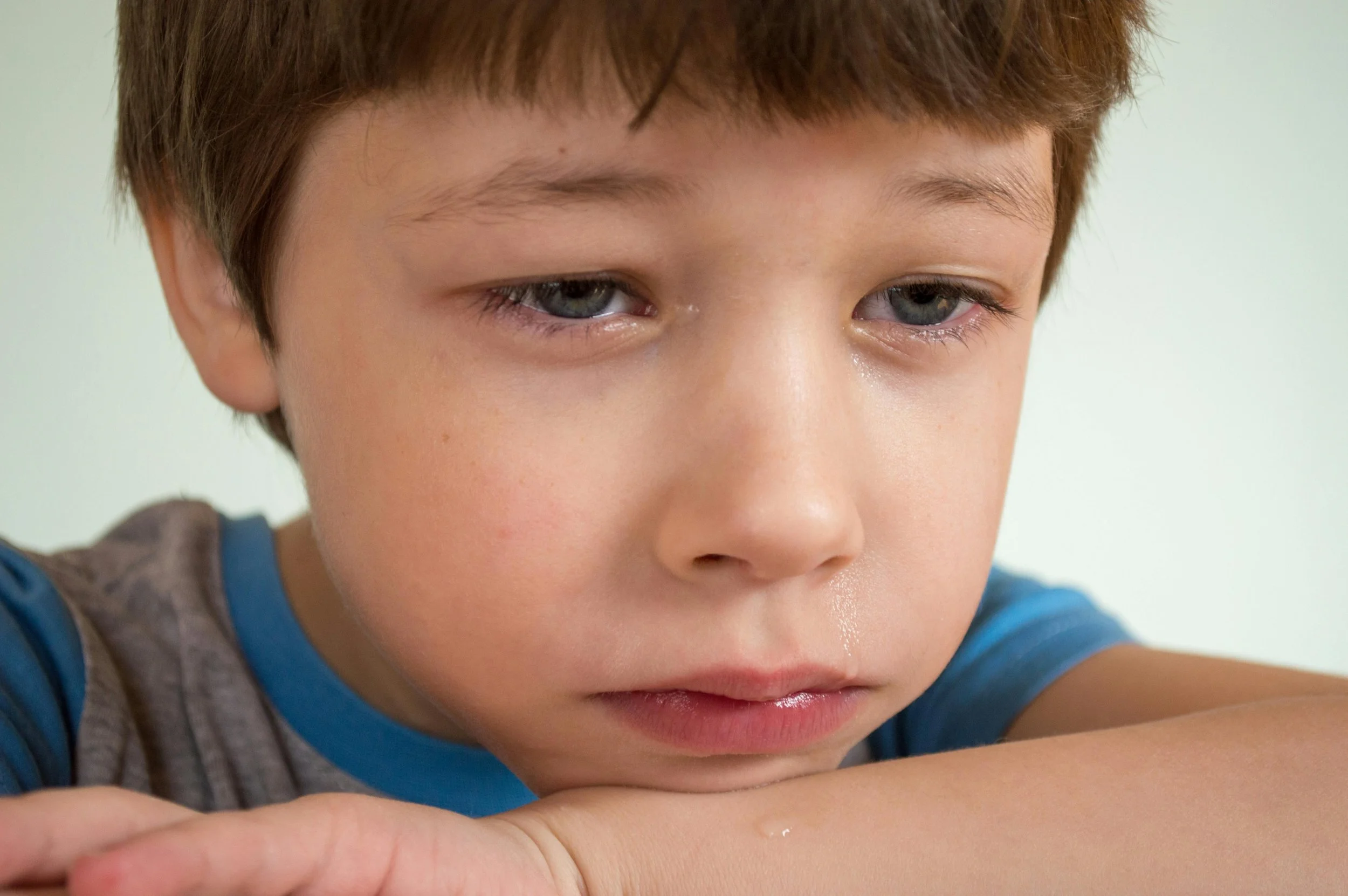
A child does not always say when school has started to feel heavy. Often, the first signs appear in the face, the silence, or the dread they cannot yet explain.
What the outside did not show
From the outside, I do not think I looked like a child in crisis. I still went to school. I still knew the kids around me. I
still looked, to most people, like I was part of the group. That is one reason I think parents can miss these moments. Social pain does not always announce itself dramatically. It often hides inside routine.
What I was carrying internally was very different. Every day, I went into lunch bracing. I knew where I was going to sit. I knew who would be there. And I knew there was a good chance I would be made into the joke again. It was not one explosive event. It was repetition. Sometimes that is what wears a child down most. Not the one terrible moment, but the daily expectation that the moment is coming again.
By the time that kind of thing settles into a child’s nervous system, the dread often starts before the actual event. That is why the Sunday Scaries can matter so much. They are not always about homework, schoolwork, or laziness. Sometimes they are the body’s way of anticipating a place where the child no longer feels emotionally safe.
That weekend, I felt it hard.
I remember folding laundry on Sunday night and realizing that something in me had reached the end of its tolerance. I did not want to fake being sick, although I thought about it. I did not want to stay home forever. What I wanted was for lunch not to feel like a small public humiliation waiting to happen.
That is when I decided I would sit somewhere else.
The kind of courage adults often miss
People talk about courage as though it always looks bold. In childhood, it often does not.
Sometimes courage is not a confrontation. Sometimes it is not a speech. Sometimes it is not fighting back on the playground or announcing your boundaries in a way that makes adults clap.
Sometimes courage is a quieter move than that. It is a child deciding, “I cannot keep doing this to myself,” and making one change to protect their own peace. That was my move.
The next day, at lunch, I sat at a different table. I knew the kids there, but they were not exactly my close friends. That detail matters too. I did not want anyone to think I needed rescuing. I did not want to make a scene. I just wanted to get through lunch without becoming the target again.
My friend Phil came over and invited me back to my old table. I told him, “No thanks, I’m okay.” My old table looked over, pointed, and laughed. And then, after about a week, that stopped.
That week was not easy. But something more important happened on the other side of it. I made new friends. I learned that one social group did not get to define my whole world. And I renewed my confidence in something that has stayed with me ever since: I could do hard things without turning them into a fight.
Why I did not handle it by fighting
Some people later asked why I did not just confront the kid directly or fight him on the playground.
The truth is, I had already learned something about that kind of response, and I did not like what it did to me.
I was raised taking martial arts, and on a family vacation years earlier, I had confronted someone physically. I made that person cry. It did not feel empowering. It did not make me feel bigger, stronger, or proud. It made me feel guilty. I remember telling the person watching us that I felt sick afterward and going off by myself until my parents came back.
That memory stayed with me.
So by sixth grade, even if other people thought “standing up for myself” should look aggressive, I knew that was not the form of courage I wanted. Hurting someone else did not make me feel safe. It made me feel worse.
I think that matters for parents too.
Sometimes adults assume the only healthy alternative to quiet suffering is direct confrontation. But not every child is built for that, and not every situation is made better by it. Some children do not need to be pushed into a fight they do not want. They need help finding a move that protects them without violating who they are.
That is part of what Yabbit has always meant to me.
What this story has to do with Yabbit the Rabbit
Yabbit was never meant to represent fear in the abstract. He was meant to represent a very specific emotional truth: the moment gets big, the body hesitates, and the child is caught between wanting to move and not knowing how.
That is why my own childhood experiences matter here.
In stories, adults sometimes want a child character to be brave in a way that is clean and cinematic. In real life, bravery is often messier and much quieter than that. A child may not roar. They may not announce what they are doing. They may simply move one chair, choose one new table, say one calm “no thanks,” or take one small step that gives them a little more dignity than the day before.
That is Yabbit’s world.
He is not fearless. He is not the child who charges ahead without friction. He is the child who feels the size of the moment. And that is why so many children recognize themselves in him. They know what it feels like when the social world gets heavy, when the start gets hard, or when staying where they are feels worse than trying something new.
Snail matters in that emotional world too. Snail does not shame Yabbit for pausing. He balances him. He reminds children that persistence can exist right beside hesitation. One part of you can be unsure while another part of you is still willing to move.
That is not just a story truth. It is a child-development truth.
What parents can notice before a child says the words
One of the reasons I wanted to tell this story is that many children do not bring adults the clean version of what is happening.
They do not say, “I am being excluded.”
They do not say, “A friend has turned on me socially.”
They do not say, “I feel trapped in a daily humiliating routine.”
They show you instead.
They start dreading a specific part of the day.
They ask to stay home.
They get quieter about school.
They seem tense on Sunday night.
They avoid the lunchroom, recess, a team, a practice, or a place that used to feel ordinary.
They start solving the problem privately before they ever invite you in.
That last one is important. Some children do not hide their pain because they do not trust their parents. They hide it because they are trying to protect themselves from feeling weak, dramatic, needy, or exposed. Sometimes they are also trying to protect their parents from becoming angry, reactive, or bigger than the situation feels manageable.
That is why I am such a believer in non-confrontational openings.
If you rush in too hard, the child may go underground.
How to help without creating more conflict
I think the best first move is often quieter than parents expect. Start by noticing, not accusing.
“I’ve noticed lunch seems harder lately.”
“You seem tense on Sunday nights.”
“You haven’t sounded like yourself after school.”
“I may be wrong, but it feels like something about school has gotten heavier.”
That kind of language matters because it gives the child room to step toward the conversation without feeling trapped inside it. Then listen longer than you think you need to.
Do not interrupt with solutions in the first thirty seconds. Do not immediately tell them what they should have done. Do not ask ten rapid-fire questions that make it feel like a deposition. Give them space to tell it the way a child tells it: unevenly, indirectly, sometimes in fragments.
Then help the child separate the problem from their identity.
This is not, “Why are you letting this happen?”
It is, “That sounds painful.”
It is not, “Why didn’t you tell me sooner?”
It is, “I’m glad you’re telling me now.”
It is not, “You need to stand up for yourself.”
It is, “Let’s think about what would help you feel safer.”
That is the difference between creating a second stressful scene at home and becoming the safe place where the child can finally put the truth down. If you want a post that pairs naturally with this one, this is the strongest internal companion on understanding the pattern underneath the behavior: https://www.yabbitrabbit.com/parent-resources/shy-anxious-or-hesitant-how-to-tell-the-difference
The goal is not always confrontation
Sometimes the most useful adult fantasy is also the least helpful one. We imagine the clean confrontation, the apology, the schoolyard justice, the scene where the child or the parent says exactly the right thing and the problem collapses in one neat moment.
Real childhood is usually not that tidy.
Sometimes the child does need adult intervention. Sometimes the school does need to know. Sometimes a repeated pattern is exactly what outside support is for. But even then, the emotional goal is not to turn the child into a warrior overnight. The goal is to help the child feel less trapped and more supported.
Sometimes that means helping them move groups.
Sometimes that means helping them script one sentence.
Sometimes that means documenting what is happening.
Sometimes that means telling the school.
Sometimes that means helping them build one small alternative rather than demanding one big performance.
That is why I still believe so much in tiny brave steps. They are not soft. They are often the most realistic doorway into change.
This is the best internal companion if you want the practical next-step framework: https://www.yabbitrabbit.com/parent-resources/how-to-help-your-child-take-tiny-brave-hops
What I hope parents take from this story
I do not share this story because I think every child should handle social pain the way I did. I share it because I want parents to understand how quiet these moments can be while they are still shaping a child deeply.
A child can be going to school every day and still be struggling. A child can be functioning and still be bracing. A child can be trying to solve the problem privately and still desperately need a safe adult.
And sometimes the bravest thing a child does is not fighting back. Sometimes it is moving toward a safer place without becoming someone they do not want to be.
That is one of the reasons The Rabbit in the Moon exists at all.
It was born out of moments like this. Moments where fear, hesitation, and the desire to protect yourself all show up at once. Moments where a child needs a story that says, “You are not weak for feeling this. You are not wrong for hesitating. And courage does not have to be loud to count.”
Yabbit the Rabbit is an investment in your child’s emotional growth
If your child hesitates, shuts down socially, dreads certain moments at school, or needs courage made smaller and more emotionally honest, The Rabbit in the Moon can help.
It gives children a character who feels what they feel without being labeled, and it gives parents a calmer language for supporting a child who is trying to find a safer next step.
FAQs
What are signs my child may be struggling socially at school?
Look for changes in mood or behavior around specific parts of the day, like lunch, recess, carpool, or Sunday night. A child may become quieter, more avoidant, more tense, or suddenly reluctant to go without clearly explaining why.
Why might a child not tell a parent they are being teased?
Many children feel embarrassed, exposed, or worried that adults will overreact. Some also want to solve the problem privately because they do not want to look weak or dependent.
Should I tell my child to confront the other child directly?
Not automatically. Some situations do benefit from a direct response, but not every child feels safe or emotionally equipped to do that well. The better question is which response protects the child without escalating the harm.
What is a non-confrontational way to start the conversation?
Lead with observation, not accusation. Try something like, “I’ve noticed school seems heavier lately,” or, “Lunch has seemed hard recently. Want to talk about it?” That creates room rather than pressure.
When should I involve the school?
If the pattern is repeated, is affecting your child’s well-being, or is making school feel unsafe, it is worth involving the school. You do not need to wait for the situation to become dramatic before you take it seriously.
How does The Rabbit in the Moon help with moments like this?
The book helps children understand hesitation without shame. Yabbit gives them a character who feels the size of the moment, and Snail helps model the persistence and support that make a next step feel possible.