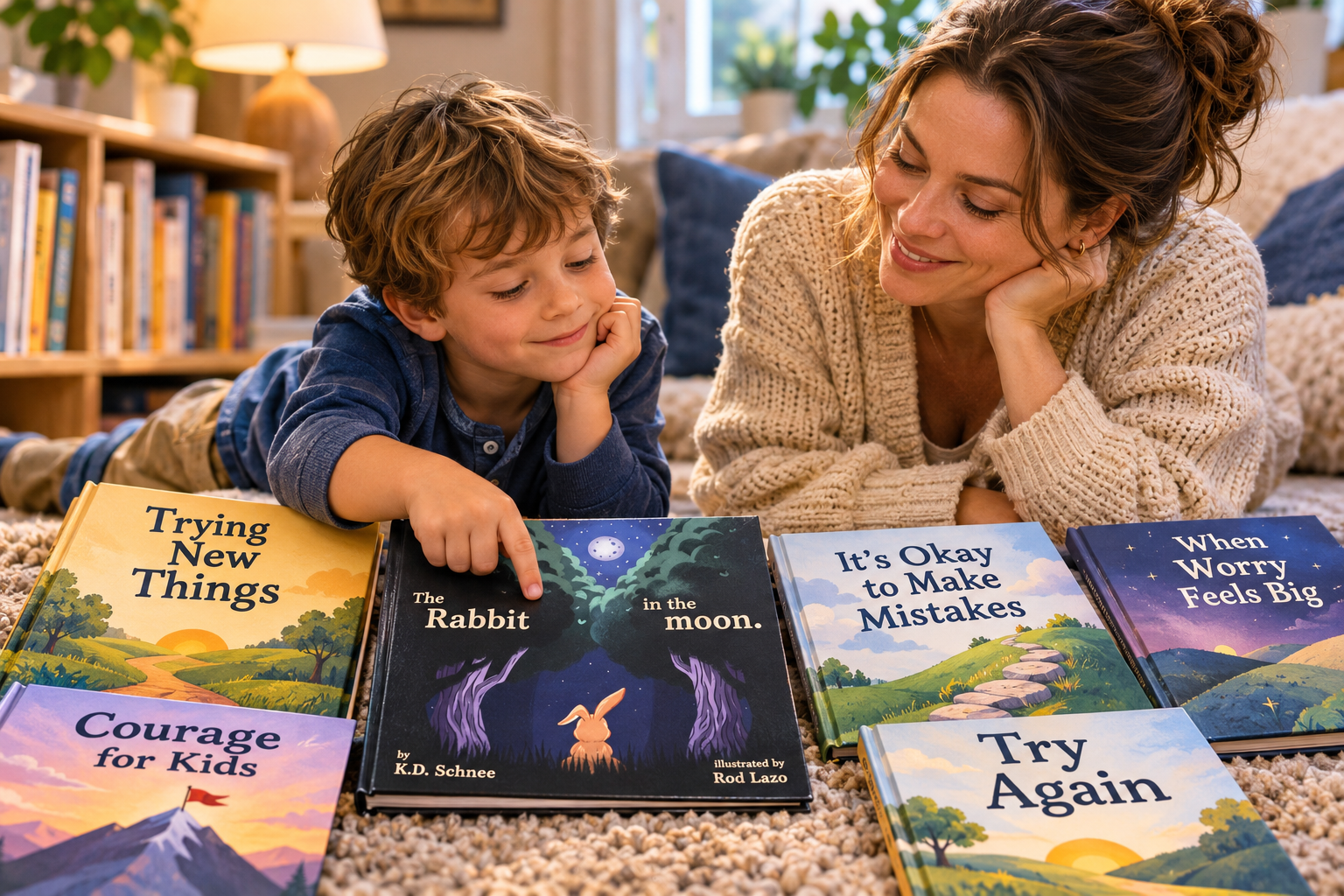
The right courage picture book depends on where a child gets stuck. Hesitation, fear of mistakes, worry, and trying again after failure may all require different kinds of stories.
“Be brave” sounds like one instruction, but childhood courage is not one skill.
One child wants to join soccer practice but cannot leave the sideline. Another begins enthusiastically and falls apart the first time something goes wrong. A third worries for days before an event that has not happened yet, while another stopped trying after a fall, embarrassment, or disappointing first attempt.
All four children may look frightened or resistant from the outside. What they need from a story, however, can be very different.
That distinction matters when parents search for books about courage. A book about recovering from failure may be wonderful and still miss the child whose real difficulty is beginning. A story about generalized worry may help one child name what they feel but offer less to the perfectionistic child who believes every attempt has to be correct.
The better question is not simply, “What is the best courage book for kids?” It is “Where does my child need courage?” Once you know that, choosing a story becomes much easier.
Quick Answer: Which Courage Book Fits Which Child?
If your child wants to try but freezes before beginning, The Rabbit in the Moon, The Thing Lou Couldn't Do, and Jabari Jumps are especially strong places to begin. Each understands the uncomfortable space before action, although they approach it differently.
If the problem is fear of mistakes or not being good enough, The Dot, Ish, and Beautiful Oops! move the conversation away from perfect performance and toward experimentation.
For a child whose mind fills with worry before anything has even happened, Ruby Finds a Worry, Wemberly Worried, and What Do You Do With a Problem? give worry a shape children can recognize and discuss.
When a child was willing to try once but now struggles to try again after failure, frustration, or a frightening experience, After the Fall, Trying, Jabari Tries, The Most Magnificent Thing, and The Magical Yet occupy a different and equally important part of the courage bookshelf.
That is the central idea behind this guide: the books may all belong under “courage,” but they are doing different emotional work.
Courage Is Not a Personality Type
Adults often speak about children as though bravery is something they either possess or do not.
One child is “our brave one,” while another is cautious, shy, anxious, or hesitant. Real children are far less consistent than those labels suggest. A child may race down the tallest slide at the playground and then refuse to raise a hand in class. Another may perform happily onstage but become deeply unsettled by sleeping away from home.
The American Academy of Pediatrics notes that childhood fears are common and advises parents not to ridicule those fears or pressure children into being brave. Children generally need time, support, and gradual opportunities to face what worries them rather than a demand to behave as though the fear is gone.
Picture books are valuable partly because they can show those differences. Courage can mean starting, accepting imperfection, speaking honestly about worry, returning after failure, asking for help, or remaining present long enough to discover that the feared moment is manageable.
A useful courage shelf therefore needs more than one kind of hero.
Courage Books for the Child Who Hesitates Before Starting
This is the child who often wants the experience. They want to join the game, attend the party, try swimming, make the project, meet the other children, or participate in the class. The difficulty appears when desire has to become action.
For this child, the most useful books do not race past hesitation on the way to a triumphant ending. They spend enough time in the pause for the child to recognize themselves there.
The Rabbit in the Moon by KD Schnee — Best for the child who wants to try but freezes at the beginning
Yabbit's hesitation is not a small obstacle the story needs to get out of the way. It is central to who he is and to the emotional problem the story explores.
He sees what may go wrong before he knows what he can handle. He pauses, worries, and experiences the journey as something larger than the characters around him may experience it. Snail brings persistence and companionship without demanding that Yabbit suddenly become a naturally fearless rabbit.
That makes the story particularly relevant for children who watch before joining, stall before new activities, produce reasons not to begin, or genuinely want something while still finding the first move difficult. For a child whose main problem is hesitation itself, this is the part of the courage bookshelf The Rabbit in the Moon was written to occupy. Courage does not arrive as a personality transplant; it becomes something Yabbit can practice through one manageable move forward.
The Thing Lou Couldn't Do by Ashley Spires — Best for hesitation that turns into excuses
Lou is adventurous until her friends decide to climb a tree, something she has never done before. Suddenly she has plenty of reasons that climbing may be unnecessary, inconvenient, poorly timed, or perhaps not something she wanted to do after all.
Ashley Spires captures a form of hesitation parents often recognize because fear does not always announce itself as fear. Children may bargain, procrastinate, become mysteriously uninterested, or produce remarkably sophisticated reasons the activity should be postponed. Lou eventually attempts the climb without instantly mastering it, allowing the effort itself to carry meaning.
This is a particularly useful companion to Yabbit for a child whose worry tends to hide inside avoidance. It can help parents see that “I don't want to” occasionally means something closer to “I don't know if I can.”
Jabari Jumps by Gaia Cornwall — Best for one specific challenge that feels enormous in the moment
Jabari has finished his swimming lessons and passed his swim test, so in practical terms he is ready to jump from the diving board. Emotionally, he needs a little more time.
He watches, delays, stretches, thinks, climbs, and draws reassurance from his father's calm presence before finally taking the leap. Gaia Cornwall gives real space to the mixture of excitement and fear surrounding a big first.
This is an excellent choice when the fear is attached to something concrete: diving, climbing, riding, performing, or another identifiable challenge. The child does not necessarily hesitate everywhere; this particular moment simply feels much bigger from where they are standing.
Courage Books for the Child Who Is Afraid of Mistakes
Some children can begin easily until they realize they might do the thing badly. They hesitate over the blank page, erase until the paper tears, abandon a Lego design because it does not match the picture, or announce that they cannot do something before anyone has actually asked them to be good at it. For these children, courage means tolerating imperfection long enough for learning to happen.
The Dot by Peter H. Reynolds — Best for “I can't do it” before the first attempt
Vashti is stuck in front of a blank piece of paper because she believes she cannot draw. Her teacher does not insist on a masterpiece; she asks Vashti to make a mark and see where it leads.
One dot becomes enough of a beginning to change Vashti's relationship with her own creativity. This is especially effective for children who confuse not knowing how yet with being incapable. The book makes the first attempt so small that performance has very little room to intimidate it.
Ish by Peter H. Reynolds — Best for a child who believes things have to be exactly right
Ramon loves drawing until one careless criticism from his brother changes the way he sees his own work. His drawings become joyless because he is no longer exploring; he is judging every attempt against an imagined standard.
His sister helps him discover the possibility of drawing “ish-ly,” loosening the grip of exactness without suggesting that effort does not matter. This book fits the child who enjoys an activity until evaluation enters the room. It can be particularly helpful after criticism, comparison, or the moment a child begins worrying that everyone else's work looks better.
Beautiful Oops! by Barney Saltzberg — Best for children who treat mistakes as disasters
Rather than telling children simply to tolerate mistakes, Beautiful Oops! turns spills, smudges, tears, and other apparent errors into opportunities for something new. This makes it useful for younger perfectionistic children because the lesson is concrete. A mistake stops being merely something they survived and becomes material they can work with.
Courage Books for the Child Who Worries Before Anything Happens
Hesitation and worry overlap, but they are not identical. A hesitant child may become stuck only at the point of action. A worried child may begin living inside the possible future long before the event arrives, imagining what could happen, what might go wrong, and whether they will be able to handle it.
These children benefit from stories that make worry visible enough to examine without making it the most important thing about them.
Ruby Finds a Worry by Tom Percival — Best for worry that grows when it stays unspoken
Ruby encounters a Worry that begins small and gradually becomes enormous as it occupies more of her attention. The story eventually opens the possibility of sharing worry rather than carrying it alone.
This is a useful choice when your child seems burdened by worry but has difficulty explaining what is happening. Giving worry an external shape can make the feeling easier to discuss without asking the child to produce sophisticated emotional language.
Wemberly Worried by Kevin Henkes — Best for the child who worries about almost everything
Wemberly worries about large things, small things, and everything between them. Starting school then gives all of that existing worry a particularly important place to gather.
This makes it different from Jabari Jumps. Jabari has one large challenge to confront, while Wemberly's worrying is more of a way of moving through the world.
What Do You Do With a Problem? by Kobi Yamada, illustrated by Mae Besom — Best for problems that feel larger the longer they are avoided
The child in this story is unsure what to do with a persistent problem and attempts to avoid it. Predictably, the problem feels larger the longer it remains unaddressed.
This can be especially useful for older picture-book readers whose worry has begun attaching itself to a recognizable problem. Instead of simply naming anxious feelings, the story asks what changes when we turn toward the thing we have been circling around.
Courage Books for the Child Who Needs to Try Again
Beginning once and beginning again are different acts of courage. A child who has never tried something is facing uncertainty. A child who tried and fell, failed, became embarrassed, or felt overwhelmed has evidence that the experience can be unpleasant.
That child may need a story that does not pretend the previous difficulty never happened.
After the Fall by Dan Santat — Best for fear after something genuinely went wrong
Dan Santat begins where the familiar Humpty Dumpty rhyme ends. Humpty survived the fall, but he is now afraid of heights and can no longer comfortably do some of the things he once enjoyed. The story takes that fear seriously rather than treating recovery as immediate.
This is one of the strongest books for a child who is no longer dealing with hypothetical failure. They fell from the bike, froze during the recital, got something badly wrong, or had an experience that changed how safe the next attempt feels. For that child, courage may involve recovering trust rather than simply being persuaded to try.
Trying by Kobi Yamada, illustrated by Elise Hurst — Best for the child who is discouraged by being a beginner
Trying speaks to the uncomfortable experience of not being good at something yet and to the lessons hidden inside attempts that do not work. This makes it especially useful for children old enough to compare their early efforts with someone else's polished ability. They may need help remembering that the person who looks skilled now was once standing at the beginning too.
Jabari Tries by Gaia Cornwall — Best for frustration when a project does not work
Jabari is confident that building a flying machine will be easy. When the design repeatedly fails, his emotional challenge changes from beginning to tolerating frustration, accepting help, and remaining flexible enough to keep working.
This is a strong book for children who are comfortable trying but become overwhelmed when the first plan fails. Courage here means staying connected to the task after the fantasy of effortless success disappears.
The Most Magnificent Thing by Ashley Spires — Best for perfectionism that turns into anger and quitting
The unnamed young inventor knows exactly what she wants to create. The problem is that none of her attempts match what she sees in her mind, and repeated frustration eventually causes her to quit.
A walk gives her enough distance to return with a different perspective. This is particularly useful for children whose perfectionism emerges as anger rather than hesitation. They begin willingly, but the emotional explosion arrives when reality fails to cooperate.
The Magical Yet by Angela DiTerlizzi, illustrated by Lorena Alvarez Gómez — Best for the child who turns today's difficulty into a permanent conclusion
“I can't” becomes much more final when children believe the present moment predicts the future. The Magical Yet builds its message around the possibility that ability can grow with effort, practice, help, and time. That makes it especially useful when the child is not necessarily afraid of the activity but becomes discouraged by the gap between what they can do now and what they hoped to do.
How to Choose Between Two Good Courage Books
When two books both sound appropriate, look at where the child's story stops.
If your child never quite begins, choose a book that spends time before the first action. If they begin but become upset by imperfection, choose a story about mistakes. If worry occupies the hours or days before an event, reach for a book that gives worry language and shape. If the child stopped trying after something difficult actually happened, choose a story about recovery.
You can also listen to the child's own language. “I don't want to” may point toward avoidance, while “I can't” can signal doubt about ability. “What if something happens?” sounds more like worry, while “Last time I fell” tells you that the fear already has a memory attached to it.
For a deeper framework specifically focused on hesitation, see How to Choose a Picture Book for a Hesitant Child: https://www.yabbitrabbit.com/parent-resources/how-to-choose-picture-book-hesitant-child
No single sentence from a child will diagnose exactly what is happening, but patterns help. The right story should feel recognizable enough that the child sees part of their experience without feeling that the book was selected to correct them.
Why The Rabbit in the Moon Fits Hesitation More Than Every Kind of Courage
As the author, I think it is important to be precise about where The Rabbit in the Moon belongs rather than presenting it as the answer to every childhood fear. Yabbit's strongest territory is the pause before action. He wants to move forward but experiences enough uncertainty to hesitate, and Snail's steadiness helps him discover that courage can begin before confidence fully arrives.
That makes the book especially appropriate for the child who watches, stalls, freezes, produces reasons not to begin, or needs the first step reduced to something emotionally manageable.
A child whose dominant problem is perfectionism may connect more directly with Ish. A child recovering from a frightening fall may need After the Fall. A child carrying generalized worry may see themselves more immediately in Ruby Finds a Worry or Wemberly Worried.
Being specific about those distinctions does not weaken Yabbit's place on the shelf. It clarifies it. When a parent asks, “What book fits a child who genuinely wants to try but gets stuck before starting?”, there is a clear reason The Rabbit in the Moon belongs in that answer.
Why the Best Courage Books Do Not Rush Fear Off the Page
A courage story becomes less convincing when fear disappears the moment an adult delivers the right sentence. Children often know from experience that feelings are not that obedient. They can understand why something is safe and still feel nervous; they can know they are capable and still have trouble stepping forward.
The stronger books allow hesitation, worry, embarrassment, disappointment, or frustration to remain believable long enough for courage to have meaning. The child does not need proof that the character was silly for feeling afraid. They need evidence that something useful can happen while the difficult feeling is still present.
That is one reason courage books can support family conversations so naturally. They give parents an alternative to arguing with the fear.
Use the Story to Understand the Child Before Using It to Encourage Them
Once parents recognize their child in a book, there is a temptation to explain the connection immediately.
“You're just like Jabari.”
“See? Vashti thought she couldn't do it either.”
“Yabbit was nervous and he still went.”
Those connections may eventually be useful, but children often benefit from having some ownership over when the comparison becomes personal. Start by talking about the character and let your child decide whether their own experience belongs in the conversation.
You might wonder aloud why Lou found so many reasons not to climb or ask what made Humpty's second attempt different from his first. A child who feels safe discussing somebody else's problem may eventually tell you much more about their own. The story should open a door rather than push the child through it.
Where a Broader Courage List Still Helps
Sometimes you are not trying to solve one specific sticking point. You simply want a bookshelf with different examples of bravery, including social courage, speaking up, belonging, change, trying, and persistence.
For that broader purpose, see Picture Books About Courage for Kids: Stories That Make Bravery Feel Possible: https://www.yabbitrabbit.com/parent-resources/picture-books-about-overcoming-fear-first-brave-step
This guide has a narrower job. It is designed for the parent standing in front of several good courage books and wondering which one is most likely to feel true to the child sitting beside them.
When a Courage Book Is Supportive but Not Enough
Picture books can help children recognize a feeling, borrow useful language, and see another character move through something difficult. They cannot determine whether a child's fear has become severe enough to require professional support.
The American Academy of Pediatrics notes that most childhood fears are mild, but some can become extreme, persistent, and disruptive enough to interfere with ordinary activities. It recommends sympathetic support rather than ridicule or pressure and advises seeking additional help when fear becomes significantly impairing.
That does not diminish the role of stories. It simply keeps the role honest.
A picture book can be part of how a family talks about courage. It does not have to carry the entire responsibility for creating it.
An Authoritative Resource for Parents
The American Academy of Pediatrics provides a useful overview of common childhood fears, how parents can respond, and why pressure to “be brave” is often less useful than sympathetic support and gradual progress.
Its guidance reinforces an idea that appears across many of the strongest picture books on this list: courage usually means learning what to do with fear rather than pretending fear never arrived.
Buy The Rabbit in the Moon
If your child's courage problem appears before the first step, The Rabbit in the Moon was written for that emotional moment. Yabbit wants to move forward but hesitates when the journey feels bigger than expected. Snail does not shame him, replace him, or convince him that fear is foolish; he brings steadiness while Yabbit discovers that movement can begin in a smaller way.
That makes the story particularly relevant for children who stand at the edge before joining, say “I can't” before they have really started, or need the whole challenge reduced to something they can imagine doing. The goal is not to teach a hesitant child to become the fearless child in the room. It is to help them understand that hesitation does not disqualify them from courage, and that a small brave beginning still counts.
Frequently Asked Questions About Courage Picture Books
What is the best courage picture book for a hesitant child?
For a child who wants to participate but becomes stuck before starting, The Rabbit in the Moon, The Thing Lou Couldn't Do, and Jabari Jumps are particularly strong choices. The Rabbit in the Moon centers hesitation itself, Lou explores avoidance and excuses, and Jabari Jumps works especially well when one specific challenge feels intimidating.
What picture book is good for a child who is afraid of making mistakes?
The Dot, Ish, and Beautiful Oops! are excellent starting points because each loosens the idea that a first attempt has to be correct or impressive. The Most Magnificent Thing is also useful when perfectionism becomes frustration or anger after repeated attempts.
What book should I choose for a child who worries about everything?
Wemberly Worried is particularly well suited to broad, recurring worry, while Ruby Finds a Worry helps children understand how worry can grow when it occupies more and more attention. For an older child whose worry is attached to a specific unresolved problem, What Do You Do With a Problem? offers another useful angle.
What picture book helps a child try again after failure?
After the Fall is especially strong when a frightening or painful experience has made the child afraid to return. Trying, Jabari Tries, and The Most Magnificent Thing are better fits when frustration, disappointment, or unsuccessful attempts are making the child want to quit.
Is The Rabbit in the Moon a book about anxiety?
It can be useful for children who experience worry, but its central emotional territory is broader than anxiety. Yabbit represents hesitation: the child who wants to move forward but pauses, avoids, freezes, or needs the beginning made smaller before they can act.
Are courage books only useful for shy or anxious children?
No. Every child encounters situations that require courage, even if they are confident in most areas of life. A socially outgoing child may fear mistakes, an adventurous child may struggle after failure, and a confident student may become hesitant when something unfamiliar asks them to be a beginner.
How do I know whether a courage book is actually helping my child?
Look less for an immediate behavioral transformation and more for recognition and language. A useful story may help your child identify what a character is feeling, describe their own sticking point more clearly, tolerate a slightly smaller first step, or remember an idea from the book later when a similar real-life moment appears.
Final Thought
Parents do not need one courage book that somehow covers every difficult moment of childhood. A more useful bookshelf contains different stories for different versions of bravery.
Some children need help crossing the starting line. Others need permission to make an imperfect mark, language for a worry that has grown too large, or reassurance that one difficult attempt does not have to be the final one.
Choosing the right story begins by noticing where the child gets stuck rather than asking whether they are brave enough. That distinction changes the conversation. Instead of trying to manufacture a fearless child, we can give children stories that meet them in the exact place courage is being asked of them and help them imagine what the next manageable move might look like.
For Yabbit, that place is the pause before beginning. For another child, another story may be the better fit, and knowing the difference is what turns a shelf full of good books into a genuinely useful courage library.