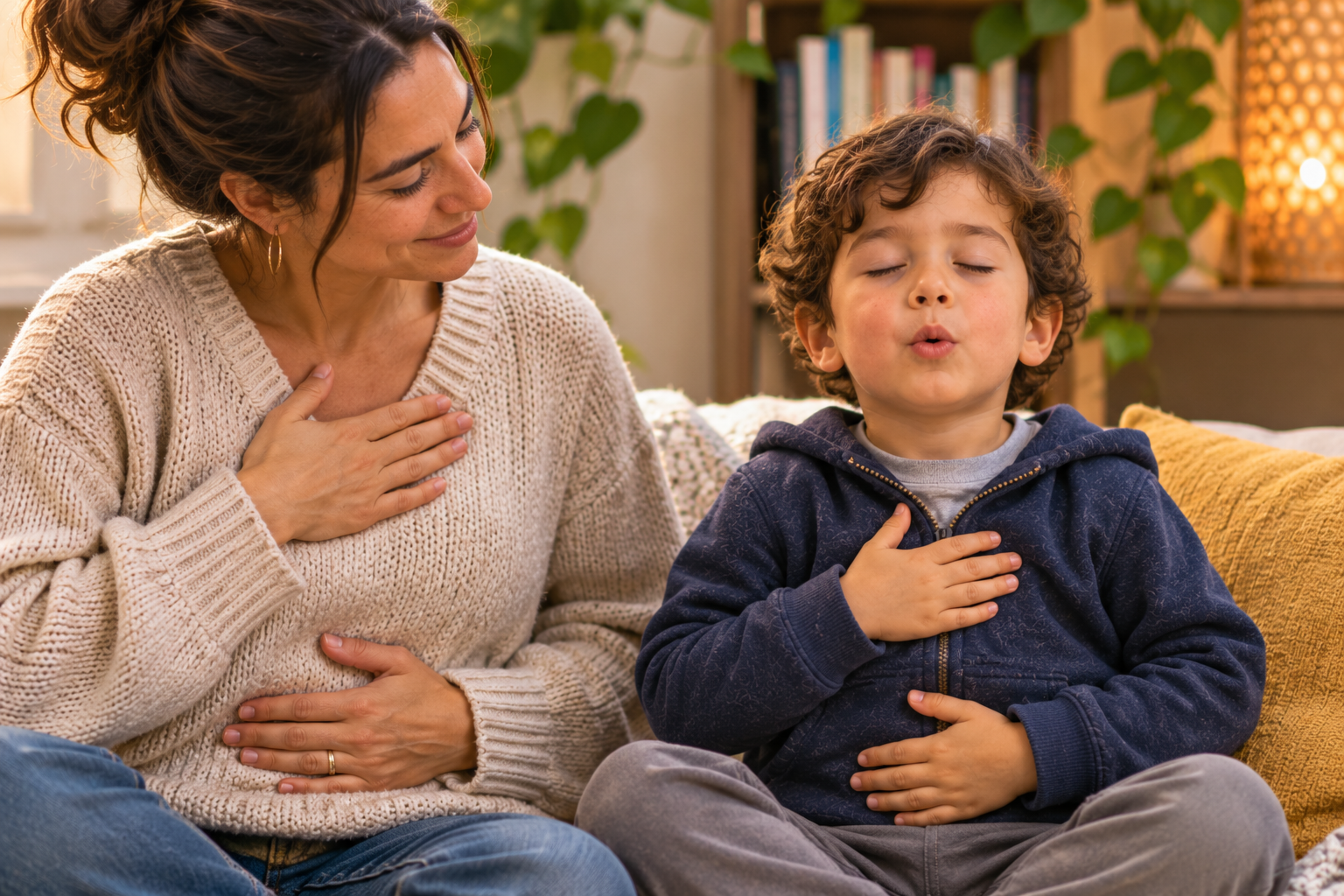
Simple calming exercises can give children something concrete to do when worry, frustration, or overwhelm makes it harder to think clearly.
“Calm down” makes perfect sense to an adult who can already recognize what overwhelm feels like and draw from years of experience managing it. To a four-year-old whose stomach feels strange, shoulders are tight, thoughts are racing, and entire attention has narrowed around one frightening moment, it is not much of an instruction.
Children often need something more concrete. They need a way to slow the moment down enough to notice their breathing, feel their feet underneath them, look around the room, move their body, or reconnect with something happening right now instead of everything their worry says might happen next.
Breathing and grounding exercises can provide that kind of pause. They are not magic tricks for making difficult emotions disappear, and a child does not need to become perfectly calm before they can move forward. Instead, these exercises can become small tools children practice over time, especially when adults introduce them during ordinary moments rather than waiting until emotions have already reached their highest point.
For children who frequently struggle with worry, physical complaints, avoidance, sleep difficulties, perfectionism, or other possible signs of anxiety, our broader guide explains what parents may want to watch for and when professional support may be appropriate.
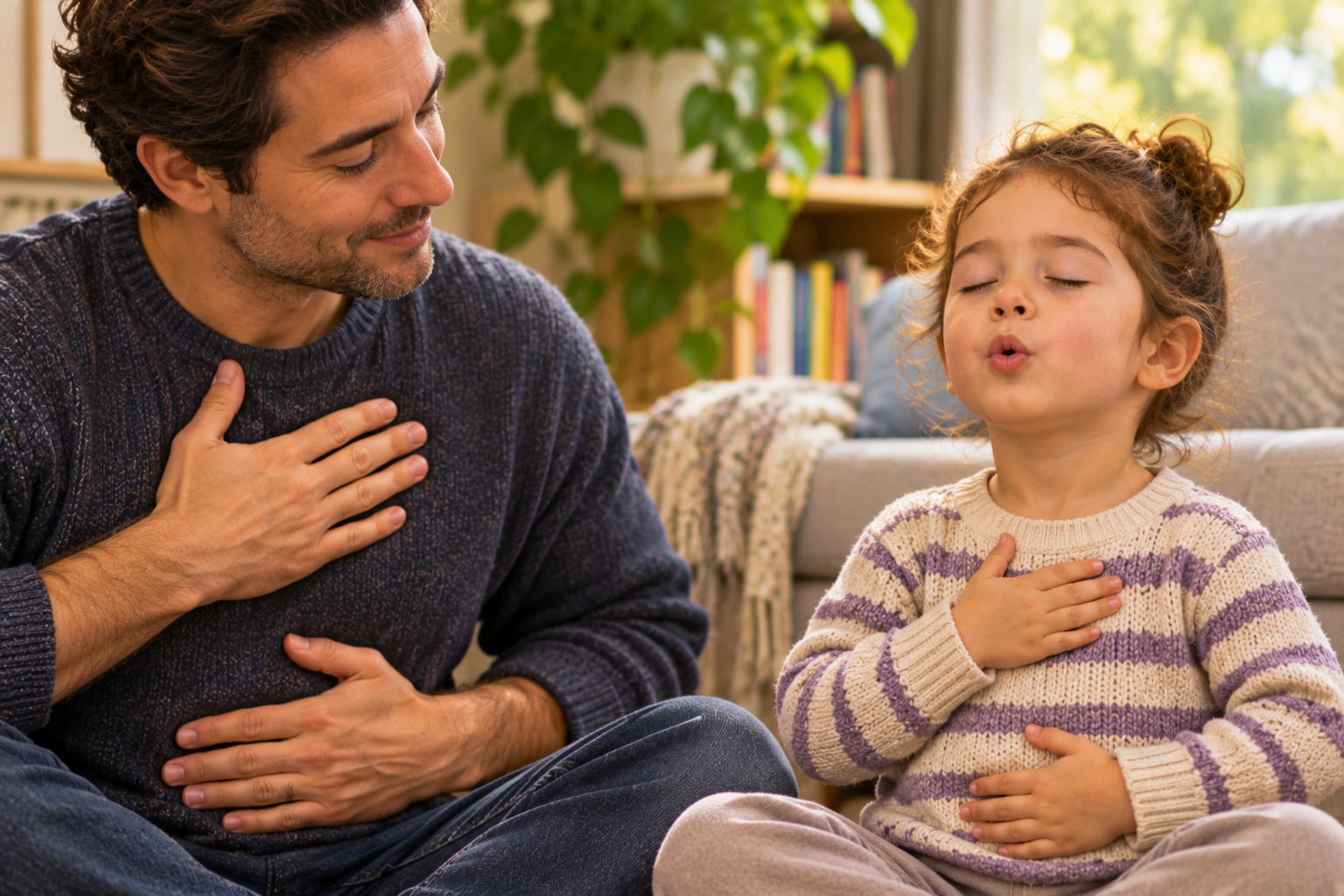
Breathing exercises are often easier for young children to learn when they are practiced during calm moments rather than introduced for the first time during intense distress.
What Is a Calming Exercise for a Child?
A calming exercise is simply an activity that helps a child slow down, notice what is happening in their body or environment, and regain enough steadiness to think about what comes next. Depending on the child and the situation, that might involve breathing, paying attention to the senses, feeling physical contact with the floor, stretching, walking, rocking, or another predictable movement.
The goal is not to teach children that uncomfortable feelings are bad or that they have failed when an exercise does not immediately make them feel better. Fear, anger, frustration, embarrassment, disappointment, and excitement can all remain present while a child becomes more aware of what their body is doing.
That distinction matters because emotional regulation is not the same thing as emotional erasure. A child can still be nervous about walking into school after taking a few slow breaths, and a child can still feel frustrated after pressing their feet into the floor. The exercise has still been useful if it creates a little more space between the feeling and what happens next.
Why Breathing and Grounding Can Help Kids Slow the Moment Down
The American Academy of Pediatrics recommends several body-based strategies for children experiencing stress, including slow breathing, belly breathing, movement, rhythmic activity, and attention to sensory experiences. HealthyChildren.org also notes that slow, longer exhalations can help settle the body's stress response and suggests allowing children to notice their breathing by placing a hand on the chest or belly.
Children do not need to understand the biology behind those strategies for them to be useful. A preschooler can notice a belly moving up and down. A six-year-old can feel both feet pushing into the floor. An eight-year-old can deliberately look around the room and notice what they can see, hear, and touch.
The simpler the exercise feels, the more likely it is to become something the child can eventually remember without an adult conducting every step.
1. Try Simple Belly Breathing
Belly breathing is one of the easiest places to begin because it gives a child something physical to notice. Ask your child to place one hand gently on their belly and breathe normally for a moment, without immediately telling them to make the breath deeper or slower.
Once they notice the movement, invite them to breathe in gently through the nose and then let the air come out slowly. You can say, “See if you can feel your hand move a little when you breathe in, and then feel it settle when you breathe out.”
Young children do not need precise counts, complicated breath-holding instructions, or pressure to perform the technique correctly. For a three- or four-year-old, simply noticing two or three slower breaths may be plenty. An older child may enjoy counting quietly to three while breathing in and four while breathing out, but the counting should help rather than become another task they are afraid of doing incorrectly.
Some children dislike focusing on their breathing, particularly when they are already very upset. If your child becomes more uncomfortable when asked to notice their breath, there is no reason to insist. Grounding through the senses or gentle movement may suit that child better.
2. Smell the Flower and Blow Out the Candle
Young children often respond more naturally to an image than to an instruction such as “Take a deep diaphragmatic breath.” The familiar idea of smelling a flower and gently blowing out a candle turns slow breathing into something they can picture and imitate.
Invite your child to pretend they are holding a flower near their nose. They can breathe in slowly as though smelling it, then imagine a candle in front of them and gently blow toward the flame without trying to blast it across the room.
The word “gently” is useful because children sometimes interpret breathing exercises as a competition to take the largest possible breath. That can make the activity uncomfortable and distract from the point. The breath should feel easy enough that your child could repeat it several times without strain.
You can also use the imagery without announcing that it is a calming exercise. During a worried moment, “Let’s smell the flower and blow out the candle together” may feel much more approachable to a five-year-old than “You need to regulate your breathing.”
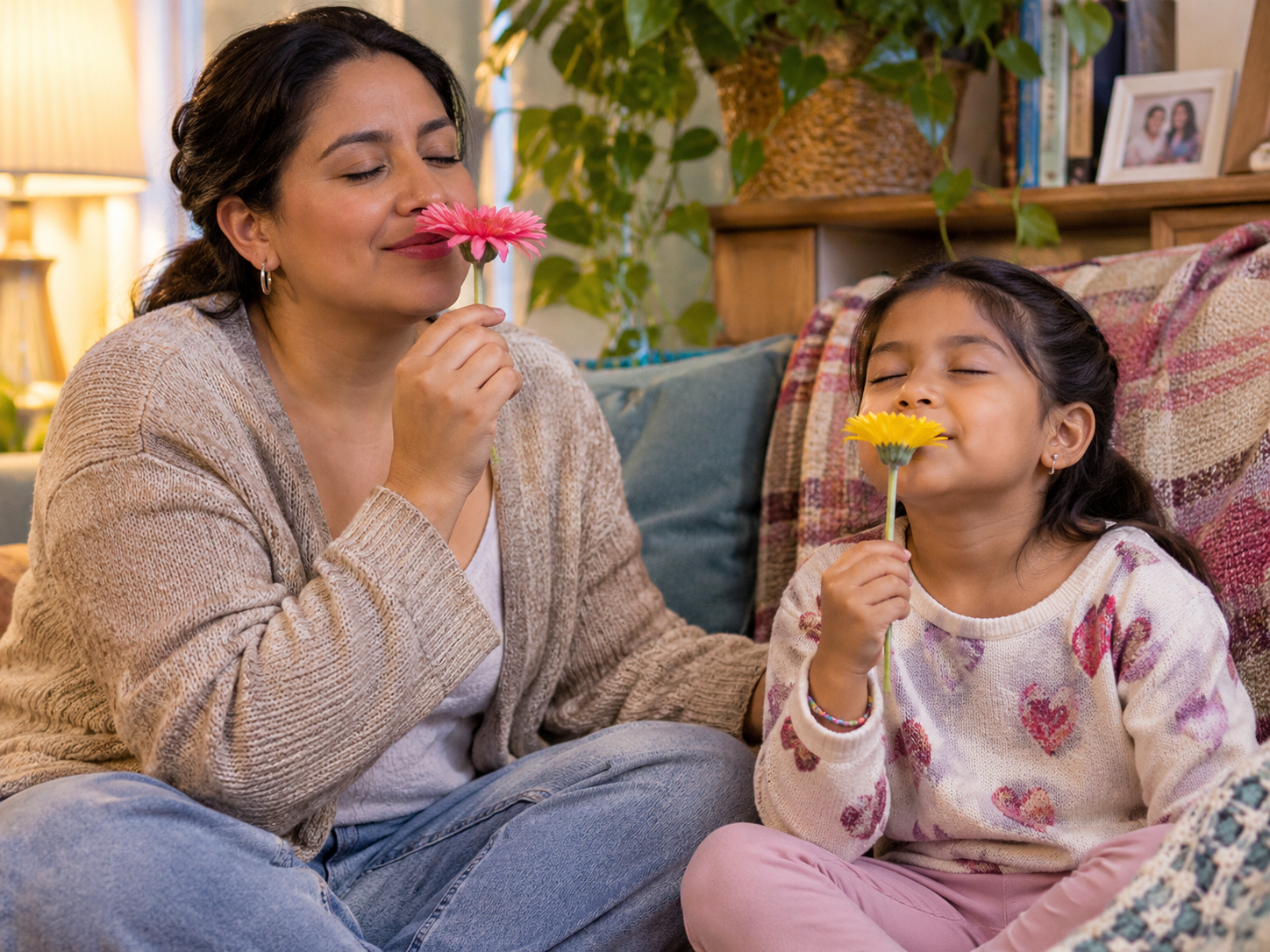
Imaginative breathing activities can make slow breathing easier for preschool and early-elementary children to understand without complicated counting.
3. Use a Simple 3-2-1 Grounding Exercise
Grounding exercises bring a child's attention back toward what is actually happening around them. When worry becomes absorbed in what might happen next, noticing the immediate environment can give the child's attention somewhere concrete to go.
For young children, I prefer a simplified 3-2-1 exercise rather than asking them to remember a long sequence. Invite your child to look around and name three things they can see, two things they can hear, and one thing they can feel with their body.
A child might notice a blue chair, a window, and their shoes. They might hear a car outside and the refrigerator humming, then notice that their hands feel warm or that their feet are touching the rug.
There is no correct answer. If your child becomes preoccupied with finding the “right” three objects or insists they cannot hear two sounds, simplify it further. Ask them to find one thing they see and one thing they feel, because the purpose is to reconnect with the present moment rather than successfully complete a worksheet in their head.
This technique can work particularly well before a new activity, during a waiting period, or after a child says that everything feels too much at once. It gives the mind a small, concrete job while the emotional wave has time to lose some of its momentum.
4. Press Your Feet Into the Floor and Notice Your Body
Children sometimes experience worry as a surprisingly physical event. Their stomach may hurt, their hands may feel shaky, their shoulders may rise, or they may feel as though their body wants to run even when they are standing still.
One very simple grounding exercise is to help the child notice where their body is making contact with something solid. Ask them to place both feet on the floor and gently press downward for a few seconds. Then let the pressure go and notice the difference.
You might say, “Can you feel the floor holding your feet?” or “Notice what your shoes feel like against the ground.” If the child is sitting, they can also notice the chair underneath their legs and back.
This does not need to become a lesson about anatomy or the nervous system. The useful part is the experience of shifting attention away from the swirl of thoughts and toward a physical sensation that is happening right now.
For some children, a gentle squeeze of their own hands, holding a familiar object, or pushing their palms together may serve the same purpose. Children vary considerably in which sensations they find comfortable, so follow their response rather than assuming every grounding technique will feel calming to every child.
5. Use Slow Movement Instead of Asking the Child to Sit Still
Not every child regulates best by becoming quiet and motionless. Sometimes the body needs movement before the mind has any interest in a breathing exercise.
The American Academy of Pediatrics includes activities such as walking, rocking, stretching, dancing, and other forms of physical movement among strategies that can help children cope with stress. That is useful for parents to remember because a child pacing around the room is not necessarily refusing to calm down. Movement may be the doorway that helps them settle.
Try taking a slow walk around the room together, stretching arms toward the ceiling, rolling the shoulders, rocking gently from one foot to the other, or walking outside for a few minutes. The activity does not need to be vigorous, and it does not need to look like formal exercise.
The important thing is to notice what happens afterward. Some children become more available for conversation once their body has moved. Others simply return to play or the next activity, which may be all that was needed.
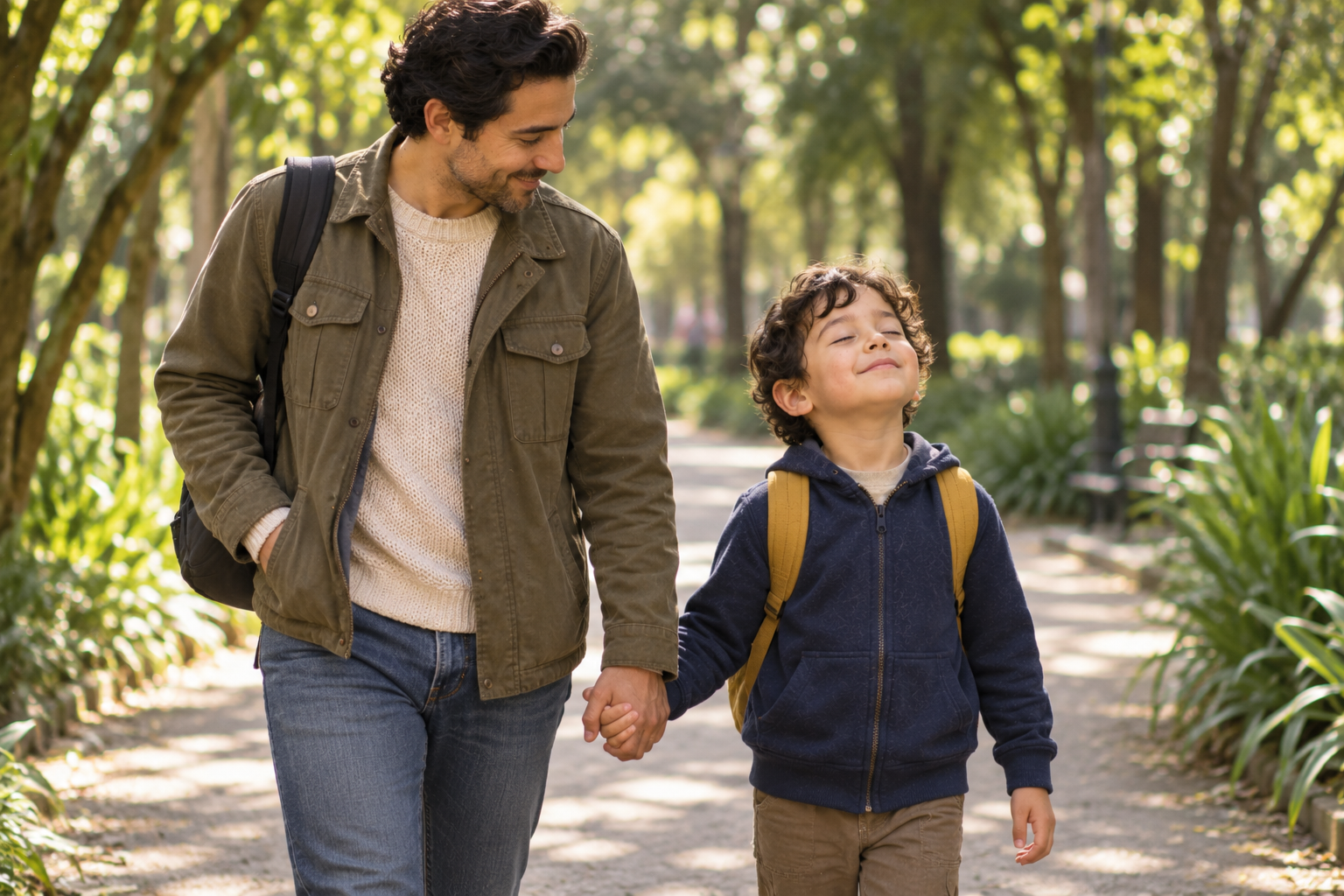
Some children regulate more easily through gentle movement than by sitting still, particularly when stress or frustration has created a strong urge to move.
Practice Calming Skills Before Your Child Desperately Needs Them
The worst time to teach a completely unfamiliar coping strategy is often the moment when a child is already overwhelmed.
Imagine being furious, frightened, or embarrassed and having someone suddenly explain a five-step technique you have never seen before. Even adults would struggle to receive the lesson gracefully.
Instead, practice one or two exercises when nothing is wrong. Try belly breathing before a bedtime story, play 3-2-1 while waiting for food at a restaurant, or notice your feet on the ground while sitting together at the park. When the activity is already familiar, the child has a better chance of recognizing it later.
You also do not need to practice all five exercises. A child who finds one or two tools genuinely helpful has something more valuable than a parent who can recite a catalog of fifteen coping techniques.
Let the Child Borrow Your Calm Before Expecting Independence
Young children learn emotional regulation partly through relationships. They often need an adult to provide a slower voice, predictable presence, and manageable pace before they can summon those qualities independently.
That is why “Take a breath” shouted from across the room tends to land differently from sitting nearby and taking a slow breath yourself. The second response gives the child something to join rather than another instruction to obey.
You can model the exercise without demanding participation. If your child is upset, you might say, “I’m going to slow my breathing while I sit here with you,” and then simply do it. Children sometimes join once the spotlight disappears.
Over time, the goal is for the child to develop more ownership of the tools. That process is gradual, and needing help at four, six, or eight years old does not mean the skill is failing.
Calming Down Does Not Have to Come Before Courage
One subtle problem with calming techniques is that adults can accidentally turn calmness into another requirement. A child begins to hear, “You need to calm down before we can do anything,” which can make a difficult emotion feel like an obstacle they must eliminate.
For hesitant children, a more useful sequence is often to slow the moment enough to find the next manageable action. The child may still feel nervous when they step into the classroom, approach the playground, put on the skates, or begin the assignment.
That is where our Tiny Brave Hop approach fits. Once a child has enough room to think again, the next question can become, “What is one small part you could do from here?” You can read the full framework here: https://www.yabbitrabbit.com/parent-resources/how-to-help-your-child-take-tiny-brave-hops
Breathing and grounding help create space. A Tiny Brave Hop gives that space somewhere to go.
Where The Rabbit in the Moon Fits
The Rabbit in the Moon was written for children who hesitate before something difficult and need courage to feel smaller and more reachable. Yabbit does not become fearless before moving forward, and the story does not suggest that a worried child simply needs to calm down and get on with it.
That distinction is important. Children can practice breathing, grounding, or movement while still understanding that fear itself is not a failure.
For a family using these exercises, a story can also provide emotional distance. Instead of asking a child to analyze themselves every time they feel worried, parents can sometimes talk about what a character notices, what helps the character continue, and how a large challenge can become a smaller next step.
The Rabbit in the Moon can support conversations about hesitation, courage, friendship, and beginning while afraid. It is not a treatment for childhood anxiety, but it can give families shared language for moments when a child needs the first step to feel less enormous.
Do Not Force a Calming Exercise That Is Making Things Worse
A coping skill should not become another battle. If your child says they do not want to breathe slowly, refuses to count objects around the room, or becomes irritated when you ask them to notice their feet, pay attention to that response. The technique may not fit the child, or it may simply be the wrong moment for it.
Some children want physical closeness when overwhelmed. Others need more space. Some respond to movement, while others prefer stillness. Some will happily pretend to smell a flower at age four and find the same exercise unbearably silly at age eight.
The purpose of having several options is not to cycle through them frantically until one produces a calm child. It is to gradually discover which tools your child finds genuinely useful.
Avoid Using the Exercise as a Way to Shut Down Emotion
There is a difference between saying, “Let’s take a moment and see what your body needs,” and saying, “Go take your breaths because you are getting upset again.” The first approach treats the skill as support. The second can make the child feel that strong emotions are inconvenient and need to be removed before adults are willing to listen.
Once your child has settled enough to communicate, stay curious about what caused the distress. A breathing exercise may help with the physical intensity of a school-morning worry, for example, but it will not tell you whether the child is afraid of separation, struggling academically, being excluded socially, or worried about a particular teacher.
Regulation can open the door to understanding. It should not replace understanding.
What If the Exercise Does Not Calm My Child?
Nothing has gone wrong if your child remains worried after three breaths or still feels frustrated after a grounding exercise. Emotions do not operate on a timer, and calming techniques are not guaranteed switches.
Instead, look for smaller changes. Perhaps your child can answer a question now, their breathing has slowed slightly, they can tell you what feels wrong, or they are able to consider one next step that felt impossible five minutes earlier.
Those shifts matter because regulation is often gradual. A useful exercise may reduce the intensity enough to restore some flexibility without making the feeling disappear.
If there is no change, stop pushing the technique. Staying nearby, reducing stimulation, giving the child time, or returning to the issue later may be more helpful.
When Calming Exercises Are Not Enough
Breathing, grounding, movement, and body-awareness exercises are everyday coping tools. They are not diagnostic tests, and they are not treatment for an anxiety disorder or another mental-health condition.
Talk with your child's pediatrician or another qualified professional when fear, worry, avoidance, or emotional distress is persistent, becoming more intense, or interfering with school attendance, sleep, friendships, eating, family activities, or age-appropriate independence. Recurrent physical symptoms such as stomachaches, headaches, dizziness, or sleep problems should also be taken seriously rather than automatically attributed to anxiety.
Professional support does not mean parents should stop using simple coping tools. It means those tools become one part of a broader plan based on what the child actually needs.
An Authoritative Resource for Parents
HealthyChildren.org, from the American Academy of Pediatrics, offers practical guidance for helping children cope with stress. Its recommendations include slow breathing, belly breathing, movement, sensory activities, and other strategies that help children notice and settle their physical stress response.
HealthyChildren.org: https://www.healthychildren.org/English/healthy-living/emotional-wellness/Building-Resilience/Pages/why-kids-act-out-tips-to-help-your-child-cope-with-stress.aspx
The resource is particularly helpful because it presents these techniques as part of a broader approach to helping children cope rather than promising that one exercise will solve every difficult emotion.
Frequently Asked Questions
What are the easiest calming exercises for young children?
Simple belly breathing, pretending to smell a flower and blow out a candle, noticing a few things in the room, pressing the feet into the floor, and gentle movement are all accessible starting points. The best exercise is usually the one your child understands easily and is willing to use without feeling pressured.
At what age can children learn breathing exercises?
Many preschoolers can practice simple breathing activities when the instructions are concrete and playful. Younger children usually do better with short exercises and imagery rather than precise counting or complicated patterns.
What is a grounding exercise for kids?
A grounding exercise directs attention toward something happening in the present moment, such as sights, sounds, physical sensations, or contact with the floor. It can give a worried or overwhelmed child something concrete to notice when their attention has become consumed by what might happen next.
Should I tell my child to take deep breaths when they are having a meltdown?
You can offer breathing, but it should not become a demand. If your child is too overwhelmed to follow instructions, staying close, reducing stimulation, and waiting until they can engage may be more useful than repeatedly telling them to breathe.
How many times should a child repeat a breathing exercise?
There is no magic number that every child needs to reach. A few comfortable, slower breaths may be enough, particularly for younger children, and the exercise should stop if the child feels uncomfortable or wants to use another strategy.
What if grounding exercises make my child more frustrated?
Stop the exercise rather than insisting that the child finish it. Different children respond to different forms of regulation, and movement, quiet presence, physical comfort, or simply having more time may work better in that moment.
Can breathing and grounding exercises treat childhood anxiety?
These exercises can be useful coping tools, but they do not diagnose or treat an anxiety disorder on their own. If anxiety is persistent, severe, or interfering with your child's everyday life, discuss the pattern with a pediatrician or qualified child mental-health professional.
Final Thought
Children do not need a giant collection of emotional-regulation tricks. They need a few tools that make sense to them, adults who do not panic when big feelings appear, and enough practice to discover what helps their particular body slow down.
Sometimes that tool will be a breath. Sometimes it will be feet pressed against the floor, a quiet walk beside a parent, or three familiar things spotted across a room. The purpose is not to manufacture perfect calm, but to give a child a little more room between “this feels enormous” and whatever comes next.
That little bit of room can be enough for a child to notice that the next step does not have to be the whole journey. It only has to be the next step.