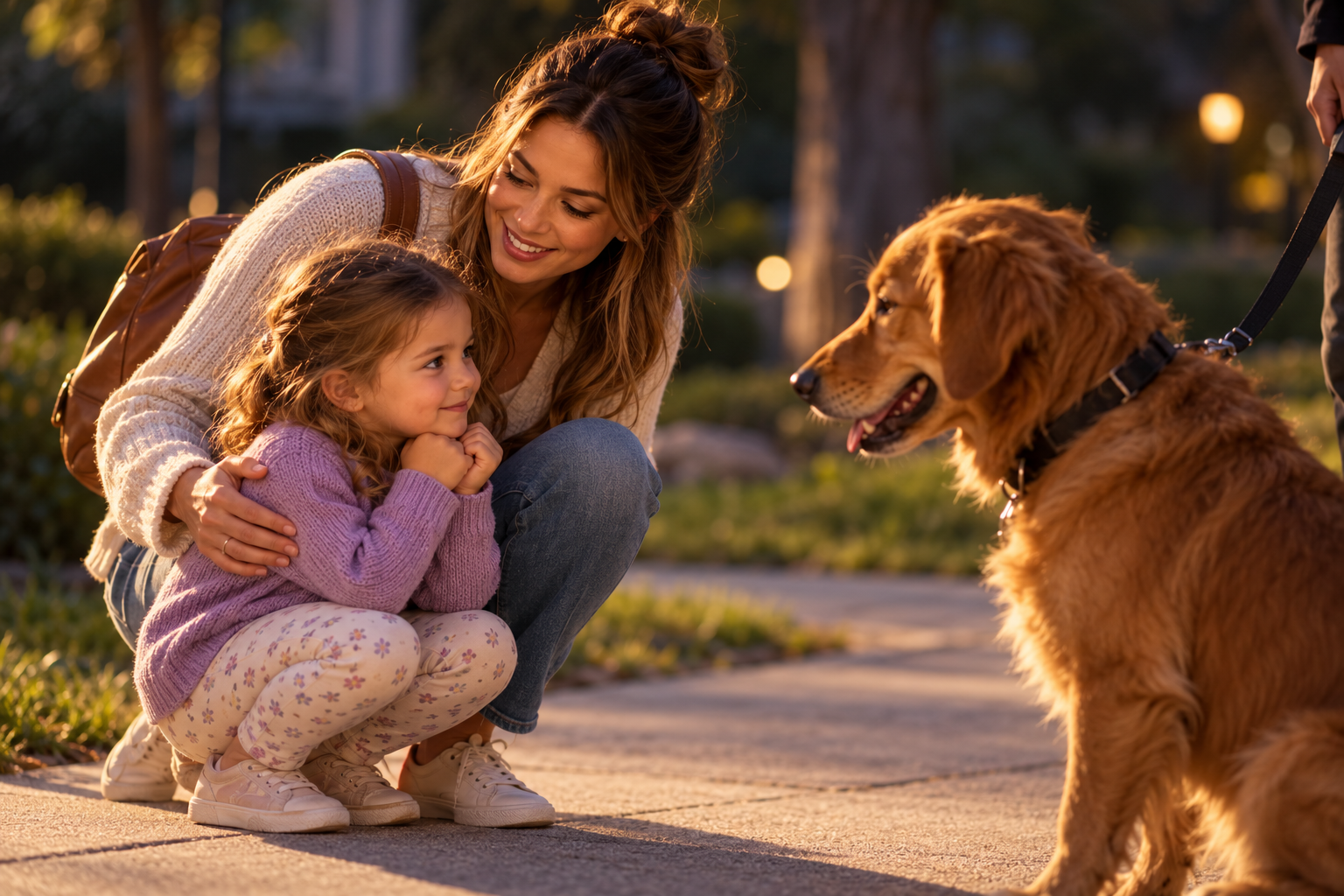
Helping a child who is afraid of dogs does not require forcing contact. Confidence can grow through safe information, appropriate distance, and small experiences the child can manage.
A dog can be twenty feet away, calmly walking beside its owner, and still feel enormous to a frightened child. The child may grab your hand, move behind you, refuse to continue down the sidewalk, or begin asking whether the dog is coming closer before the animal has shown the slightest interest in them.
For adults who are comfortable around dogs, the reaction can be difficult to understand. We can see that the dog is leashed, relaxed, and occupied with sniffing a tree, while the child sees teeth, barking, fast movement, and an animal whose next decision they cannot predict.
Fear of animals is common in childhood. The American Academy of Pediatrics specifically includes large barking dogs among common childhood fears and advises parents not to ridicule those fears or pressure children into acting brave before they are ready.
At the same time, dogs are animals, not stuffed toys, and some caution around them is appropriate. The goal should never be to persuade a child that every dog is friendly or that being brave means petting an animal they do not want to touch.
A much healthier goal is to help the child learn the difference between sensible caution and fear that begins controlling where they can go and what they can do.
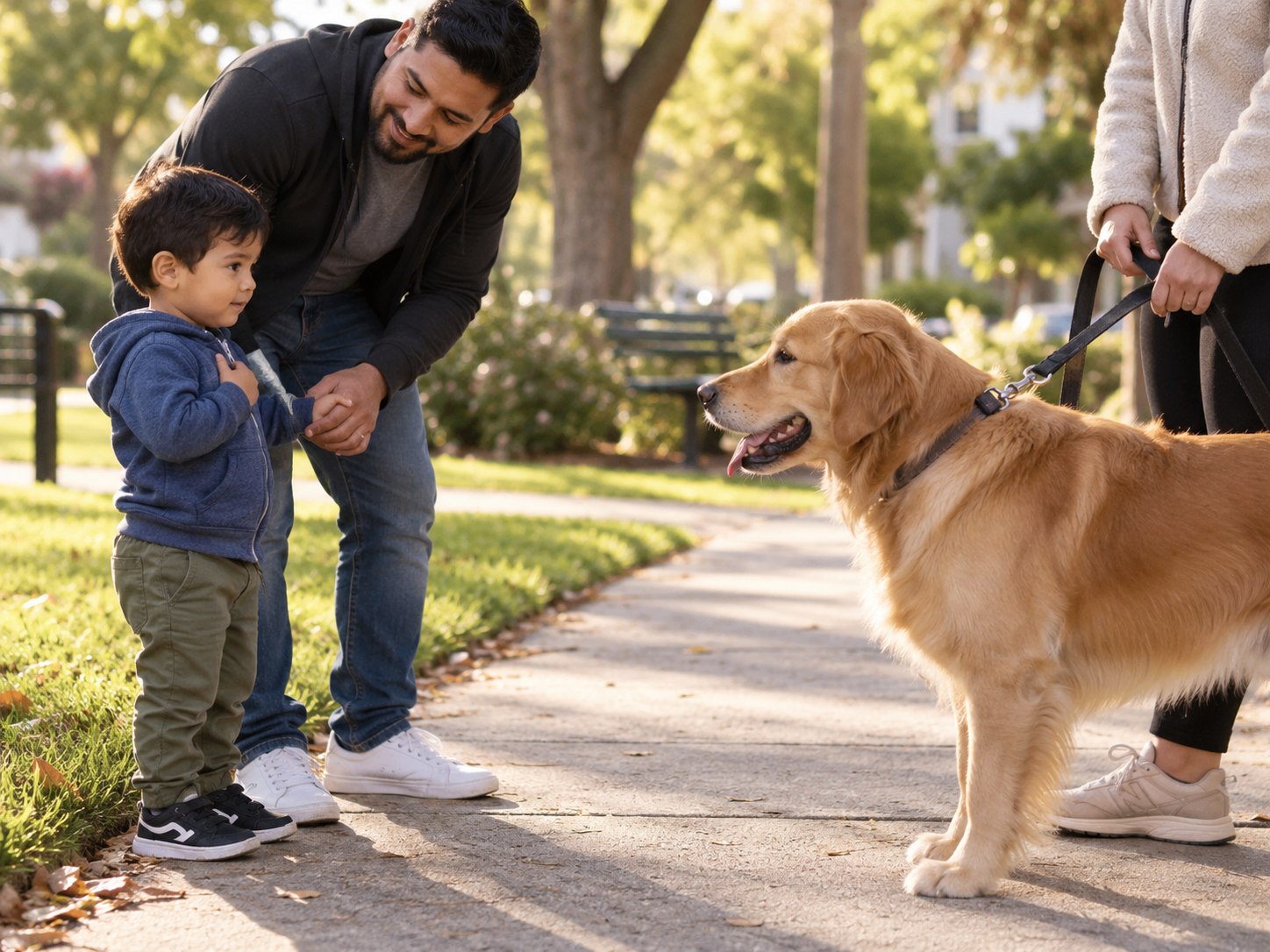
A child who is afraid of dogs can begin building confidence without touching one. Watching safely from a comfortable distance can be a meaningful first step.
Why Are Some Children So Afraid of Dogs?
Dogs contain several qualities that can feel unpredictable to young children. They move quickly, bark suddenly, jump, sniff, stare, wag, shake themselves, and sometimes approach people without an invitation that makes sense to a child.
Size matters too. Even a medium-sized dog can be close to eye level with a preschooler, and a dog that seems ordinary to an adult can feel remarkably large from three feet off the ground.
A child also may not understand what different dog behaviors mean. Adults who have spent time around dogs can distinguish between a relaxed animal, an excited dog, and one that should be left alone. A young child may simply register movement and noise, then assume danger.
Some fears begin after a specific experience. A dog may have barked unexpectedly, jumped on the child, chased them, knocked them down, or snapped nearby. The child does not have to have been bitten for that moment to become memorable.
Other children become afraid without any obvious incident. They may have seen another person react fearfully, watched frightening dog videos, heard stories about bites, or simply decided that an unpredictable animal deserves considerable suspicion.
Understanding the origin can help, but parents do not have to solve the mystery before helping the child move forward.
Appropriate Caution Around Dogs Is a Good Thing
There is an important difference between helping a child manage fear and teaching them that dogs are harmless.
The Centers for Disease Control and Prevention notes that any dog can bite, particularly when frightened, nervous, eating, playing, protecting something, or not feeling well. Children are also more likely than adults to be bitten and can experience more serious injuries.
That means a child who asks before approaching a dog, keeps distance from an unfamiliar animal, or decides not to pet one is not failing a courage test. Those can be sensible choices.
The problem arises when fear becomes much larger than the actual situation. A child who cannot walk through a park because a dog might appear, refuses to visit friends whose dog will be safely separated, or panics whenever a leashed dog appears across the street may be losing more freedom to the fear than basic safety requires.
Confidence around dogs should therefore mean calm, informed caution, not automatic trust.
Find Out What Part of Dogs Feels Scary
“I'm scared of dogs” can describe several very different fears.
One child may be frightened almost entirely by barking. Another may tolerate a quiet dog until it starts moving toward them. A child who was once knocked over may worry about jumping, while another is focused on teeth or the possibility of being bitten.
Some children are comfortable watching small dogs but frightened by large ones. Others are fine with the family dog and terrified of unfamiliar dogs because they do not know what those animals will do.
Ask about the specific part of the experience when the child is calm rather than interrogating them while a dog is nearby. You might ask what they think could happen, what part makes their body feel most worried, or whether there are some dogs that feel less frightening than others.
The answer gives you somewhere more useful to begin. A child who fears barking may need a different first step from a child whose fear began after being chased.
Do Not Tell a Frightened Child, “He’s Friendly”
Few sentences are used more automatically around nervous children and dogs than “Don't worry, he's friendly.” The person saying it is usually trying to reassure the child, but friendliness is not really the question the child is asking. They are asking whether the animal will approach, jump, bark, lick, touch them, or do something they cannot predict.
Even a genuinely friendly dog can frighten a child by rushing over enthusiastically.
Instead of asking the child to accept someone else's assessment of the dog, give them information about what is happening now. You might say, “The dog is on a leash and staying beside his owner. We can keep walking over here,” or, “You do not have to pet the dog. We can give him space.”
That language offers something fear understands much better than a vague promise: a plan.
Never Force a Child to Pet a Dog to Prove They Are Brave
A common response to dog fear is to arrange an encounter with a supposedly perfect dog and encourage the child to get it over with. The dog is gentle, everyone knows the owner, and several adults may assure the child that nothing bad will happen if they just reach out.
From the adult perspective, this can look like a shortcut to confidence. From the child's perspective, it can feel like being trapped between the animal they fear and the adults whose approval they want.
The American Academy of Pediatrics specifically advises parents not to pressure children into being brave. When a fear becomes significant enough to require behavioral treatment, the AAP describes a much more gradual process in which exposure begins with small, nonthreatening experiences rather than immediately demanding physical contact.
A child does not need to pet a dog to demonstrate progress. They may eventually choose to, but touching an animal should never become the entrance fee for being considered courageous.
Start With Distance the Child Can Handle
When a child becomes frightened the moment a dog appears, the first useful experience may happen much farther away than adults expect. Perhaps the child can watch a calm leashed dog from across a park while continuing a conversation with you. That distance may allow them to notice the dog without becoming so overwhelmed that all they can think about is escaping.
Another child may begin with photographs, children's books, or videos of calm dogs before watching one in person. The American Academy of Pediatrics uses exactly this kind of progression when describing professional treatment for significant dog phobias, moving from discussing dogs and viewing images toward observing and eventually being near a calm animal. HealthyChildren.org
The principle is valuable even outside treatment: confidence grows more easily when the child can remain present long enough to learn something from the experience. There is an important limit, however.
Parents should not improvise a program of increasingly close encounters with unfamiliar dogs, particularly when a child's fear is severe. Any real-world interaction must respect normal dog-safety rules, and significant phobias are better addressed with professional guidance.
Let Watching Count as Progress
Adults tend to value visible action. We notice when the child pets the dog, throws the ball, or finally walks through the park without holding our hand.
Watching can look like nothing is happening, but a hesitant child may be doing a great deal internally. They are seeing how the dog moves when nobody approaches it. They are noticing that a leash keeps the animal with its owner, that barking eventually stops, or that a dog can pass without coming toward them.
Those observations become information the child did not have when fear was filling in every blank.
A parent can support this without turning observation into a quiz. There is no need to ask every thirty seconds whether the child feels less afraid yet. Let them notice, stay at a manageable distance, and leave the experience with the sense that they handled it.
Teach Dog Safety Because Knowledge Can Reduce Uncertainty
Dog safety gives children something practical to do instead of leaving them with only the instruction to “not be scared.”
The CDC advises people not to approach unfamiliar dogs, even when they appear friendly, and says young children should not play with dogs without adult supervision, including dogs they already know. It also recommends allowing a dog to see and sniff before reaching out to pet it.
Those rules can actually be reassuring for a worried child because they remove some of the ambiguity. They do not have to decide whether every passing dog is safe enough to touch because touching every dog was never the expectation in the first place.
Parents can explain that we ask the owner before approaching, give dogs space when they are eating or resting, and never run up to an unfamiliar animal. If a dog is loose or behaving in a way that concerns you, the adult takes responsibility for deciding what to do next.
A child who knows the rules may begin to feel less responsible for predicting every dog's behavior.
Teach the Child What to Do if an Unfamiliar Dog Approaches
One reason dog fear can feel so overwhelming is that children may imagine themselves completely powerless if a dog comes toward them. The CDC recommends staying still and calm if an unfamiliar dog approaches, avoiding direct eye contact, and waiting for the dog to pass or slowly backing away rather than running.
You can teach those ideas calmly at home without staging an encounter with a real dog. Practicing what “stand still” or “slowly back away” looks like can give the child an action plan without frightening them with dramatic scenarios.
The tone matters. Dog safety should feel similar to learning how to cross a street or wear a bicycle helmet, not like preparing for an inevitable attack. Knowing what to do can lower uncertainty while preserving appropriate respect for animals.
Be Careful With Your Own Reaction Around Dogs
Children pay close attention to adults when deciding whether something is safe. If a parent stiffens every time a dog appears, immediately pulls the child behind them, repeatedly warns that the dog might bite, or crosses the street regardless of what the animal is doing, the child may learn that dogs require emergency-level attention.
This does not mean parents should conceal legitimate concern. If a dog is loose, aggressive, or behaving unpredictably, respond appropriately and prioritize safety.
The useful difference is between reacting to the dog that is actually there and reacting automatically to the category of dogs as though they all present the same risk. Calm behavior can teach the child that safety decisions are based on information rather than fear alone.
What If the Fear Started After a Dog Jumped on or Chased Your Child?
A frightening experience deserves to be treated as frightening. If a dog jumped on your child, chased them, knocked them down, snapped, or bit them, avoid rushing to prove that other dogs are different. Your child may need time before they are ready to encounter dogs more closely again.
You can acknowledge what happened without predicting that it will happen every time. A response such as, “That dog scared you when he jumped on you. It makes sense that you're watching dogs more carefully now,” respects the child's experience while leaving room for future confidence.
Later, safe experiences with dogs may help the child discover that animals behave differently from one another. Those experiences should unfold gradually rather than being arranged as a dramatic corrective moment.
If the child was bitten or scratched, attend to the physical injury first and seek appropriate medical advice. The CDC notes that bites and scratches can transmit germs even when an injury does not initially appear severe.
Do Not Let Avoidance Quietly Take Over the Child’s World
Avoidance is wonderfully convincing because it works immediately.
The child sees a dog, crosses the street, and feels better. They decline the birthday party where a dog lives and feel relieved. Soon they stop going to the park, avoid certain neighbors, or ask whether every house they visit has a dog before agreeing to go.
Each individual decision may seem small, but together they can teach the child that avoiding dogs is what keeps them safe. That does not mean parents should deliberately trap children in frightening situations. It means watching whether reasonable caution is gradually becoming a shrinking map of where the child feels able to go.
When fear begins controlling ordinary family activities, it may be time to work more deliberately on small, safe encounters or seek professional guidance.
Use a Tiny Brave Hop Instead of “Go Pet the Dog”
Dog fear is almost perfectly suited to the idea of making the next step smaller because there are so many meaningful steps between complete avoidance and physical contact. A Tiny Brave Hop might be looking at a picture of a dog without turning away, watching a calm leashed dog from across the park, remaining on the same side of a wide sidewalk while a dog passes at a comfortable distance, or saying hello to a dog's owner while the animal remains controlled.
None of those steps requires touching the dog. What matters is that the child does something slightly beyond what fear would normally choose while remaining within a situation they can manage. That experience gives them new evidence: they were nervous, they stayed, and the feeling eventually changed.
For the complete framework, see How to Help Your Child Take Tiny Brave Hops. The goal is not to march through the steps as quickly as possible. A Tiny Brave Hop only works when it is genuinely small enough for the child to participate rather than something an adult has renamed “tiny” because they want faster progress.
Let the Child Have Some Control
Fear becomes harder when a child believes they have no say in what happens next. Whenever safety allows, give your child meaningful choices. They might choose whether to continue watching from the bench or move a little closer, whether to stay for another minute or finish for the day, or whether they want to speak to a dog's owner without interacting with the dog itself.
Choice does not mean allowing fear to dictate every family decision. It means avoiding unnecessary power struggles around contact that does not need to happen.
This is especially important with petting. If your child does not want to pet a dog, there is rarely a compelling reason they must. Being able to remain calm near dogs is a much more useful life skill than learning to touch them on command.
Praise What the Child Actually Did
When a frightened child makes progress, describe the action rather than declaring the fear conquered. You might say, “You were nervous when the dog came down the sidewalk, and you stayed beside me while he passed,” or, “Last time you wanted to leave the park when you saw a dog, and today you watched from the bench.”
That kind of feedback gives the child evidence of their own growing capacity. Try to avoid turning a successful experience into a prediction that they should now be fine with every dog. A calm encounter with one leashed animal does not obligate the child to feel comfortable with the barking dog at a neighbor's house tomorrow.
Confidence is more durable when children are allowed to notice progress without being told they have graduated from fear.
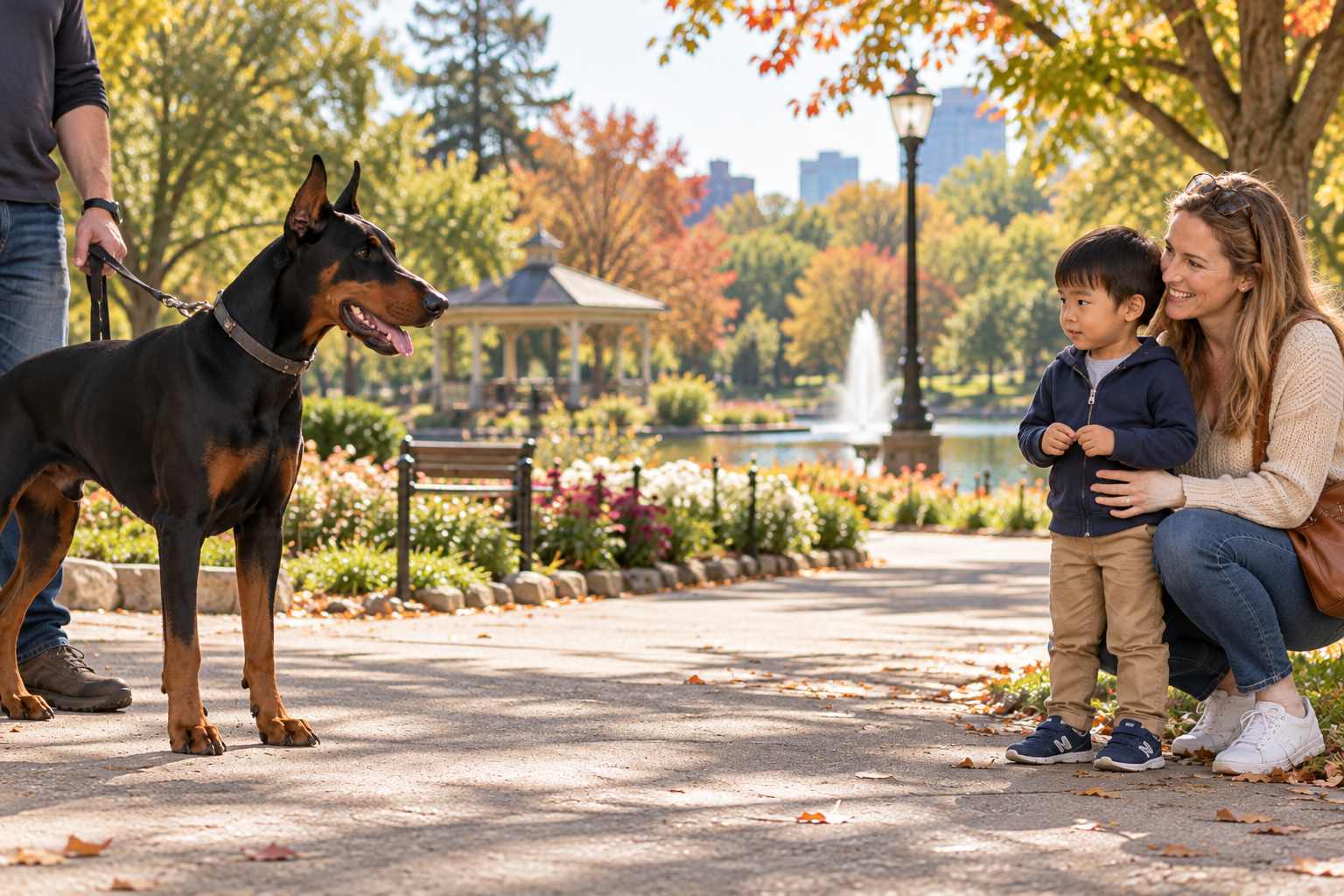
Progress for a child afraid of dogs may begin with staying nearby, observing calmly, and discovering that they can manage the feeling without being forced into contact.
Do Not Compare Your Child With Children Who Love Dogs
Some children encounter a dog and appear to lose all sense of personal boundaries in their enthusiasm to meet it. Your cautious child may watch this performance from several yards away with no intention of joining.
Comparisons rarely make the worried child more confident. Saying, “Look at your sister, she's not scared,” may instead tell the child that everyone else can handle something they apparently cannot.
A better comparison is with the child's own previous experience. Perhaps last month they would not enter the park if a dog was visible, while today they remained long enough to play on the swings. That change belongs to them, which makes it far more useful than measuring their temperament against somebody else's.
Picture Books Can Help Children Explore Dog Fear at a Safe Distance
Stories can give a worried child access to dogs without requiring immediate real-world contact. A picture-book dog stays on the page. The child can observe its size, expression, behavior, and relationship with other characters while remaining completely in control of the distance.
Books can also help children talk indirectly about fear. Instead of asking, “Why are you so afraid of dogs?”, a parent can wonder why a character is nervous, what might help them feel safer, or what a sensible first step could be.
The purpose is not to secretly persuade the child into petting a dog afterward. Reading works best when the story remains a place for curiosity rather than another disguised test.
A child who becomes interested in dogs through stories may eventually bring that curiosity into the real world, but the connection does not need to be forced.
Why The Rabbit in the Moon Fits This Kind of Fear
The Rabbit in the Moon is not a story about dogs, which means I would never present it as a substitute for teaching actual dog safety. Its connection comes from the emotional experience underneath the fear. Yabbit knows what it feels like to want to move forward while another part of him keeps producing reasons to remain where he is.
That is often what happens when a child is afraid of dogs. They may want to walk through the park, visit a friend, or stop feeling panicked every time they hear barking, but the complete leap from fear to comfort feels impossibly large.
Yabbit does not solve hesitation by suddenly becoming fearless. Snail brings steadiness and companionship while Yabbit discovers that moving forward can happen in smaller pieces, which gives families useful language for a fear that may also need to be approached gradually.
A parent does not have to ask, “Are you ready to pet the dog?” The more useful question may be, “What would one small brave hop look like from where you are right now?”
Sometimes the answer will be watching. Sometimes it will be staying. Eventually, the child may decide they are ready for something more.
When Fear of Dogs May Be More Than an Ordinary Childhood Fear
Fear of dogs exists on a spectrum. A child who prefers not to pet unfamiliar dogs or becomes nervous when a large dog barks may simply be showing ordinary caution. The concern becomes greater when the fear is extreme, persistent, causes significant distress, or interferes with ordinary life.
The American Academy of Pediatrics gives the example of a six-year-old whose fear of dogs becomes so intense that the child refuses to go outside because a dog might be present. In those situations, the fear may have developed into a specific phobia rather than remaining an everyday childhood worry.
When avoidance is expanding, panic is intense, or the child is unable to participate in activities they genuinely want to do, talk with your pediatrician or a qualified child mental-health professional. Treatment for significant phobias often involves carefully structured behavioral approaches, including gradual exposure conducted in a controlled way. HealthyChildren.org
Parents do not have to diagnose the problem themselves. The useful question is whether fear is simply making the child cautious or beginning to make their world substantially smaller.
Help With Fear Without Turning Every Fearful Moment Into a Project
Once parents decide to help with a fear, it can be tempting to work on it constantly. Every dog becomes an opportunity. Every walk becomes practice, every story becomes a lesson, and every successful encounter earns a discussion about progress.
Children sometimes need ordinary life to remain ordinary. If your child notices a dog and keeps playing, you do not necessarily need to point out that they handled it beautifully. If they walk past one without mentioning it, there is no requirement to stop and conduct a bravery debrief.
Fear loses some of its power when it stops receiving center stage. Support the child when they need help, create manageable opportunities when appropriate, and allow successful moments to pass quietly too.
A Broader Guide for Children Who Hesitate Before Trying
Fear of dogs is specific, but the emotional pattern of wanting to move forward while feeling unable to begin appears in many parts of childhood.
If your child also freezes before new activities, hangs back when something feels unfamiliar, or says “I can't” before trying, How to Help a Child Who Is Afraid to Try explores that broader pattern:
The important distinction with dogs is that hesitation should never be treated as something to eliminate indiscriminately. Children need both courage and judgment, and learning when to approach versus when to keep a respectful distance is part of growing up around animals.
An Authoritative Resource for Parents
The American Academy of Pediatrics provides guidance on common childhood fears and phobias, including fear of dogs, along with advice about avoiding pressure and how gradual behavioral treatment may be used when fear becomes severe.
The CDC also provides current dog-safety guidance for families, including bite prevention, supervision of young children, unfamiliar dogs, and what to do when a dog approaches. CDC
Buy The Rabbit in the Moon
If your child often wants to move forward but becomes stuck when fear makes the next step feel too large, The Rabbit in the Moon was written for that emotional space. Yabbit hesitates rather than charging confidently ahead, while Snail brings the kind of steady companionship that allows courage to develop without humiliation or pressure. Their journey gives families a way to talk about fear without making fearlessness the requirement for progress.
That message can be especially useful with a child who is afraid of dogs because the goal should never be reckless bravery. A child can respect an animal, follow sensible safety rules, maintain appropriate boundaries, and still discover that fear does not have to make every decision for them.
Sometimes courage means moving closer. Sometimes it means staying where you are calmly instead of running away, and sometimes the wise choice is deciding not to approach the dog at all. Learning the difference is part of becoming brave too.
Frequently Asked Questions About Children Who Are Afraid of Dogs
Is it normal for a child to be afraid of dogs?
Yes. The American Academy of Pediatrics identifies fear of animals, including large barking dogs, as a common childhood fear. Many childhood fears ease over time with support, although particularly intense or persistent fears can sometimes develop into phobias that interfere with daily life. HealthyChildren.org
Should I make my child pet a friendly dog so they see there is nothing to fear?
No. Forcing physical contact can turn the encounter into another frightening experience and teaches the child that their boundaries disappear when adults decide an animal is safe. A child can make meaningful progress by observing a calm dog, remaining nearby at a comfortable distance, or learning appropriate dog-safety skills without petting the animal.
What should I say when my child becomes frightened by a dog?
Acknowledge what the child is experiencing and give them concrete information about the situation. You might say, “I know the dog makes you nervous. He is on a leash with his owner, and we can stay over here while he passes,” which validates the fear without confirming that the child is in immediate danger.
What if my child is afraid only of barking dogs?
Try to separate barking from the broader category of dogs so that one frightening sound does not automatically make every dog feel dangerous. You can help your child learn that dogs bark for different reasons while still maintaining appropriate distance and letting them become familiar with the sound gradually rather than deliberately exposing them to a dog that is barking intensely.
Should my child learn to pet dogs eventually?
Not necessarily. The more useful goal is for the child to understand dog safety and to function comfortably enough around dogs that fear does not unnecessarily restrict everyday life. Whether the child eventually wants to pet a calm dog is a personal choice rather than a required milestone.
What should I do if my child became afraid after being chased, jumped on, or bitten?
Take the experience seriously and avoid immediately arranging another close encounter to prove that dogs can be friendly. Give the child time, rebuild confidence gradually, and seek professional support if the fear becomes intense or starts restricting ordinary activities. If a bite or scratch occurred, address the physical injury and seek appropriate medical advice because dog bites and scratches can transmit germs. CDC
When should I seek professional help for my child's fear of dogs?
Consider talking with your pediatrician or a qualified child mental-health professional when the fear is severe, persistent, causes panic, or leads your child to avoid parks, friends' homes, outdoor activities, or other parts of ordinary life. The AAP notes that significant phobias may be treated with behavioral approaches that introduce the feared situation gradually and in controlled, nonthreatening steps. HealthyChildren.org
Final Thought
Helping a child who is afraid of dogs is not a project to turn them into someone who races toward every Labrador they see. Dogs deserve appropriate caution, children deserve control over unnecessary physical contact, and bravery should never require ignoring sensible boundaries.
What parents can help change is the part of fear that begins making the world smaller. A child can learn that seeing a dog does not automatically require crossing the street, that hearing a bark does not mean an animal is coming after them, and that they have practical ways to respond when an unfamiliar dog is nearby.
Those lessons usually grow through experience rather than persuasion. The child watches from a distance, stays a little longer than before, learns the safety rules, notices what actually happens, and slowly collects evidence that they can handle more than fear predicted.
Eventually, confidence may look surprisingly ordinary. A dog walks past, the child notices it, and the afternoon continues.