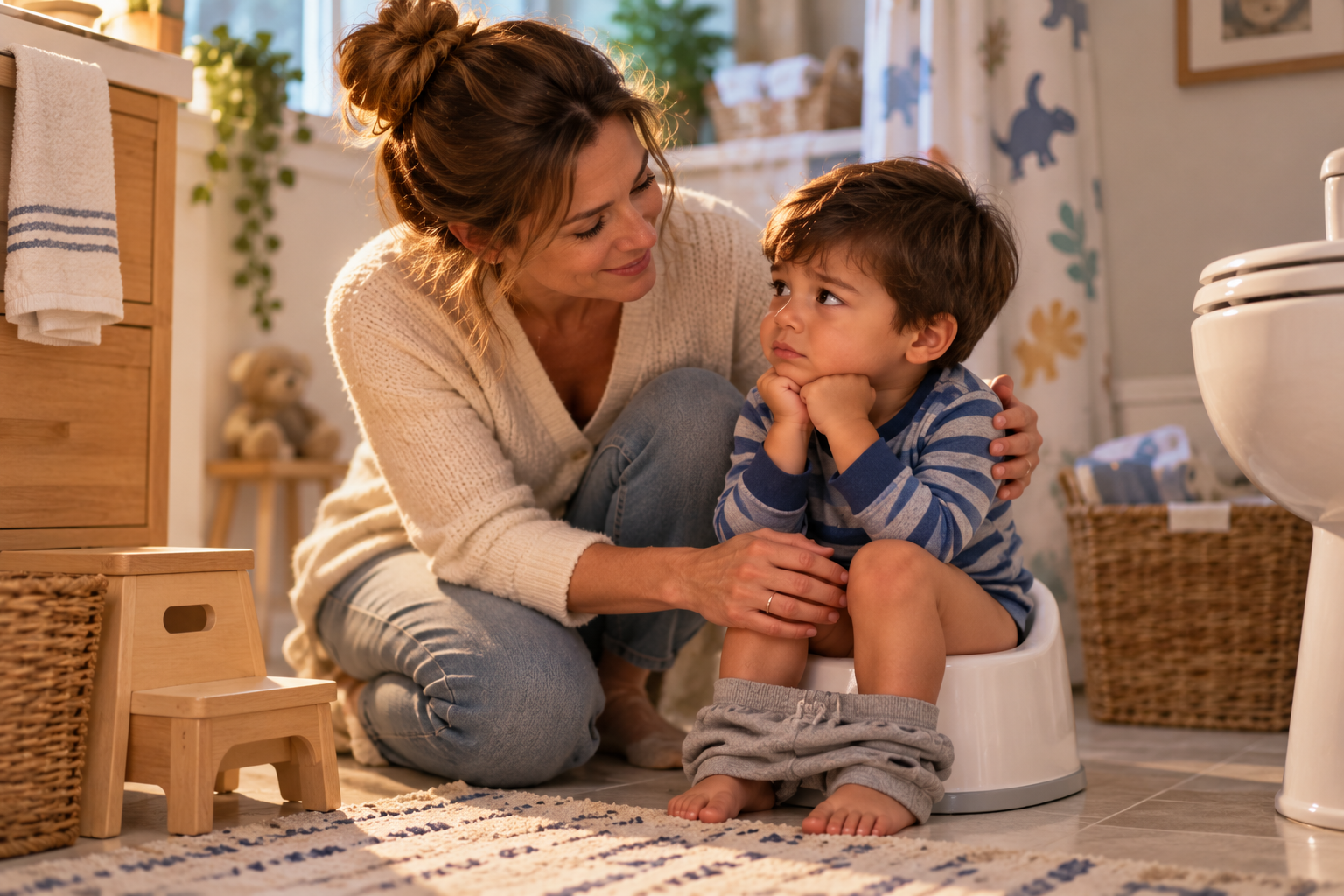
Potty training anxiety can come from fear of the toilet, flushing, painful bowel movements, or pressure around success. Understanding what feels frightening is often more useful than simply insisting that a child try again.
A toddler can be perfectly happy talking about the potty, reading books about the potty, and following a parent into the bathroom with absolutely no respect for privacy, yet become deeply opposed to using the toilet themselves. Some children refuse to sit. Others happily pee in the potty but insist on a diaper when they need to poop. A child may become frightened by the flush, worry about falling into the toilet, hide when they feel a bowel movement coming, or suddenly resist after weeks of apparent progress.
From the adult side, the solution can seem obvious: they know how to use the potty, so why will they not simply do it?
From the child's side, toilet training can involve a surprising collection of unfamiliar sensations and expectations. They are being asked to notice signals inside their body, interrupt what they are doing, remove clothing, sit on an unfamiliar object, release something they previously allowed to happen inside a diaper, and then watch it disappear with a loud mechanical whoosh.
For some children, that transition is exciting. For others, one piece of the process becomes frightening enough that the entire bathroom starts to feel difficult.
The goal is not to win a contest of wills. It is to figure out what is making the next step hard and help the child become comfortable enough to learn without fear, pain, or pressure running the process.
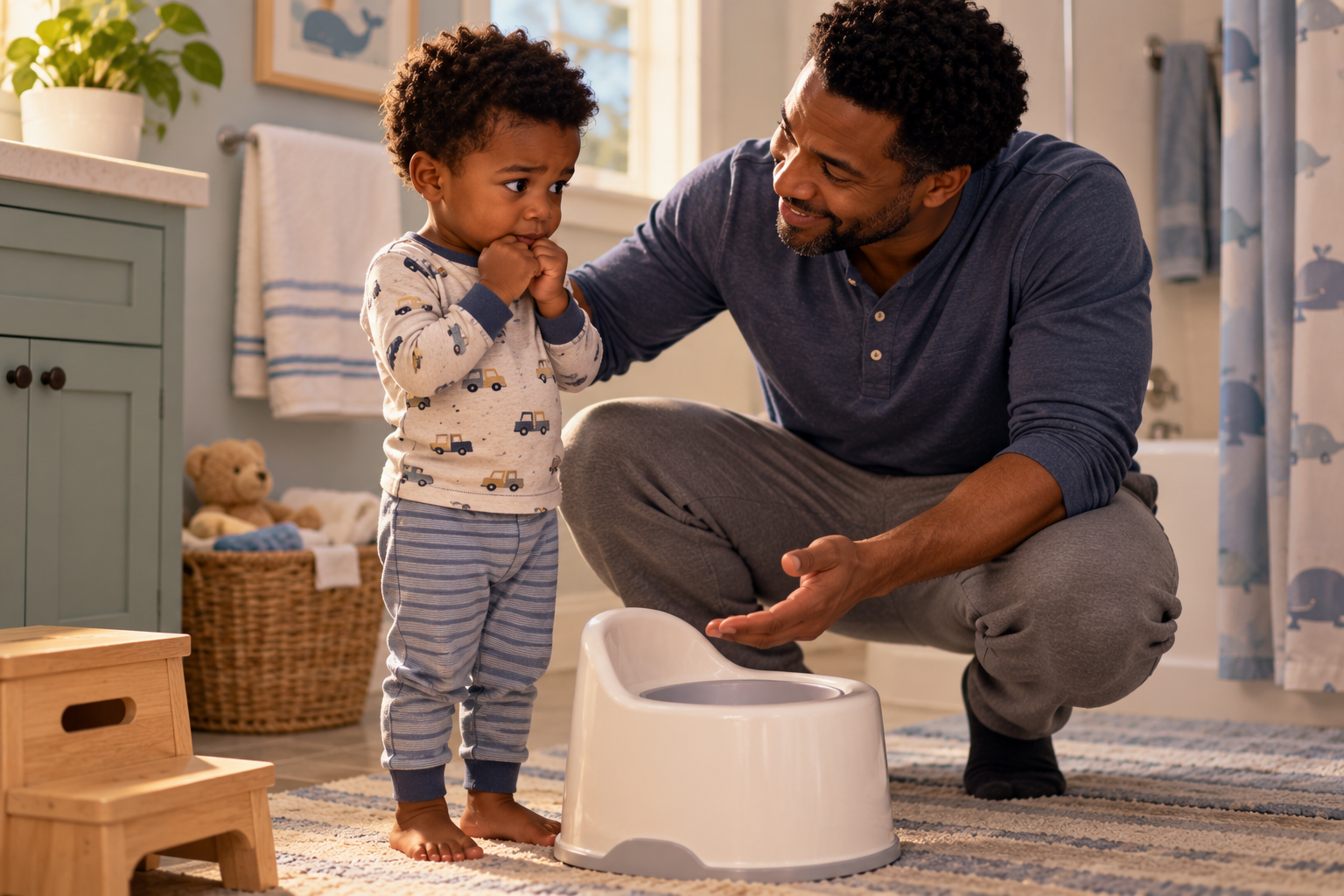
A toddler who refuses the potty may be reacting to fear, unfamiliar sensations, physical discomfort, or pressure rather than simply being stubborn.
Why Do Some Toddlers Become Afraid of the Potty?
Fear during toilet training is not unusual because toddlers are learning something that requires both physical and emotional readiness. The American Academy of Pediatrics notes that children's growing imaginations can actually complicate toilet training. A young child may become afraid of the flushing toilet or even imagine that they could somehow be flushed away themselves.
Other fears are more concrete. A full-size toilet may feel unstable beneath small legs, the opening may look enormous, and the flush can be startlingly loud. A child may dislike the sensation of sitting without a diaper, feel uncertain about releasing urine or stool, or become anxious because adults are suddenly paying intense attention to something their body used to handle privately.
The fear does not have to make sense to an adult before it can affect the child. A toddler who believes that poop is somehow part of their body may experience flushing it away very differently from an adult who sees a routine bodily function. The AAP specifically notes that some children become anxious about letting urine or stool go or fear what happens when the toilet flushes. HealthyChildren.org
Before You Assume It Is Anxiety, Rule Out Pain and Constipation
One of the most important distinctions in potty-training anxiety is whether the child is afraid because toileting feels unfamiliar or because it has actually hurt.
A painful bowel movement can change the entire process. If a child has passed a hard or uncomfortable stool, they may begin holding the next one because they expect it to hurt too. Withholding can then contribute to constipation, which can make future bowel movements more difficult and reinforce the child's fear.
The American Academy of Pediatrics notes that constipation can occur during toilet training and that stool withholding can become part of the problem. This is why a child who screams when they need to poop, repeatedly holds stool, has hard or painful bowel movements, or suddenly becomes extremely resistant should not simply be treated as though they need firmer toilet-training expectations. Pain changes the equation.
If you suspect constipation, withholding, painful bowel movements, or another physical problem, talk with your child's pediatrician. The emotional side of potty training becomes much harder to address when the child has good reason to believe that using the toilet may hurt.
Why Will My Child Pee in the Potty but Refuse to Poop There?
This is one of the more confusing potty-training patterns because the child has clearly demonstrated that they understand at least part of the process. Urinating and having a bowel movement can nevertheless feel very different to a young child.
Pooping may require more time, involve stronger physical sensations, or bring up worries about letting something leave the body. Some children also value privacy or control around bowel movements more strongly than adults expect.
The AAP notes that toddlers and preschoolers can become reluctant or anxious about letting go of stool and that concerns about bodily control, privacy, or fear of the potty may intensify that reluctance. If your child asks for a diaper to poop, try to view that behavior as information before treating it as defiance. They have found one way of having a bowel movement that currently feels predictable and safe, and your task is to understand what makes the alternative more difficult.
That does not mean diapers must continue indefinitely. It means the path toward the toilet will usually be more productive when the child is helped across the emotional and physical gap rather than simply being told that diapers are now forbidden.
Do Not Turn the Potty Into a Daily Battle
Few parenting contests are less winnable than trying to force another human being to urinate or have a bowel movement on command. Young children ultimately control when they release urine and stool, which gives toilet training unusual potential for power struggles. The AAP explicitly advises parents to stay calm and avoid turning toileting into a battle involving begging, pleading, pressure, punishment, or escalating negotiations. HealthyChildren.org
Parents can become understandably invested because toilet training affects preschool, travel, childcare, laundry, family routines, and the tantalizing possibility of finally purchasing fewer diapers. Those practical pressures are real, but a toddler cannot necessarily convert them into physical readiness or emotional confidence.
When every bathroom visit becomes a negotiation, the potty can stop being an ordinary place to learn a new skill and become the stage where parent and child repeatedly test who will give in first. Once that happens, resistance may have as much to do with control as with the original fear.
Calm does not mean abandoning expectations. It means refusing to make every attempt carry the emotional weight of whether toilet training is succeeding.
Find Out Which Part of the Potty Feels Scary
“I'm scared of the potty” can mean many different things, and parents will be much more effective if they know which part is causing trouble. A child may be afraid of falling in, flushing, sitting without support under their feet, releasing poop, feeling a splash, hearing an automatic toilet, or being alone in the bathroom. Another child may not fear the toilet itself at all but may be worried because adults have become upset during previous accidents.
Talk about the experience at a neutral time rather than waiting until the child urgently needs to go. You might ask whether the potty feels too big, whether the flush sounds scary, or which part they wish they could change.
For a toddler who cannot explain the fear clearly, observation can tell you a great deal. Notice exactly when resistance begins. A child who willingly sits but panics when you reach for the flush handle is telling you something different from a child who refuses to enter the bathroom.
Make the Toilet Physically Feel More Secure
Sometimes anxiety improves when the child's body simply feels more stable. A child sitting on an adult toilet may feel as though they are balancing above a large opening with their feet hanging in the air. A properly fitted toilet insert and secure foot support can make the position feel much less precarious, while some children are more comfortable beginning with a small floor-level potty.
Let the child become familiar with the equipment without making every interaction a demand to produce something. They can inspect it, sit briefly while dressed, choose where a potty chair goes, or practice getting on and off.
The point is not to convince them through explanation alone. Their body needs opportunities to discover that the seat is stable, their feet are supported, and they can get up when they want to.
Fear of Flushing Deserves Its Own Step
To adults, flushing is the satisfying final chapter of using the toilet. To a young child, it is a sudden roar that causes something to spin away and disappear.
The AAP specifically recognizes fear of flushing as a toilet-training issue and suggests giving children some control over the process. If flushing frightens your child, there is no rule requiring them to sit on the toilet while it happens. They might begin by leaving the bathroom while you flush, watching from the doorway, standing beside you while you do it, or eventually choosing when to press the handle themselves.
What matters is that the fear becomes understandable and manageable rather than another moment when the child feels surprised and powerless. Automatic public toilets can be especially difficult because they remove even that predictability. A child who handles the toilet at home may still become frightened in a public restroom where the flush is louder and can activate unexpectedly.
What to Do When Your Child Refuses to Sit on the Potty
If simply sitting has become the battleground, temporarily remove the expectation that sitting must produce anything. A child can practice sitting while clothed, then perhaps sit briefly with pants down when they are ready. These experiences allow the child to become familiar with the position without feeling that an adult is waiting impatiently for proof that the attempt “worked.”
Keep early practice short and calm. The useful experience is not necessarily a successful pee or poop but a child discovering that they can approach the potty, sit, and get back up without something frightening happening.
If refusal becomes intense, repeatedly forcing the child onto the potty can deepen the association between toileting and loss of control. HealthyChildren's guidance similarly cautions against forcing potty sitting when withholding and power struggles are developing. Progress may look less impressive for a while, but reducing the conflict can create the conditions in which learning becomes possible again.
Use a Tiny Brave Hop Instead of Demanding the Whole Skill
A frightened toddler may hear “Use the potty” as one enormous demand, while adults see a simple everyday task. Breaking the experience into smaller pieces can change what the child believes is possible. A Tiny Brave Hop might be walking into the bathroom without protesting, sitting on the potty while dressed, sitting for ten seconds without pressure to pee, listening to the toilet flush from the hallway, or helping a stuffed animal practice the routine during pretend play.
The American Academy of Pediatrics notes that expanding imagination can be used constructively during toilet training through pretend play with dolls, puppets, or stuffed animals, even though that same imagination can also contribute to toilet fears. The Tiny Brave Hop should address the fearful part of the experience rather than trying to control the child's bodily function.
We can make entering the bathroom, sitting, or tolerating the flush smaller. We cannot responsibly turn “produce a bowel movement now” into a courage assignment. For the broader approach to making intimidating experiences smaller, see How to Help Your Child Take Tiny Brave Hops.
The measure of a useful step is whether the child can practice it while remaining engaged enough to learn. If an adult has to restrain, threaten, or overpower the child to complete the “small step,” it was not actually small from the child's point of view.
Let the Child Have Appropriate Control
Toilet training contains some things children should control and others adults should structure. Parents can determine that the bathroom is available, establish routines, provide appropriate equipment, teach hygiene, and respond consistently to accidents. The child still controls what happens inside their body.
Giving a toddler limited choices can make that distinction easier. They may choose between the potty chair and toilet insert, decide which book to look at before a bathroom attempt, choose whether a parent waits just inside or outside the door, or decide whether they want to flush themselves.
Those choices do not turn toilet training into a free-for-all. They give a child who may feel physically vulnerable some reasonable influence over how the experience unfolds.
Be Careful With Rewards When Fear Is the Real Problem
Sticker charts and small rewards can be useful for some families, but they do not solve every form of toilet resistance. If the child already wants to use the potty but is frightened of pain, flushing, or releasing stool, increasing the prize may simply communicate that adults desperately need something the child still feels unable to do. A sufficiently large reward can create more pressure rather than less fear.
The AAP encourages positive attention and specific praise during toilet training while also cautioning against letting toileting become a power struggle. Praise the part the child can control. You might notice that they told you they needed to go, sat even though they were nervous, tried the unfamiliar bathroom, or stayed calm while the toilet flushed.
That kind of encouragement makes success broader than whether something ended up in the bowl.
Accidents Do Not Need an Emotional Soundtrack
Adults sometimes reveal far more with their faces than they intend. A puddle on the floor can produce disappointment, frustration, alarm, or an exhausted “again?” before a parent has consciously decided how to respond. Young children are excellent collectors of this emotional information.
Accidents are easier to learn from when they remain relatively boring. Help the child clean up in an age-appropriate way, change clothing, briefly remind them what to do next time, and then continue with the day.
The goal is not to pretend accidents are delightful. It is to avoid attaching shame to a bodily skill the child is still learning. A child who already feels anxious about the potty should not also become anxious about what their parent will think if they fail to get there in time.
What If Your Child Hides to Poop?
Hiding behind furniture, retreating into another room, or seeking privacy before a bowel movement can frustrate parents because it seems to prove the child knows exactly what is happening. In one sense, that is useful information. The child may recognize the bodily signal and have developed a predictable routine for responding to it, even though that routine does not yet involve the toilet.
Rather than treating hiding as evidence that the child is being deliberately difficult, look at what the ritual provides. They may want privacy, a familiar body position, the security of a diaper, or freedom from adult attention.
The AAP's guidance acknowledges that concerns about privacy, control, and fear can all affect bowel training.
That gives parents something to work with. A child who wants privacy may eventually tolerate having the bowel movement in a diaper while standing in the bathroom before progressing toward a potty. If constipation or withholding is involved, however, the child's pediatrician should guide the medical side rather than parents improvising a behavioral progression around painful stooling.
Public Toilets Can Be a Different Fear Entirely
A child who confidently uses the toilet at home may act as though a public restroom is an entirely different species. Public bathrooms are louder, less predictable, and full of hand dryers that appear to have been engineered from small jet engines. Automatic flushers can activate while the child is still sitting, stalls can feel unfamiliar, and the toilet itself may be larger than the one at home.
Do not assume that success at home should automatically transfer everywhere at once. A child may need time simply to enter public bathrooms, look around, and become familiar with the sounds before using one comfortably.
When possible, tell them what to expect before there is an urgent need. A child who knows that the toilet might flush automatically and that you will stay nearby has more information than one who discovers both facts in the middle of an already stressful moment.
Potty-Training Regression Does Not Mean Everything Has Been Lost
A child who seemed toilet trained can suddenly begin having accidents, asking for diapers, or refusing the toilet again. Changes such as a new sibling, moving, starting school, travel, family stress, or other disruptions can affect skills that previously appeared secure. The AAP notes that regression can occur when young children are adjusting to changes and recommends considering physical explanations such as constipation when the cause is unclear.
The useful response is curiosity rather than catastrophe. Look at what changed around the time the regression began, whether the child is experiencing pain or constipation, and whether pressure around toileting has recently increased.
A setback does not erase everything the child learned. It may simply be a sign that some part of the process currently needs more support.
Know When Pausing Can Be More Productive Than Pushing
There are times when adults become so invested in forward motion that any pause feels like failure.
If toilet training has become a daily conflict, the child is extremely distressed, or every attempt ends with escalating resistance, stepping back from pressure may be more productive than doubling down. That does not mean ignoring medical issues or allowing severe stool withholding to continue untreated. It means recognizing that emotional readiness cannot always be accelerated by increasing demands.
A useful pause can give parents time to reset the atmosphere, address constipation or other physical problems, and allow the bathroom to become ordinary again. When practice resumes, expectations can begin smaller and with less emotional baggage attached.
This is especially important when the child is capable of a skill but fear has become connected to performing it. Repeated battles tend to make the bathroom more emotionally charged, not less.
What Parents Can Say Instead of “You're a Big Kid Now”
Calling a child a “big kid” can be encouraging, but it can also create an uncomfortable identity test when the child is genuinely frightened. If the message becomes “big kids use the potty and babies wear diapers,” a struggling toddler may hear that accidents, fear, or needing more time means something embarrassing about who they are.
More useful language describes the process rather than ranking the child. You might say, “Your body is learning how to use the potty,” or, “That flush still feels loud, so we're going to practice one little part at a time.”
When a child succeeds, focus on what they did. You can notice that they listened to their body, told you what they needed, sat even though they were nervous, or tried again after an accident. The child is learning a skill, not auditioning for big-kid status.
Help a Hesitant Child Without Turning Hesitation Into Defiance
Potty training can expose one of the easiest parenting mistakes to make: interpreting hesitation as refusal and refusal as deliberate opposition. Sometimes a child is testing limits. Sometimes they are tired, distracted, or far more interested in finishing a block tower than responding to their bladder.
At other times, “No!” is the only language they currently have for “I don't understand what this will feel like,” “Last time that hurt,” or “I don't feel in control when you make me sit here.” Parents do not need to accept every refusal indefinitely to take those possibilities seriously. Understanding the reason behind the resistance simply gives you a better chance of responding to the actual problem.
For the broader pattern of children who freeze, avoid, or refuse when something feels intimidating, see How to Help a Child Who Is Afraid to Try. The important difference with potty training is that physical discomfort and bodily readiness must always remain part of the picture.
Picture Books Can Make the Potty Less Mysterious
Picture books can help because they allow children to watch the process happen to someone else before they have to perform it themselves. A character can sit, wait, flush, have an accident, try again, or discover that the potty is less mysterious than expected. For a child whose imagination is contributing to fear, pictures can also make the sequence more concrete and predictable.
Reading should not become another form of pressure. Finishing a potty book does not have to end with, “Now it's your turn,” because children quickly learn when a story is actually a disguised assignment. Let the book provide familiarity first. Once the process looks less strange, the child may become more willing to explore it in real life.
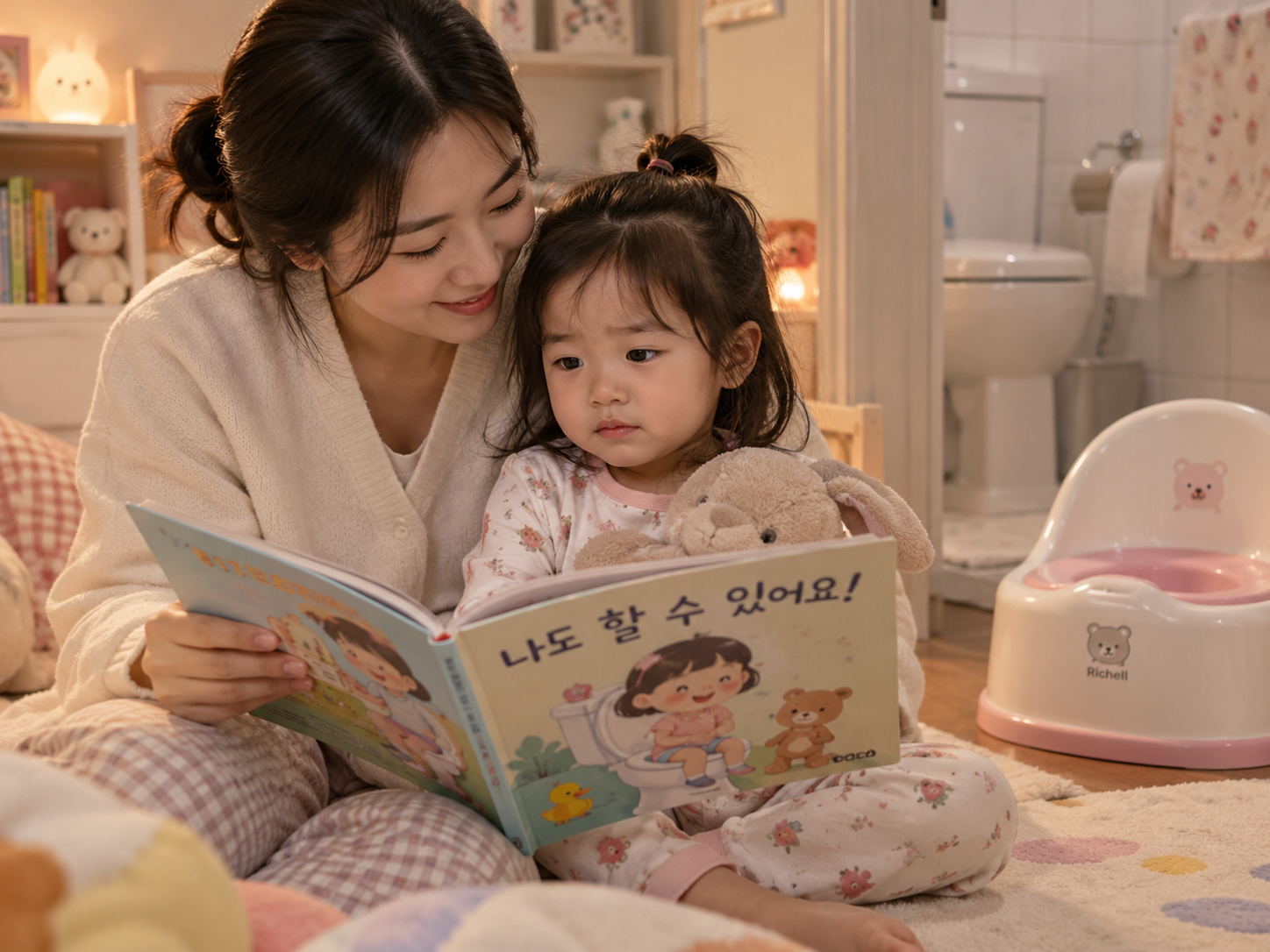
Picture books can make toilet training more predictable by letting toddlers explore sitting, flushing, accidents, and trying again before they are expected to manage the experience themselves.
Why The Rabbit in the Moon Fits Potty-Training Anxiety
The Rabbit in the Moon is not a potty-training book, and I would never present it as one. Its connection is the emotional experience of hesitation. Yabbit knows what it feels like when something that other people think should be manageable becomes much larger once he is standing in front of it.
That experience can be familiar to a toddler who understands perfectly well what the potty is for but still cannot bring themselves to sit, flush, or let go of a bowel movement there. Simply repeating that there is nothing to fear does not necessarily make the next step feel smaller.
Snail brings steadiness instead of pressure, and Yabbit learns that moving forward does not require becoming fearless first. That gives parents a useful way to think about toilet-training anxiety without turning Yabbit into a mascot for bathroom success.
A Tiny Brave Hop might be sitting while dressed today, trying the toilet insert tomorrow, or pressing the flush handle after getting off the toilet next week. The particular step matters less than helping the child experience progress without humiliation or force.
When to Talk With Your Child's Pediatrician
Toilet-training resistance is common, but some patterns deserve medical attention because anxiety may not be the whole story. Talk with your child's pediatrician if bowel movements are painful, constipation or stool withholding is developing, your child repeatedly avoids pooping for long periods, toileting problems are persistent or worsening, or a previously toilet-trained child develops unexplained regression. The AAP specifically advises considering physical causes such as constipation when regression has no clear explanation.
Continued fecal soiling after toilet training can also warrant pediatric evaluation. HealthyChildren notes that children with ongoing poop accidents or fecal soiling should be discussed with a pediatrician because treatment and support are available. HealthyChildren.org
Parents do not need to decide whether a problem is physical, behavioral, or emotional before asking for help. Those categories often interact, particularly when one painful experience creates fear and fear then changes the child's toileting behavior.
An Authoritative Resource for Parents
The American Academy of Pediatrics' Potty Training Center covers readiness, emotional development, constipation, regression, resistance, praise, and other issues that can affect toilet training.
It is especially useful when parents are trying to determine whether a difficult potty-training period is part of ordinary learning or whether physical discomfort, withholding, regression, or another concern should be discussed with the child's pediatrician. HealthyChildren.org
Buy The Rabbit in the Moon
If your child often hesitates when a new experience feels much larger than adults expect, The Rabbit in the Moon offers a story about courage that does not require fear to disappear first. Yabbit worries, stalls, and finds reasons not to begin, while Snail brings companionship and steady persistence. Their journey gives families language for shrinking an intimidating next step without shaming the child for needing it to be smaller.
That idea can be useful during toilet training even though the story itself is not about the potty. A child does not need to master the whole process tonight. Sometimes progress begins with one manageable part of the experience becoming a little less frightening than it was yesterday.
Frequently Asked Questions About Potty-Training Anxiety
Is it normal for a toddler to be afraid of the potty?
Yes. Young children can become frightened by the size of the toilet, the flushing sound, the sensation of releasing urine or stool, or the idea that they could fall in or be flushed away. The American Academy of Pediatrics specifically recognizes fears of the toilet and flushing as issues that can appear during toilet training. HealthyChildren.org
Why does my child pee in the potty but refuse to poop there?
Pooping can feel more physically and emotionally complicated than urinating. Some children are worried about releasing stool, want more privacy or control, have become accustomed to pooping in a diaper, or have experienced a painful bowel movement that made them afraid of the next one. Persistent pain, constipation, or withholding should be discussed with your child's pediatrician.
Should I force my toddler to sit on the potty if they refuse?
Repeatedly forcing a frightened child to sit can deepen the power struggle and make the potty more emotionally charged. A better starting point is understanding what they fear and practicing smaller parts of the experience, while physical issues such as constipation or pain should be addressed with a pediatrician. HealthyChildren.org
What should I do if my child is afraid of the toilet flushing?
Let flushing become its own gradual skill rather than requiring the child to tolerate it while sitting. They might initially leave before you flush, watch from farther away, stand beside you, and eventually choose to flush themselves when they feel ready. The AAP specifically notes that giving children some control over flushing can help with this fear. HealthyChildren.org
Can constipation cause potty-training anxiety?
Yes. A child who experiences a painful bowel movement may begin withholding stool because they expect the next one to hurt, and constipation can complicate toilet training. If your child has hard or painful stools, is withholding, or seems frightened to poop because of pain, talk with their pediatrician rather than treating the problem only as behavioral resistance. HealthyChildren.org
Should I use rewards when my child is afraid of the potty?
Small rewards or praise can be helpful for some children, but a reward cannot remove physical pain or automatically make a frightening experience feel safe. Focus praise on manageable behaviors the child controls, such as telling you they need to go, approaching the potty, sitting briefly, or trying again without turning every successful bowel movement into a high-stakes event. HealthyChildren.org
When should I call the pediatrician about potty-training problems?
Talk with your pediatrician when you suspect constipation or withholding, bowel movements are painful, regression is persistent or unexplained, fecal soiling continues after toilet training, or the problem is becoming more severe rather than gradually improving. A pediatrician can help determine whether physical discomfort, developmental factors, or other issues are contributing to the child's resistance. HealthyChildren.org
Final Thought
Potty training is one of those childhood milestones that can look straightforward from the outside and feel remarkably complicated from inside a toddler's body. Adults know what the toilet is for, but the child is still learning how it feels, what happens when they let go, which sensations are safe, and how much control they have over the process.
When fear enters that learning process, more pressure rarely makes the unfamiliar feel safer. Parents can make much more progress by identifying what is frightening, taking pain seriously, keeping the emotional temperature low, and shrinking the next step until the child has something they can actually practice.
Success does not have to arrive in one triumphant bathroom moment. It may begin when the child enters without crying, sits without being forced, allows the toilet to flush, tells you that they need to poop, or discovers that one previously frightening part of the routine is now manageable.
Those small changes are not detours from potty training. For an anxious child, they are often how toilet training finally begins to move forward.