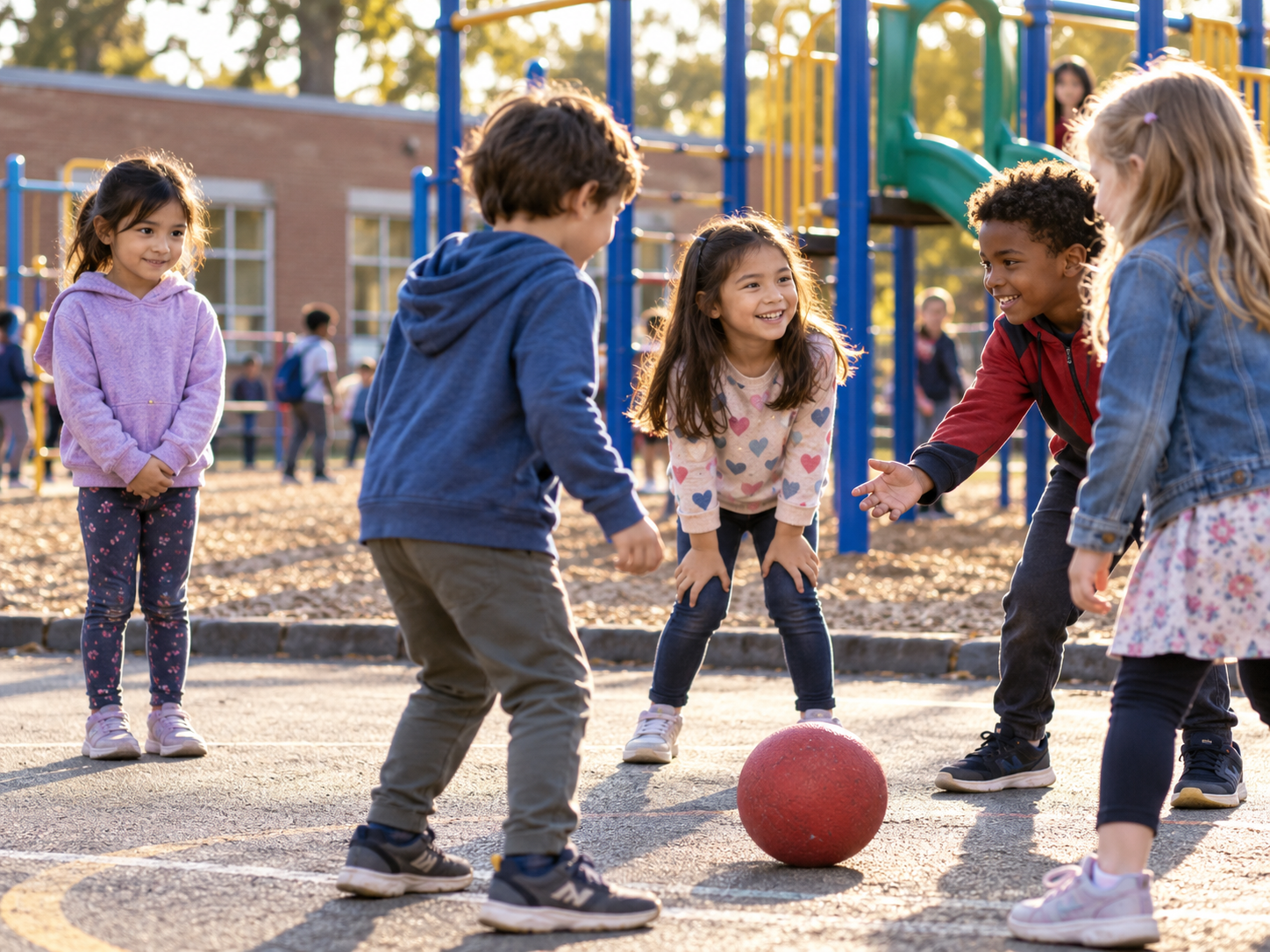
A shy child may genuinely want friendship while still finding the first move at recess difficult. Small social steps can make joining a group feel more manageable without turning shyness into something that needs to be fixed.
Recess can look wonderfully simple from the adult side of the playground. Children run outside, find someone to play with, and spend twenty minutes burning off enough energy to return to math. For some children, recess is much more complicated.
The basketball game has already started. Three children are halfway through an imaginary adventure whose rules apparently require seventeen minutes of prior knowledge. Best friends have paired off before everyone reaches the blacktop, and a child who wants company is left standing near the edge trying to figure out how people actually enter these things.
A shy or slow-to-warm child may want friends very much and still find that first social move surprisingly difficult. They may watch another child for several days without speaking to them, walk toward a game and then change direction, or tell you after school that nobody wanted to play even though they never quite managed to ask.
That gap between wanting connection and knowing how to begin is where parents can help. The goal is not to turn a quiet child into the most outgoing person on the playground. It is to give them a few practical ways to move toward friendship while respecting the temperament they already have.
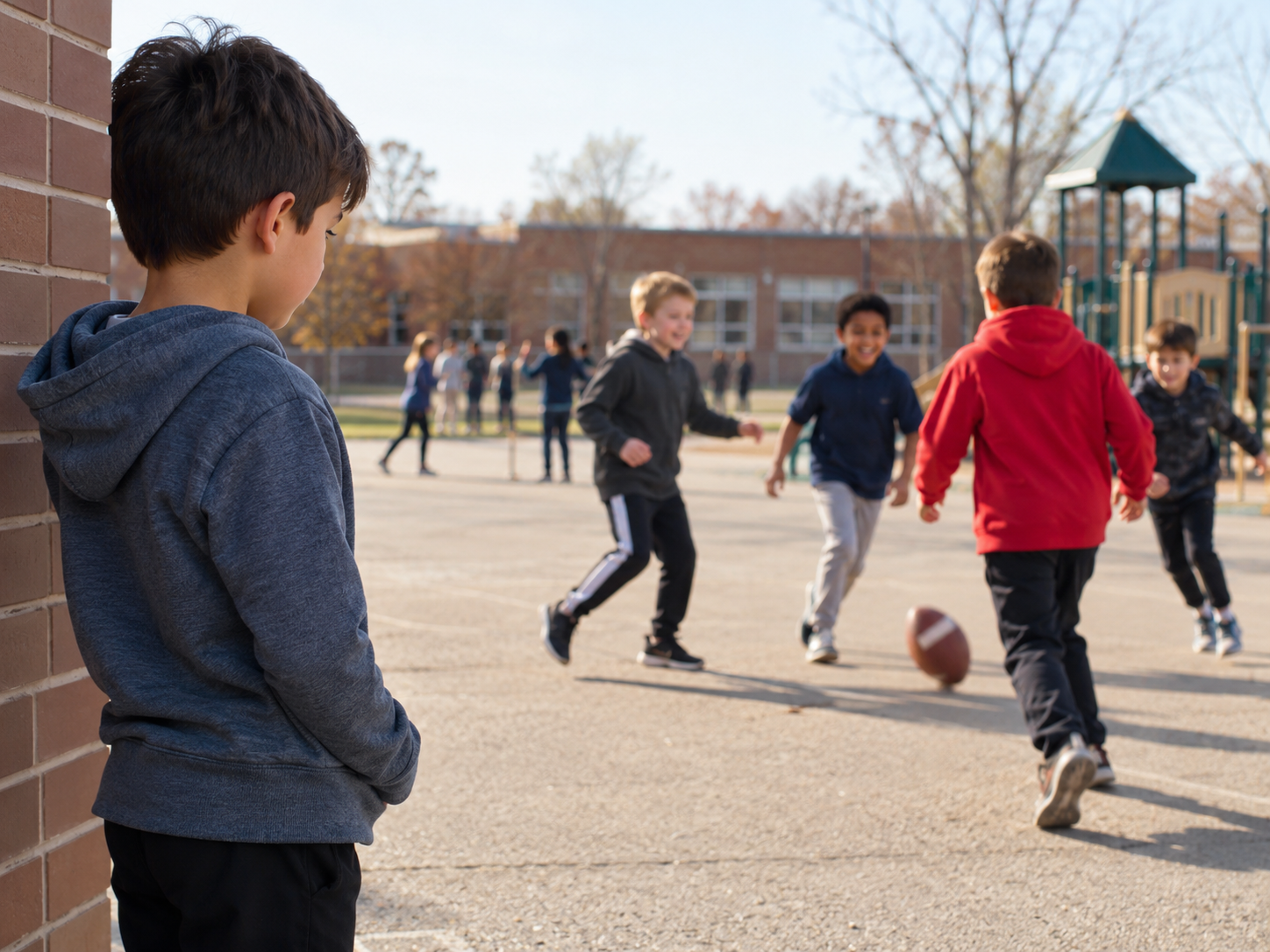
For a shy child, the hardest part of recess may not be friendship itself but figuring out how to enter a game or conversation that has already begun.
Why Recess Can Be Harder Than the Classroom for a Shy Child
Classrooms usually have structure. There is a teacher, an assignment, a seating arrangement, and some indication of what everyone is supposed to be doing.
Recess removes much of that scaffolding. Children have to decide where to go, whom to approach, what to say, how to tell whether a game is open to new players, and what to do if someone says no. These are sophisticated social decisions, even though adults often reduce them to “Go play.”
For a naturally outgoing child, that freedom may feel exciting. For a child who is slow to warm, it can feel like arriving at a party where everyone else received the instructions beforehand.
Children’s Hospital of Philadelphia notes that many shy or slow-to-warm children need additional time to adjust to unfamiliar people and social situations. CHOP recommends preparation, practice, modeling, and positive feedback rather than treating shyness as a personality problem that needs to be corrected. Children's Hospital of Philadelphia
That distinction is especially useful at recess. The child may not need to become less shy before friendship becomes possible. They may need more practice with the mechanics of entering a social situation.
First, Find Out What Is Actually Happening at Recess
When a child says, “Nobody plays with me,” the parental instinct is understandably immediate. We picture our child alone against a chain-link fence while every other student forms joyful friendship circles in the distance.
Sometimes the reality is painful and does require adult attention. Children can be excluded, rejected, bullied, or repeatedly left out.
At other times, “Nobody plays with me” means the child approached one friend who wanted to play something different. It may mean they spent most of recess watching because they did not know how to enter the game, or that they rejected several activities because none felt comfortable.
Before deciding what the problem is, gather information gently. You might ask what the other children were playing, where your child usually stands, whether there is anyone they enjoy talking with in class, or what happened the last time they tried to join. Questions about the scene are often easier to answer than “Why don’t you make friends?”
The goal is to understand the social obstacle well enough to help with the right part.
Shyness Is Not the Same Thing as Not Wanting Friends
A quiet child is not necessarily a lonely child. Some children genuinely prefer one or two close friendships, need more time alone than their siblings do, or have little interest in joining a large playground group. That is not automatically a problem.
The more important question is whether the child is content with their social life or feels unable to have the friendships they want.
HealthyChildren notes that childhood shyness is common and that many shy children eventually function well socially once they have had enough time to adjust. Concern becomes more appropriate when shyness significantly interferes with the child’s ability to establish relationships or participate in ordinary social situations. HealthyChildren.org
That means the goal is not maximum sociability. If your child is happy spending recess drawing with one friend, that may be a perfectly healthy social life. If they come home repeatedly upset because they want connection but cannot figure out how to make the first move, there is something useful to work on.
Make “Go Make a Friend” Much Smaller
“Go make a friend” sounds simple because adults compress an entire social process into four words. The child still has to choose someone, approach them, decide when to speak, think of something to say, risk being ignored or rejected, understand what the other child is doing, and figure out what happens after the opening sentence.
That is a lot of uncertainty packed into one instruction. A smaller goal might be to say hello to one classmate. Another child might begin by standing near a game long enough to understand what is happening. Someone else might ask one question about what the group is playing.
These steps may look tiny from the bench. From inside the child, they may require considerable courage.
This is the same principle behind the Tiny Brave Hop Method. When the complete social goal feels too large, the child looks for the smallest meaningful action that still moves them toward connection.
They are not being asked to become socially fearless. They are practicing the first move.
Teach Your Child How to Watch Before Joining
Adults sometimes interpret watching as avoidance. At recess, watching can also be useful information gathering.
A child approaching a game needs to understand what everyone is doing, whether the game is open to additional players, and where there may be a natural opening. Running directly into the middle of a complicated game with “Can I play?” is not always the easiest social move, particularly when the child does not yet understand the rules.
Teach your child to observe for a moment. They can notice who seems friendly, what the game is called, whether teams are involved, and whether another child is standing nearby rather than deeply engaged. Once they understand what is happening, their opening can become more specific.
Instead of asking a vague “Can I play?”, they may be able to say, “Can I be on your team?” or “Can I be next?” That makes joining feel less like interrupting and more like entering something they already understand.
Practice a Few Recess Openings at Home
Social confidence can improve when children have language ready before they need it. This does not mean giving your child a laminated playground script and expecting them to execute it perfectly. It means practicing a few simple openings so their brain does not have to invent both courage and dialogue at exactly the same moment.
You can role-play casually at home. Pretend you are already playing soccer and let your child practice joining. Switch roles and let them be the child inside the game while you make an awkward attempt to enter.
Humor helps here because social practice should not feel like remediation. Useful openings are usually simple and connected to what is already happening. A child might ask, “What are you playing?”, “Can I be next?”, “Do you want to play tag?”, or “Can I help build that?”
CHOP specifically recommends practicing social situations with slow-to-warm children before they encounter them in real life, particularly when the child and potential friend have a known shared interest.
Practice does not eliminate nervousness. It simply removes one of the things the child has to invent while nervous.
Help Your Child Find One Child, Not the Whole Playground
Large groups can make friendship feel harder than it needs to be. If your child is shy, entering a game involving twelve children may be a much bigger social demand than talking to one child while waiting for class to start.
Look for existing points of connection. Perhaps there is a classmate your child already mentions at home, someone they sit beside, a child who likes the same animal, sport, book series, game, or strange collectible currently sweeping the second grade.
Friendship often grows more naturally from repeated low-pressure interactions than from dramatic playground introductions. You might ask the teacher whether there is a classmate your child seems comfortable with. That information can help you focus on one realistic connection instead of treating recess as a general popularity problem.
One friendship can change the entire emotional landscape of school.
Give Your Child a Job When Joining Feels Too Abstract
Some children struggle with “join them” because they do not know what joining actually requires. A role can make the entry point clearer.
If other children are building something, your child might ask whether they can collect materials. If a soccer game is happening, perhaps they can retrieve the ball or wait to rotate in. If children are drawing with chalk, your child can begin beside them rather than needing to enter through conversation alone.
Shared activity often takes pressure off direct social performance. Children do not always become friends by sitting down and discussing the possibility of friendship. They become friends because both happen to be digging an unnecessarily ambitious hole, collecting acorns, inventing rules for a game, or drawing dragons on the same stretch of pavement.
The activity gives the relationship somewhere to begin.
What to Say Before School
Try not to make recess friendship the central mission of the morning. A child who leaves home thinking, “Today I have to make a friend” may arrive at school carrying more pressure than they had yesterday.
Choose one small intention instead. You might say, “If you see Maya at recess, maybe your brave step is asking what she is playing.” Another day, the goal might simply be staying near the game for a few minutes instead of walking away immediately.
Keep the language curious rather than contractual. You are not sending your child into school with a quota. You are helping them recognize one opportunity if it appears.
What to Say After School
The car ride home can accidentally become a performance review. Parents who are worried about friendship understandably want information, so the child hears, “Did you talk to anybody? Did you ask Maya to play? Why didn’t you try the thing we practiced?”
That can make recess feel like something they are being graded on twice, once socially and again at home. Ask about the day broadly before zooming in.
If recess comes up, you can ask what people were playing or whether anything funny happened. If your child tried one of the social steps you practiced, notice the effort rather than immediately asking whether it produced a new best friend.
“You walked over and asked even though you were nervous” reinforces the courageous behavior. Whether the other child said yes is partly outside your child’s control.
Teach Your Child That “No” Is Not the Same as “Nobody Likes Me”
Friendship requires risk because other children get to have preferences too. A child may ask to join a game and hear no. Someone may already have enough players, want time with another friend, or simply respond awkwardly because children are not universally known for diplomatic finesse.
For a shy child, one rejection can feel enormous. Help them separate the response from their identity.
A child saying “not now” does not automatically mean “nobody wants you here.” Sometimes the useful next step is finding another child, another activity, or another opportunity later.
This is easier to teach before the rejection happens. You can role-play both outcomes at home so “no” does not arrive as proof that attempting friendship was a mistake.
Help Them Recover From an Awkward Attempt
Children need to know that social courage can survive awkwardness.
They may walk over and forget what they planned to say. Another child may not hear them. They may enter the game incorrectly, call someone the wrong name, or discover halfway through the interaction that they have absolutely no idea what is happening.
Adults do this too. We simply have better vocabulary for pretending everything went according to plan. If your child tells you about an awkward moment, avoid performing a forensic analysis unless they want one.
You can acknowledge that it felt uncomfortable and then help them notice what happened next. Most social mistakes are not permanent. Children benefit from learning that embarrassment rises, passes, and does not require abandoning the entire possibility of friendship.
When the Teacher Can Help
Parents sometimes hesitate to involve the teacher because they do not want to make their child’s social life into a school project. There is a useful middle ground.
If your child has been consistently alone, is distressed about recess, or cannot seem to enter peer activities despite wanting to, the teacher may have information you do not. They see classroom pairings, group dynamics, and which children naturally gravitate toward one another.
Ask what they have noticed rather than beginning with a request that they “find my child a friend.” A teacher might know that your child talks comfortably with someone during reading groups but never approaches them outside. They may be able to create occasional paired activities or suggest a classmate who seems like a natural fit.
The goal is not to engineer a friendship. It is to create more opportunities for one to develop.
When Adults Should Not Stay Out of It
There is a difference between giving children room to navigate friendship and ignoring exclusion. If your child is repeatedly being mocked, deliberately excluded, bullied, threatened, or targeted by other children, the solution is not another Tiny Brave Hop toward the same group. Adults need to become involved.
Similarly, if a child says everyone refuses to let them play, take enough time to understand whether this is a skill problem, a group-dynamics problem, or active peer rejection. Children should learn social resilience. They should not be required to earn basic respect by repeatedly approaching people who are treating them badly.
Do Not Turn “Shy” Into Your Child’s Name
Adults often introduce children by explaining them. A parent may say, “She’s shy,” “He takes a while to warm up,” or “She won’t talk to people she doesn’t know.” In the moment, those descriptions may feel harmless or even helpful, especially when a child is standing quietly beside you and another adult is waiting for a response.
The problem is that children hear those explanations too. When the same label is repeated often enough, “shy” can begin to sound less like a description of what happened in one situation and more like a definition of who the child is. A child who expects to be “the shy one” may begin entering new situations already assuming that talking, joining, or warming up will be especially difficult for them.
Children’s Hospital of Philadelphia cautions against labeling children as shy or stand-offish and recommends language that leaves more room for temperament and adjustment. Saying that a child “takes a little time to warm up” describes what they may need without suggesting that their social behavior is fixed.
That distinction matters because children can look very different depending on the setting. A child may stay quiet during the first ten minutes of a birthday party and spend the next hour laughing with one new friend, or say almost nothing around unfamiliar adults while being animated and expressive with classmates they trust. Temperament is real, but it does not have to become a prediction about what your child will always be capable of socially.
Praise the Social Courage, Not the Popularity
Parents naturally want friendship efforts to work. When a child finally asks someone to play, we hope the answer is yes, and it can feel like a little victory when the two children run off together. That outcome matters to the child, of course, but it is not the only thing worth noticing.
The part your child can actually control is the effort they made to connect. They walked over, asked the question, stayed near the group long enough to join, introduced themselves, or tried again after an awkward first attempt. Those are meaningful social skills, even when the result is not immediate friendship.
When you praise those actions, you help your child understand that courage has value even when the social outcome is uncertain. You might say, “I know you were nervous, and you still went over and asked,” or “You stayed with it even after the first try felt awkward.” That kind of feedback keeps the focus on the behavior your child can practice rather than on whether another child responded exactly the way they hoped.
Friendship is never completely under one person’s control. A child can practice approaching, asking, listening, joining, and trying again, but they cannot force another person to become a friend. Reinforcing the courage it takes to make those first moves gives your child something steadier to build on than popularity alone.
Use Picture Books to Practice Friendship at a Safe Distance
Stories can be especially useful for shy or hesitant children because the social problem belongs to somebody else for a while. A child can watch a character feel left out, hesitate before joining, misunderstand another person, or eventually find an unexpected friend without immediately having to explain what happened at their own recess.
That distance can make social situations easier to think about. Instead of asking your child what they should have done differently, you can ask what the character might try next, why joining the group felt difficult, or what made another child seem approachable. Children will sometimes offer thoughtful solutions for a fictional character that they would resist if the same ideas were presented as direct advice about themselves.
For book recommendations chosen specifically around this experience, see Picture Books About Making Friends for Shy Kids: Stories That Help Children Join In Without Pressure.
The most important thing is to let the story remain a story first. If your child makes the connection to recess on their own, that can open the door to a useful conversation. If they do not, the reading still has value because you have given them a safe way to observe friendship, hesitation, and belonging without turning every difficult social moment into a lesson.Use a Tiny Brave Hop for the First Social Move
The Tiny Brave Hop Method fits recess particularly well because friendship often becomes intimidating when the child imagines the entire outcome at once. They are not simply thinking about saying hello. They may already be imagining whether the other child will like them, whether they will have anything to talk about tomorrow, whether the group will accept them, and whether the friendship will last.
Bring the task back to what can happen now. The first hop might be standing closer to a game, saying hello to one child, asking what they are playing, offering to help, or staying near the group long enough to see whether an opening appears. For the full framework behind making difficult first steps smaller, use How to Help Your Child Take Tiny Brave Hops.
The goal is not to reduce friendship to a formula. It is to give a hesitant child somewhere to begin.
Why The Rabbit in the Moon Fits the Child at the Edge of Recess
The Rabbit in the Moon is not a book about playground friendship, and that is part of why its connection here can feel natural rather than forced. Yabbit’s story is about the emotional pause that can happen before action, when a child wants to move forward but the next step suddenly feels much larger once they are standing in front of it.
A child at the edge of the playground may understand that feeling immediately. They may want to join the game, talk to another child, or be part of what is happening, but still find it difficult to cross the few feet between watching and participating. The desire for friendship is there, yet the first move can feel uncertain enough to stop them.
Yabbit understands that hesitation from the inside. He does not become fearless because someone tells him there is nothing to worry about, and Snail does not push him to become a different kind of rabbit. Instead, Snail brings steadiness and persistence while Yabbit learns that moving forward can happen in smaller pieces.
That is where Yabbit’s language can become useful for recess. Instead of asking, “Why don’t you just go make friends?”, a parent can make the question more manageable: “What would one small brave hop toward the game look like today?” For one child, that might mean standing a little closer. For another, it might mean saying hello, asking what the others are playing, or staying long enough to notice an opening.
Friendship does not always begin with a confident introduction or an instant connection. Sometimes it begins with a hesitant child taking one small step toward the people they hope to know.
When Shyness May Be More Than a Slow-to-Warm Temperament
Most shy children do not need treatment simply because they take longer to enter social situations. HealthyChildren notes that many naturally shy children eventually function well socially after an adjustment period. Concern becomes more appropriate when shyness is severe enough to interfere with relationships or everyday functioning.
Pay attention to the degree of distress and restriction. If your child wants friends but consistently cannot speak to peers, avoids school or social activities because of fear, becomes extremely distressed in ordinary social situations, or remains isolated despite substantial support and opportunities, consider discussing the pattern with your pediatrician or a qualified child mental-health professional.
Seeking help does not mean the child failed to become outgoing. The goal was never outgoing. The goal is helping the child participate in the relationships and experiences they want.
The American Academy of Pediatrics, provides guidance on ordinary childhood shyness, adjustment, relationships, and when more significant social difficulty may warrant additional attention.
Buy The Rabbit in the Moon
If your child wants to join but sometimes freezes before taking the first social step, The Rabbit in the Moon was written for that emotional space.
Yabbit hesitates when the journey ahead begins to feel bigger than expected. Snail offers persistence and companionship without shaming him for needing time, and Yabbit eventually discovers that courage does not require him to become fearless before he moves.
That idea can travel naturally onto the playground. The whole goal does not have to be “make a friend today.” Sometimes the meaningful goal is smaller: walk closer, watch for a minute, say hello, or ask one child what they are playing.
Friendship has to begin somewhere. For a hesitant child, one small brave hop is enough of a beginning.
Frequently Asked Questions About Helping a Shy Child Make Friends
How can I help my shy child make friends at recess?
Start by identifying the exact part of recess that feels difficult, then practice one manageable social action at home. Your child might learn how to watch a game before entering, ask one child what they are playing, or approach someone they already know from class. The goal is to make the first social move easier rather than asking the child to solve friendship all at once.
Should I tell my child to just go ask someone to play?
You can encourage your child to approach other children, but “just go ask” may be too broad for a child who does not know whom to approach, what to say, or how to enter an activity already in progress. Breaking the process into smaller steps often gives the child something more concrete to practice.
What if my child says nobody plays with them at recess?
Take the statement seriously without assuming you already know what it means. Ask what other children were playing, whether your child tried to join, what happened when they approached, and whether there is anyone they feel comfortable with in class. If the pattern continues or your child seems consistently isolated, ask the teacher what they have observed.
Should I contact the teacher if my child is alone at recess?
Yes, when the problem is persistent or upsetting your child. Approach the teacher as a source of information rather than asking them to manufacture a friendship. They may notice classroom connections, peer dynamics, or patterns at recess that can help you understand whether your child needs social practice, more opportunities for connection, or adult support around exclusion.
How do I help my child handle rejection from other kids?
Help them understand that one child saying no does not automatically mean nobody likes them. Children may already be playing with someone else, have enough players, or simply respond awkwardly. Practice what your child can do next, such as approaching another activity or trying again with the same child at another time.
When should I worry about my child’s shyness?
Ordinary shyness or a slow-to-warm temperament is common. It is more concerning when social fear consistently prevents the child from forming relationships, participating in ordinary school or social activities, or doing things they genuinely want to do. In those cases, discussing the pattern with your pediatrician or a qualified child mental-health professional can be helpful. HealthyChildren.org
Can picture books help a shy child make friends?
Picture books can give children a safe way to observe friendship challenges before they have to navigate them themselves. Stories can help children recognize hesitation, consider possible ways to join a group, understand rejection or belonging, and borrow language they can later use in real-life situations.
Final Thought
For a shy child, friendship may begin long before anyone else can see it. It may begin while they are watching the same group play every day, learning the rules of the game from a distance. It may begin when they mention one classmate repeatedly at dinner, practice a sentence in the car, or finally stand a few feet closer than they did yesterday.
Adults are often waiting for the visible result: the invitation, the game, the new friend running alongside them after school. The child may still be working on the approach. That is worth respecting.
We do not need to make shyness disappear before connection becomes possible. We can help children understand the social landscape, give them language for entering it, support them when an attempt feels awkward, and make the first move small enough that courage has somewhere to begin.
Over time, those little approaches accumulate. A hello becomes a conversation. A conversation becomes a shared game. A shared game may become the person your child looks for when recess begins.
Friendship can grow quietly. For some children, that is exactly how it is supposed to start.