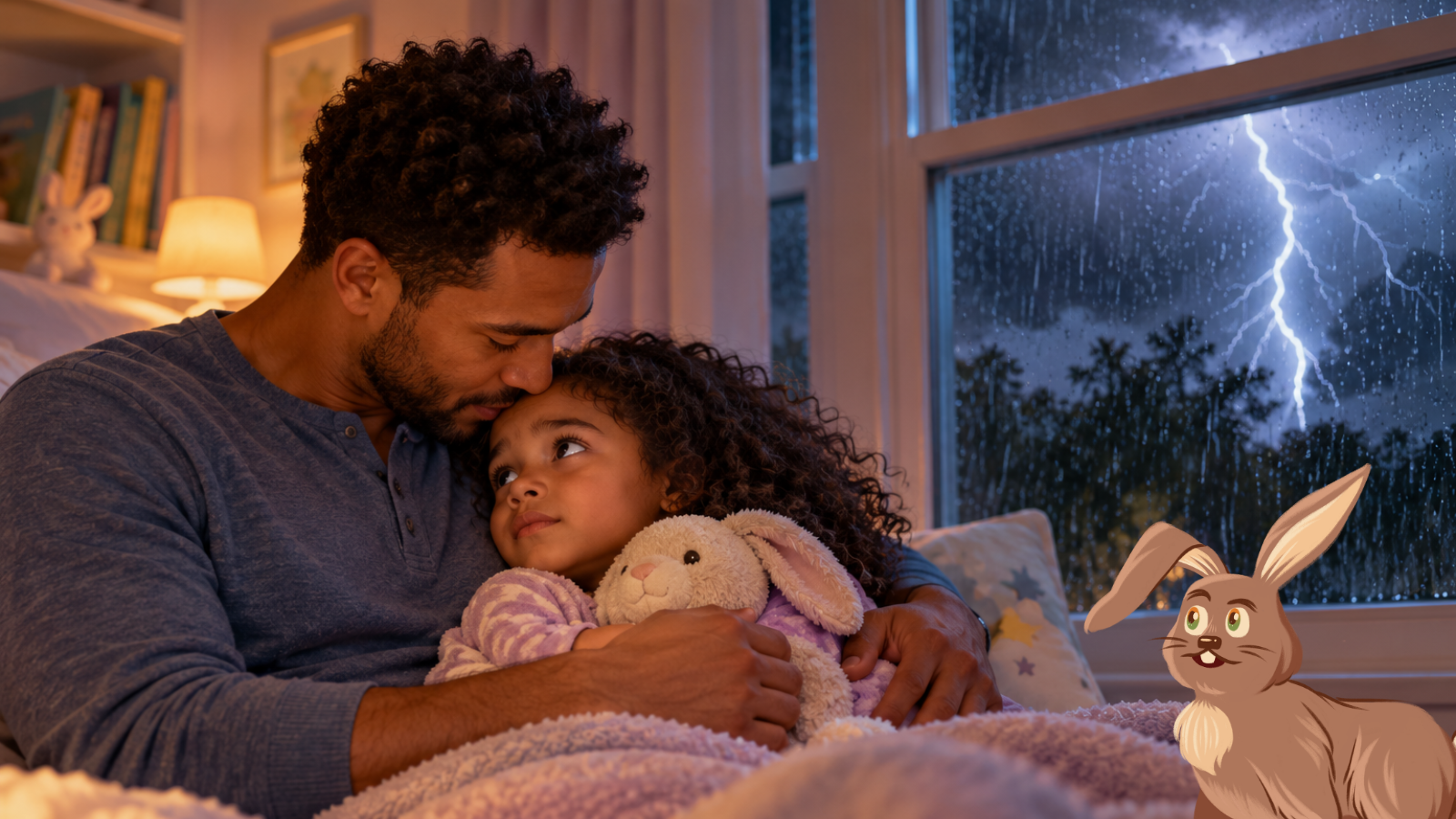
Helping a child who is afraid of thunderstorms means taking the fear seriously while making the storm more predictable, limiting unnecessary checking, and giving the child a clear plan for what happens next.
A thunderstorm can turn an ordinary afternoon into a full household event when a child is afraid of storms.
One rumble in the distance may lead to questions about lightning, tornadoes, power outages, trees falling, whether the family should go somewhere safer, and how long the storm will last. Some children become frightened only when thunder is directly overhead. Others begin worrying hours earlier because the sky looks dark or someone mentioned rain in the forecast.
From a child’s point of view, thunderstorms contain almost everything that makes uncertainty difficult. They are loud, unpredictable, impossible to stop, and capable of changing the environment very quickly. Lightning appears without warning. Thunder can shake the windows. Adults may suddenly start checking weather alerts or moving things inside, which tells an observant child that something unusual is happening.
The goal is not to convince children that storms are harmless. Severe weather is real, and families should follow appropriate safety guidance when conditions require it. The more useful goal is to help children separate actual safety steps from the anxious feeling that they must monitor the weather constantly in order to prevent something bad from happening.
That distinction is where parents can make a real difference.
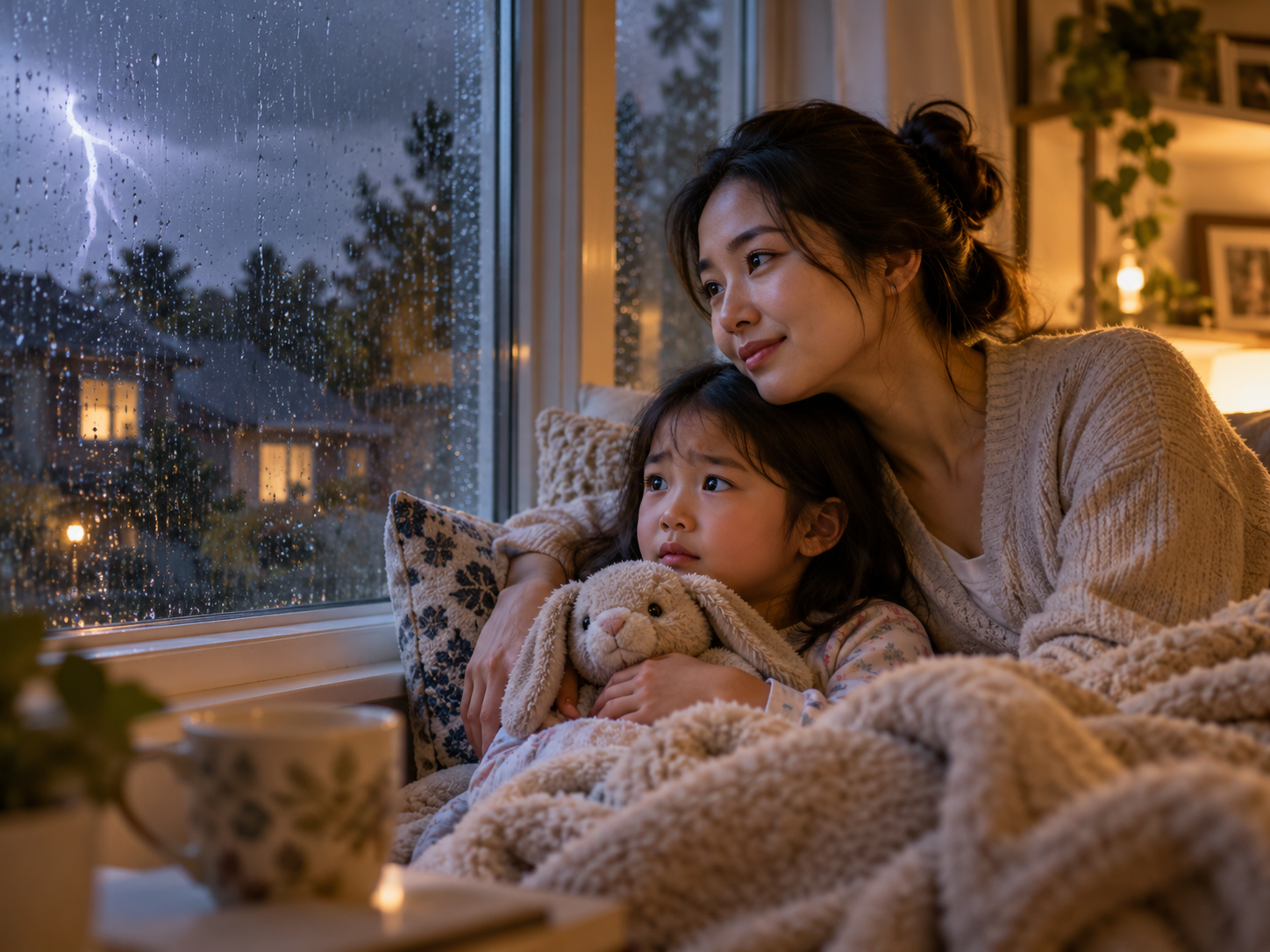
Children who are afraid of thunderstorms often need both reassurance and a clear safety plan, but too much checking can make the fear feel even more important.
Is It Normal for Children to Be Afraid of Thunderstorms?
Yes. Fear of thunderstorms is a common childhood fear.
The American Academy of Pediatrics includes thunderstorms among the ordinary fears children may experience as they grow and encounter new situations. Most childhood fears are mild and tend to ease over time with support and reassurance. The AAP also cautions parents not to ridicule a child’s fear or pressure them into acting brave before they are ready. HealthyChildren.org
That does not mean every storm fear should be ignored. The important question is how much of the child’s life the fear begins to occupy.
A child who seeks comfort during a loud storm is having a very different experience from a child who refuses to leave the house because clouds are in the forecast, repeatedly checks weather apps, cannot concentrate at school because storms are possible later, or needs constant reassurance that nothing bad will happen.
Mayo Clinic notes that, for children with significant storm anxiety, the anticipation of the storm can become more difficult than the storm itself. The worry may start long before the first thunder arrives and can lead to avoidance, repeated forecast checking, or requests for reassurance. That difference between fear during a storm and fear of the possibility of a storm is important for parents to recognize.
Why Thunderstorms Can Feel So Frightening to Children
Thunderstorms combine several forms of uncertainty at once.
The noise can be startling, particularly for younger children or children who are sensitive to loud sounds. Lightning appears suddenly and unpredictably. The house may become darker. Rain can hit windows hard enough to sound dramatic, and wind can make trees and objects move in ways children do not normally see.
The adults may also behave differently. Parents check phones, close windows, move outdoor furniture, watch the sky, or discuss warnings. Even when those actions are calm and appropriate, a child may interpret them as evidence that danger is everywhere.
Then there is imagination. Children often have incomplete information about how weather works, and the brain is remarkably good at filling information gaps with possibilities. If a child knows that lightning can be dangerous but does not understand when, where, or how adults respond to severe weather, “lightning can be dangerous” can easily become “lightning may hit our house any second.”
More information can help, but only when the information is appropriate for the child’s age and does not drown them in frightening possibilities.
Start With a Simple Family Storm Plan
One of the most useful things you can give an anxious child is a clear answer to the question, “What do we do if the weather becomes dangerous?” A simple family safety plan makes the adults responsible for monitoring real risk instead of leaving the child feeling responsible for it.
You might explain that grown-ups watch official weather information, that your family has a safe place to go if necessary, and that you will tell the child if the plan changes. The child does not need to decide whether the clouds look serious enough, determine when shelter is necessary, or interpret every weather alert.
Mayo Clinic specifically recommends talking with children about the family’s storm safety plan because knowing what will happen can reduce some of the uncertainty surrounding severe weather.
Keep the plan simple enough that it reassures rather than becomes another subject to obsess over. A young child does not need a detailed seminar on every possible weather emergency. They need to know that the adults have a plan and that they will be told what to do.
Explain the Storm Without Turning It Into a Disaster Documentary
Learning how storms work can make them less mysterious. You might explain that thunder is the sound created when lightning heats the air very quickly, or that dark clouds can contain rain without automatically meaning something dangerous is about to happen. A child who understands the basic sequence of a storm may begin to see it as weather rather than a collection of frightening surprises.
The information should match the child’s developmental level. Mayo Clinic recommends books, websites, or other resources that explain storms themselves while cautioning parents not to dwell on destruction.
A seven-year-old who wants to understand thunder probably does not need a montage of tornado damage, fallen houses, and lightning-strike videos. Information should make the world more understandable, not provide anxiety with a larger research department.
If your child loves science, weather can even become something interesting to learn about. Curiosity and fear can coexist, and sometimes curiosity gradually begins taking up more space.
Be Careful With Repeated Weather Checking
Checking the weather when severe conditions are possible is sensible. Checking the forecast fifteen times because the child needs to hear once more that there probably will not be a storm is something different.
Children with significant storm anxiety may begin relying on what clinicians call safety behaviors. These are actions that provide temporary relief from anxiety but can make the child feel increasingly dependent on them. Mayo Clinic gives repeated forecast checking and repeatedly asking whether the family needs shelter as examples. Mayo Clinic News Network
The problem is not that checking a forecast is inherently harmful. The problem is what the checking teaches. If every anxious feeling leads to another weather check, the child may begin believing that uncertainty itself is intolerable and that constant monitoring is what keeps them safe.
Parents can gently shift responsibility back where it belongs. You might say, “I am keeping an eye on the weather, and if we need to do anything different, I will tell you.” Then try not to reopen the entire forecast conversation every five minutes unless new safety information actually appears.
Give Reassurance Without Entering an Endless Reassurance Loop
Children naturally look to their parents for comfort when they are frightened, and a thunderstorm is an entirely reasonable time to want someone close. The difficulty begins when reassurance stops helping for more than a few seconds and turns into a cycle where every answer immediately produces another worried question.
A child might ask whether everyone is safe, hear that they are, and then wonder whether the lightning could get closer. Once that question is answered, they may worry about whether the family’s safety plan will work, or whether the storm could suddenly become worse. The parent keeps answering because the child is clearly distressed, but the relief never lasts very long.
At that point, more reassurance is not necessarily creating more security. The child’s anxious mind has learned that uncertainty should be answered with another check, another question, or another confirmation. The problem is not that the parent is being too comforting; it is that no amount of reassurance can completely remove uncertainty from a thunderstorm.
A steadier response can be more helpful. You might say, “I know the storm sounds scary. I am watching the weather, and I will tell you if we need to do anything different. Right now we are following our plan.” That message acknowledges the fear while also making it clear that the adults are responsible for monitoring the situation.
The goal is not to refuse comfort. It is to offer reassurance in a way that helps the child feel supported without teaching them that every anxious thought requires a new investigation before they can feel safe again.
Let Your Child Be Afraid Without Making Fear the Main Event
Parents often become anxious about their child’s anxiety.
We see fear and immediately want to remove it, distract from it, explain it away, or convince the child that nothing is wrong. Those instincts are understandable, but they can make a child feel that being afraid is itself a problem that must disappear quickly.
You can acknowledge the feeling without giving it command of the evening. Try something like, “That thunder was really loud. I can see why it startled you,” and then return to whatever the family was doing.
You do not have to create a special emergency atmosphere every time it rains unless the weather actually requires one. This can be especially useful for children who are learning to watch adults for cues. If every rumble causes the household to stop, gather around the radar, and discuss danger, the child may understandably conclude that thunder deserves maximum attention.
Calm normalcy communicates something different: we notice the storm, we follow safety guidance, and ordinary life can continue.
Help With the Sound Without Pretending It Is Not Loud
For some children, thunderstorm anxiety is partly sensory.
Thunder is not merely an idea. It is a sudden, booming sound that can vibrate through a room and arrive with no warning. Children who are sensitive to loud noises may react strongly even if they understand that the family is safe.
You can reduce the sensory load without teaching the child that thunder must be escaped at all costs. Closing windows, moving to an interior room, playing familiar music, or using comfortable noise-reducing headphones may help some children remain regulated enough to stay engaged with what is happening around them.
The goal is not to create a perfect soundproof bubble. It is to give the child enough support that they can experience the storm without becoming completely overwhelmed. Over time, some children may need less of that support.
What to Do When Storm Anxiety Shows Up at Bedtime
Storms can become especially difficult at night because darkness, separation, and tiredness already make some children more vulnerable to worry. A child who can tolerate rain at 3:00 in the afternoon may become much more frightened when the same rain is hitting the windows after the lights go out. The first step is to keep bedtime as recognizable as possible.
If conditions are safe, continue the usual sequence of pajamas, brushing teeth, story, and settling down rather than allowing the entire night to become organized around checking the storm. You can make reasonable adjustments, such as leaving the door open or allowing a familiar comfort item, without completely rebuilding the bedtime routine around fear.
If your child already struggles with nighttime worry, use Bedtime Anxiety in Kids: What to Say and What to Do for the broader bedtime framework. The important thing is consistency. A child can be afraid of thunder and still experience bedtime as predictable.
Do Not Use “There Is Nothing to Be Afraid Of”
Parents usually mean this kindly.
The difficulty is that thunder is loud, lightning looks dramatic, and some storms genuinely do require safety precautions. Telling a child there is absolutely nothing to be afraid of can feel disconnected from what their senses are telling them.
A more useful response is, “Thunder can sound scary, and we know what to do during storms.” That sentence does two things at once. It validates the experience without confirming that the child is currently in danger.
You might also say, “The grown-ups are watching the weather. Your job is to stay with us and follow the plan.” That reduces the burden of monitoring the world while still acknowledging that storm safety is real.
Avoid Calling the Child Dramatic or Overreacting
Fear can look inconvenient from the outside.
The child may ask the same question repeatedly, refuse to move away from you, cry when there is only distant thunder, or become upset long before the rain begins. Parents who already know that the storm is likely to be mild can find that reaction frustrating.
The AAP specifically advises against belittling or ridiculing childhood fears and against pressuring children to act brave. That does not mean parents have to agree with every anxious prediction. You can say, “I know you are worried about the storm,” without saying, “Yes, something terrible may happen.”
Taking the feeling seriously and agreeing with the fear are not the same thing.
Gradually Help the Child Tolerate More of the Experience
Avoidance usually feels wonderful in the short term. If a child is frightened by storms, closing every curtain, hiding under blankets, refusing to leave the house whenever rain is forecast, and checking the radar constantly may all reduce anxiety temporarily. The problem is that the child never gets much opportunity to discover that they can handle the experience.
For significant fears and phobias, the AAP describes gradual exposure to the feared situation in small, nonthreatening doses as part of behavioral treatment. Mayo Clinic similarly describes gradually helping children face storm-related fear, beginning with manageable steps and building from there.
Parents do not need to create a home therapy program, particularly when a child’s anxiety is severe. What you can do in ordinary family life is avoid turning every mild storm into something the child must completely escape.
A child may begin by listening to distant thunder while sitting beside you. Later, they might watch rain through the window for a minute before returning to an activity. The step should be manageable enough that the child remains engaged rather than overwhelmed.
Use a Tiny Brave Hop Instead of Demanding Fearlessness
This is where the Tiny Brave Hop idea fits naturally. A child who is terrified of storms does not need to prove they are brave by standing at the window during thunder or pretending the noise does not bother them. The useful question is what small action helps them tolerate a little more uncertainty than before.
One child’s Tiny Brave Hop may be staying in the living room instead of hiding in the closet. Another may be allowing the curtains to remain open during ordinary rain. A child who repeatedly checks the forecast may agree to let the parent handle weather updates for the next thirty minutes.
These are small changes, but they matter because they give the child evidence that anxiety can rise and fall without constant escape. For the full framework, read How to Help Your Child Take Tiny Brave Hops.
The point is not to create a fearless storm watcher. It is to help the child discover that fear does not need to make every decision.
What If My Child Is Afraid of Tornadoes During Every Thunderstorm?
Tornado fear can make ordinary thunderstorms much more difficult because the child may begin treating every dark cloud as the beginning of a severe-weather emergency. This is another place where a family safety plan can help.
Explain that adults use reliable weather information to know when different actions are necessary. Avoid asking the child to interpret clouds or determine risk themselves, and try not to spend hours discussing every rare possibility whenever rain appears.
If your area does receive a severe-weather alert, follow official safety guidance calmly. The child needs to see that safety planning and panic are not the same thing. After the situation passes, return to ordinary life rather than continuing to review everything that might have happened.
Should Children Watch the Weather Forecast?
It depends on how the child uses the information. For some children, a brief look at the forecast makes the day more predictable. For others, the forecast becomes a source of constant monitoring, especially when every percentage of rain or storm icon triggers another round of worry.
Pay attention to what happens after the child checks. If the information helps them understand the plan and move on, it may be useful. If it creates a need to check again five minutes later, the forecast may be feeding the anxiety rather than reducing it.
In that case, the parent can take over the monitoring. You might say, “I will check the weather when we need to, and I will tell you if our plan changes.” That gives the child permission to stop being the family meteorologist.
How Picture Books and Stories Can Help With Storm Fear
Stories can help because they move fear onto the page. A child can watch another character become frightened by noise, darkness, uncertainty, or something outside their control without immediately having to explain their own reaction.
Books that explain weather can make storms more understandable. Stories about fear and courage can help with the emotional side of the experience. The useful book does not need to insist that storms are fun. It can simply show that fear can be felt, understood, and lived through.
This is one reason I think stories work best when they do not rush toward “See? There was never anything to worry about.” Children tend to trust stories more when the fear makes sense before the story asks the character to move through it.
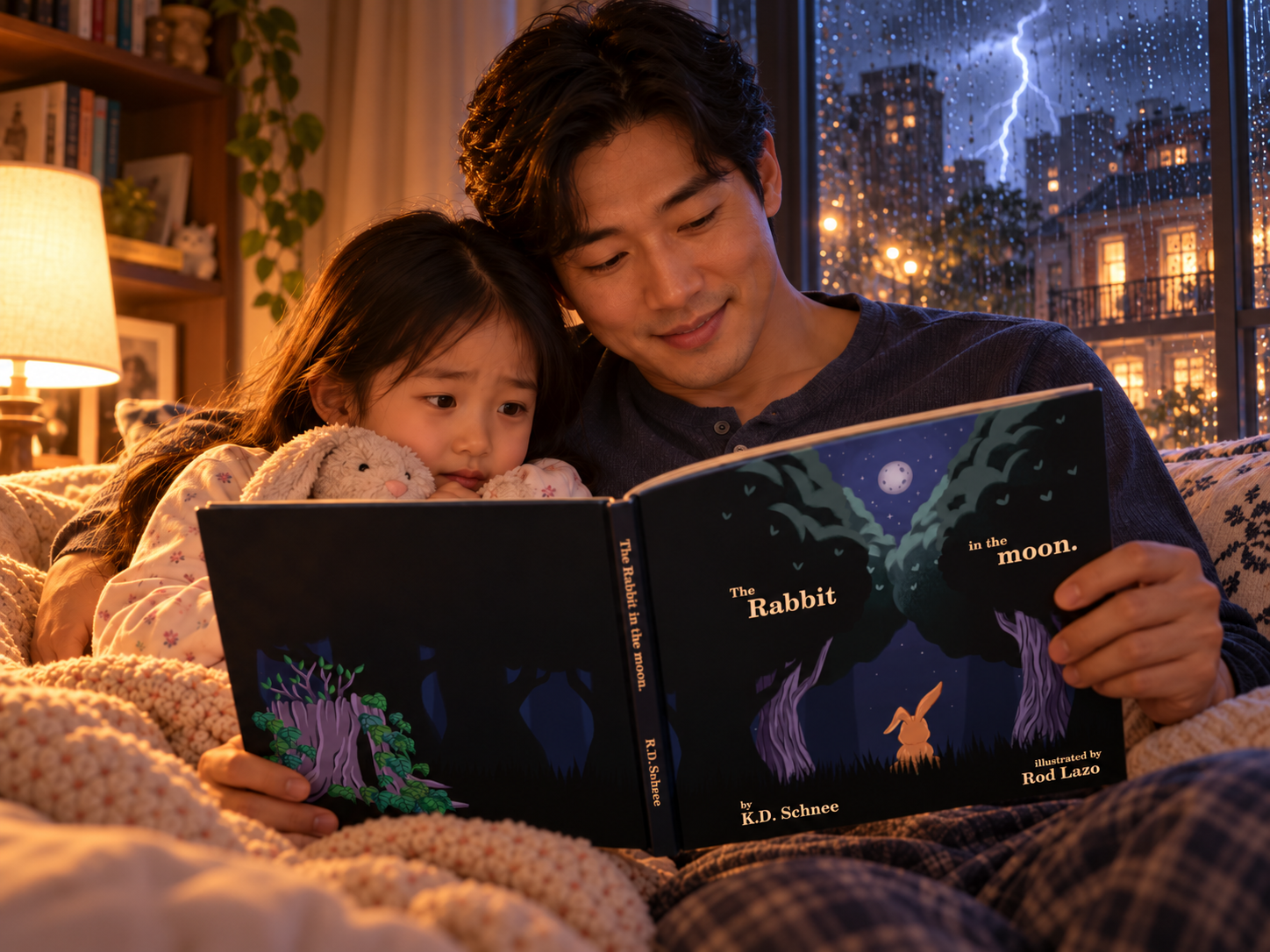
Stories can help children explore fear at a safe distance while giving families language for thunder, uncertainty, reassurance, and courage.
Why The Rabbit in the Moon Can Help With Storm Anxiety
The Rabbit in the Moon is not a book about thunderstorms, and I would not present it as one. Its connection to storm fear lies in the emotional experience Yabbit represents.
Yabbit knows what it feels like when something ahead begins to feel bigger than expected. He hesitates. He worries. He does not suddenly become a fearless rabbit just because someone tells him everything will be fine.
Snail brings steadiness and companionship while Yabbit discovers that he can move forward in smaller pieces. That emotional pattern can be useful for children who become overwhelmed by storms. They do not have to stop being scared before the evening can continue. They may simply need to identify what the next manageable thing is.
That might mean staying in the room, listening to one rumble, letting the parent handle the weather app, or returning to the bedtime story after the thunder passes. The storm may still be outside. The child can still take one small brave hop inside.
When Storm Fear May Need Professional Support
Most childhood fears do not require treatment. The concern grows when the fear becomes persistent, increasingly intense, or begins narrowing the child’s life.
If your child repeatedly refuses activities because storms might occur, cannot concentrate because they are monitoring the weather, experiences severe distress whenever rain is forecast, loses significant sleep, or needs escalating reassurance for long periods, it may be worth talking with your pediatrician or a qualified child mental-health professional.
Both the American Academy of Pediatrics and Mayo Clinic recommend seeking additional support when fear becomes persistent or interferes with ordinary daily functioning. Professional support does not mean the fear was handled incorrectly at home.
It simply means the child may need more help learning how to manage it.
Buy The Rabbit in the Moon
If your child becomes overwhelmed when something uncertain or unfamiliar suddenly feels bigger than expected, The Rabbit in the Moon was written for that emotional territory.
Yabbit worries and hesitates, while Snail brings steadiness and persistence. Their story does not ask children to become fearless before they move. Instead, it gives families language for finding one manageable next step when the whole experience feels too large.
For a child who is afraid of thunderstorms, that idea can become very practical. The goal is not to enjoy every thunderclap or prove that the storm is no longer scary. The goal is to discover what one small brave hop looks like while the fear is still present.
Frequently Asked Questions About Thunderstorm Anxiety in Kids
Is it normal for children to be afraid of thunderstorms?
Yes. Thunderstorms are among the common fears children may experience, particularly because the noise, lightning, wind, darkness, and unpredictability can feel overwhelming. Most childhood fears improve over time with support, but persistent fear that interferes with everyday life deserves additional attention. HealthyChildren.org
Why does my child worry about storms even when the weather is clear?
For some children, the anticipation of a storm becomes more distressing than the storm itself. They may repeatedly check forecasts, ask for reassurance, avoid activities, or worry about what might happen later. Mayo Clinic specifically identifies this anticipatory anxiety as a common feature of more significant storm fear. Mayo Clinic News Network
Should I keep reassuring my child that no storm is coming?
Some reassurance is appropriate, but repeated reassurance can become part of an anxiety loop in which the child needs another answer every time uncertainty returns. It is often more helpful to remind the child that you are monitoring the weather and will tell them if the family needs to take action.
Should I let my child check the weather app when they are anxious?
Occasional checking can be useful, especially when weather information is genuinely relevant. If the child begins checking repeatedly because each check only provides temporary relief, it may be better for the parent to take over weather monitoring and share only information that affects the family’s plan.
How can I help my child when thunder is especially loud?
Acknowledge that the sound is startling and reduce unnecessary sensory stress when appropriate. Closing windows, moving to a quieter interior space, using familiar music, or comfortable noise-reducing headphones may help some children remain calm enough to cope without turning thunder into something that must always be completely avoided.
Can picture books help a child who is scared of storms?
They can help in two different ways. Books about weather can make storms less mysterious, while stories about fear and courage can help children recognize that being frightened does not mean they are unable to cope. The strongest books support understanding without promising that fear will disappear immediately.
When should I get professional help for my child’s fear of thunderstorms?
Consider talking with your pediatrician or a qualified mental-health professional if storm anxiety is persistent, worsening, causing significant distress, interfering with sleep or school, restricting activities, or leading to extensive avoidance and reassurance-seeking. HealthyChildren.org
Final Thought
Storms are a difficult kind of childhood fear because the child cannot control when they arrive. Parents cannot promise that thunder will never be loud, lightning will never flash, or severe weather will never require the family to take precautions. Trying to make those promises would not create real security anyway.
What children can learn is something more durable. They can learn that the adults have a safety plan, that every cloud does not require panic, and that fear can rise without needing to control the entire evening.
They can also learn that courage during a storm does not have to look impressive. It may be sitting beside a parent instead of hiding, letting someone else handle the weather app, going back to the bedtime story after a loud rumble, or simply noticing that the thunder passed and they are still okay.
That is how confidence usually grows: not because uncertainty disappears, but because the child gradually discovers that they can live through a little more of it than they thought.