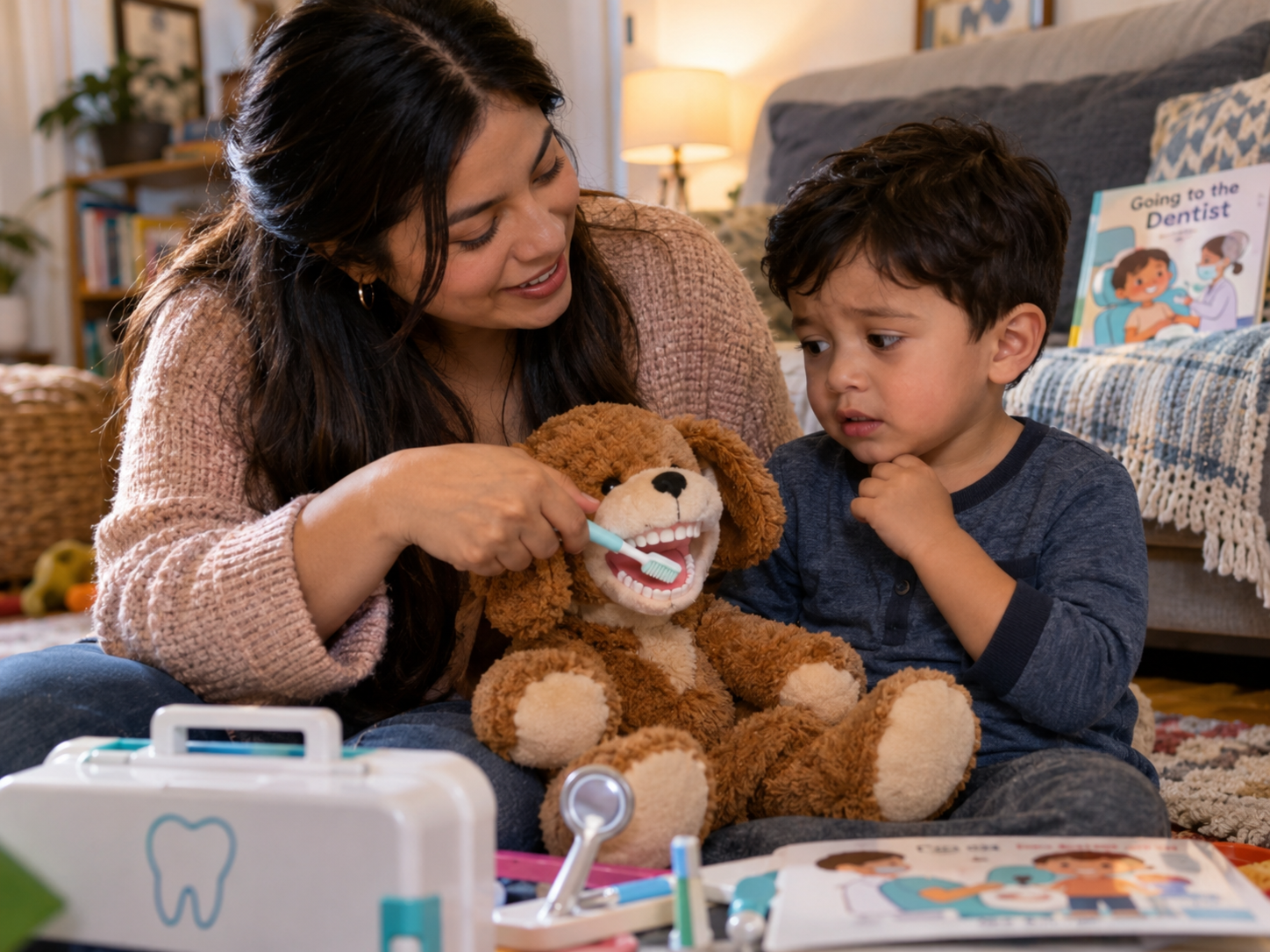
Preparing an anxious toddler for the dentist works best when parents make the visit more predictable, use calm and honest language, and practice small parts of the experience before appointment day.
A toddler can be perfectly happy brushing their teeth at home and still become deeply suspicious the moment someone suggests that a stranger would like to look inside their mouth under a bright light. From the child’s perspective, this is not particularly irrational.
A dental office is full of unfamiliar sights, sounds, smells, tools, people, and expectations. Someone the child has never met may ask them to sit in a strange chair, lean backward, open their mouth, tolerate a light near their face, and allow instruments into a part of their body that adults usually spend considerable time telling them belongs to them.
Parents understand why the visit matters. Toddlers experience what it feels like.
That difference is why preparing an anxious toddler for the dentist should not be about convincing them that there is absolutely nothing to worry about. The more useful goal is to make the experience understandable enough that the child does not have to confront every unfamiliar piece at the same time.
A little preparation can turn the dentist from one large mystery into a sequence of smaller, recognizable moments. The child may still cry, cling, refuse to open their mouth immediately, or need extra time. None of those reactions automatically mean the preparation failed.
For toddlers, a successful visit does not always look calm. Sometimes success simply means that an unfamiliar experience became a little more familiar.

Preparing an anxious toddler for the dentist works best when parents make the visit more predictable, use calm and honest language, and practice small parts of the experience before appointment day.
How Do You Prepare an Anxious Toddler for the Dentist?
The best way to prepare an anxious toddler for the dentist is to make the experience predictable without making it enormous. Explain the basic sequence in simple language, practice a few parts of the visit at home, let the dental office know ahead of time that your child is nervous, and avoid promising that every part will feel easy.
You might tell your child that the dentist is going to count and look at their teeth, that there will be a special chair and bright light, and that you will be nearby. At home, practice opening wide while you count teeth, let a stuffed animal have a pretend checkup, or look at pictures of a dental office together.
The American Dental Association specifically recommends talking about what will happen, practicing opening the mouth, and using books or videos to make a first visit more familiar. For younger children, that kind of rehearsal can be more useful than a long explanation because toddlers understand an experience much better when they can see and act out pieces of it. MouthHealthy
Remember That the Dentist May Feel Bigger to Your Toddler Than It Does to You
Adults have years of experience telling us what a dental appointment is. We know what a waiting room is, why the chair moves, what the light is for, and why somebody wearing gloves wants us to open our mouth.
A toddler has none of that context.
The chair may move unexpectedly. The light may feel enormous. A mask can hide part of the dentist’s face. The suction makes a strange noise. Gloves feel different from hands. Even the ordinary request to “open wide” asks a young child to cooperate with something they may never have practiced with anyone outside the family.
When parents recognize how much new information is packed into the appointment, a toddler’s hesitation becomes easier to understand. The child is not necessarily deciding that dentistry is terrible. They may simply be trying to work out what this room is and what these people expect from them.
That is why familiarity matters so much before the visit.
Tell Your Toddler Enough, but Not Everything
Parents often move toward one of two extremes when a child is nervous. We either say very little because we do not want to worry them, or we explain every possible thing that could happen because we hope information will create confidence. Toddlers usually do better somewhere in the middle.
Tell them the parts they are likely to experience, using language they can picture. You might explain, “The dentist is going to look at your teeth and count them,” or, “There is a chair that leans back so the dentist can see your mouth.”
That is enough information to begin creating a mental picture without turning tomorrow’s appointment into the major storyline of the household. If this is an ordinary checkup, there is little reason to introduce your toddler to every dental procedure they might someday encounter. A child who is preparing to have their teeth counted does not need an unsolicited preview of fillings, drills, injections, or tooth extractions.
At the same time, avoid making promises you cannot guarantee. “Nothing will hurt” may sound reassuring, but if something does feel uncomfortable, the child may become frightened by both the sensation and the realization that the promise was wrong.
Calm honesty usually creates more trust than perfect reassurance.
Practice Opening the Mouth at Home
One of the simplest things you can do before the appointment is also one of the most useful: practice opening wide. Turn it into play rather than rehearsal for an ordeal.
Count your toddler’s teeth while they lie on the couch. Let them count yours. Ask a stuffed animal to open its mouth and become the dentist yourself.
You can even give the game a predictable sequence. The teddy bear sits down, opens wide, gets five imaginary teeth counted, and then the checkup is finished. Your toddler can take a turn next if they want to.
The point is not to reproduce a professional dental exam in your living room. It is to make the basic action of somebody looking inside the mouth less novel.
The ADA specifically recommends practicing mouth opening before a young child’s first dental appointment, and the AAPD uses the same basic logic in its professional “tell-show-do” approach: explain what will happen, let the child experience or see it in a nonthreatening way, and then proceed. MouthHealthy
Play Dentist With a Stuffed Animal
Pretend play gives toddlers something real appointments rarely do: control.
At the dentist, your child is the patient. At home, they can be the dentist, the parent, the assistant, or the extraordinarily demanding dental hygienist attending to a stuffed giraffe.
Let your toddler count the toy’s teeth, shine a flashlight near its mouth, ask it to open wide, or pretend to brush its teeth. You can make the animal slightly nervous and allow your child to reassure it.
That reversal can be revealing. A toddler may tell the stuffed bear exactly what they themselves need to hear: “It’s okay. Mommy stays here,” or, “You open your mouth and then you’re done.”
Children often work through unfamiliar experiences by repeating them through play until the sequence makes more sense. Keep the game light. You are introducing familiarity, not conducting exposure therapy at the kitchen table.
Look at the Dental Office Before the Appointment
If the office has photographs on its website, look at them with your child. You may be able to show them the building, waiting room, dental chair, or dentist before the appointment happens.
Some practices may also allow a brief visit or provide information for parents about what children will encounter. If your toddler is especially hesitant with unfamiliar places, it is reasonable to ask the office what they recommend.
Seeing the location beforehand can remove several unknowns at once. Tomorrow’s mysterious “dentist” becomes the place with the blue chairs, the fish tank, or the big window that the child has already seen in a photograph.
The AAPD includes positive pre-visit imagery and direct observation among the behavior-guidance approaches that can help familiarize children with dental settings. Its guidance also emphasizes that strategies should be individualized because children differ in temperament, past experiences, treatment needs, and what helps them feel secure. AAPD
Tell the Dental Office That Your Toddler Is Anxious
You do not need to wait until your child is crying in the chair to tell the dental team that new situations are difficult for them.
Mention it when you schedule or confirm the appointment. Explain briefly what tends to happen when your child is uncertain. Perhaps they need extra time before allowing someone to touch them, become frightened by loud noises, strongly dislike reclining, or do better when adults show them an object before using it.
This is particularly important if your child has sensory sensitivities, developmental differences, or a previous medical or dental experience that frightened them.
Pediatric dental behavior guidance is supposed to be individualized. The AAPD specifically describes communication, tell-show-do, positive reinforcement, distraction, desensitization, sensory-adapted environments, and other options that dental professionals may consider depending on the child. AAPD
Parents do not need to determine which professional technique should be used. Your job is simply to give the dental team useful information about the child walking through their door.
Choose the Appointment Time With Your Toddler in Mind
Timing can make a remarkable difference with young children. A toddler who is normally cheerful at 9:00 in the morning may be an entirely different citizen at 1:30 after missing a nap, getting hungry, and spending three hours defending their constitutional right not to wear shoes.
Whenever possible, schedule the appointment for a time when your child is usually rested and fed rather than during a predictable low point in the day. The ADA specifically suggests considering morning appointments for young children because they may be more rested and cooperative then. MouthHealthy
The exact hour matters less than knowing your own child. If mornings are chaos in your household and your toddler is at their best after lunch, use that information. You are trying to prevent ordinary toddler exhaustion from joining dental anxiety and forming an unnecessary supergroup.
Be Careful With Your Own Dental Anxiety
Children are extraordinary observers of adults, particularly when adults are trying very hard not to look worried. If you dread the dentist yourself, you do not need to perform a Broadway production about how tremendously exciting dentistry is. Your child is unlikely to be fooled, and exaggerated cheerfulness can make an ordinary appointment sound suspiciously important.
What helps is keeping your own history separate from theirs. Avoid telling stories about terrible dental experiences, painful procedures, or how much you hate going. Do not joke about drills, needles, or dentists hurting people because the joke may land very differently in a toddler’s imagination.
The ADA advises parents to avoid passing their own anxiety on to children and to keep the framing of the visit positive. It also advises against using the dentist as a punishment or threat. Your child gets to have their own relationship with dental care.
Do Not Use the Dentist as a Threat
Threatening a child with dental or medical care can be remarkably effective in creating exactly the association parents later wish they could undo. “If you do not brush your teeth, the dentist is going to have to do something terrible” may motivate a toothbrush tonight, but it also turns the dentist into the consequence waiting for children who fail.
The ADA explicitly advises parents never to use a dental visit as punishment. A better message is that the dentist helps us take care of our teeth. That explanation can remain true even when a procedure is uncomfortable.
Healthcare does not need to be presented as fun in order to be presented as safe, purposeful, and supported.
Avoid Turning the Appointment Into a Test of Bravery
An anxious toddler already has enough to manage without also wondering whether the visit will determine if they are a “big kid.” Try to avoid framing cooperation as proof that they are brave, grown-up, or good. Those labels may work temporarily, but they raise the emotional stakes of crying, refusing, or becoming overwhelmed.
A child can be courageous and still cry. They can need to sit on your lap and still be courageous. They can initially refuse to open their mouth, need another explanation, and eventually allow the dentist to count three teeth.
Courage is not measured by how little emotion appears during the appointment.
If we want toddlers to develop a healthier relationship with fear, it helps to praise what they actually did rather than the personality they were expected to perform. You might say afterward, “You were nervous and you opened your mouth so the dentist could look,” or, “You did not like the chair moving, and you stayed close to me while you figured it out.”
Those observations are much more believable to a child than pretending they were fearless.
Decide What the Tiny Brave Hop Is Before You Go
Dental appointments can become overwhelming when the child experiences the entire visit as one giant demand. A Tiny Brave Hop makes the first goal smaller.
For one toddler, that may be walking into the office. For another, it may be sitting in the chair while a parent holds them. Another child may be willing to open their mouth for five seconds or let the dentist count the front teeth.
You do not need to determine in advance exactly how much of the appointment your child will tolerate because the dentist must make clinical decisions based on the care that is actually needed. What you can do is help your child understand the next immediate step rather than asking them to emotionally process the whole appointment before it begins.
Instead of saying, “You have to let the dentist do everything,” you might say, “First we are going inside and saying hello. Then we will find out what happens next.”
That smaller horizon can make the experience much easier for a hesitant child to approach. For the broader Yabbit framework behind this approach, read How to Help Your Child Take Tiny Brave Hops.
What Should You Say on the Way to the Dentist?
Keep the language steady and specific enough that your toddler knows what is happening. You might say, “We are going to the dentist so they can look at your teeth. You will sit in a special chair, and the dentist may count your teeth with a little mirror. I will be there with you.”
If your toddler tells you they are scared, resist the instinct to immediately argue with the feeling. “There is nothing to be scared of” may be factually reassuring to an adult, but it does not match the child’s experience.
Try something more grounded: “You are not sure what it will be like because this is new. We are going to find out together.” The second response does not enlarge the fear, but it also does not ask the child to pretend the fear is gone.
What Should You Avoid Saying Before the Dentist?
Some reassurance accidentally introduces ideas the child had not considered. If your toddler has not asked whether the appointment will hurt, repeatedly saying, “It will not hurt, I promise,” can plant a new question: Wait, was hurting one of the possibilities?
The same problem occurs when adults start discussing needles, drills, shots, pulling teeth, or other procedures that are not part of the scheduled visit. Stay close to what you actually know.
You can describe what the appointment is for, what is likely to happen, and what your child can do if they feel nervous. If the dentist has told you that a particular procedure is planned, ask the office how they recommend preparing your child so the language you use matches what the dental team will do.
The AAPD recommends age-appropriate, nonthreatening communication and stresses that behavior guidance should be tailored to the child and planned care.
What If Your Toddler Cries at the Dentist?
Crying at a dental appointment does not automatically mean the visit has gone badly. A toddler can cry because they are frightened, frustrated, overstimulated, tired, angry about being asked to sit still, or simply unhappy that several unfamiliar adults have become very interested in their mouth.
Young children do not always regulate fear quietly. Your role is not to make the crying stop as quickly as possible so the appointment looks successful. Stay calm, remain available, and let the dental professional guide what is clinically appropriate.
If the dentist decides that the exam can proceed safely while your child is upset, you can support them. If the dental team decides a different approach, more time, or another visit is appropriate, that is a professional decision based on the child's needs and the treatment involved.
Parents sometimes leave these appointments feeling embarrassed because their toddler did not behave the way they imagined everyone else’s children behave. A pediatric dental office has met toddlers before. You do not have to apologize for having one.
What If Your Toddler Refuses to Open Their Mouth?
Begin by remembering that refusal is information. Your child may be overwhelmed by the person, the position, the light, the unfamiliar sensation, or the fact that the request happened faster than they could process.
That does not mean you decide independently that the exam no longer matters. Dental care is healthcare, and the dentist is responsible for determining what is medically necessary and what behavior-guidance options are appropriate.
What you can do is help reduce the emotional traffic around the request. Keep your own language brief, avoid bargaining for twenty minutes, and give the dental team room to communicate directly with your child.
AAPD guidance includes tell-show-do and other strategies designed specifically to familiarize children with procedures and build cooperation through predictable, age-appropriate communication. AAPD
Sometimes toddlers surprise everyone once the parent stops trying to conduct the appointment from the sidelines.
Should You Offer a Reward After the Dentist?
There is a difference between celebrating an experience and bargaining for cooperation. The ADA advises parents not to bribe children for dental visits.
That does not mean the family cannot do something pleasant afterward. Going to the park, choosing the music in the car, or sharing some relaxed time together can simply become part of the day rather than payment for not crying.
The distinction matters because a large promised prize can accidentally tell a child that something truly terrible must be coming if adults are willing to pay this well for participation. You want the dental visit to become increasingly ordinary. A pleasant ritual afterward can help, but it should not turn cooperation into a transaction.
How Picture Books Can Help Before a Dental Visit
Picture books are useful because they let the child visit an unfamiliar experience while sitting somewhere safe. A literal dentist book can show the chair, tools, dentist, and sequence of a checkup. That kind of book is useful for reducing uncertainty because the child gets to see what an adult means when they say “the dentist will look at your teeth.”
Another kind of story can help with the emotional part of the experience. The book may not feature a dentist at all, but it may show a character facing something unfamiliar, needing support, or taking one step before feeling completely ready.
These books do different jobs, and you do not have to choose between them. For specific picture-book recommendations around medical fear, use Books for Kids Afraid of Doctor Visits: Stories That Make Medical Moments Feel Safer. That companion article is about selecting the story. This one is about what you do with the real child when appointment day arrives.
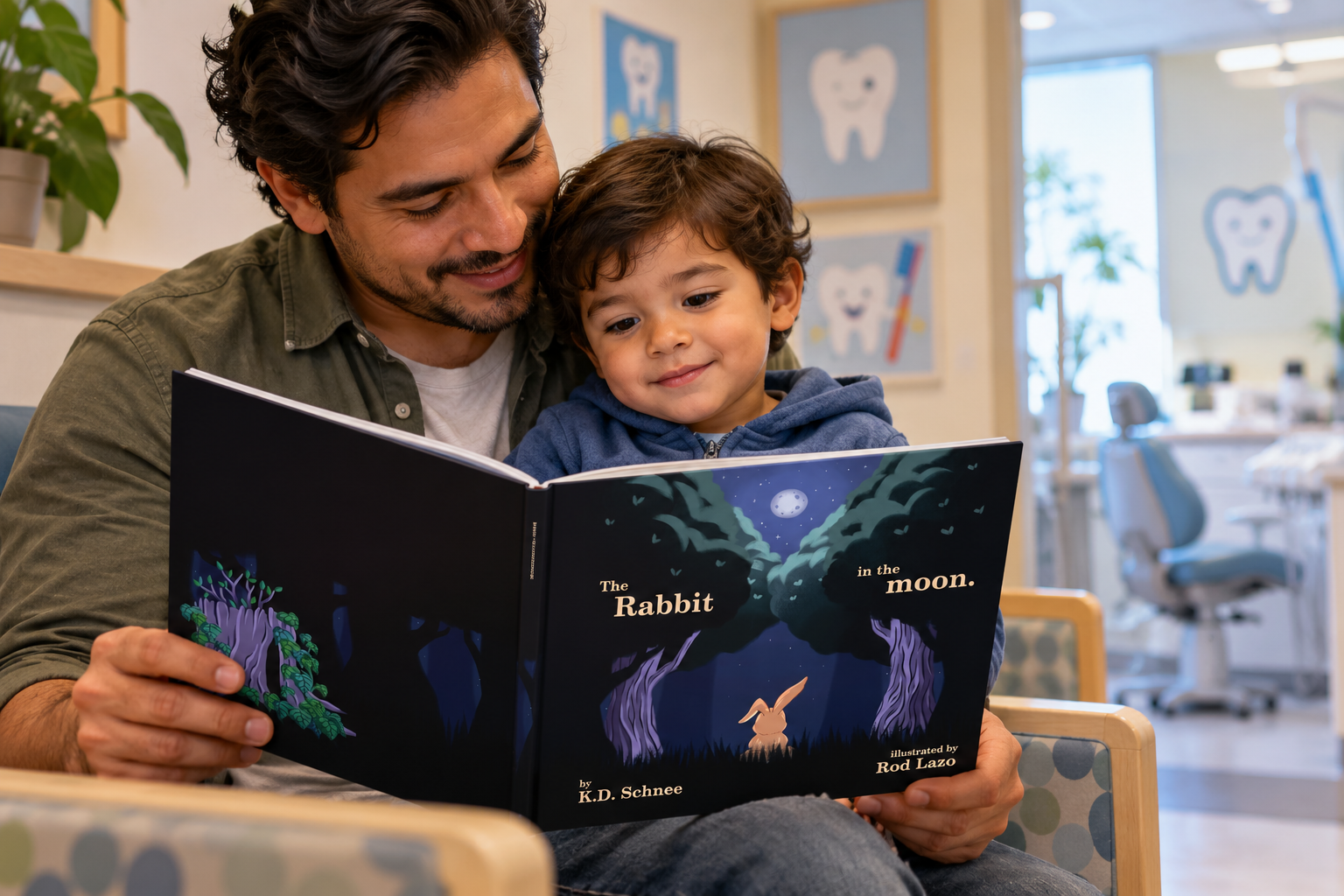
Reading about dental and medical experiences before an appointment can help toddlers preview unfamiliar people, places, and routines while they are still in a calm environment.
When a Previous Dental or Medical Experience Is Part of the Fear
Preparation may need to look different if your child has already had an upsetting healthcare experience.
A toddler may not have the language to explain why an office feels frightening. They may remember the emotional experience more clearly than the details, particularly if they have experienced painful treatment, an emergency visit, hospitalization, or another situation where they felt overwhelmed.
Tell the dental office about that history before the appointment. The AAPD recommends that previous behavior during dental treatment, temperament, medical history, and previous behavior-guidance experiences be considered when planning care.
This is also a situation where parents should be cautious about treating every fear as something they can resolve with enough practice at home. Sometimes the most helpful thing you can do is give the dental team accurate information and allow trained professionals to build an appropriate plan.
What About Toddlers With Sensory Sensitivities?
Dental offices can be unusually demanding sensory environments. Bright lights, reclining, gloves, tastes, smells, vibration, suction, unfamiliar textures, and sounds may all happen within a small physical space. If you already know that your child is sensitive to light, sound, touch, taste, or changes in body position, tell the office beforehand rather than waiting to see whether the problem appears.
The AAPD recognizes sensory-adapted dental environments among the behavior-guidance options that may be considered for anxious patients and children with special healthcare needs. Research reviewed by the organization also found benefits from some sensory-adapted approaches for children with special healthcare needs, although the best strategy depends on the individual child. AAPD
Ask what the practice can reasonably accommodate. The answer may influence whether that office is a good fit for your child.
Why The Rabbit in the Moon Can Help With the Moment Before the Dentist
The Rabbit in the Moon is not a book about dentistry, and I would not present it as one. Its connection to a dental appointment happens before anyone counts a tooth.
Yabbit knows what it feels like to want to move forward and then hesitate when the journey becomes real. He does not solve the problem by becoming fearless. Snail remains steady beside him while Yabbit discovers that he can keep moving without having to feel completely ready first.
That is often the emotional position of an anxious toddler before an unfamiliar appointment. The child may not need another explanation of teeth. They may need a way to understand that nervousness and movement can happen together.
A parent can use the language of the story gently: “Going into the dentist can be one tiny brave hop. I’ll go in with you, and then we’ll find out what the next hop is.” The story does not promise a tear-free appointment. It gives the child a familiar idea to carry into one.
Do Not Measure Success by Whether Your Toddler Was Calm
Parents understandably want the first dental visit to go beautifully because we know there will be many more of them. That can create its own pressure. If success means your toddler walks into the office happily, lies back without protest, opens wide on request, chats pleasantly with the dentist, and leaves waving like the mayor, many perfectly normal toddlers are going to fail this test.
Use a broader definition. Perhaps your child walked into the office after initially refusing. Maybe they sat in the chair but would not recline. Perhaps the dentist counted only a few teeth before the child had enough.
Your dentist will determine whether the necessary clinical care was completed. From the emotional side, however, progress may be much smaller and still matter.
A first visit can simply be the beginning of learning what dental care feels like.
Buy The Rabbit in the Moon
If your child often wants to move forward but hesitates when a new experience becomes real, The Rabbit in the Moon was written for that emotional space. Yabbit worries about the journey ahead, while Snail brings the steadiness and persistence that help him keep moving. The story does not tell children that fear is silly or require Yabbit to become fearless before he can make progress.
For an anxious toddler facing the dentist, that idea can give families useful language before the appointment. You are not asking the child to conquer the entire visit in advance. You are helping them discover the first manageable step and staying close enough that they do not have to take it alone.
Frequently Asked Questions About Toddlers and Dentist Anxiety
How far in advance should I tell my toddler about a dentist appointment?
For most toddlers, you do not need to turn the appointment into a weeklong countdown. Give enough advance notice to practice and create familiarity, but keep the conversation proportionate to the event. A few calm conversations, pretend checkups, and picture-book readings are usually more useful than repeatedly reminding the child that the dentist is coming.
What should I tell my toddler before their first dental visit?
Explain the parts they can understand: the dentist will look at and count their teeth, there will be a special chair and light, and you will be nearby. The ADA recommends talking about what will happen and practicing opening the mouth before the visit. MouthHealthy
What if my toddler cries through the dental appointment?
Crying does not automatically mean the appointment was harmful or that preparation failed. Toddlers often express fear, frustration, and sensory overload through crying. Stay calm and let the dentist determine what care can safely and appropriately continue.
Should I promise my toddler that the dentist will not hurt?
Avoid promises you cannot guarantee. If the appointment is expected to be a simple examination, describe what you know rather than introducing frightening possibilities. If a procedure is planned, ask the dental office how they recommend explaining it so your language remains honest and age appropriate.
Is a pediatric dentist better for an anxious toddler?
Pediatric dentists receive specialized training in caring for children, including behavior guidance, but individual practices and children vary. Whether you choose a pediatric or family dentist, look for a provider who is comfortable treating toddlers, communicates clearly with parents, and is willing to adapt the approach to your child when appropriate.
Can I stay with my toddler during the dental visit?
Policies vary by practice and procedure. AAPD behavior guidance recognizes parental presence or absence as something that may be considered depending on the child, parent, dentist, and clinical situation. Ask the office ahead of time so you know what to expect rather than discovering the policy in the treatment room. AAPD
Can picture books really help a toddler who is afraid of the dentist?
They can help make an unfamiliar experience more predictable and give children language or images for what they are going to encounter. The ADA specifically suggests books or videos about dental visits as one way to prepare young children, although stories should support preparation rather than being expected to eliminate anxiety completely. MouthHealthy
Final Thought
Preparing an anxious toddler for the dentist is not an exercise in talking them out of fear. The unfamiliar may still feel unfamiliar when you arrive, and even a well-prepared child may decide that reclining under a bright light while somebody counts their teeth is not how they hoped to spend Tuesday morning.
What preparation can do is reduce the number of surprises. Your child has seen the chair, practiced opening their mouth, heard what the dentist is going to do, played through the sequence with a stuffed animal, and learned that you will still be there when something feels strange.
That creates a different kind of courage from the cheerful, fearless version adults sometimes imagine. The child is allowed to be nervous while discovering that they can move through an unfamiliar experience with support.
For a toddler, that is more than enough bravery for one appointment.
Authoritative external resources: The American Dental Association provides practical guidance for preparing young children for first dental visits, including practicing at home and considering appointment timing.
The American Academy of Pediatric Dentistry provides the more detailed professional framework behind individualized behavior guidance for anxious children.
AAPD: Behavior Guidance for the Pediatric Dental Patient