
Recurring stomachaches before school can sometimes accompany anxiety, but physical pain should be taken seriously rather than automatically blamed on nerves. Patterns over time can help parents and pediatricians understand what may be happening.
The backpack is packed, breakfast is over, and five minutes before everyone needs to leave, your child says the familiar words: “My tummy hurts.” If this happens once, you probably assume they ate too quickly or picked up a bug. When it happens again on Tuesday, disappears over the weekend, and returns Sunday night or Monday morning, a different question begins to form.
Could anxiety actually be making their stomach hurt? It can, but that does not mean parents should assume every school-morning stomachache is psychological.
Abdominal pain in children has many possible causes, and recurring symptoms deserve to be taken seriously. At the same time, the connection between the brain and digestive system is very real, which means fear, stress, and anticipation can sometimes produce genuine physical discomfort.
That middle ground matters. A child may not be pretending to feel sick, and they may not have a stomach illness either. Their body may be expressing distress before they have the words to explain what feels difficult about school.
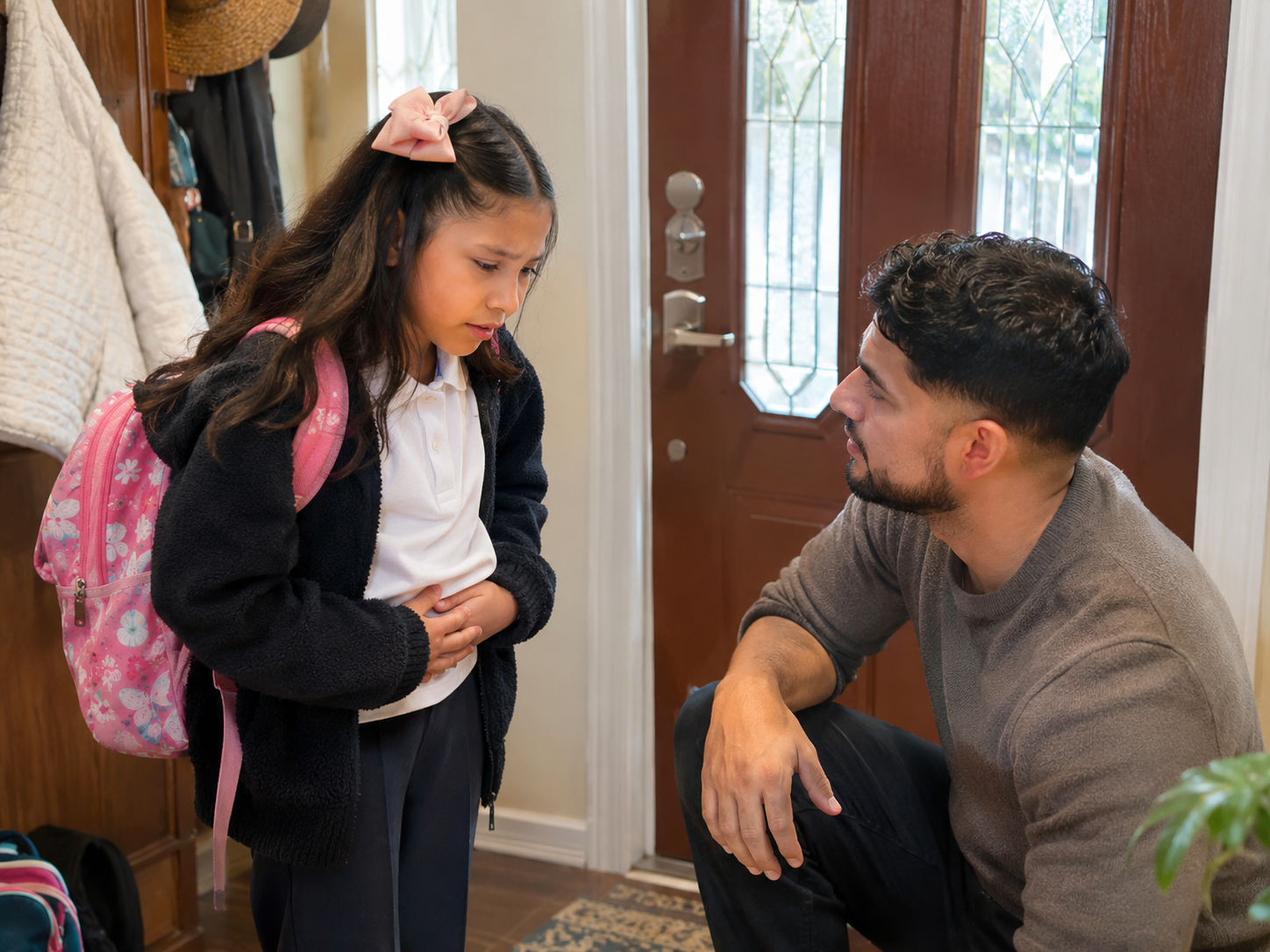
A stomachache that repeatedly appears before school can be useful information, especially when the child also shows worry, avoidance, or difficulty separating.
Quick Answer: Can Anxiety Really Cause Stomachaches in Children?
Yes. Anxiety and emotional stress can produce very real physical symptoms, including stomach pain, nausea, headaches, dizziness, and the feeling that a child urgently needs the bathroom. The American Academy of Pediatrics explains that emotional stress can sometimes be associated with recurrent abdominal pain and that the brain and digestive system communicate constantly through what doctors describe as the gut-brain interaction.
That does not make the pain imaginary. The child's stomach really can hurt even when a medical examination does not reveal an infection or another obvious physical cause. The important word is can.
A stomachache before school should not automatically be labeled anxiety. Constipation, infection, food intolerance, reflux, gastrointestinal conditions, and many other physical problems can also cause abdominal pain. When symptoms are recurring, severe, unusual, or accompanied by other concerning signs, the child's pediatrician should help determine what is going on.
The Timing of the Stomachache Can Tell You Something
Parents often begin noticing a pattern before they understand what it means. The child wakes up saying their stomach hurts on Monday but eats normally on Saturday.
The pain appears before school, improves once the child is allowed to stay home, or fades after they arrive and settle into the classroom. Symptoms may become stronger after vacation, illness, a difficult school experience, or a change in teacher or classmates.
HealthyChildren.org notes that children with school avoidance can experience stomachaches, headaches, nausea, dizziness, and other symptoms that tend to occur on school days and may be absent on weekends. That pattern does not prove anxiety. It does, however, give parents and pediatricians useful information. Instead of focusing only on whether the stomach hurts, begin noticing when it hurts, what happens immediately beforehand, what makes it better, and whether the same pattern appears around other stressful situations.
A Nervous Stomach Does Not Mean Your Child Is Faking
One of the most damaging responses to recurring stomachaches is telling a child, “There's nothing wrong with you.” The adult may mean that the doctor did not find a physical illness. The child may hear something very different: “The pain you feel is not real.”
Physical symptoms associated with emotional distress are genuine sensations. Children can experience butterflies, nausea, cramping, urgent bathroom trips, headaches, muscle tension, and changes in appetite when they are nervous or stressed. The fact that a symptom is influenced by emotion does not make it pretend.
Parents can hold two ideas at once: “I believe your stomach hurts” and “we are still trying to understand why it hurts.” That response creates a much better starting point than debating whether the child is sick enough to deserve sympathy.
Why the Stomach Responds to Stress
The brain and digestive system are in constant communication. Anyone who has ever felt butterflies before speaking in public or lost their appetite before an important event has experienced a mild version of that relationship.
Children experience it too, but they may not yet understand the connection between what they are thinking and what their body is doing. A child may genuinely believe the problem begins and ends with their stomach because the physical sensation is much easier to identify than the worry underneath it.
The American Academy of Pediatrics describes functional abdominal pain disorders as disorders of gut-brain interaction. These conditions can involve recurring abdominal pain even when there is no single structural explanation for the symptoms, and stress can be one of several factors associated with the problem.
That is more complicated than saying, “Your child is nervous, so their stomach hurts.” The gut-brain relationship involves biological processes, and persistent abdominal pain deserves proper medical evaluation rather than an amateur diagnosis at the breakfast table.
Ask What Happens Before the Tummy Starts Hurting
When the pattern seems connected to school, try moving the conversation away from the stomach for a moment. Instead of repeatedly asking, “Does it still hurt?” explore what the child is expecting from the day ahead.
You might ask whether anything feels different at school today, whether there is a test, presentation, substitute teacher, playground problem, difficult class, bathroom concern, or separation that feels harder than usual. A younger child may respond better when you offer possibilities rather than asking the enormous question, “Why are you anxious?”
Do this during a calm time whenever possible. A child who is already clutching their stomach while everyone waits by the door may not have enough emotional space to analyze the entire school day. The conversation may be much more productive after school, during dinner, while drawing, or before the next difficult morning arrives.
School Anxiety Is Not Always About Schoolwork
Adults sometimes assume that anxiety about school must mean academic pressure. For some children, it does. A child who struggles with reading, worries about getting an answer wrong, or fears being called on may begin associating school with repeated embarrassment or uncertainty.
Other children are worried about separation. Some are navigating friendship problems, bullying, lunch, recess, bathrooms, loud environments, sensory discomfort, or a teacher relationship that feels difficult.
A child may even feel anxious about something seemingly small, such as not knowing where to put their backpack after a schedule change. The stomachache tells you that something may feel difficult. It does not tell you what that something is. That part still requires curiosity.
Do Not Turn Every Stomachache Into a Debate About School Attendance
When the same complaint appears repeatedly, families can fall into a predictable argument. The child says their stomach hurts. The parent says they went to the doctor and nothing is wrong.
The child insists the pain is real. The parent points out that it disappeared last Saturday. Eventually, everyone is arguing about whether the child is sick instead of talking about what school feels like.
You do not need to prove that anxiety is responsible before responding calmly. You might say, “I believe that your stomach hurts. We also know this has been happening mostly before school, so I want us to understand what your body may be telling us.” That sentence validates the symptom without immediately agreeing that staying home is the only solution.
When school refusal is becoming part of the pattern, see Child Refuses to Go to School? How to Handle School Morning Anxiety Without a Power Struggle: https://www.yabbitrabbit.com/parent-resources/big-transitions-what-to-say-when-child-wont-go
Keeping a Simple Pattern Log Can Help
Parents do not need to create a medical spreadsheet worthy of a research hospital. A few simple notes can reveal more than memory alone. Record when the stomachache starts, how long it lasts, whether it occurs on weekends, what the child ate, whether there were bowel changes, whether school was missed, and what was happening that day.
You might discover that symptoms consistently appear before math, Monday drop-off, tests, presentations, or time with a particular group of children. You might instead discover that the pain is completely unrelated to school and follows meals or bowel patterns. Either result is useful.
The purpose of tracking is not to prove that the symptom is psychological. It is to give the pediatrician a clearer picture of when and how the problem occurs.
Buy The Rabbit in the Moon
The Rabbit in the Moon is not a treatment for stomach pain or childhood anxiety, and it should never be used to tell a child that they simply need to be braver and go to school. Its connection to this experience is more specific.
Yabbit understands the moment when something feels larger from the inside than it appears to everyone else. He hesitates before taking the next step, and Snail's steady presence helps him move forward without requiring the uncertainty to disappear first.
For a child whose school worry shows up as hesitation, avoidance, or difficulty beginning the day, Yabbit can give families another way to talk about what is happening. A parent can wonder what feels big to Yabbit without immediately demanding that the child explain why their own stomach hurts. Sometimes that emotional distance makes a conversation easier.
What Should You Do on a Morning When Your Child Says Their Stomach Hurts?
Start by taking the symptom seriously rather than immediately deciding whether it is “real.” If the child has a fever, vomiting, diarrhea, severe pain, appears unusually ill, or has another medical concern, respond as you would to any physical illness and contact the pediatrician when appropriate. If your child has already been medically evaluated and you are seeing a familiar pattern of school-morning discomfort, keep the morning as calm and predictable as possible.
You can acknowledge the pain without conducting an hour-long investigation at the door. Something such as, “I know your stomach feels uncomfortable. We have talked with the doctor, and we are going to keep watching it. Right now let's get ready one step at a time,” validates the child's experience while preserving the routine. The exact attendance plan will depend on your child's health and the guidance you receive from their pediatrician and school.
Staying Home Can Bring Relief, Which Can Complicate the Pattern
If school is contributing to anxiety, staying home often makes the child feel better quickly. That relief makes perfect sense. The difficult situation has disappeared.
The complication is that avoidance can become increasingly appealing when it reliably removes the discomfort. A child may begin learning that a stomachache leads to staying home, staying home makes the anxious feeling disappear, and therefore avoiding school is the safest response when the same sensation returns.
This does not mean the child is manipulating anyone. It means the family may need professional guidance for breaking the cycle while still taking the physical symptoms seriously.
The goal should not be to force a sick child into school. It should be to distinguish illness from an anxiety-and-avoidance pattern carefully enough that neither problem is ignored.
Look for the Pattern Behind the Pattern
The stomachache itself may only be the first clue. Notice whether the child also becomes unusually clingy, asks repeated questions about school, has trouble sleeping on Sunday nights, becomes irritable while getting dressed, refuses breakfast, moves very slowly in the morning, or starts asking to stay home before mentioning physical symptoms.
A child may also suddenly dislike activities they previously enjoyed or become particularly worried about making mistakes. Those broader patterns can help parents understand whether the stomachache appears alongside a larger anxiety picture. For a broader overview, see Anxiety Symptoms in Children Ages 3–8: What's Typical, What to Watch, and When to Ask for Help: https://www.yabbitrabbit.com/parent-resources/anxiety-symptoms-children-ages-3-8
The purpose is still not to diagnose your child. It is to notice enough of the pattern to know what information is worth bringing to a professional.
Avoid Asking “Does Your Stomach Hurt?” Over and Over
Once parents become worried about a symptom, it is natural to check constantly.
“How's your stomach?”
“Does it still hurt?”
“Does it hurt now?”
“What about now?”
Repeated symptom checking can unintentionally make the stomach the center of the child's attention. The child begins scanning their body for every sensation because adults keep signaling that the sensation is important.
That does not mean ignoring the child. After you have acknowledged the discomfort and checked for anything medically concerning, return attention to ordinary activities when appropriate. Let the child's day contain things other than monitoring their abdomen.
When symptoms change or worsen, reassess. The goal is simply to avoid turning every ordinary sensation into a family emergency.
Help the Child Describe More Than “My Tummy Hurts”
Young children often have limited language for abdominal sensations. A parent can help by gently asking whether the stomach feels tight, crampy, bubbly, nauseated, empty, full, sharp, or uncomfortable. You might also ask where the pain is located and whether anything seems to make it better or worse.
Do not interrogate the child or suggest symptoms they have not reported. The point is to help them become more accurate observers of their own body. That information can be useful to the pediatrician and can also help the child distinguish between different kinds of physical experiences over time.
Emotional language can be developed in the same way. A child may eventually begin noticing, “My tummy gets tight when I think about reading in front of the class,” which is much more useful than being told by an adult, “Your stomach only hurts because you're anxious.”
When the Child Seems Fine the Moment School Is Cancelled
This can be deeply frustrating for parents. Your child looked miserable ten minutes ago, and now that they know they are staying home, they are happily building Lego on the floor.
It is tempting to interpret that transformation as proof that the child was faking. A rapid improvement can also be consistent with anxiety. Once the anticipated stressor disappears, the child's physical arousal may decrease and the stomach discomfort may ease with it.
The important question is not whether the child deserved to feel bad. It is why the same sequence keeps happening. If staying home repeatedly produces dramatic relief, share that observation with the child's pediatrician and school. It may become an important part of understanding the pattern.
Do Not Promise That Nothing Bad Will Happen at School
Parents naturally want to reassure.
“You'll be fine.”
“Nothing is going to happen.”
“There's nothing to worry about.”
Those statements can calm a child briefly, but they also ask the parent to guarantee something nobody can guarantee. School contains mistakes, awkward moments, difficult assignments, disagreements, surprise fire drills, bad lunches, and days when a friend is not particularly friendly.
A more useful message is confidence in the child's ability to handle ordinary uncertainty. You can say, “I don't know exactly what today will be like, but there are adults at school who can help you, and we can handle problems if they come up.” That shifts the goal from creating certainty to developing confidence that uncertainty can be managed.
Picture Books Can Help Without Becoming a Test
A child who regularly feels sick before school may already feel that adults spend a great deal of time discussing their problem. Picture books can offer a gentler route into the subject because the child is not immediately the focus. You can talk about a character who hesitates, worries, makes a mistake, or needs help without stopping after every page to ask, “Is this how you feel at school?”
Sometimes children make the connection themselves. Sometimes they simply enjoy the story, which is valuable too. A book should not become another assignment designed to produce the correct emotional response. The goal is to give the family language and connection, not to make the child prove they are ready for school by the final page.

Reading about worry during a calm moment can give children language for difficult feelings without making a school-morning stomachache the center of every conversation.
When Should You Call the Pediatrician?
Recurring abdominal pain deserves medical attention when you are concerned, particularly when the pattern is new, persistent, severe, or changing. The pediatrician can consider common physical causes and decide whether further evaluation is needed.
Parents should be especially attentive when abdominal pain is accompanied by concerning symptoms such as repeated vomiting, gastrointestinal bleeding, unexplained weight loss, slowed growth, recurrent fever, difficulty swallowing, persistent diarrhea, significant lethargy, or other changes in the child's general health. Those symptoms should not be explained away as anxiety.
Even when the pediatrician believes stress or anxiety may be contributing, that conclusion does not mean the pain is unimportant. Disorders involving the interaction between the gut and brain are genuine medical conditions, and children may need a combination of medical, behavioral, dietary, or psychological support depending on the diagnosis. If the stomachaches are repeatedly interfering with school attendance, friendships, meals, sleep, or normal activities, that level of disruption is itself worth discussing with the pediatrician.
When Anxiety May Need Its Own Support
Sometimes the medical evaluation answers one question but reveals another. The child's gastrointestinal health may be reassuring, yet school mornings remain filled with distress, avoidance, physical discomfort, and fear. That is when parents may need to look more directly at the anxiety itself.
A pediatrician can help determine whether referral to a qualified child mental-health professional would be appropriate. School staff may also provide useful observations about what happens after the child arrives, whether symptoms continue during the day, and whether particular classes, peers, transitions, or expectations appear connected to the problem.
The goal is not simply to make the stomachache disappear. It is to understand what the child's body and behavior are telling you about their overall experience.
An Authoritative Resource for Parents
The American Academy of Pediatrics provides detailed information about recurring abdominal pain and disorders of gut-brain interaction through HealthyChildren.org. The resource explains how brain-gut communication can contribute to genuine physical symptoms while also outlining signs that warrant further medical evaluation.
HealthyChildren.org: Disorders of Gut-Brain Interaction: Functional Abdominal Pain Disorders
This is particularly useful for parents because it avoids the false choice between “physical” and “emotional.” Children's abdominal pain can involve a complicated interaction of physical processes, stress, and other factors, and the pediatrician is the appropriate person to help sort through them.
Frequently Asked Questions About Stomachaches Before School
Can anxiety really make a child's stomach hurt?
Yes. Stress and anxiety can be associated with real abdominal discomfort because the brain and digestive system communicate closely. That does not mean every stomachache is caused by anxiety, so recurring or concerning symptoms should still be evaluated by a pediatrician.
Why does my child's stomach hurt on school days but not weekends?
A school-day pattern can suggest that anticipation, separation, academic stress, peer concerns, or another school-related issue may be contributing. HealthyChildren.org notes that children with school avoidance sometimes experience stomachaches and other physical symptoms primarily on school days, but the pattern alone does not establish a diagnosis.
Is my child faking a stomachache to stay home from school?
Do not assume so. Children can experience genuine physical symptoms when they are anxious, even when no illness is found. A better approach is to take the discomfort seriously while working with the pediatrician and school to understand why the symptoms repeatedly appear.
Should I send my child to school if their stomach hurts from anxiety?
That decision depends on the child's medical condition, the severity of the symptoms, and the plan developed with their pediatrician and school. When anxiety-driven school avoidance has been identified, repeatedly staying home can sometimes strengthen avoidance, but a parent should not ignore genuine illness or severe symptoms in order to maintain attendance.
What should I track if my child keeps complaining about stomach pain?
Keep simple notes about when the pain occurs, how long it lasts, where it hurts, what the child ate, bowel patterns, other symptoms, school attendance, stressful events, and what seems to make the discomfort better or worse. These observations can help the pediatrician see patterns that may not be obvious during a single office visit.
When is a child's stomachache serious enough to call the pediatrician?
Contact your pediatrician when abdominal pain is persistent, recurring, severe, or concerning to you. Symptoms such as repeated vomiting, blood in the stool or gastrointestinal bleeding, unexplained weight loss, slowed growth, recurrent fever, significant diarrhea, swallowing problems, or changes in the child's overall health deserve medical attention rather than being attributed to anxiety.
Can a picture book help a child who gets anxious stomachaches before school?
A picture book cannot treat abdominal pain or an anxiety disorder, but it can help families talk about uncertainty, hesitation, and courage without putting the child immediately under the spotlight. For children whose worry appears before beginning something difficult, Yabbit can offer a familiar character through whom those feelings can be explored more gently.
Final Thought
When a child's stomach hurts before school, parents naturally want a clear answer. Is the child sick? Are they anxious? Are they trying to stay home? Is something happening at school? Should you push forward, keep them home, call the doctor, or simply wait?
Sometimes the answer becomes obvious. Often it does not.
The most useful starting point is to believe what the child is telling you about their body without deciding too quickly what is causing it. Look for patterns, ask curious questions when the child is calm, involve the pediatrician when symptoms recur, and pay attention to what may be happening at school as well as what is happening in the stomach.
A nervous stomach is not imaginary, and a physical symptom does not automatically mean a child is physically ill. Children's bodies and emotions are in conversation with each other all day long.
Parents do not need to decode that conversation perfectly on the first morning. They only need to listen carefully enough to know when the pattern is asking for a closer look.