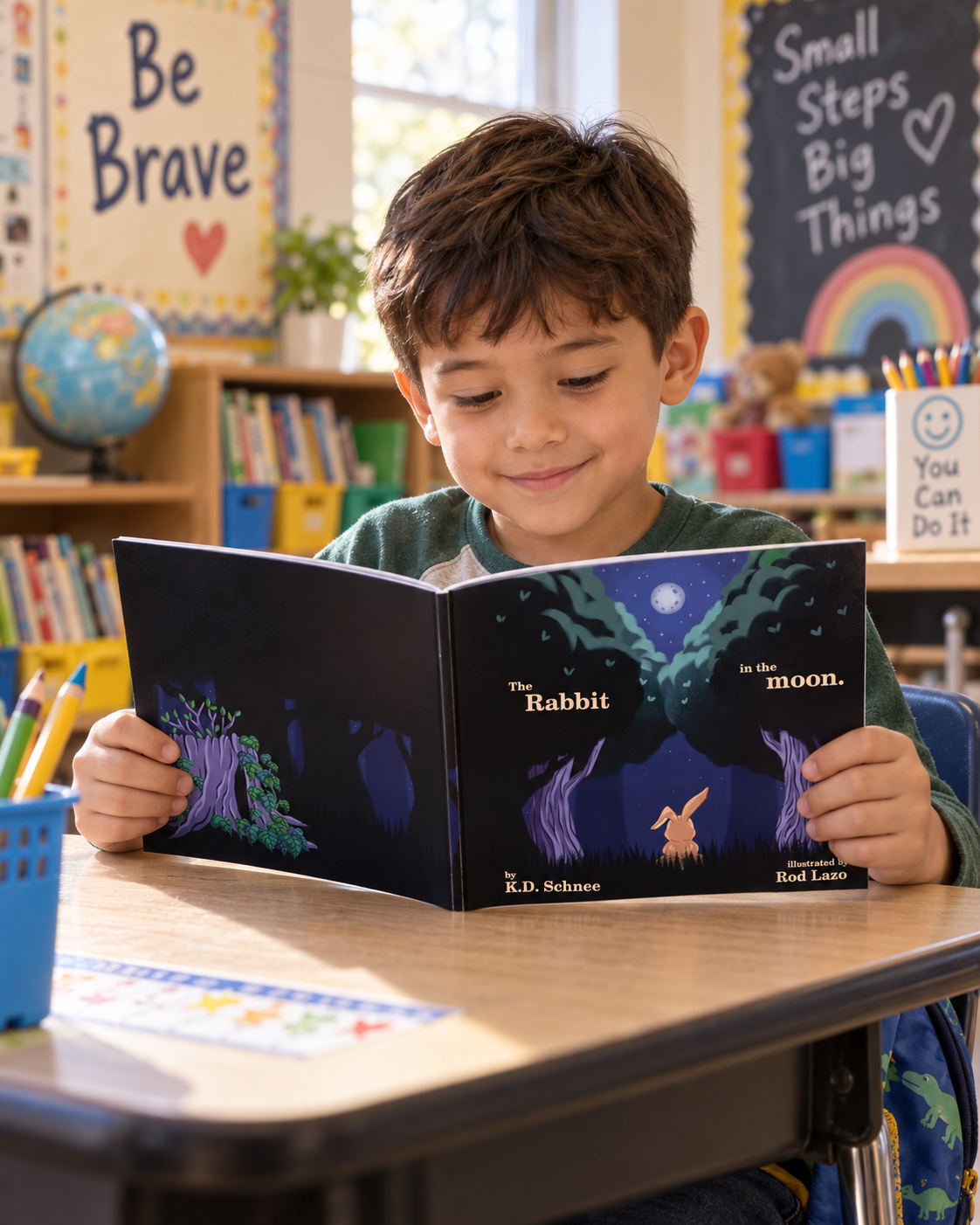
Picture books about courage for kids can help children build bravery, confidence, resilience, and the courage to take one small brave step forward.
When parents go looking for picture books about courage for kids, they are rarely searching for a lesson in bravery. Usually, there is a specific child behind the search. It may be a child standing outside the classroom door who suddenly does not want to go in, a child watching the other kids climb while insisting they would rather stay on the ground, or a child who wants to join the game but cannot quite make their feet move toward it.
Adults tend to recognize courage after something impressive has happened. Children often meet it much earlier, in the uncomfortable space between wanting to do something and actually beginning. That is why I am particular about books that call themselves stories about bravery. Children do not need twenty different characters telling them not to be scared. They need stories that understand fear, embarrassment, uncertainty, mistakes, disappointment, and hesitation well enough to show what courage looks like inside those feelings.
The best courage books do not create fearless children. They help children discover that fear does not always get the final vote.
What Are the Best Picture Books About Courage for Kids?
There is no single best courage book because children do not all get stuck in the same place. Jabari Jumps is wonderful for the child standing at the edge of something they genuinely want to try. After the Fall speaks to the child who already tried, got hurt or embarrassed, and now has to decide whether to return. The Day You Begin understands the courage required to enter a room where you feel different, while The Dot is for the child whose fear of doing something badly prevents them from beginning at all.
The Rabbit in the Moon belongs to a different kind of moment. It is about the pause before the first step, when a child wants to move forward but the thing ahead has suddenly become too large. That distinction matters because I would rather help a parent find the right book for the child in front of them than pretend every story about bravery serves the same purpose.
A good courage bookshelf should have range. Childhood asks for courage in too many different ways for one definition to cover them all.
What Courage Actually Looks Like in Childhood
Ask an adult to picture courage and we tend to make the scene too large. We imagine danger, sacrifice, or someone charging forward while everybody else backs away. Ask a child to practice courage, however, and the scene may be a birthday party, a swimming lesson, a spelling word, or saying hello to three children who already seem to know one another.
A five-year-old may need courage to stay at a party after a parent leaves. A seven-year-old may need it to admit that they do not understand the assignment. Another child may happily race down a ski hill and then freeze when asked to read four sentences aloud. Children rarely fit neatly into our categories, and a child who is bold in one part of life can be deeply hesitant in another.
That is one reason I do not particularly like calling a child “brave” or “not brave.” Courage is much more useful when we treat it as something a child does rather than something a child is. A child can be nervous and still do something courageous. They can need help and still be brave. They can cry, change their mind, try tomorrow, or take a smaller step than the adults around them expected.
Once courage stops being a personality test, children have much more room to practice it.
What Makes a Courage Book Useful?
The first test is simple: the book has to work as a story. Children can spot a lecture hiding inside a picture book surprisingly quickly, and if every character and plot point exists only to deliver the lesson adults want the child to learn, the book may be worthy without ever becoming loved.
After that, I look at how the story treats the difficult feeling. Does the character get to be scared without being ridiculed? Does the hesitation make sense? Does somebody offer support without taking over? Most importantly, does courage happen through an action a real child could imagine taking?
I am also wary of books that make bravery look too easy. A character worries for three pages, receives a pep talk, and suddenly charges toward the thing they feared. Real children are often more complicated than that. They may approach, retreat, watch someone else, ask a question, try one piece, change their mind, and come back later. That is still movement.
If your child is dealing specifically with fear, rather than the broader question of courage, I would start with my guide to picture books about overcoming fear. The books below cast a wider net and include fear, but they also explore mistakes, identity, belonging, persistence, self-expression, asking for help, and the courage to begin.
20 Picture Books About Courage for Kids
I chose these books because they show children different versions of courage rather than repeating the same message twenty times. Some are about beginning. Others are about recovering, speaking up, trying again, handling change, or remaining yourself when fitting in would be easier.
1. The Rabbit in the Moon by KD Schnee
I am putting my own book first, so I should also be clear about why. The Rabbit in the Moon was not written to teach every kind of courage. It was written around one I know very well: the courage to begin when hesitation has taken over.
Yabbit agrees to help Snail, but once the size of the journey becomes real, all the reasons not to go begin arriving. There is a particular kind of child who understands that shift immediately. The sleepover sounds exciting on Tuesday, the soccer team sounds fun during registration, and the school play sounds wonderful until auditions begin. Then the moment arrives and the idea no longer feels safely hypothetical.
That child is not necessarily being difficult. The distance between imagining something and beginning it can feel enormous. Yabbit does not solve that problem by becoming a different rabbit. He hesitates, receives support, and starts moving, which is exactly the idea I wanted children to carry out of the story.
Courage does not always arrive as a leap. Sometimes it is one tiny brave hop.
2. Courage by Bernard Waber
If you want a book that expands a child’s definition of courage, Bernard Waber’s Courage remains difficult to beat. What I like about it is the way it refuses to reserve bravery for extraordinary people or dramatic moments. Courage appears in ordinary choices and everyday situations, which is much closer to a child’s actual life.
That also gives parents a useful way to talk afterward. Instead of asking, “Are you brave?” you can begin noticing moments when courage showed up: “That took courage.” One asks a child to prove something about themselves, while the other helps them recognize something they already did.
3. Jabari Jumps by Gaia Cornwall
Jabari is ready to jump off the diving board, at least until he has to climb it. That small shift is what makes the story so effective. The fear arrives when Jabari can see the height, feel the ladder underneath him, and understand exactly what comes next.
His father does not shame him or turn the moment into a referendum on bravery. He stays close and gives Jabari enough room to find his own way toward the jump. For children who badly want to do something but become nervous as the moment approaches, Jabari Jumps gets the emotional timing right.
Wanting to try and being afraid to try can exist at exactly the same time.
4. The Thing Lou Couldn't Do by Ashley Spires
Lou’s friends want to climb a tree, but Lou has never climbed one before. What follows will be familiar to anyone who has watched a child realize they may not immediately be good at something. Suddenly there are many excellent reasons why climbing is unnecessary, inconvenient, or not especially interesting after all.
The excuses are funny because they are recognizable. Avoidance often arrives sounding perfectly reasonable. This makes the book especially useful for children who protect themselves from failure by deciding not to participate in the first place.
Lou does not need a speech about self-esteem. She needs enough room to discover that “I can’t do that” and “I can’t do that yet” are not the same sentence.
5. Brave Irene by William Steig
Brave Irene gives children a more traditional adventure. Irene sets out through terrible weather to deliver a gown for her sick mother, and the journey asks more of her than she expected.
What holds up beautifully is Irene’s determination. There are times when courage means beginning, but there are also times when it means continuing after the beginning has become uncomfortable, inconvenient, or far harder than expected. Children understand that kind of courage too.
It is one thing to start the hike. It is another to keep walking once you are tired.
6. After the Fall by Dan Santat
I recommend After the Fall often because it begins where most bravery stories would end. Humpty Dumpty has already fallen, and although he has been put back together, the experience has not disappeared. Heights now frighten him.
That matters because adults sometimes assume that once the scraped knee heals, the embarrassing moment passes, or the tears stop, the child should be ready to go again. Not always. A child who fell off a bike may remember the fall the next time the helmet goes on, and a child who froze during a recital may feel it again when somebody mentions the next performance.
Courage after something has gone wrong is different from courage before anything has happened, and Santat understands that difference extremely well.
7. The Most Magnificent Thing by Ashley Spires
Some children are not afraid to begin. Their difficulty arrives when the thing they make does not look right. The Most Magnificent Thing is one of my favorite books for children whose frustration rises quickly when their current abilities cannot yet match what they can imagine.
The girl in the story knows what she wants to create, but knowing is not the same as making. Anyone who has watched a child crumple a drawing because one line went wrong understands how painful that gap can feel.
The courage here is quiet but important. It is the willingness to stay with something imperfect long enough to see another possibility.
8. The Dot by Peter H. Reynolds
“I can’t draw” is a small sentence with an impressive ability to stop everything. Vashti’s teacher does not answer it with a long speech about believing in herself. She simply asks her to make a mark.
That tiny beginning is why the book has lasted. Children are often told that confidence will help them act, but The Dotquietly reverses the order. Sometimes the action comes first and confidence has to catch up.
For a child who is afraid of doing something badly, one mark can be a more useful beginning than ten minutes of encouragement.
9. The Magical Yet by Angela DiTerlizzi, illustrated by Lorena Alvarez Gómez
Adults use the word “yet” so often in growth-mindset conversations that it can start to sound like something printed on a classroom poster. This book gives the word some life back.
There is a meaningful difference between “I can’t do this” and “I can’t do this yet.” The second sentence does not guarantee success, but it refuses to declare the story finished too early. That is useful for children learning to read, ride, swim, draw, catch, write, climb, speak in front of people, or do any of the hundred things childhood asks them to be bad at before they become better.
Learning requires a certain tolerance for not being good yet, and that tolerance often requires courage.
10. Rosie Revere, Engineer by Andrea Beaty, illustrated by David Roberts
Rosie makes things, which means that sooner or later Rosie also makes things that do not work. This is where the book earns its place on a courage list.
Children who love inventing eventually discover that imagination is much tidier in the head than it is once cardboard, tape, gravity, and real-world materials get involved. Towers fall, tape fails, and the marvelous thing in the imagination comes out crooked.
Rosie’s story helps separate a failed attempt from a failed child. I would put this book in front of any young maker who says, “It didn’t work,” with the finality of someone shutting down a factory forever.
11. The Day You Begin by Jacqueline Woodson, illustrated by Rafael López
There is physical courage, and then there is walking into a room where you are convinced everyone else belongs more than you do. The Day You Begin understands the second kind beautifully.
Children can feel different because of language, food, family, money, culture, appearance, experience, temperament, or for reasons they cannot fully explain. Sometimes everybody else simply seems to know the rules already.
The book does not pretend that feeling disappears because somebody says, “Just be yourself.” Connection begins more modestly, through sharing, listening, and the possibility that another person may meet you somewhere in the middle.
12. The Proudest Blue by Ibtihaj Muhammad with S. K. Ali, illustrated by Hatem Aly
Faizah watches her older sister Asiya wear her hijab to school and also watches how other children react to it. The story broadens a courage bookshelf in an important way because not every story about bravery should be about conquering a private fear.
Children also need stories about holding onto something meaningful when other people make that harder. There is courage in trying something new, but there is also courage in refusing to become smaller because somebody else does not understand you.
That is a very different kind of bravery, and children benefit from seeing it represented.
13. The Name Jar by Yangsook Choi
Unhei is new to school and begins wondering whether her Korean name will be too difficult for her classmates. The premise is quiet, but the question underneath it is not.
How much of yourself should you change to make belonging easier? Children begin negotiating versions of that question earlier than adults sometimes realize. Names, lunches, accents, clothes, family traditions, and interests can all become places where children feel pressure to blend in.
The Name Jar gives children a thoughtful way to explore belonging without treating sameness as the price of admission.
14. A Bad Case of Stripes by David Shannon
Camilla Cream loves lima beans, but she is worried that other people will find that unacceptable. Then she breaks out in stripes, and the book becomes wonderfully strange.
That strangeness is part of why the message works. Shannon never needs to stop the story for a lecture on peer pressure because the anxiety becomes visible in increasingly absurd ways.
Early elementary children are remarkably alert to what everybody else likes, wears, watches, eats, and talks about. Sometimes courage is as simple as admitting you like the lima beans.
15. The Smallest Girl in the Smallest Grade by Justin Roberts, illustrated by Christian Robinson
Sally notices what other people miss. She sees the pushing, teasing, and small cruelties taking place around her, and eventually she decides that noticing is not enough.
A conversation about courage is incomplete without moral courage. Standing up for someone else is not the same skill as climbing the diving board, but it may require just as much bravery because the risk is social rather than physical.
The child who speaks up may not be the biggest, loudest, or most confident person in the room. Sometimes courage begins with simply being the one who noticed.
16. I Am Courage by Susan Verde, illustrated by Peter H. Reynolds
Some books show courage through a particular character and story, while I Am Courage names the idea more directly. That makes it useful in a different way.
The book explores trying, speaking up, asking for help, getting back up, and moving forward. I would pair it with a more narrative courage book rather than expect it to do the same job.
Children benefit from both approaches. A story allows them to recognize courage in someone else, while a more direct book can help them find the language for what they have already seen.
17. Tomorrow I'll Be Brave by Jessica Hische
I like that this book contains the word “tomorrow.” Childhood development would be much easier if every child were ready at precisely the moment an adult decided they ought to be, but children rarely cooperate with that schedule.
Tomorrow I'll Be Brave leaves room for becoming. It explores bravery alongside curiosity, creativity, confidence, and other qualities children are still figuring out. There is something generous about telling a child that growth can continue tomorrow.
Courage matters, but it should not become another performance children are afraid of failing.
18. The Koala Who Could by Rachel Bright, illustrated by Jim Field
Kevin likes things the way they are, which will make him familiar to many parents. The temptation with a child who resists change is to focus only on the resistance and ask why every new experience requires such a negotiation.
Predictability serves a purpose, though. Familiar things feel safer because the child already knows what happens next. The Koala Who Could understands that before it asks Kevin to change.
That order matters. Children are far more open to a story’s invitation when they do not feel the story has spent the first half judging them.
19. What Do You Do With a Problem? by Kobi Yamada, illustrated by Mae Besom
Some problems shrink when we look at them closely, while others remain difficult. Either way, very few become clearer while we are running in the opposite direction.
What Do You Do With a Problem? gives shape to avoidance and to the strange way a problem in the imagination can begin occupying more space than the problem itself. I like the book especially for older children because they are beginning to understand that facing something does not mean magically fixing it.
Sometimes facing a problem simply means getting close enough to understand what it actually is.
20. The Rabbit Listened by Cori Doerrfeld
This may be the least obvious courage book on the list, which is one reason I wanted it here. Something terrible happens to Taylor’s block structure, and one animal after another arrives with an opinion about what Taylor should do next.
The rabbit listens.
We tend to praise children for bravery when they push through, bounce back, or try again. Those things can require courage, but so can admitting that something hurt, crying, saying you are not ready, or letting another person stay beside you without fixing anything.
If courage only counts when a child moves quickly past difficult feelings, our definition is too narrow.
Which Courage Book Is Right for Your Child?
I would choose by the moment your child gets stuck, not by the word “courage” on the cover or in the book description. If the difficulty comes before the first step, start with The Rabbit in the Moon, Jabari Jumps, The Thing Lou Couldn't Do, or The Dot. Those books understand that the beginning itself can be the hardest part.
If your child starts easily but struggles when something goes wrong, try The Most Magnificent Thing, Rosie Revere, Engineer, The Magical Yet, or After the Fall. Those stories give mistakes and setbacks somewhere productive to go instead of treating them as evidence that the child should stop.
For a child dealing with change, The Koala Who Could may feel familiar. For belonging and social courage, I would look at The Day You Begin, The Name Jar, The Proudest Blue, and A Bad Case of Stripes. If speaking up is the issue, The Smallest Girl in the Smallest Grade gives courage another shape entirely.
The closer the book comes to the child’s actual experience, the less explaining you will have to do afterward. That is usually a good sign.
Courage Is Not the Same as Confidence
Parents often use courage and confidence interchangeably, but I think separating them is useful. Confidence says, “I think I can do this.” Courage becomes most important when the child is not so sure.
A child may have very little confidence about a new experience and still be willing to take one small step toward it. That first swim lesson can create confidence for the second. Saying hello once can make tomorrow’s hello easier. Reading one sentence aloud can change how the next sentence feels.
In other words, courage sometimes has to go first.
This is also why encouragement can backfire when it gets too big. “You’ve got this!” sounds supportive to an adult, but to a child who is quite certain they do not, it can feel like one more expectation to meet. Smaller language is often more useful: “I’ll stay with you,” “You can watch first,” or “Let’s find the first part.”
Those sentences leave room for the child’s real feeling while still keeping the door open.
Why Small Courage Matters
I grew up as a child who could hesitate, and that experience eventually became part of Yabbit. What stays with me now, both as a children’s author and as someone who spends a great deal of time thinking about these stories, is how easy it is for adults to mistake the size of a child’s action for the size of the courage required to take it.
Walking ten feet into a classroom does not look dramatic to an adult. Neither does touching the water, raising a hand, or standing close enough to watch the other children play. We are looking at the distance from the outside, while the child is feeling it from the inside.
That is the thinking behind the Tiny Brave Hop Method. When the whole challenge feels too large, I would rather help a child find a smaller beginning than spend ten minutes trying to convince them the challenge is not scary.
The first step might be standing beside the group before joining it, putting your feet in the pool before swimming, opening the workbook before solving the problem, or walking to the classroom door before worrying about the entire day. Small does not mean meaningless. Sometimes small is exactly what makes movement possible.
Why The Rabbit in the Moon Belongs on a Courage Bookshelf
I do not think The Rabbit in the Moon is the right book for every problem involving courage, and I think it is important to say that clearly. I would not choose it first for a child dealing with bullying because there are books that address speaking up much more directly. If a child is struggling with cultural identity or feeling different at school, The Proudest Blue, The Name Jar, or The Day You Begin may meet that moment better.
If the wound came from a previous failure, I might hand you After the Fall. That is part of being useful to parents. My book does not need to win every category in order to have a strong reason to exist.
I know exactly where Yabbit belongs. He belongs with the child who wants to do something and cannot quite cross the distance between wanting and starting. That child may say, “I don’t want to.” They may bargain, delay, or produce an astonishing number of reasons why tomorrow would be better. Sometimes they may say nothing at all.
From the outside, adults see resistance. Inside, the child may be staring at a first step that has somehow grown to the size of the moon.
Yabbit knows that feeling. Snail does not shame him for it, but he also does not let hesitation write the end of the story. Together, they keep moving.
That is the kind of courage The Rabbit in the Moon was written to give children: not the command to be fearless, but permission to begin before they feel completely ready.
How to Read a Courage Book Without Turning It Into a Lesson
Adults who purchase a book because it addresses a particular problem can become very efficient at turning storytime into a seminar. Children notice. You do not need to stop every few pages and ask what the character is feeling, and you certainly do not need to close Jabari Jumps the night before swim lessons and announce, “See? Just like you.”
Give the story some room first. Let your child laugh, interrupt, study the illustrations, disagree with a character, or decide that a part you considered important was not especially interesting. Let the book belong to them before asking it to help you.
If you want to talk afterward, one thoughtful question is enough. I like, “Where do you think the brave part was?” because there may be more than one good answer. Perhaps the brave part was climbing the ladder. Perhaps it was admitting you were nervous, going back after failing, or asking somebody to stay.
Later, when real life serves up a similar moment, the story gives you shorthand. “This feels a little like Jabari’s ladder” or “What would Yabbit’s tiny brave hop be here?” can be far more effective than a speech because the language already belongs to a story the child understands.
That is when a courage book becomes more than a story about somebody else.
Buy The Rabbit in the Moon
If you have a child who wants to try but sometimes freezes when the moment actually arrives, The Rabbit in the Moonwas written with that child in mind. Yabbit is not fearless, and I never wanted him to be. He hesitates, worries, and discovers that a challenge can look much larger from the place where you have not started yet.
With Snail beside him, Yabbit learns that courage does not require a personality transplant. He does not need to become the boldest rabbit in the forest. He needs a way to begin.
For families, teachers, grandparents, and caregivers, that leaves behind a simple piece of language for the next difficult moment: What is the tiny brave hop? Not the whole journey, just the part that gets us moving.
Buy The Rabbit in the Moon on Amazon
FAQs About Picture Books About Courage for Kids
What are the best picture books about courage for kids?
The strongest courage books depend on the kind of courage a child needs. The Rabbit in the Moon and Jabari Jumps are useful for children hesitating before a first step, while After the Fall is especially good for trying again after something went wrong. The Day You Begin explores the courage to connect when you feel different, and The Dot and The Most Magnificent Thing are strong choices for children who worry about mistakes or not being good enough.
How do picture books help children become more courageous?
A book cannot manufacture courage for a child, but it can make a difficult experience easier to recognize. Children get to watch somebody else hesitate, fail, ask for help, try, recover, or begin. Later, when they face a similar moment, the story can give them both language and a mental picture of what moving forward might look like.
Does being courageous mean a child is not afraid?
No. Fear and courage regularly appear together. A child can be nervous about entering a classroom, jumping into a pool, reading aloud, or meeting someone new and still do something courageous. In fact, if nothing about the situation feels difficult, courage may not be required at all.
What is the difference between courage and confidence for children?
Confidence is the expectation that you can handle something. Courage becomes useful when that expectation is missing. A child may have very little confidence about a new experience and still ta