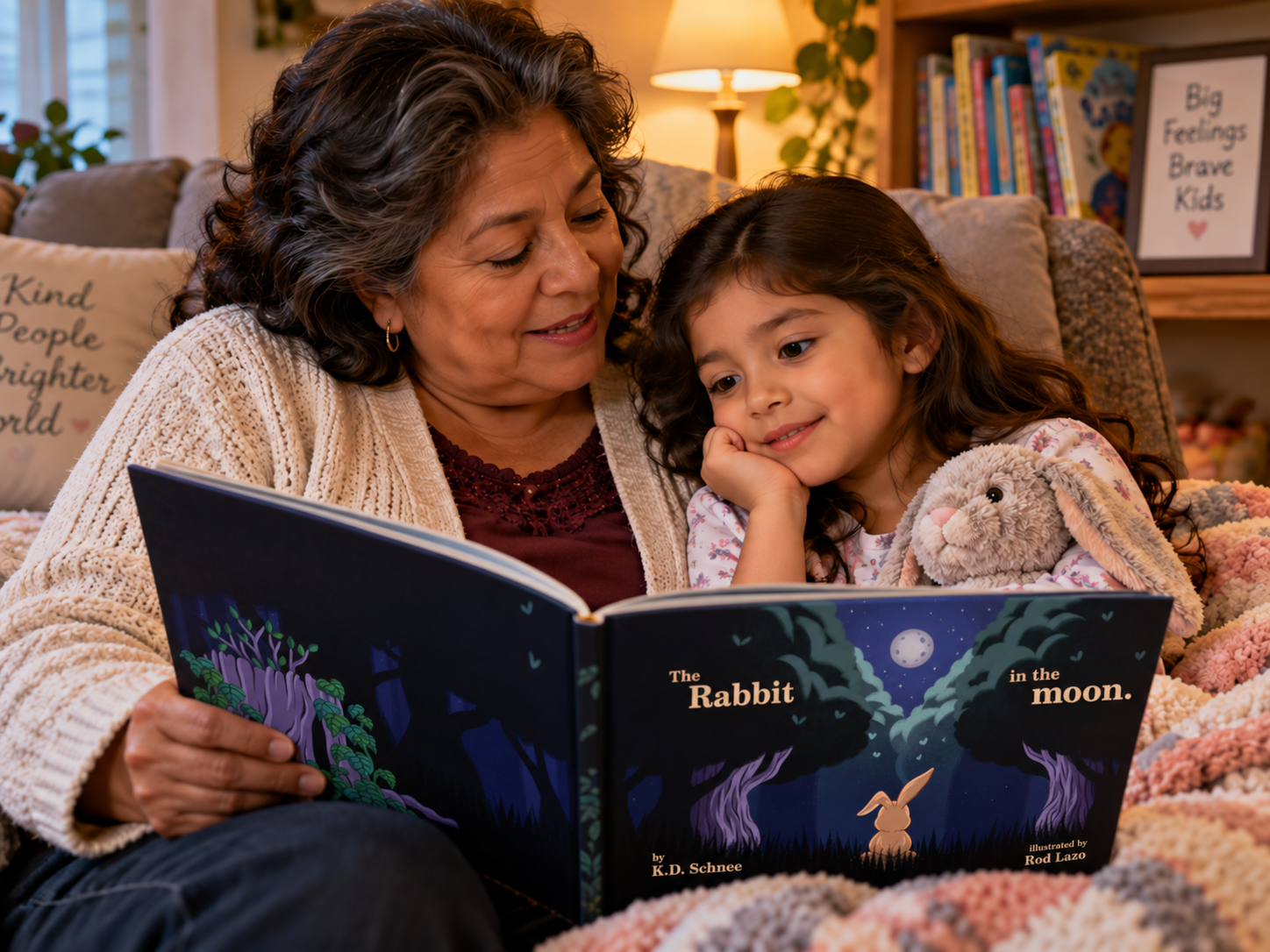
Bibliotherapy for children can use carefully chosen picture books and thoughtful conversation to help kids recognize emotions, see their experiences reflected in stories, and find language for feelings that may be difficult to explain.
A child may refuse to tell you why school feels frightening and then spend ten minutes explaining exactly why a rabbit in a picture book does not want to leave home. Another child may insist that nothing is bothering them but become deeply concerned about a character who made a mistake. A child who has no answer when you ask, “How are you feeling?” may be perfectly capable of telling you that someone in a story looks lonely, embarrassed, worried, jealous, or afraid.
This is one of the quiet powers of children’s literature. A story gives children another person’s experience to look at before anyone asks them to examine their own. There is a term for the intentional use of books to help people explore emotions, personal problems, and difficult experiences: bibliotherapy.
The word can sound more clinical than the experience itself, particularly when we are talking about young children and picture books. At its most approachable, bibliotherapy may involve choosing a story that reflects something a child is experiencing, reading it together, and allowing the character’s experience to open a conversation that would have been harder to begin directly.
The important caution is contained in the word therapy. A meaningful picture book can help a child recognize a feeling, feel less alone, develop emotional vocabulary, consider another perspective, or imagine a different response. That does not mean every book about emotions is therapy, nor does it mean parents and teachers should attempt to become therapists because they have found the right story.
Understanding that distinction is what makes bibliotherapy genuinely useful rather than another oversized promise attached to children’s books.
What Is Bibliotherapy for Kids?
Bibliotherapy is the intentional use of books and reading to help someone explore emotional experiences, personal challenges, or psychological concerns. With children, this can involve fiction, picture books, stories, poetry, or more structured self-help materials, depending on the setting and purpose.
The American Library Association has historically defined bibliotherapy as the use of selected reading materials to support people working through mental or emotional difficulties, and its definition specifically notes the role professional guidance can play when bibliotherapy is being used therapeutically.
Modern research often makes a useful distinction between self-help bibliotherapy and creative bibliotherapy. Self-help bibliotherapy generally uses nonfiction materials designed to teach strategies or provide structured guidance. Creative bibliotherapy uses stories, fiction, poetry, and picture books, often combined with discussion or reflection, to promote emotional understanding and wellbeing.
For parents of young children, creative bibliotherapy is usually the more relevant concept. A child may encounter a character who worries about school, misses a parent, makes a painful mistake, feels left out, struggles with anger, experiences grief, hesitates before trying something new, or discovers that another person sees the same situation differently.
The child does not have to announce, “That character is me,” for the book to be meaningful. Sometimes simply recognizing the emotional shape of an experience is enough to begin making it more understandable.
Is Reading a Book About Feelings the Same Thing as Bibliotherapy?
Not necessarily, and I think this distinction matters.
Children read emotionally meaningful books all the time without anyone practicing bibliotherapy. A bedtime story about friendship can help a child think about friendship. A book about fear may give them a new word for worry. A character’s mistake may stay in their mind the next time something goes wrong.
That is simply part of what literature does.
Bibliotherapy becomes more intentional when the adult selects a book because its emotional territory relates to something the child may be experiencing and then creates an opportunity for reflection. The adult may ask what the character seems to be feeling, wonder why the character acted a certain way, notice what helped, or return to the story later when a similar situation occurs in real life.
Even then, I would be careful about using the word therapy too casually. A parent thoughtfully reading a picture book with a worried child is not performing psychotherapy. A teacher discussing a story about belonging is not diagnosing or treating a student.
The book is creating an opening. Sometimes that opening is all the adult needs to provide.
Why Picture Books Can Be So Useful for Big Feelings
Children often experience emotions before they have precise language for them. A child may know that their stomach hurts before soccer practice without being able to explain that they are worried about making a mistake in front of the team. They may become angry at bedtime without recognizing that the anger began with fear about being alone.
Picture books slow emotional experiences down. A child can study a character’s face, body, choices, surroundings, and relationships. They can watch something happen, see how the character responds, and observe what changes without having to manage the real-life situation at the same time.
Illustrations add another layer because children can often read emotional information visually before they can explain it verbally. They notice that a character is standing farther away, looking down, gripping something tightly, hiding behind another person, or occupying less space on the page.
The story also provides emotional distance. Asking “Why do you think she didn’t want to go inside?” is very different from asking a child who has just refused school, “Why are you doing this?”
The first question invites curiosity. The second may feel like an accusation even when the adult does not intend it that way. That small amount of distance can make difficult feelings easier to examine.
What Actually Happens When a Child Connects With a Character?
One of the oldest ideas behind bibliotherapy is identification. Readers recognize something of themselves in a character and begin exploring their own experience through the safety of somebody else’s story.
With young children, that identification may be wonderfully unsophisticated. They may simply say, “He doesn’t want to go either,” or, “She thought everyone would laugh at her.”
Those observations matter because the child is beginning to organize an emotional experience. They can see what happened before the feeling, how the character behaved while experiencing it, and what happened afterward.
Stories can also provide perspective. A child who feels angry at a character on the first reading may understand that character differently after realizing they were frightened or embarrassed. A child who initially sees a mistake as catastrophic may watch a character survive one.
None of that guarantees that the child will behave differently in real life. Children are not computers waiting for us to install a picture-book update.
What stories can provide is rehearsal. The child sees an emotional situation represented, considers possible responses, and stores that experience alongside everything else they are learning about how people navigate the world.
What Does the Research Say About Bibliotherapy for Children?
The research is encouraging enough to take bibliotherapy seriously and cautious enough that we should avoid turning it into a miracle claim.
A 2026 systematic review examined school-based creative bibliotherapy programs for children and adolescents ages 5 to 16. The researchers found 23 relevant studies, and 13 reported positive effects on mental-health-related outcomes. However, many of the studies had methodological limitations, and the reviewers concluded that there are promising indications, rather than strong evidence, that creative bibliotherapy improves children’s mental health and related outcomes.
That conclusion is useful because it keeps expectations in proportion. Stories can contribute to emotional development and structured interventions, but the evidence does not justify saying that simply reading the right picture book will treat a mental health condition.
Another revealing study looked specifically at children’s picture books about anxiety. Researchers screened 1,640 books and closely analyzed 191 of them for eight elements commonly used in evidence-based anxiety approaches, including helping children understand anxiety, recognize body sensations, solve problems, relax, challenge thoughts, and gradually face fears.
The average book included only 2.39 of the eight elements. That does not mean those books were bad stories. It means a book about anxiety should not automatically be assumed to function as anxiety treatment simply because an anxious character appears in it.
The distinction between emotionally useful literature and evidence-based treatment deserves to remain intact.
What Can a Picture Book Realistically Help a Child Do?
A good picture book can make an experience easier to see.
It may help a child recognize that another person worries too, understand that anger can have embarrassment underneath it, or discover that a character can feel nervous and still take part. It can introduce language for emotions the child has felt without knowing how to describe them.
Stories can also normalize experiences without minimizing them. There is a meaningful difference between a book saying, in effect, “Other children experience this too,” and an adult saying, “Everybody worries, so there is nothing to be upset about.”
One creates companionship. The other can accidentally dismiss the feeling.
A book may also give families shared language. Once a child knows a character, an adult can later refer to the story without rebuilding the entire emotional conversation from the beginning. A parent might say, “This feels a little like the moment when she didn’t want to walk into the classroom,” and the child immediately knows what emotional territory they are talking about.
That shared reference is one reason I think picture books can remain useful long after the first reading.
How to Use a Picture Book Without Turning Storytime Into Therapy
If you deliberately choose a book because your child is going through something difficult, the temptation is to extract every possible lesson from it. Resist that temptation.
A story needs to work as a story before it can work as anything else. Let your child enjoy the illustrations, laugh at a strange detail, interrupt with an unrelated observation, dislike the character you expected them to identify with, or simply listen without discussing themselves.
When the story creates a natural opening, ask one thoughtful question instead of six. “What do you think was hardest for him?” or “Why do you think she changed her mind?” gives the child room to interpret rather than forcing them to confess.
It is also useful to speak about the character before moving toward the child. If you immediately ask, “Do you feel exactly like that at school?”, the emotional distance that made the story comfortable can disappear.
Sometimes the child will make the connection themselves. Sometimes they will not. Both experiences can still have value.
For practical ways to build emotional vocabulary from stories without turning the read-aloud into an interrogation, use Emotional Literacy Activities for Picture Books: 7 Simple Ideas.
How to Choose a Book for Bibliotherapy With a Child
The right book begins with the actual child rather than the label printed on the cover. If a child is worried, ask what kind of worry you are trying to help them understand. Separation from a parent, fear of mistakes, school anxiety, nighttime worry, social uncertainty, medical fears, and general “what if?” thinking may all benefit from different stories.
Then look at what the story actually does with the problem. Does it allow the character’s feeling to make sense, or does everyone simply tell them there is nothing to worry about? Does the child character have some agency? Does support help without completely rescuing them? Does the emotional change feel believable?
I also look for story quality. Children are unlikely to form a meaningful connection with a book that exists only to deliver an adult-approved lesson. Character, humor, tension, illustration, rhythm, curiosity, and surprise still matter.
The emotional match matters too. A highly direct story can be helpful for one child and uncomfortable for another. Sometimes a metaphorical story creates enough distance for the child to approach the subject more easily.
Most importantly, remember that the adult’s preferred message is not always the child’s reason for loving the book. The story has to belong partly to them.
Using Bibliotherapy for Childhood Anxiety
Anxiety is one of the most common reasons parents look for emotionally supportive books, and it is also an area where careful selection matters.
A child worried about separation may benefit from a story centered on continuing connection. A perfectionistic child may need a character who makes visible mistakes and survives them. A child who hesitates before trying something new may connect more readily with a story about the beginning than with a book that broadly explains anxiety.
This is where the research on children’s anxiety books becomes particularly useful. A book may help a child feel seen without teaching every coping strategy a clinician would use. Those are different accomplishments, and both can have value as long as we do not confuse them.
If anxiety is the reason you are looking for a book, the broader guide Children’s Books for Anxiety: 17 Picture Books That Help Worried Kids Feel Understood can help you match the story more closely to the kind of worry your child is experiencing:
Can Parents Practice Bibliotherapy at Home?
Parents can certainly use books intentionally to support emotional conversations, although I prefer being precise about what that means. You do not need therapeutic training to choose a thoughtful picture book, notice how a character feels, or give your child space to talk about something difficult. Those are ordinary parts of responsive parenting and shared reading.
What parents should avoid is treating the story as a diagnostic instrument or trying to reproduce professional therapy from a book. A child choosing the frightened character does not prove they have an anxiety disorder. A child refusing to discuss a story does not prove they are repressing something.
Stories invite interpretation. They do not provide clinical conclusions.
At home, the most useful approach is often gentle and observational. Read during a relatively calm moment, let the child encounter the story without announcing its purpose, ask a small question when it feels natural, and notice what they return to.
You may be surprised by which part of the story matters to them.
How Teachers and Counselors Can Use Creative Bibliotherapy
Schools are one of the places where creative bibliotherapy has received growing research attention because books can provide a shared experience without requiring one child to become the example for everyone else.
A teacher can read a story about entering a new group, frustration, friendship, mistakes, grief, or worry and invite students to think about the character rather than asking anyone to disclose a personal experience. That preserves some emotional safety while creating shared language the classroom can use later.
The 2026 systematic review of school-based creative bibliotherapy found that positive studies often involved thoughtful selection of age-appropriate material, structured interaction around the reading, and trained delivery. At the same time, the researchers were careful not to claim those ingredients guarantee a mental-health effect.
That is an important distinction for schools as well. A picture book can support social-emotional learning and wellbeing without being presented as clinical treatment.
School counselors and mental health professionals may use literature more deliberately within their professional practice. Their training allows them to do something different from a classroom teacher or parent using the same book, because the surrounding assessment, therapeutic goals, conversation, and follow-up are different.
The book may be identical. The intervention is not.
When Is a Picture Book Not Enough?
A picture book is not enough when a child needs professional assessment or treatment.
That does not make the book useless. A familiar story may remain comforting, help a child communicate, or continue providing language alongside professional care. It simply means the story should not be carrying responsibility it was never designed to carry.
For fears and anxiety, the American Academy of Pediatrics recommends seeking additional help when anxiety is persistent or begins interfering significantly with ordinary life, including school, sleep, friendships, play, or family activities.
Parents should pay attention to impact rather than trying to decide whether a child’s worry looks serious enough compared with somebody else’s. If fear is regularly narrowing the child’s life, intensifying, or creating substantial distress, bring the concern to the child’s pediatrician or another qualified professional.
Professional help and emotionally useful books do not have to compete with one another. They can occupy different roles in the same child’s support system.
Is The Rabbit in the Moon Bibliotherapy?
I would not market The Rabbit in the Moon as therapy, because that would make a promise the book was never designed to make. It is a picture book.
What it does offer is emotional territory that can be useful in a bibliotherapeutic or emotionally supportive reading context. Yabbit is a childlike character who wants to move forward but hesitates when the journey becomes real. Snail brings steadiness and persistence without turning Yabbit into a fearless rabbit or taking the journey away from him.
A child who freezes before school, sports, a birthday party, a new activity, or a difficult task may recognize something familiar in that relationship between wanting and beginning. The story also gives families language they can use afterward. Rather than demanding that a hesitant child become confident immediately, a parent can ask what one small, manageable next step might look like.
That is the idea behind the Tiny Brave Hop Method, but the story does not need to be presented as a therapeutic exercise for a child to take something meaningful from it. In fact, I think the book works better when Yabbit gets to be a character before he becomes anyone’s lesson.
What I Look for in an Emotionally Useful Picture Book
As a children’s author, I think emotionally useful books work best when they respect the child enough not to solve the emotional problem too neatly. Real children rarely move from fear to perfect confidence in three pages. They hesitate, approach, retreat, ask questions, watch first, accept help, change their minds, try imperfectly, and sometimes discover that the next step is smaller than the adult expected.
I look for stories that leave room for that complexity.
I also look for books that allow support without erasing agency. An adult, friend, parent, teacher, or Snail can help, but the character should still participate in whatever change occurs. A story becomes much more useful when the child sees not only that help is available, but that they still have a role in what happens next.
Finally, the book has to be worth reading even when nobody needs an emotional lesson that day. If the story only functions as medicine, children will eventually notice the spoon.
Buy The Rabbit in the Moon
If your child wants to try but sometimes hesitates when the moment of beginning becomes real, The Rabbit in the Moonwas written for that emotional space.
Yabbit is not fearless. He worries, pauses, and feels the size of the journey in front of him, while Snail provides the steady companionship that helps him keep moving. Their story gives families a way to talk about courage without pretending that fear needs to disappear first.
The book can be read simply because it is a story, and that matters to me. If it also gives a child language for something they have been feeling or gives a parent a gentler way to begin a difficult conversation, the story has found another useful place in the family.
Frequently Asked Questions About Bibliotherapy for Kids
What is bibliotherapy for children? Bibliotherapy is the intentional use of selected books and reading to help children explore emotions, personal challenges, or difficult experiences. Depending on the setting, it can range from professionally guided therapeutic reading to creative use of fiction and picture books followed by thoughtful discussion or reflection.
Is bibliotherapy the same as therapy? No. Professional bibliotherapy may be incorporated into clinical treatment by trained practitioners, but a parent reading an emotionally relevant picture book with a child is not automatically providing psychotherapy. Books can support conversation, emotional understanding, and connection without replacing professional assessment or treatment.
What is creative bibliotherapy? Creative bibliotherapy uses fiction, poetry, picture books, and other imaginative literature to support reflection, emotional understanding, or wellbeing. It differs from self-help bibliotherapy, which generally relies on nonfiction materials designed to teach specific information or coping strategies.
Can picture books help children with anxiety? Picture books can help anxious children recognize feelings, see that other characters struggle too, develop emotional language, and explore possible ways of responding. Research suggests that many anxiety books model some useful coping elements, but individual picture books should not be assumed to provide complete or evidence-based treatment for childhood anxiety.
What age is bibliotherapy appropriate for? Story-based emotional conversations can begin in the preschool years when books are chosen for the child’s developmental level and experience. The way bibliotherapy is used should change with age, language ability, reading level, emotional maturity, and whether the setting is a family read-aloud, classroom activity, counseling session, or clinical intervention.
How should a parent use a picture book about a difficult feeling? Begin by letting the child experience the story rather than announcing that the book has been selected to address their problem. Talk first about the character, ask one or two open questions when appropriate, and allow the child to decide how directly they want to connect the story with their own life.
When should I seek professional help instead of relying on books? Speak with your child’s pediatrician or a qualified mental health professional when fear, anxiety, sadness, behavioral changes, or other emotional difficulties are persistent, worsening, causing substantial distress, or interfering with school, sleep, relationships, play, or ordinary family life. Books can remain part of the child’s support, but they should not replace professional care when more help is needed.
Final Thought
One of the best things a picture book can offer a child is the chance to meet a difficult feeling somewhere other than inside themselves.
They can watch someone else worry before admitting that they worry. They can see another character make a mistake before deciding what mistakes mean about them. They can notice hesitation, loneliness, jealousy, anger, sadness, courage, or grief on a page where nothing is demanding an immediate personal answer.
Bibliotherapy builds on that natural quality of stories, but the term should not tempt us to make literature more clinical than it needs to be. Children do not always need a lesson extracted from every book, and a meaningful reading experience does not have to produce an observable breakthrough before bedtime.
Sometimes the most useful thing a book does is give a feeling a character, a shape, a sentence, or a place in a story. Then, when that feeling appears in the child’s own life, it is no longer completely unfamiliar.