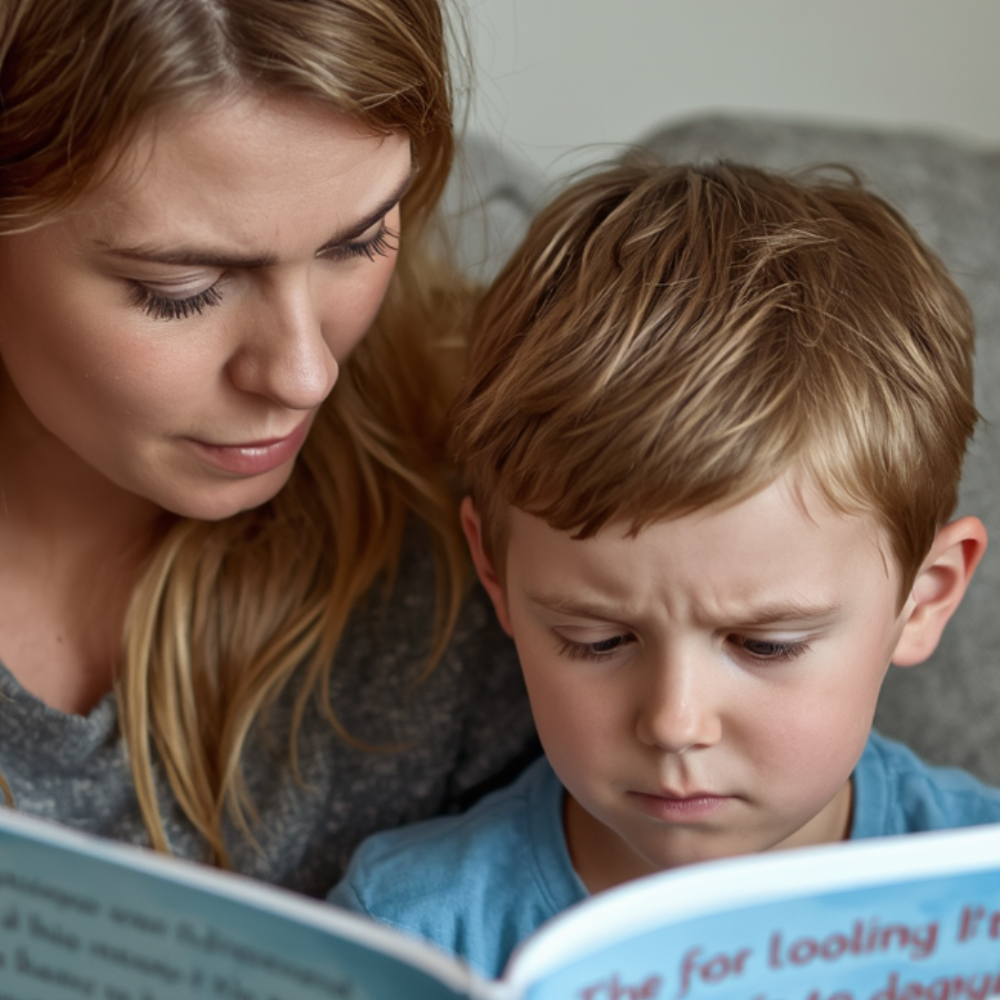
Children’s books for anxiety can help worried kids recognize what they are feeling, talk about fear and uncertainty, and discover that they can move forward one brave hop at a time.
Parents who search for children’s books for anxiety are usually trying to solve a much more specific problem than the search phrase suggests. There is a child behind the query, and something has begun to feel harder than it used to.
Perhaps your child worries about school long before Monday morning arrives. Maybe bedtime has become an hour of questions about things that seemed perfectly manageable in daylight. Your child may cling at goodbye, become furious when a mistake appears on the page, complain of a stomachache before an unfamiliar activity, or spend the entire drive to a birthday party insisting that they never wanted to go in the first place.
Sometimes children can tell us they are worried. Often they cannot.
That is one reason picture books can be so useful. A story gives children another child, rabbit, raccoon, llama, or worry-shaped creature to look at instead of asking them to explain themselves on command. The feeling moves onto the page, where everyone can examine it with a little more breathing room.
The best anxiety books do not promise children that nothing frightening, embarrassing, difficult, or uncertain will ever happen. They help children understand that worry can be present without having to control the entire story.
Which Children’s Books About Anxiety Are Best for Kids?
The best children’s books about anxiety match the story to the kind of worry a child is actually experiencing. For general worry, Ruby Finds a Worry, Wemberly Worried, and The Huge Bag of Worries are strong starting points, while other picture books about anxiety may be better for separation, mistakes, hesitation, or fear of trying.
What Anxiety Can Look Like in Children
Anxiety does not always arrive with the words “I am anxious.” Younger children in particular may experience worry through their behavior or their bodies before they have the language to explain what is happening.
A child may repeatedly ask what will happen, avoid something they once wanted to do, become unusually irritable, have difficulty sleeping, complain about stomachaches or headaches, cling to a caregiver, struggle to concentrate, or become extremely hard on themselves. Some children grow quiet when they are worried, while others become louder, angrier, sillier, or more controlling because uncertainty feels uncomfortable.
The American Academy of Pediatrics notes that occasional fears and worries are a normal part of childhood, particularly as children encounter new experiences. Concern becomes more significant when anxiety is persistent or begins interfering with ordinary activities such as school, sleep, friendships, play, or family life.
That distinction matters when we talk about “anxiety books.” A picture book can help a child understand a feeling or begin a conversation, but buying a stack of books is not the same thing as assessing or treating an anxiety disorder. Parents do not need to diagnose their children in order to notice that something is hard, and authors should not pretend that a story can perform the work of a qualified clinician.
What a story can do is give a feeling somewhere safe to land.
What Makes a Good Anxiety Book for a Child?
A useful anxiety book should recognize the child’s feeling without enlarging it. That sounds simple, but children’s books can miss in both directions. Some dismiss fear so quickly that the message becomes, “There was never anything to worry about.” Others concentrate so heavily on anxiety that they risk making worry feel like the most important thing about the child.
The books I trust tend to occupy the middle ground. They allow the character to worry, hesitate, cry, make mistakes, ask for help, or need reassurance without turning those responses into defects. At the same time, the story eventually creates movement. The child sees that something can happen after the worried feeling arrives.
Good anxiety books also leave families with language they can use again. A phrase, image, character, or small moment from a story can become shorthand later, when the child is standing outside the classroom, staring at the diving board, worrying about a mistake, or asking the eighth bedtime question of the evening.
That is where a picture book becomes more than a story about worry. It becomes part of the conversation a family already knows how to have.
If you want a deeper framework for matching the story to your child’s particular worry, use How to Choose the Right Anxiety Book for Your Child as the companion guide.
17 Children’s Books for Anxiety and Worry
The books below are organized around different ways worry can appear. Some help children name anxious feelings, while others are stronger for separation, hesitation, mistakes, change, or the fear of trying. No single book needs to do every job.
Ruby Finds a Worry by Tom Percival
Ruby’s worry begins small and quietly grows as she tries to ignore it. The story gives worry a visible presence, which can be especially helpful for children who know something feels wrong but cannot explain what they are carrying. The book also opens a natural conversation about what can happen when worries are shared rather than hidden.Wemberly Worried by Kevin Henkes
Wemberly worries about big things, tiny things, and things most other people have not thought to worry about yet. Her tendency to imagine what might go wrong will feel familiar to children whose anxiety lives mostly in anticipation. The story is particularly useful because Wemberly is never reduced to her worry; she remains funny, sympathetic, and fully herself.The Huge Bag of Worries by Virginia Ironside, illustrated by Frank Rodgers
Jenny’s worries follow her around in an increasingly heavy bag that nobody else can see. The metaphor works because many children experience worry exactly that way: invisible to everyone else but surprisingly exhausting to carry. The story creates an opening for children who tend to collect several worries at once rather than becoming stuck on one specific fear.A Little SPOT of Anxiety by Diane Alber
Some younger children respond well to a more concrete explanation of feelings, and this book makes anxiety visual and accessible. It is more instructional than many of the narrative picture books on this list, which can be useful when a child benefits from clear language and recognizable emotional cues. I would use it alongside stories rather than expecting it to replace the emotional richness of a character-driven book.Wilma Jean the Worry Machine by Julia Cook, illustrated by Anita DuFalla
Wilma Jean is caught in the exhausting machinery of “what if?” thinking, which makes this a useful book for children whose minds repeatedly leap ahead to possible problems. The story helps make anxious thinking easier to notice and discuss. It works best when adults use it as an invitation to conversation rather than turning every anxious thought into something that has to be corrected.The Rabbit Listened by Cori Doerrfeld
Taylor is upset after something important falls apart, and a parade of animals arrives with advice about what Taylor should do. The rabbit offers something different by simply staying close and listening. Although this is not exclusively a book about anxiety, it belongs on this shelf because worried children are often surrounded by adults trying to solve the feeling before the child has even had time to experience it.The Rabbit in the Moon by KD Schnee
The Rabbit in the Moon is especially relevant when worry appears as hesitation. Yabbit wants to help Snail, but the size of what lies ahead begins to feel different once the journey becomes real. He worries, stalls, and experiences the emotional distance between wanting to do something and actually beginning it.I include my own book transparently because that particular moment is the reason Yabbit exists. He is not a character who teaches children to eliminate fear. Snail’s steadiness helps him discover that he can move while uncertainty is still present, which gives families a different way to talk about the child who wants to participate but cannot quite cross the starting line.
Jabari Jumps by Gaia Cornwall
Jabari has decided that he is ready to jump from the diving board, but being ready in theory turns out to feel very different from standing beneath the ladder. His father gives him room to work through the fear without embarrassing him or forcing the moment. For children whose worry intensifies immediately before an activity begins, the emotional timing of this story is wonderfully recognizable.The Thing Lou Couldn’t Do by Ashley Spires
Lou is enthusiastic about adventure until her friends decide to climb a tree, something she has never done before. Her sudden supply of reasons not to climb will be familiar to families of children who protect themselves from possible failure by avoiding the attempt. The humor keeps the story light while still taking the fear of not being good at something seriously.The Koala Who Could by Rachel Bright, illustrated by Jim Field
Kevin prefers the predictability of staying exactly where he is, which makes the story useful for children whose anxiety appears when routines, environments, or expectations change. The book does not begin by scolding him for resisting something new. Instead, it acknowledges the comfort of familiarity before showing what becomes possible when the world changes anyway.What Do You Do With a Problem? by Kobi Yamada, illustrated by Mae Besom
Problems can become much larger in our imagination when we spend all our energy trying not to look at them. This book gives that experience a visual form, which can help children talk about the way a worry sometimes grows through avoidance. It is less about solving a particular childhood fear than about changing a child’s relationship with the thing they would rather not face.The Kissing Hand by Audrey Penn, illustrated by Ruth E. Harper and Nancy M. Leak
Chester Raccoon does not want to leave his mother and go to school, so she gives him a kiss in his palm that he can carry with him. The enduring power of the story is its concrete ritual. Young children often understand connection more easily when love is represented by something they can physically imagine taking with them.Llama Llama Misses Mama by Anna Dewdney
Llama’s first experience of school feels very different once Mama leaves. The story allows him to miss her while gradually discovering that the unfamiliar classroom contains people, activities, and rhythms he can begin to trust. For children struggling specifically with school separation, the book provides a reassuring pattern without pretending goodbye is instantly easy.The Invisible String by Patrice Karst, illustrated by Joanne Lew-Vriethoff
This story gives children a simple metaphor for emotional connection across distance. For a child who worries about being away from a parent, grandparent, sibling, or another important person, the idea of an invisible connection can make separation feel less absolute. Its strength is reassurance rather than courage, so it is especially helpful when the child first needs to feel connected before taking the next step.The Magical Yet by Angela DiTerlizzi, illustrated by Lorena Alvarez Gómez
Children who become anxious about performance often hear “I can’t” in their own heads long before anyone else has judged the result. The Magical Yet introduces the possibility that inability may be temporary rather than permanent. That small shift can be useful for children whose worry comes from expecting themselves to master a skill before they have had time to learn it.After the Fall by Dan Santat
Humpty Dumpty has survived his famous fall, but being repaired does not erase what happened. He is now afraid of heights, which makes this a particularly thoughtful story for children who are anxious because something has already gone wrong once. The book understands that courage after a difficult experience has a different emotional texture from courage before the first attempt.Giraffes Can’t Dance by Giles Andreae, illustrated by Guy Parker-Rees
Gerald’s difficulty is not only dancing; it is dancing while others are watching and judging him. That makes the story useful for children whose anxiety is tied to embarrassment, comparison, or performing in front of other people. The playful tone gives children enough distance to enjoy the story while still recognizing the fear of being seen getting something wrong.
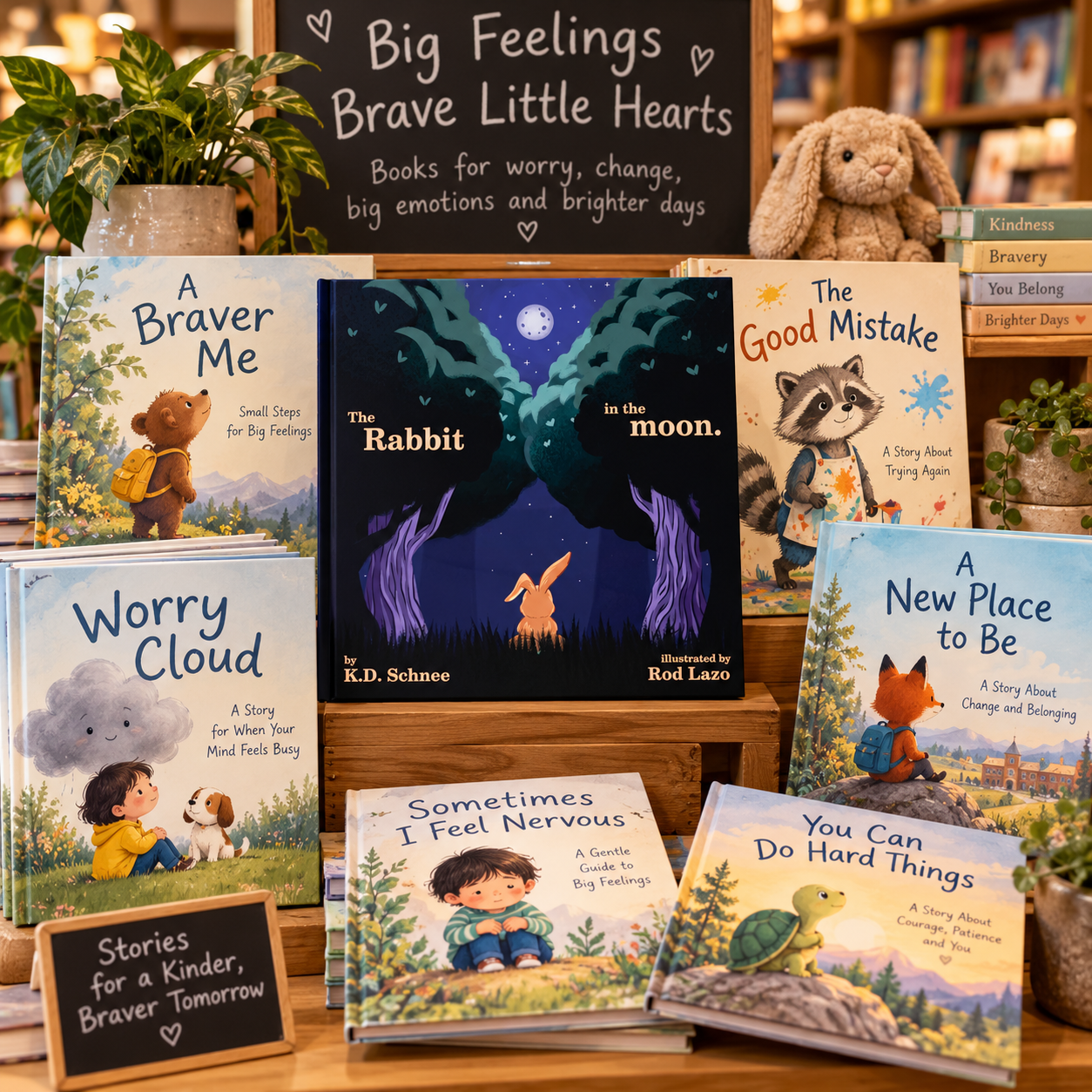
The most useful anxiety books for children match the worry a child is actually experiencing, whether that involves separation, uncertainty, mistakes, change, or the fear of beginning.
Why the Best Anxiety Book Depends on the Worry
Parents understandably search for “the best book for anxiety,” but anxiety is too broad for one book to occupy that position honestly. A child worried about being away from a parent has a different emotional problem from a child who panics about getting an answer wrong. A child who stays awake imagining frightening possibilities may need a different kind of story from the child standing silently at the edge of the playground because joining feels impossible.
This is why the books on this page should be treated as a starting shelf rather than a ranking. The goal is not to collect all seventeen. It is to notice which story resembles the child in front of you.
A book becomes far more useful when a child can recognize the shape of their own difficult moment without feeling as though an adult deliberately handed them a lesson disguised as storytime.
How to Read an Anxiety Book Without Making Your Child More Anxious
One of the easiest ways to make an emotionally useful book less useful is to introduce it with too much urgency. Children have excellent radar for the sentence, “I bought this because we need to work on you.”
Whenever possible, read anxiety books during calm moments rather than only in the middle of a crisis. Let the child enjoy the illustrations, notice the character, disagree with the story, interrupt, laugh at the wrong part, or ask a question you were not expecting. The experience should still feel like reading together.
Afterward, one thoughtful question is usually enough. You might ask what seemed hardest for the character, what the character was worried might happen, or what helped things begin to change. Talking first about the character gives the child emotional distance, which may make it easier for them to bring their own experience into the conversation later.
Then leave some room. Children often understand more from a story than they are prepared to explain immediately.
What Should Parents Say When Worry Shows Up Later?
The language from a familiar book becomes most useful when it returns naturally rather than as a lecture. If a child is nervous about entering the classroom, attending practice, trying again after a mistake, or walking into an unfamiliar room, you can remind them of the story without insisting that they reproduce the character’s behavior.
Instead of telling a child there is nothing to worry about, acknowledge that the moment feels difficult and help them identify something manageable. You might say, “You do not have to figure out the whole afternoon right now. Let’s decide what the first part is,” or, “You can still feel nervous while we work out what comes next.”
That approach matters because anxiety can tempt both children and adults into thinking the only successful outcome is making the feeling disappear. Often the more realistic goal is helping the child discover that they can remain connected, supported, and capable while some uncertainty is still present.
Where Tiny Brave Hops Fit Into Anxiety
Yabbit was created for a particular kind of worried moment: the pause before beginning. Some children know what they want to do but become stuck when imagination turns into action. The swimming lesson is no longer something happening next Saturday; they are standing beside the pool. The party is no longer an idea; the door is opening. The teacher is no longer describing the assignment; the blank page is directly in front of them.
In those situations, a larger pep talk is not always the answer. Sometimes the child needs the beginning made smaller.
The Tiny Brave Hop Method asks adults to look for one manageable action rather than demanding the entire leap at once. That might mean watching first, walking to the door, trying one part, asking for help, standing beside the group, or staying for a short period before deciding what comes next.
For the full parent framework, read How to Help Your Child Take Tiny Brave Hops.
The important distinction is that making the first step smaller is not the same thing as promising that a child will never have to face anything uncomfortable. The purpose is to give them an entry point into the experience so courage has somewhere to begin.
When a Picture Book Is Helpful but Not Enough
Picture books can help children recognize feelings, borrow language, rehearse difficult situations through story, and feel less alone. They are supportive tools, not treatment for an anxiety disorder.
The American Academy of Pediatrics advises parents to take children’s fears seriously without ridiculing them or pressuring them into bravery. It also recommends seeking additional support when anxiety persists or begins interfering with ordinary activities such as school, sleep, play, relationships, or family life.
If your child’s worries are becoming intense, frequent, or disruptive, speak with your pediatrician or another qualified mental health professional. A good book can continue to be part of the child’s support system, but it should not be expected to carry a job that requires professional care.
Authoritative external resource: American Academy of Pediatrics / HealthyChildren.org, Fears & Phobias in Children: How Parents Can Help
Why The Rabbit in the Moon Belongs on an Anxiety Bookshelf
The Rabbit in the Moon is not a book about every kind of childhood anxiety, and I think that distinction makes its purpose clearer rather than weaker.
Yabbit is most useful for children whose worry appears as hesitation, avoidance, or difficulty beginning. He represents the child who genuinely wants to participate but stalls when the moment arrives. Because he understands that experience from the inside, the story never asks him to transform into a fearless rabbit before anything can happen.
Snail provides the complementary strength. He is persistent and steady, helping the journey continue without erasing Yabbit’s uncertainty or doing the emotional work for him.
That relationship gives families language for a particular kind of anxiety that can otherwise become frustrating for everyone involved. The child is not necessarily saying no because they do not care. Sometimes they care very much, which is exactly why the first step feels so large.
Buy The Rabbit in the Moon
If your child wants to try but sometimes freezes when the moment arrives, The Rabbit in the Moon was written for that space between wanting and beginning.
Yabbit worries and hesitates, while Snail brings steadiness and persistence to their journey. The story does not ask children to become fearless. It gives them another possibility: they can feel uncertain and still discover one small way forward.
For parents, grandparents, teachers, and caregivers, the book can also provide shared language for the next difficult moment. Instead of asking a child to summon confidence they do not yet feel, you can begin with a simpler question: What is one tiny brave hop?
[BUY THE BOOK BUTTON: USE EXISTING AMAZON LINK]
Frequently Asked Questions About Children’s Books for Anxiety
What are the best children’s books for anxiety?
The best children’s books for anxiety depend on the kind of worry a child is experiencing. Ruby Finds a Worry and Wemberly Worried are useful for general worry, while The Kissing Hand and Llama Llama Misses Mama are stronger for separation. The Rabbit in the Moon and Jabari Jumps are especially helpful when worry appears as hesitation before trying something new.
Can picture books help children with anxiety?
Picture books can help children recognize emotions, see that other characters experience similar feelings, and find language for worries that may be difficult to explain directly. They can also give parents and children a shared reference for later conversations. Books can support emotional understanding, but they do not replace professional care when anxiety is persistent or significantly disruptive.
What is the difference between a worry book and a courage book?
A worry book usually helps children recognize, name, or talk about anxious feelings. A courage book focuses more on what happens when a child moves toward something difficult while uncertainty is still present. Some picture books do both, but knowing which need is more important can help you choose a better fit.
Which anxiety books are best for a child who worries about everything?
For children whose worries seem to multiply or follow them throughout the day, Ruby Finds a Worry, Wemberly Worried, and The Huge Bag of Worries are useful starting points. These stories make worry visible without attaching the feeling to one narrow situation.
Which books are best for children who freeze before trying something new?
The Rabbit in the Moon, Jabari Jumps, and The Thing Lou Couldn’t Do are strong choices for children who want to participate but become hesitant when the moment of beginning arrives. Each story shows, in a different way, that uncertainty does not have to disappear before movement becomes possible.
Should I read an anxiety book when my child is already upset?
You can, but emotionally useful books often work better when they are first introduced during a calm moment. That allows the child to experience the story without feeling that it has been assigned because something is wrong. Later, familiar characters and language can be gently recalled when a real worry appears.
When should I seek professional help for my child’s anxiety?
Talk with your child’s pediatrician or another qualified professional if anxiety is persistent, worsening, or interfering with school, sleep, eating, friendships, play, or family life. Picture books can be valuable tools for connection and conversation, but they should not be expected to replace evaluation or treatment when a child needs additional support.
Final Thought
The best children’s books for anxiety do not make a child’s world perfectly safe or promise that worry will disappear after thirty-two illustrated pages. What they can do is make an internal experience visible, understandable, and a little less lonely.
A child can watch somebody else worry before having to explain their own worry. They can see another character hesitate, ask for help, make a mistake, miss a parent, face an unfamiliar situation, or discover that the frightening beginning was only one part of a much larger story.
That is a meaningful role for a picture book. It does not need to cure the feeling to help a child understand that the feeling is not the end of the story.