The best book questions do not test a child. They open the story a little wider.
The best children’s book discussion questions help kids talk about a story without making reading feel like a quiz. A good question invites a child to notice, wonder, connect, and think, while still letting the book feel like something shared.
That distinction matters.
A lot of parents want to help their children get more out of books. They want to build comprehension, encourage language, support emotional intelligence, and make reading feel meaningful. The intention is good. But sometimes, without meaning to, adults turn storytime into a small oral exam.
“What happened first?”
“What was the problem?”
“What did the character learn?”
“What was the main idea?”
Those questions are not wrong. Children do need to understand what they read. But if every book ends with a little interrogation under the blanket, some children start to brace themselves before the first page even turns.
As the author of The Rabbit in the Moon, I think about this a lot. A picture book should give children room to feel and think before adults rush in to extract the lesson. The right question can help a child enter the story more deeply. The wrong rhythm of questions can make the story feel like homework wearing pajamas.
The goal is not to ask more questions. The goal is to ask better ones.
What makes a good children’s book discussion question?
A good children’s book discussion question gives the child space.
It does not demand the “correct” answer too quickly. It does not put the child on trial for whether they listened hard enough. It does not interrupt every page so often that the story loses its music. A good question helps the child look again, think a little longer, or connect the story to something they already understand.
For young children, especially ages 3 to 8, the best questions are often simple and open-ended. “What do you notice?” may do more than a complicated comprehension prompt. “How do you think the character feels?” can open a better conversation than “What was the theme?” A child may not have the language yet for a polished answer, but they may point to a picture, make a face, or say something wonderfully crooked that tells you they are thinking.
That counts.
Good discussion questions also follow the child’s lead. If your child is fascinated by the moon on the page, stay with the moon for a moment. If they notice that a character looks worried, stay there. If they ask why a character did something, you do not need to rush back to your prepared question list. The child has already opened a door.
Walk through that one.
Why kids shut down when reading feels like a quiz
Children shut down when they feel watched instead of invited.
Some children love answering questions. Others freeze. A hesitant child may worry about being wrong. A struggling reader may feel embarrassed. A tired child may simply not have the energy to perform understanding at the end of the day. Even a child who enjoyed the story may suddenly become quiet if the adult’s questions feel too pointed.
This is why tone matters as much as the question itself.
“What happened on this page?” can be asked warmly, with curiosity, or it can sound like the adult is checking whether the child paid attention. Children hear the difference. They may not explain it that way, but they feel it.
A story is not a worksheet. It is a shared space. When children feel safe in that space, they are more likely to talk, wonder, and return to the book again. When the space feels like a test, many children retreat into one-word answers.
“Good.”
“I don’t know.”
“Nothing.”
“Can we be done?”
Those are not always signs that the child did not understand the book. Sometimes they are signs that the conversation format is not working.
The best first question to ask about any children’s book
The best first question is often the simplest: “What do you notice?”
That question works because it does not assume what the child should have noticed. It lets them begin where they are. One child may notice the character’s face. Another may notice a tiny object in the corner of the illustration. Another may notice that the page feels dark, funny, crowded, calm, or strange. All of those answers can become part of the conversation.
“What do you notice?” also works because children can answer it without needing advanced vocabulary. They can point. They can describe. They can say, “His ears look sad,” which is not a textbook sentence, but may be emotionally brilliant.
If the child gives a very small answer, you can gently extend it. “You noticed his ears. What do they make you think he is feeling?”
Now you are not testing. You are building. That is the kind of reading conversation that helps children trust their own thinking.
Questions to ask before reading a children’s book
Before reading, keep the questions light. You are not trying to squeeze predictions out of the book before it has had a chance to breathe. You are simply helping your child arrive.
Try questions like:
“What do you notice on the cover?”
“What do you think this book might feel like?”
“Does this look like a funny story, a quiet story, a brave story, or something else?”
“Who do you think we are going to meet?”
“What are you curious about before we start?”
“Have you ever read a book that looks like this one?”
“Which part of the cover made you want to open it?”
For a picture book, the cover is already part of the story. Children often read it before adults do. They notice color, faces, mood, size, animals, shadows, and tiny details that adults overlook because we are busy being efficient little grocery carts of responsibility.
Let the cover do some work.
If your child does not want to answer, that is okay. You can simply say what you notice yourself: “I notice the moon is very big on this cover. It makes me wonder if the story will feel quiet or mysterious.” Modeling curiosity teaches the child how to talk about books without forcing them to perform.
Questions to ask while reading
During the book, ask fewer questions than you think you need.
A child needs time to sink into the story. If the adult stops too often, the book becomes chopped into little thinking assignments. That can be especially hard for children who already struggle to stay with a story.
Choose one or two moments that feel worth pausing for. Look for a strong facial expression, a surprising choice, a beautiful illustration, a moment of fear, a turning point, or a page where the child seems especially interested.
Try questions like:
“What changed on this page?”
“How do you think the character feels right now?”
“What do you think might happen next?”
“Who is helping in this part?”
“What would you do if you were there?”
“Does this page feel calm, worried, silly, brave, or something else?”
“What do you see in the picture that the words did not say?”
“Why do you think the character stopped here?”
“What do you think the character needs?”
“Should we look at this page a little longer?”
That last question is underrated. Some pages deserve time. Children do not always need a question that leads somewhere. Sometimes they need permission to stay.
Questions to ask after reading
After reading, try not to pounce.
Let the story settle for a moment. Some children answer better after a pause. Some need to flip back to a page. Some need the adult to begin with a comment instead of a question.
You might say, “I keep thinking about the part where Yabbit paused before going forward,” and then wait. A child may jump in. Or they may not. Either response is information.
When you do ask a question, choose one that helps the child connect with the story rather than prove they remembered every detail.
Try:
“Which part do you remember most?”
“Was there a page you wanted to look at again?”
“Did any part surprise you?”
“Did this story remind you of anything?”
“Which character did you understand best?”
“What do you think changed from the beginning to the end?”
“Was there a part that felt hard, funny, brave, or sad?”
“What would you ask the character if you could?”
“Would you want to read this one again? Why or why not?”
“What did the story leave you thinking about?”
Not every book needs a full discussion. Some nights, “Which page do you want to see again?” is plenty. Some nights, the best discussion is your child falling asleep with the story still warm in the room.
That counts too.
Questions that help kids talk about feelings
Picture books are one of the safest ways to talk about feelings because the child does not have to begin with themselves. They can begin with the character.
That distance matters. A child may not be ready to say, “I felt nervous at school today.” But they might be able to say, “Yabbit looks nervous.” That is a doorway. Once the child can recognize a feeling in a character, they may later recognize it in themselves.
Try questions like:
“How do you think the character feels here?”
“What in the picture makes you think that?”
“Did the feeling get bigger or smaller?”
“Who helped the character feel safer?”
“What did the character do when the feeling got big?”
“Have you ever had a feeling a little like that?”
“What would you say to the character?”
“What helped the character keep going?”
“What was one small brave thing the character did?”
“What feeling do you think the character had at the end?”
These questions are especially useful with The Rabbit in the Moon because Yabbit’s hesitation is visible before it is solved. Children can notice the pause. They can notice Snail’s steadiness. They can talk about fear, support, and bravery without the conversation becoming too direct too quickly.
For more ideas on using picture books to build emotional language, read: https://www.yabbitrabbit.com/parent-resources/emotional-literacy-activities-for-picture-books
The goal is not to make every story therapeutic. The goal is to notice when a story gives a child language they may need later.
Questions that build reading comprehension without pressure
Comprehension matters. Children need to understand what happened, why it happened, and how the pieces of a story fit together. The trick is to build comprehension without making the child feel like they are being graded.
Instead of asking only fact-checking questions, mix in questions that let children explain, infer, and connect.
Try:
“What was happening at the beginning?”
“What problem did the character face?”
“What changed in the middle?”
“How did the character try to solve the problem?”
“What did the character learn or understand?”
“Why do you think the character made that choice?”
“What part of the story helped you figure that out?”
“What do you think the ending means?”
“If you told someone about this book, what would you say first?”
“What would you call this story if you gave it a new title?”
The strongest comprehension questions are not traps. They are invitations to think. If your child gives a partial answer, build from it. If they say, “I don’t know,” try offering two choices: “Do you think Yabbit felt ready, or do you think he still felt unsure?” A choice can give a hesitant child a safer way into the answer.
If they still do not answer, model your own thinking. “I think he still felt unsure, but he had someone helping him. That made the next step feel possible.”
Children learn how to think about books partly by hearing adults think gently out loud.
Questions that help kids connect books to real life
Books matter more when children can carry something out of them.
That does not mean every book needs a moral. It means stories can help children rehearse real moments in a safe place. A child can think about courage through Yabbit before needing courage at school. They can think about asking for help before they need to ask for help. They can think about trying again before the next mistake arrives.
Try questions like:
“Have you ever felt like this character?”
“Does this remind you of anything that happened at school, home, or bedtime?”
“What would be hard about being in this story?”
“What would be fun about being in this story?”
“What would you want someone to say to you in that moment?”
“What did the character do that you might try someday?”
“Did anyone in the story need help?”
“What kind of help would you want?”
“What is one tiny brave hop the character took?”
“What is one tiny brave hop you could take?”
That last question should be used carefully. It is not meant to turn the book into a behavior plan every time. Sometimes a story should remain a story. But when your child is already connecting the book to a real moment, the tiny brave hop question can be useful.
It gives the child a practical next step without making courage feel enormous.
Questions for kids who give one-word answers
Some children answer every book question with “good,” “fine,” “I don’t know,” or the classic small-child legal defense: shrugging while becoming boneless.
This does not always mean they are uninterested. They may be tired, unsure what kind of answer you want, worried about being wrong, or simply not used to talking about books.
Start with questions that are easier to enter.
Instead of “What did you think?” try “Point to the page you liked best.” Instead of “Why did the character do that?” try “Did this part feel funny or serious?” Instead of “How did the character change?” try “Did Yabbit feel the same at the end as he did at the beginning?”
You can also give a sentence starter:
“I noticed…”
“I wondered…”
“I liked…”
“I felt…”
“I think…”
“The character looked…”
For a hesitant child, a sentence starter can be a tiny brave hop into the conversation. It gives them the first few stepping stones instead of asking them to leap across the river while everyone watches.
Questions for children who want to talk the whole time
Some children do not need encouragement to talk about books. They need a gentle riverbank.
If your child stops on every page with theories, memories, questions, invented subplots, and a ten-minute explanation of why the rabbit should own a spaceship, that is not a failure. That is engagement. It just may need shape, especially at bedtime.
Try using a simple agreement: “Let’s choose two pages where we stop and talk, and the rest we’ll read straight through.” Or say, “That is a great thought. Hold it in your hand until the end of the page.” Children often like concrete images like that.
You can also use a bookmark or sticky note for big thoughts. “Let’s mark this page and come back after we finish.” That teaches the child that their ideas matter without letting every idea carry the book into a corn maze.
The point is not to silence the child. The point is to preserve the story’s flow while making room for the child’s mind to be wonderfully awake.
Questions teachers can use after a classroom read-aloud
Teachers need questions that invite many children into the conversation without making one child feel put on the spot.
A good classroom discussion question should leave room for different answers. It should help children listen to one another, return to the text or illustration, and connect the book to classroom life.
Try:
“What did you notice that someone else might have missed?”
“Which page changed the feeling of the story?”
“What did the character want?”
“What made the problem hard?”
“Who helped, and how?”
“What is one word you would use to describe this story?”
“What did the illustrations tell us that the words did not?”
“What would you ask the character?”
“Where did someone show courage?”
“What is one tiny brave hop someone took?”
For a book like The Rabbit in the Moon, teachers can use the discussion to build shared language around hesitation, support, and courage. The class can talk about Yabbit without singling out any one child who is nervous, shy, or reluctant to begin.
That is one of the gifts of a good picture book. It lets a classroom look at a feeling together.
Questions parents should avoid overusing
Some questions are useful in small doses but exhausting when overused.
“What was the main idea?” can help an older child, but it can feel stale if it appears after every bedtime story. “What lesson did you learn?” can make a book feel preachy. “Why did the author write this?” may be valuable sometimes, but not when the child simply wants to enjoy a story about a moonlit rabbit and a snail with quiet emotional range.
Also be careful with questions that have one obvious answer but are delivered as if they are deep.
“Was Yabbit scared?”
“Yes.”
“And should we be brave?”
“Sure.”
“And is bravery good?”
“Can I have water?”
That is not a conversation. That is a parent dragging a moral across the floor.
Children do not need every story to end with a lesson announcement. Often, the lesson works better when it is allowed to live inside the story.
How many questions should parents ask during storytime?
Usually, fewer than you think.
One good question before reading, one thoughtful pause during the story, and one gentle question after reading may be enough. Some nights, even that may be too much. The child may need the book to be a calm experience, especially at bedtime or after a hard day.
The more important question is whether your child is still enjoying the book. If the discussion is making the story richer, keep going. If your child starts giving smaller answers, looking away, or asking to be done, you may have crossed from conversation into extraction.
Pull back.
You can always talk about the book later. Children often bring stories up at strange times, in the car, during breakfast, or while putting on shoes. When they do, listen. That delayed comment may be the real discussion.
Stories do not always bloom on our schedule.
How to use The Rabbit in the Moon for book discussion
When reading The Rabbit in the Moon, focus on the emotional journey rather than trying to explain the meaning too quickly.
Yabbit is a hesitant character. Snail is steady and persistent. Owl, Bat, and She-wolf each bring a different kind of support. The story gives children several ways to talk about fear, courage, help, and small brave steps without feeling directly examined.
You might ask:
“What do you think Yabbit is feeling here?”
“How can you tell?”
“What kind of helper is Snail?”
“Which character would you want beside you if something felt hard?”
“What part of the journey felt biggest?”
“When did Yabbit take one tiny brave hop?”
“Did Yabbit have to feel fearless to keep going?”
“What helped him try?”
“Was there a page that felt brave to you?”
“What is one tiny brave hop you noticed in the story?”
These questions work because they come from the story itself. They are not pasted on afterward. They help children see that courage can be quiet, supported, and small enough to begin.
That is the heart of Yabbit.
Turn answers into conversation, not correction
When a child answers a book question, resist the urge to immediately improve the answer.
If the child says, “He is sad,” and you think the character is actually nervous, try asking, “What makes you think sad?” instead of correcting them. The child may point to something real. Or they may not yet have the word for nervous and are using the closest word they know.
That is not wrong in a useless way. It is a starting point.
You can build from it: “I see what you mean. His face does look sad. I wonder if he might also feel nervous because the journey looks big.”
Now you have added language without shutting the child down.
This is one of the most important habits in book discussion. Children learn more when adults treat their answers as openings, not errors to swat away. Of course, there are times to clarify facts. But in emotional and interpretive conversations, start by understanding what the child saw.
A child who feels listened to is more likely to keep talking.
A simple read-aloud conversation routine
If you want an easy structure, try this:
Before reading, ask: “What do you notice?”
During reading, ask: “How do you think the character feels?”
After reading, ask: “What part stayed with you?”
That is enough to begin. Those three questions cover observation, emotion, and memory without turning the book into a quiz. They work for many picture books, including The Rabbit in the Moon, and they are simple enough to remember when you are tired.
For a broader guide on making picture-book read-alouds more meaningful, read: https://www.yabbitrabbit.com/parent-resources/how-to-read-picture-book-with-your-child
Do not worry about asking perfect questions. Your child does not need a literary seminar in footie pajamas. They need a story, a caring adult, and a few invitations to think out loud. That is where good reading conversations begin.
External Resource
For more on dialogic reading and how adults can turn read-alouds into conversation, Reading Rockets offers this helpful guide:
https://www.readingrockets.org/topics/comprehension/articles/dialogic-reading-having-conversation-about-books
Buy the Book
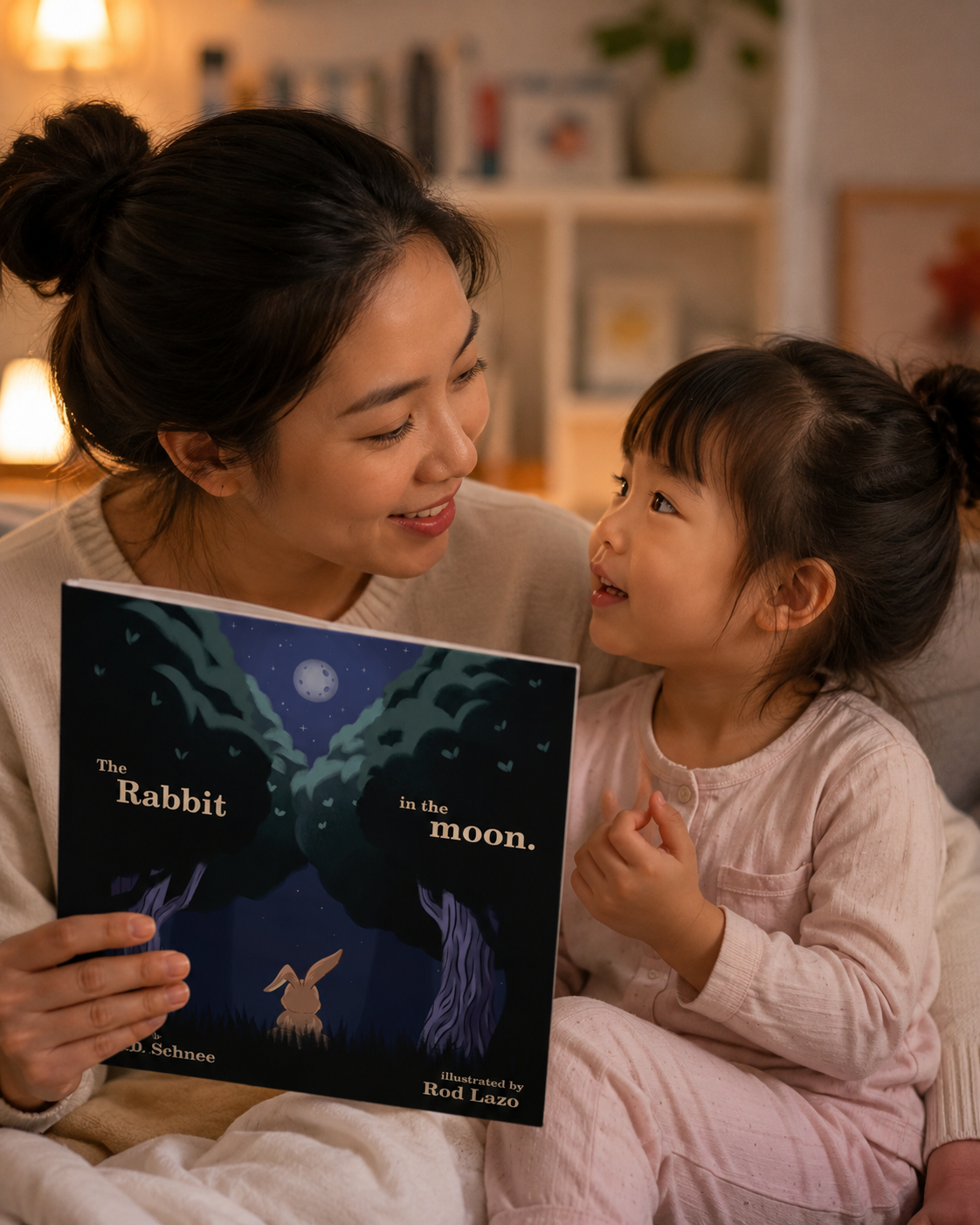
If you want a picture book that naturally opens conversations about fear, hesitation, support, and courage, The Rabbit in the Moon belongs on your shelf.
Yabbit is not fearless. He pauses before the journey. Snail brings steadiness and quiet support. Together, they help children understand that courage does not have to arrive all at once. It can begin with one tiny brave hop.
For parents, teachers, grandparents, counselors, and caregivers, The Rabbit in the Moon gives children more than a story. It gives them a character to talk about when feelings are hard to name, and a phrase they can use when the next step feels too big.
A good discussion question can help a child enter a book.
A good book can help a child enter a feeling safely.
FAQs
What are good children’s book discussion questions?
Good children’s book discussion questions are open-ended, simple, and connected to the story. Try asking, “What do you notice?” “How do you think the character feels?” “What changed?” or “Which part stayed with you?”
How do I talk to my child about a book without making it feel like homework?
Ask fewer questions and keep your tone curious. Let your child point, wonder, laugh, disagree, or return to a favorite page. The goal is conversation, not proving that your child understood every detail.
Should parents ask questions before, during, or after reading?
All three can work, but you do not need to ask many questions. One question before reading, one pause during the story, and one gentle question after reading is often enough.
What should I ask after reading a picture book?
After reading a picture book, ask questions that help your child remember, connect, and respond. Try, “Which page do you want to see again?” “What part surprised you?” or “Did this story remind you of anything?”
How can book discussion questions build emotional language?
Book questions can help children notice feelings in characters before talking about their own feelings. Asking “How do you think the character feels?” gives children a safer way to practice emotional language.
What if my child only gives one-word answers?
Make the question smaller. Ask your child to point to a favorite page, choose between two feelings, or finish a sentence starter such as “I noticed…” or “I wondered…” One-word answers often mean the child needs an easier way in.
How does The Rabbit in the Moon help with book discussions?
The Rabbit in the Moon gives children a gentle story about hesitation, support, and courage. Parents and teachers can ask about what Yabbit feels, how Snail helps, and what one tiny brave hop looks like in the story.