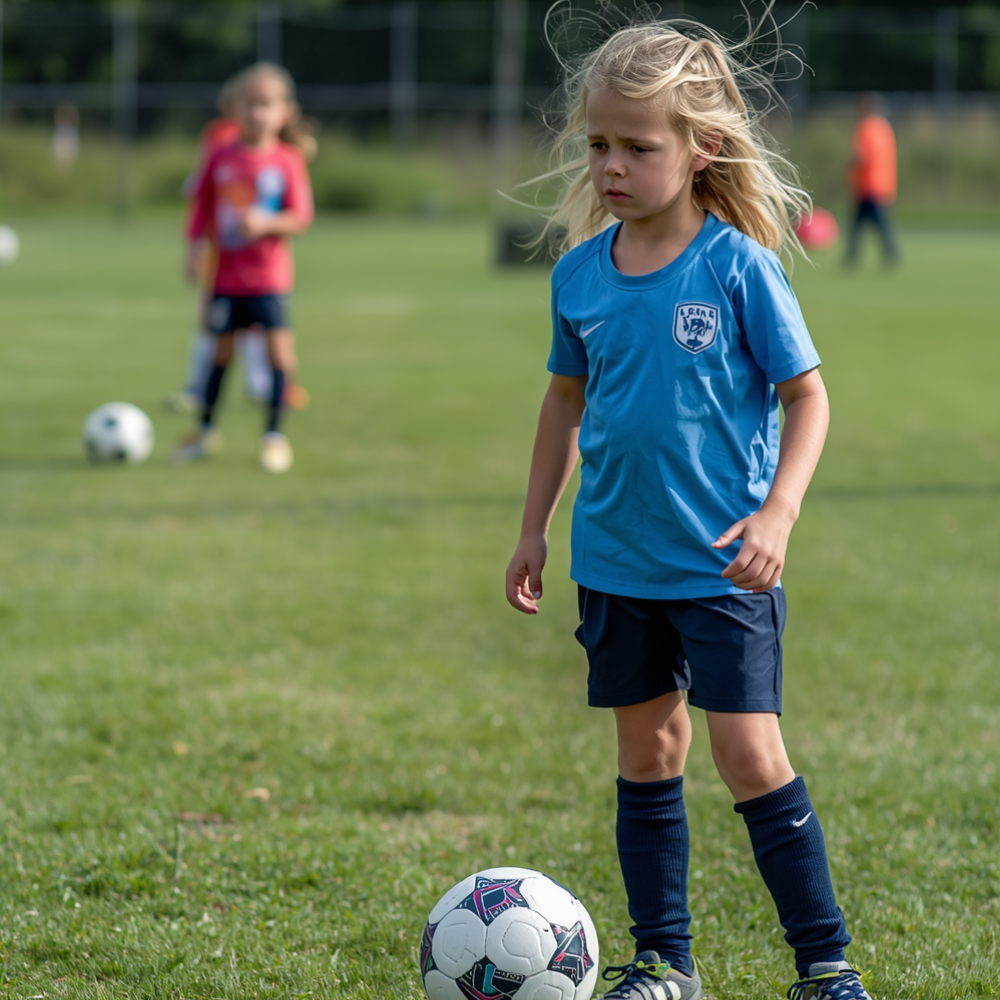
A child who hesitates at sports practice may still want to participate; sometimes the difficult part is crossing the distance between wanting to play and feeling ready to begin.
A child can spend three weeks asking when soccer starts and then refuse to get out of the car at the first practice. They can beg for swim lessons, pick out the goggles, talk excitedly about learning to dive, and then grip the side of the pool as though the original plan belonged to somebody else. They can happily throw a baseball with you in the backyard but become quiet when a coach, teammates, uniforms, and spectators enter the picture.
From an adult’s perspective, the contradiction can be baffling. If you wanted to do this, why are we suddenly negotiating in a parking lot? From the child’s perspective, there may be no contradiction at all.
Wanting to play a sport and feeling ready to participate in it are two different experiences. The first happens in imagination, where the child can picture the fun parts. The second introduces uncertainty, other people, unfamiliar rules, physical skills, mistakes, comparison, noise, coaches, and the possibility of being watched while learning something they cannot yet do well.
For a hesitant child, that distance between wanting and beginning can become the hardest part of the sport. The goal is not to convince every child that they must love organized sports. It is to help parents recognize when a child genuinely wants to participate but needs a smaller, lower-pressure way into the experience.
Quick Answer: How Do You Help a Hesitant Child Try Sports?
If your child wants to try a sport but freezes, hangs back, or refuses when the moment arrives, begin by figuring out what part feels difficult. The problem may be unfamiliarity, being watched, fear of making mistakes, uncertainty about the coach or other children, or the feeling that they have to perform before they have had time to learn.
Once you understand the obstacle, make the first step smaller. A child who cannot join an entire soccer practice may be willing to watch warmups, kick the ball with you beside the field, meet the coach beforehand, or participate in the first drill. A child nervous about swimming may begin by sitting on the pool edge or watching another lesson before getting in.
The purpose is not to remove every uncomfortable feeling. It is to give the child a realistic doorway into participation while keeping the sport connected to curiosity, movement, learning, and fun rather than turning the first day into a test of courage.
First, Find Out Whether Your Child Is Hesitant or Simply Does Not Want the Sport
This is the most important distinction in the entire conversation. Parents sometimes assume that every refusal should be overcome because perseverance is good for children. At other times, we assume a child’s nervousness means the activity is simply not for them. Either conclusion can come too quickly.
A hesitant child often shows signs that part of them still wants the experience. They may talk about the sport at home, play it comfortably with family members, watch other children with interest, ask questions about when practice is happening, or feel disappointed that they could not make themselves join. Their resistance tends to appear as the moment gets closer.
A child who genuinely dislikes the sport often sounds different. They may show little interest even in low-pressure settings, repeatedly tell you that the activity itself is not enjoyable, or become noticeably happier when offered another form of movement. They may dislike the sport but love biking, hiking, dancing around the kitchen, climbing, martial arts, swimming, or simply playing outside.
That information matters. The American Academy of Pediatrics recommends that children have opportunities to explore different sports and emphasizes that their own interests and preferences should matter. Parental support is valuable, but forcing participation is not likely to create the long-term relationship with physical activity that most parents actually want.
There is a meaningful difference between helping a child cross a nervous threshold and repeatedly pushing them toward an activity they are telling you they do not enjoy.
Why Some Children Hesitate Around Sports
Sports combine several experiences that can be difficult for a hesitant child. The obvious challenge is physical skill, but the emotional challenge often begins before anyone kicks, throws, catches, swims, serves, or performs anything.
A child may not know where to stand. They may not know the coach. Everyone else may appear to understand rules they have never heard before. Some children already know one another. The field is noisy. Parents are standing nearby. Older children may be practicing on the next court. The uniform feels strange. The child realizes that somebody will eventually hand them the ball.
Adults look at that scene and see soccer practice. A hesitant child may see twenty-five small uncertainties arriving at once. Understanding which uncertainty matters most is far more useful than simply telling the child to be brave.
Reason One: Everything Is Unfamiliar
Some children need more information before their bodies are willing to join something new.
They want to know where you will be, who the coach is, where they should put their backpack, what happens first, whether they need to change clothes, what happens if they need the bathroom, and whether everyone else already knows what they are doing.
Adults may hear those questions as excessive worry. Often they are simply the child’s attempt to turn an unknown experience into a sequence they can understand.
For these children, preparation can be more useful than encouragement. Visit the field before the first practice if possible. Show them where you will sit. Find a photo of the facility. Ask the coach what the first ten minutes usually look like. Arriving early, when there are fewer people and less noise, can make the environment easier to absorb.
None of that guarantees the child will march confidently onto the field. It does reduce the number of surprises they are trying to process at once.
Reason Two: They Are Afraid of Being Watched
Sports make learning unusually public. A child can struggle privately with a puzzle or drawing at home. At practice, missing the ball may happen in front of teammates, a coach, several parents, and somebody’s intensely interested golden retriever.
For children who are sensitive to embarrassment, that visibility can change the experience completely. The fear is not always “I cannot do this.” Sometimes it is “Everyone will see that I cannot do this yet.”
That final word matters because childhood sports involve learning skills by being imperfect at them repeatedly. Every child who can confidently catch, kick, swim, skate, shoot, serve, or tumble once had absolutely no idea what they were doing.
Knowing that intellectually does not necessarily make public mistakes comfortable.
Parents can help by talking about what learning actually looks like before practice begins. Instead of promising, “You’ll be great,” try explaining that the first practices are where children are supposed to find out what they do not know yet. The point is not to protect them from every mistake, but to make mistakes feel less like evidence that they do not belong.
Reason Three: They Are Afraid of Failing
Fear of failure was the focus of the original version of this article, and it remains an important piece of sports hesitation.
Some children do not merely dislike getting something wrong. They interpret the mistake personally. Missing a shot becomes evidence that they are terrible at basketball. Striking out becomes proof that baseball was a mistake. Falling during gymnastics becomes a reason never to attempt the skill again.
When children experience mistakes this way, encouragement focused on outcomes can accidentally increase the pressure. Telling a nervous child that they are going to score, win, or play brilliantly sounds positive, but it also gives them another result they may now feel responsible for producing.
Process language is usually safer and more useful. Notice that they stayed with the drill, listened to the coach, tried again after missing, moved closer to the group, or learned something they did not know twenty minutes earlier.
The child begins to discover that success in sports includes far more than the final score.
Reason Four: The Social Part Feels Harder Than the Sport
Sometimes the soccer is not the problem. The soccer team is.
A child may enjoy kicking the ball and still feel overwhelmed by walking into a group of unfamiliar children. They may not know how to introduce themselves, where to stand during a break, or what to do while everyone waits for practice to start.
Children who are slow to warm up socially may spend so much emotional energy managing the group that very little is left for the sport.
This is another reason meeting the coach early can help. If you know another family on the team, arranging to arrive together can remove the feeling of entering alone. Even knowing one name before practice begins can make a group feel less anonymous.
The sports skill and the social skill do not always develop at the same pace. A child may need support with one before they can show you what they can do with the other.
Reason Five: The Environment May Actually Be the Wrong Fit
Not all sports hesitation lives inside the child.
A coach may be too intense. The program may emphasize competition earlier than your child is ready for. Practices may be overly long, chaotic, loud, or poorly matched to the developmental level of the children involved.
The American Academy of Pediatrics recommends youth sports environments that emphasize enjoyment, development, and progress rather than winning, and notes that positive coaching plays an important role in whether children enjoy and remain involved in sports. That means parents should not automatically interpret resistance as something the child needs to overcome. Sometimes hesitation is information about the environment.
A child who refuses one soccer program may happily participate in a smaller recreational league. A child who freezes during a large swim class may thrive in a quieter lesson. A child who dislikes competitive gymnastics may love dance, climbing, or tumbling.
The goal is not to prove that your child can tolerate any sports environment. The goal is to help them find movement and participation that can grow into something healthy.
Why “Just Go Out There” Often Does Not Help
Parents use phrases like “Just try” because we are attempting to lower the stakes. We mean that the child does not have to succeed; they simply have to begin. Unfortunately, the child may hear something much larger.
“Try soccer” might mean ninety minutes of practice with twenty children. “Try swimming” might mean getting into deep water with a new instructor. “Go join them” might mean entering a social group, understanding the drill, knowing the rules, controlling the ball, and not embarrassing yourself, all at once.
The word try has become enormous. Instead of asking for the entire experience, make the request concrete enough for the child to see where it ends. You might ask them to walk to the field with you, greet the coach, watch the warmup, or participate in one drill before checking in again.
Now the child knows what beginning means.
The Tiny Brave Hop Approach to Sports
The Tiny Brave Hop Method is built around a simple idea: when the whole experience feels too large, find a meaningful first action small enough for the child to attempt. In sports, the first hop will depend on what is causing the hesitation.
For soccer, it might mean arriving before the team and kicking the ball with a parent for five minutes. For swimming, it could mean sitting on the side and meeting the instructor before entering the water. For baseball, the first step may be throwing with the coach away from the larger group. For dance, it could mean watching the first few minutes from the doorway. For basketball, it may be taking three shots before the formal drill begins.
A Tiny Brave Hop should still move toward participation. It is not a way of endlessly postponing the experience. The difference is that the child is being asked to approach the challenge in pieces rather than prove their courage by swallowing the whole thing at once.
For the complete framework, use How to Help Your Child Take Tiny Brave Hops.
What a First Sports Practice Can Look Like for a Hesitant Child
Parents often imagine the first successful practice as the child joining the team and completing the entire session. That may happen, but it does not need to be the only definition of success.
Suppose your child walks from the car to the field, meets the coach, watches warmups, joins one drill, becomes overwhelmed, and then sits beside you. The adult part of your brain may focus immediately on the forty minutes they did not participate.
Try noticing the fifteen minutes they did. The child who could not get out of the car last week may have just crossed several thresholds. They entered the environment, met the coach, stood near the team, and participated long enough to discover something about what practice feels like.
Those experiences become useful information for the next attempt. Progress in a hesitant child is often easier to see when you compare them with themselves rather than with the child who ran onto the field before their parent had finished parking.
What to Say Before Practice
The best pre-practice conversation is usually shorter than the anxious parent wants it to be.
Long motivational speeches can accidentally signal that something enormous is about to happen. If your child already feels uncertain, hearing ten minutes about courage, perseverance, and how proud everybody will be may convince them that practice is apparently the emotional equivalent of crossing Antarctica.
Keep the language concrete. You might say, “We’re going to walk over and meet Coach Maria first. You can stay beside me while we see what warmup looks like.”
Or, “You do not have to know how to do everything today. Today is where you find out how practice works.” If mistakes are the issue, try, “Nobody goes to practice because they already know how to do everything. Practice is where you get to be learning.”
The message underneath all of those sentences is reassuring without promising that the activity will be easy.
What to Say When Your Child Freezes at Practice
When a child freezes, adults often become more verbal precisely when the child has less capacity to process language. This is not the moment for a philosophical discussion about commitment.
Start by naming what you can actually see rather than telling the child what they feel. You might say, “You got really quiet when everyone came onto the field,” or, “You were ready until the drill started.”
Then ask a question that helps narrow the problem. “Is the hard part joining the group, or are you worried you won’t know what to do?” gives the child something more manageable to answer than “What’s wrong?”
Once you have some idea of the obstacle, find one next move.
If freezing before many types of activities has become a familiar pattern in your family, the companion guide When Your Child Freezes Before Trying: The 3-Step First Move Script offers language you can use beyond sports.
What Not to Say to a Hesitant Young Athlete
Most unhelpful sports language is not cruel. It comes from parents who desperately want to make the moment easier and end up reaching for whatever encouragement comes fastest.
“Everybody else is doing it” introduces comparison at the exact moment the child already feels conspicuous. “There’s nothing to be scared of” asks them to distrust what their body is telling them. “You begged me to sign you up” is factually understandable but emotionally unlikely to move anyone toward the field.
Even “You’re going to be amazing” can create more pressure for a child worried about performance.
A better approach is to stay close to what is actually required. The child does not need to be amazing. They do not need to match everybody else. They do not even need to stop feeling nervous.
They need enough support to discover what one honest attempt feels like.
Should You Let Your Child Watch Before Joining?
For many hesitant children, watching is part of participation rather than the opposite of it. Observation lets the child learn the rhythm of the activity. They see where children stand, how the coach gives directions, what happens after a mistake, whether the other children look relaxed, and what a drill actually involves.
The question is whether watching is functioning as preparation or becoming permanent avoidance. You can give observation a boundary. Tell the child, “Let’s watch the first drill, and then we’ll decide what one thing you want to try.” That keeps watching purposeful without demanding immediate full participation.
Some children learn the rules of a new environment with their bodies. Others learn them first with their eyes. Both can eventually arrive on the field.
Should Parents Stay or Leave During Practice?
There is no universal answer because children, ages, sports, and programs differ. The useful question is whether your presence is helping the child regulate enough to participate or keeping them focused on escaping back to you.
For a first practice, staying nearby may give a hesitant child enough security to begin. Over time, you can gradually become less central by moving farther away, talking less during practice, or creating a predictable place where the child knows you will be.
A good coach can help here. Tell them privately that your child sometimes takes time to warm up and ask how they prefer to handle the transition. You are not asking the coach to treat the child as fragile; you are giving them useful information about how this particular athlete enters new situations.
The long-term goal is greater independence, but independence does not have to arrive before the child has had a chance to feel secure.
How to Work With a Coach When Your Child Is Hesitant
A supportive coach can transform a hesitant child’s relationship with sports.
Before the first practice, keep the explanation simple. You might tell the coach that your child is excited about the sport but sometimes hangs back in unfamiliar groups or worries about making mistakes. Ask whether the child could arrive a few minutes early, help set something up, or meet the coach before everyone else arrives.
Then let the coach coach.
Parents sometimes become so invested in easing hesitation that they stand on the sideline providing a second stream of instructions. That can make the child feel as though every movement is being monitored from two directions.
A good youth coach understands that children arrive with different temperaments, skill levels, attention spans, and levels of confidence. The strongest programs make room for development rather than treating immediate performance as the price of belonging.
How Much Should You Push?
Parents of hesitant children eventually face the uncomfortable middle ground between two fears: “If I push, am I making this worse?” and “If I always let them leave, am I teaching them to avoid everything difficult?”
There is no perfect formula, but the distinction between pressure and supported persistence helps.
Pressure says the child has to complete the entire activity because the adult has already decided that participation is the correct outcome. Supported persistence acknowledges that the activity feels difficult while still looking for a reasonable way to move toward it.
You might allow the child to sit out one drill but encourage them to join the next. You might stay for the entire practice while agreeing that they only need to participate in part of it. You might return for a second session before deciding whether the sport is wrong for them.
The purpose of a smaller step is not to make avoidance permanent. It is to create enough experience for the child to make a more informed choice.
When It Is Reasonable to Stop a Sport
Quitting is not always failure. Sometimes the child tried the sport, learned what the experience felt like, and discovered that they genuinely prefer something else. Childhood is supposed to contain experimentation.
That said, it can be useful to avoid making permanent decisions during the most emotional five minutes of a difficult practice. A child who says “I quit” immediately after missing a shot may be responding to embarrassment rather than expressing a stable opinion about basketball.
Let the nervous system settle before having the larger conversation.
Ask what the child likes, what they dislike, and whether there is anything that would make the experience feel different. You may discover that they like soccer but dislike this team, enjoy swimming but not races, love dance but hate performing, or want to play baseball casually without joining a competitive league.
There are many ways to be physically active. Organized team sports are only one of them.
What Sports Can Teach a Hesitant Child When the Environment Is Right
Sport can offer hesitant children something unusually valuable because progress is tangible.
The child who would not enter the pool eventually puts their face in the water. The child who stayed beside you at soccer practice begins warming up with the team. The child terrified of striking out discovers that striking out feels disappointing but survivable.
Those experiences create evidence. The child learns that nervousness can change after beginning, that mistakes do not automatically lead to humiliation, and that skills that once felt impossible can become ordinary through repetition.
The lesson is not that sports make every child confident. The more useful lesson is that the right sports environment can give children repeated experiences of learning while imperfect, which is one of the foundations on which genuine confidence can grow.
Why The Rabbit in the Moon Fits Sports Hesitation
The Rabbit in the Moon is not a sports book, and I would not pretend that reading it will teach a child how to dribble a basketball or swing a bat. Its connection to sports happens earlier.
Yabbit lives in the moment before action, when something that sounded possible from a distance suddenly feels much bigger up close. That is exactly what happens to many children before the first practice, first swim lesson, first game, first competition, or first time entering a group where everyone else seems to know what they are doing.
Snail brings steadiness and persistence, but he does not turn Yabbit into a fearless rabbit. Yabbit still has to find his own movement forward.
That distinction is important to me because hesitant children do not need stories that make them feel defective for pausing. They need examples of courage that remain recognizable from where they are standing.
On a sports field, that might mean joining warmups. At the pool, it might mean sitting on the edge. At dance class, it may simply mean walking through the door.
The whole season does not have to happen in the first five minutes.
Buy The Rabbit in the Moon
If your child wants to participate but sometimes freezes when the moment actually arrives, The Rabbit in the Moon was written for that emotional space.
Yabbit is not fearless. He worries and hesitates when the journey in front of him becomes real, while Snail offers the steady companionship that helps him continue. Their story gives families language for moments when a child does not need to be pushed into the entire challenge but does need help finding the first manageable piece.
For sports families, that language can become wonderfully practical. Instead of asking a nervous child to conquer the whole practice, you can ask a much smaller question: “What would one tiny brave hop look like today?”
Frequently Asked Questions About Hesitant Children and Sports
How do I help a child who is afraid to play sports?
Begin by identifying what part of sports feels frightening. Some children are worried about mistakes or being watched, while others feel overwhelmed by unfamiliar people, rules, environments, or expectations. Once you know the obstacle, make the first step more manageable by visiting beforehand, meeting the coach, watching part of practice, arriving early, or participating in one small piece before expecting the whole session.
Should I make my child play a sport if they refuse?
It is worth distinguishing temporary hesitation from genuine lack of interest. A child who still talks enthusiastically about the sport or enjoys it in lower-pressure settings may need help getting through the beginning, while a child who consistently dislikes the activity may simply prefer another form of movement. The goal should be supported exploration rather than forcing a particular sport.
Why does my child love a sport at home but freeze during practice?
Practice adds social and performance pressures that are absent at home. Other children are watching, a coach is giving instructions, mistakes become visible, and the child may not know exactly what will happen. They may genuinely enjoy the sport itself while finding the organized environment difficult at first.
What should I do if my child cries before sports practice?
Stay calm and try to identify what is making the experience feel overwhelming before deciding whether the child should leave. Sometimes meeting the coach, watching for a few minutes, or agreeing on one small piece of participation can make the experience manageable. If intense distress continues repeatedly despite support and preparation, it may be worth reconsidering the program or discussing the pattern with your pediatrician.
How can I help my child stop being afraid of mistakes in sports?
Shift attention away from outcomes and toward learning. Notice effort, recovery after mistakes, listening, persistence, and gradual skill development rather than repeatedly focusing on goals, wins, scores, or flawless performance. Children are more likely to tolerate mistakes when mistakes are treated as an ordinary part of learning rather than evidence of ability.
Should a hesitant child watch sports practice before joining?
Watching can be useful when it helps the child understand an unfamiliar environment. Give the observation some structure by agreeing that the child will watch one drill and then choose one manageable action to try. This turns watching into preparation rather than indefinite avoidance.
What is a Tiny Brave Hop in sports?
A Tiny Brave Hop is the smallest meaningful action that moves a child toward participation without requiring them to handle the entire challenge at once. It might be greeting the coach, putting on the uniform, walking onto the field, touching the ball, joining warmups, sitting on the pool edge, or trying one drill while still feeling nervous.
Final Thought
A hesitant child does not need sports to become a fearless child.
They need enough room to discover what happens when nervousness and participation exist together. In the right environment, a sport can give them dozens of ordinary opportunities to experience that lesson: walking onto the field, missing the ball, trying again, learning a skill slowly, meeting a teammate, and realizing that not knowing what to do at first did not mean they did not belong there.
Parents cannot manufacture that confidence by insisting loudly enough that everything will be fine. What we can do is reduce unnecessary pressure, choose environments that value development and enjoyment, pay attention to what the child is actually telling us, and make the first step small enough to enter.
Sometimes the most important moment in a child’s season happens long before anybody keeps score. It happens when the child who was standing beside you finally takes one small step toward the game.