Children with selective mutism are not choosing silence. Reducing pressure and allowing comfortable ways to participate can help preschool feel safer while families and professionals build an appropriate support plan.
A preschool teacher says, “She hasn't spoken to me all week.”
The parent is stunned. At home, the same child sings through breakfast, negotiates bedtime like a tiny attorney, tells elaborate stories from the back seat, and has no apparent shortage of words. That contrast can be one of the first clues that something more than ordinary shyness may be happening.
Selective mutism is an anxiety disorder in which a child consistently has difficulty speaking in certain social situations where speaking is expected, even though they are able to speak in other settings. The American Speech-Language-Hearing Association, or ASHA, notes that selective mutism often begins between ages three and six and may first become apparent when children enter school, which makes preschool an especially important setting for recognizing it.
The word “selective” can be misleading. A child with selective mutism is not carefully selecting the people who deserve conversation and refusing everyone else. In the situations that trigger the condition, speaking can become extraordinarily difficult or temporarily inaccessible because of anxiety.
That distinction changes how adults should respond. A child who cannot speak because anxiety has locked the door does not need more adults knocking harder. They need the pressure around the door reduced.
What Selective Mutism Can Look Like in Preschool
Selective mutism does not look identical in every child.
One preschooler may talk continuously at home but say nothing to teachers or classmates. Another may whisper to one trusted friend but be unable to answer the teacher. A child may speak comfortably to a parent inside the classroom when nobody else is present, then become silent as soon as another adult enters.
Some children communicate readily through pointing, nodding, facial expressions, gestures, drawing, or showing an object. Others become so overwhelmed in particular situations that even nonverbal communication becomes difficult.
ASHA also notes that anxiety may show up physically. A child can appear frozen, stiff, expressionless, unusually avoidant of eye contact, clingy, or withdrawn when speech is expected. Because adults cannot see the anxiety itself, these behaviors are sometimes misread as stubbornness, rudeness, inattentiveness, or refusal.
That is one reason the home-school comparison matters so much. When a parent describes a funny, animated, highly verbal child and the preschool describes a child who rarely or never speaks, neither side necessarily has the child wrong. They may simply be seeing the child under very different levels of communication anxiety.
Selective Mutism Is Not the Same as Being Shy
A shy preschooler may hang back when entering a classroom, stay near a parent during a birthday party, or need time before talking to unfamiliar adults. Once the child becomes comfortable, conversation often begins more naturally. Selective mutism involves a more consistent difficulty speaking in particular settings or with particular people.
That does not mean parents or teachers should try to diagnose the condition themselves. It does mean that repeatedly describing a child as “just shy” can delay recognition when the pattern is more significant. A useful question is not simply, “Is this child quiet?” Instead, look at the contrast.
Does the child speak freely and naturally in some settings but remain consistently unable to speak in another? Has the pattern continued beyond the ordinary adjustment period when beginning school? Does the inability to speak interfere with classroom participation, asking for help, friendships, learning, or other everyday needs?
Those are reasons to discuss the pattern with appropriate professionals rather than waiting indefinitely for a child to “come out of their shell.”
Why Telling a Child “Just Say Hi” Can Make Speaking Harder
Adults naturally want to help a silent child over the hump.
“Tell Ms. Anna what you told me.”
“Can you say thank you?”
“You know the answer. Go ahead.”
“Use your words.”
“She's just shy. She'll talk eventually.”
Each sentence may be well intended, but it also places a spotlight on the exact behavior anxiety has made difficult. Imagine having trouble walking onto a stage and discovering that everyone in the audience has stopped what they are doing to encourage you to walk onto the stage. The cheering is supposed to help, but suddenly the thing you are struggling to do has become the most interesting event in the room.
For a child with selective mutism, reducing that performance pressure matters. ASHA recommends calm interactions, allowing adequate time for a child to respond, accepting gestures or other forms of communication when speech is not available, and avoiding pressure to speak. Adults can continue interacting warmly even when the child does not answer verbally.
The message becomes, “You belong here whether or not your voice is available right now.” That creates a very different emotional climate from waiting expectantly for words.
Give the Child Ways to Participate Before Speech Is Available
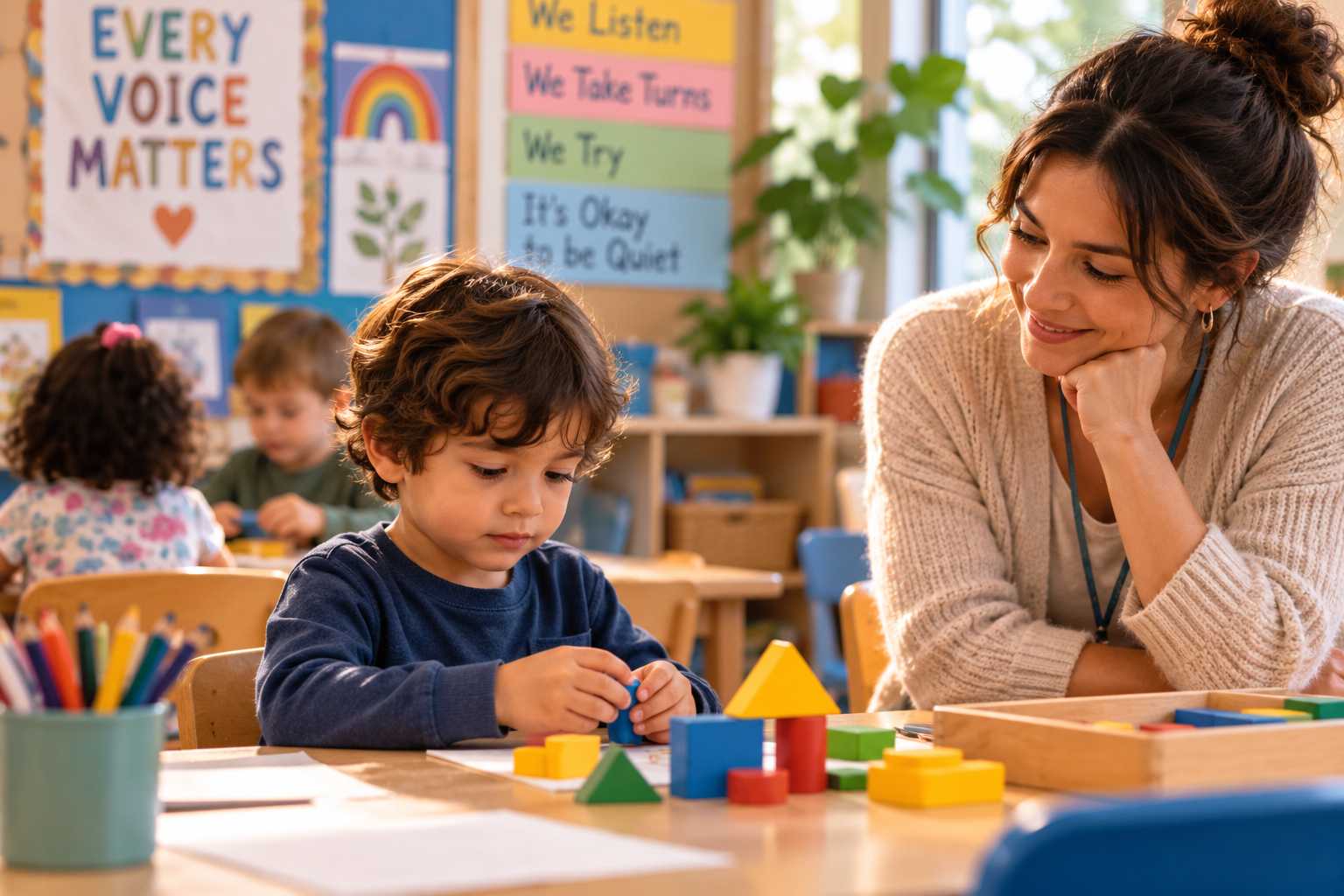
A preschool classroom runs on communication, but communication does not have to begin with spoken answers. A child may be able to point to the red crayon, place their name card beneath a choice, nod, hold up an object, draw a response, choose between two pictures, or help distribute materials. Those forms of participation allow the child to remain part of classroom life rather than becoming the child everyone waits to hear from.
Teachers can also reduce unnecessary verbal demands without removing the child from activities. Sitting beside a child rather than directly opposite them, commenting on what the child is doing instead of continually asking questions, and creating predictable routines can lower the social spotlight.
ASHA recommends strategies such as offering choices, allowing gestures or drawing, giving children sufficient processing time, maintaining calm interactions, using small cooperative groups with comfortable peers, and finding nonverbal classroom jobs that allow a child to participate successfully.
These accommodations are not the final treatment goal. They are ways of keeping connection and participation alive while a child's treatment team works gradually toward broader communication.
Buy The Rabbit in the Moon
The Rabbit in the Moon is not a treatment for selective mutism, and a child should never be asked to prove that the story “worked” by speaking afterward. Its usefulness here is gentler.
Yabbit is a character who understands what it feels like to hesitate when something seems bigger from the inside than it appears to everyone else. He does not become fearless on command, and the adults reading the story do not need to turn every page into a lesson.
For a child who experiences selective mutism, reading together can simply be a comfortable shared activity in which spoken participation is not required. A child can look, point, turn pages, notice an illustration, sit close, or enjoy the story without being asked to answer questions aloud.
The book's larger message, that courage can coexist with uncertainty, can belong to the family without becoming another demand placed on the child's voice.
What Preschool Teachers Can Do Without Turning Every Interaction Into a Speech Test
A preschool teacher may be one of the most important members of a child's support team because school is often where the difficulty speaking is most visible.
The goal is not to stop interacting with the child. Avoiding the child entirely can create isolation and make silence feel like a barrier between the child and the classroom. Instead, teachers can continue talking naturally without making every interaction depend on a spoken response.
Rather than repeatedly asking, “What color is that?” a teacher might sit beside the child and say, “You chose the purple one.” Instead of asking an open-ended question in front of the class, the teacher might offer two options that can initially be answered by pointing.
Predictability can help as well. A child who knows how morning arrival works, who will greet them, where their backpack goes, what comes next, and how they can ask for the bathroom without speaking has fewer uncertainties competing for attention.
Small-group and one-to-one situations may also be easier than speaking in front of a full class. A child who cannot answer during circle time may eventually communicate more comfortably while playing beside one trusted peer.
The important word is gradually. Teachers should be part of an agreed support or treatment plan rather than improvising increasingly difficult speaking challenges to see whether the child will finally talk.
Do Not Make the First Spoken Word a Classroom Event
When a child who has been silent at school finally speaks, adult excitement can be enormous. The instinct may be to smile broadly, call another teacher over, announce the breakthrough to the class, or tell the parent at pickup while the child is standing there.
For the child, that attention can turn one successful speaking experience into evidence that speaking causes everyone to look at them. A calm response is usually more helpful.
Continue the interaction. Respond to what the child said rather than the fact that they said it. If a child quietly says, “blue,” the teacher can simply say, “Blue. Let's put it over here,” and keep going.
Progress can certainly be recognized privately and thoughtfully within the child's support plan. What we want to avoid is making the child's voice feel like a surprise performance for adults.
Parents and Teachers Need to Compare Notes
Selective mutism is difficult to understand when adults only see one setting. The parent may reasonably think, “There cannot be a speech problem. This child never stops talking at home.” The teacher may reasonably wonder how the same child could possibly be talkative anywhere.
Both observations are useful. Parents can describe whom the child speaks with, where they speak comfortably, whether they talk to familiar people outside the home, what happens when visitors arrive, and whether their communication changes depending on who enters the room. Teachers can document situations in which the child appears most and least comfortable, whether they communicate nonverbally, which peers they approach, whether speech occurs in very small groups, and what kinds of verbal demands appear to increase distress.
That information can help professionals understand the pattern more accurately than a single observation ever could.
Avoid Speaking for the Child Every Time
This part requires balance. When a child freezes after being asked a question, a parent's instinct is often to answer immediately. Sometimes that is necessary, especially when important information needs to be communicated or the child's safety or wellbeing is involved.
But automatically answering every low-stakes question before the child has time to respond can unintentionally establish a routine in which anxiety appears, the adult rescues, and the child never has an opportunity to use whatever communication is currently possible. ASHA recommends allowing plenty of response time rather than automatically talking for a child. Depending on the situation and the child's treatment plan, an adult might wait quietly, allow a gesture, offer two choices, or redirect the interaction without making the unanswered question into a confrontation.
The goal is not to trap the child until they speak. It is to avoid rushing in so quickly that there is never room for communication to emerge.
Selective Mutism Should Not Become a Child's Classroom Identity
Preschoolers listen even when adults think they are busy building a tower. Repeatedly telling other adults, “She doesn't talk at school,” or introducing a child as “our selective mute student” can turn a condition into an identity.
It can also raise the stakes around speaking. If everyone knows the child as the one who does not talk, producing a first word can suddenly feel like crossing a stage beneath a spotlight. Adults can communicate necessary information privately while preserving the child's dignity publicly.
Teachers can also support peer relationships without asking classmates to monitor the child's speech. Other children do not need to become junior therapists. They can play, share materials, build, draw, run, laugh, and include the child without continually asking why they are not talking.
Belonging should not have a verbal entrance exam.
What About a Bilingual Preschooler Who Is Quiet at School?
This distinction deserves particular care. A child learning a new language may naturally speak less while becoming comfortable with it. Limited proficiency in the language expected at school is not the same thing as selective mutism. ASHA's diagnostic criteria specifically note that the difficulty speaking cannot be explained simply by lack of knowledge of or comfort with the language required in the situation.
For bilingual and multilingual children, professionals need to understand communication across languages and settings. Does the child speak the home language with familiar people outside the house? Are they silent in situations where either language could be used? How comfortable are they with the school's language? When did exposure to each language begin?
Being bilingual does not itself cause selective mutism, and a child should not be mislabeled simply because they are learning the language used at preschool. This is another reason professional evaluation matters. A child's communication needs to be understood in the context of their actual language experience rather than through a single classroom snapshot.
How Selective Mutism Is Treated
Treatment does not consist of finding the perfect phrase that finally convinces a child to speak. Selective mutism is commonly treated using behavioral and cognitive-behavioral approaches designed to reduce anxiety around speaking and gradually increase successful verbal communication across people, places, and situations.
The process is carefully graduated. A child may begin speaking comfortably with a trusted person in a low-pressure environment, then gradually practice with another person present or in a slightly different location. Clinicians may use approaches such as stimulus fading, shaping, reinforcement, and carefully planned exposure depending on the individual child.
ASHA emphasizes collaboration among professionals and the adults who see the child in everyday settings. Depending on the child's needs, that team may include a speech-language pathologist, psychologist or other behavioral-health professional, pediatrician, teacher, school staff, and family members.
This matters because the ultimate goal is not simply getting words to appear during a therapy appointment. Children need help becoming increasingly able to communicate in the real places where they live, learn, play, and need assistance.
Parents should not try to reproduce a clinical exposure program from an article. The treatment sequence needs to be appropriate for the individual child and coordinated by professionals with relevant expertise.
Where “Tiny Brave Hops” Fit, and Where They Do Not
Families familiar with Yabbit may recognize a similarity between gradual progress and the idea of making a difficult beginning smaller. There is an important boundary here.
The Tiny Brave Hop Method is a parenting framework for approaching ordinary hesitation in manageable steps. It is not a treatment protocol for selective mutism, and parents should not decide on their own that today's “tiny brave hop” will be requiring a child with selective mutism to say one word. When a child has selective mutism, speech goals belong inside the plan developed with qualified professionals.
The broader family philosophy can still be useful. Progress does not need to look dramatic, children should not be shamed for needing smaller steps, and courage can exist before a challenge has been fully mastered. Those ideas can shape the emotional climate surrounding treatment without replacing treatment itself.
For more about supporting courage without turning it into pressure, read: https://www.yabbitrabbit.com/parent-resources/how-to-raise-a-brave-child-without-pressure
Picture Books Can Be Shared Without Requiring a Child to Talk About Them
Reading can be especially comfortable when adults resist the urge to turn every page into a comprehension check. A preschool child with selective mutism does not need to answer “How does Yabbit feel?” aloud for the book to have meaning. They may study the illustration, point to a character, turn the page, lean closer during a favorite part, choose which book comes next, or simply listen.
This is one reason picture books can create emotional distance. The family can spend time with a character's experience without demanding that the child immediately describe their own.
If the child wants to communicate about the story nonverbally, that can be welcomed. If they speak spontaneously in a comfortable setting, adults can respond naturally instead of turning the moment into evidence that the child “can talk when they want to.”
For more ideas about keeping read-alouds conversational and low-pressure, see: https://www.yabbitrabbit.com/parent-resources/how-to-read-picture-book-with-your-child
When Should Parents Seek an Evaluation?
A few quiet days at the beginning of preschool do not automatically indicate selective mutism. Children need time to adjust to new teachers, routines, classmates, languages, and environments. ASHA's diagnostic criteria specify that the pattern lasts at least one month and is not limited to the first month of school.
Parents should consider professional guidance when the contrast between settings is persistent, when a child repeatedly cannot speak in situations where speech is expected despite speaking elsewhere, or when the difficulty is interfering with school participation, friendships, asking for help, or everyday functioning. Earlier recognition matters because a child can begin building patterns around avoiding communication, and school demands generally increase with age.
A pediatrician can be a useful starting point, but assessment may involve both speech-language and mental-health expertise. Families should look for professionals who understand selective mutism specifically rather than assuming that any speech difficulty or any childhood anxiety is approached in exactly the same way.
What Parents Can Say to a Preschool Teacher
The most useful conversation is collaborative rather than accusatory. A parent might explain that their child speaks normally at home but appears unable to speak in school, that the family is concerned about selective mutism, and that they do not want the child pressured, publicly praised for speaking, or repeatedly placed on the spot.
At the same time, parents should invite observations. Teachers see communication demands and peer interactions that parents cannot see from home, and those observations can become valuable information for an evaluation and treatment plan.
Once professionals are involved, everyone should work from the same plan whenever possible. A teacher should not be trying to make the child speak while a clinician is intentionally lowering verbal demands, and a parent should not unknowingly undo a gradual treatment step by changing the expectations at home. Consistency makes the child's environment more predictable, and predictability can be especially valuable when anxiety is already making communication difficult.
What Progress Can Look Like
Progress with selective mutism may be quieter than adults expect. A child might begin entering preschool with less visible distress. They may start communicating more through gestures, participate beside peers, whisper to one trusted person, speak while fewer people are present, or use their voice in a setting where it was previously unavailable.
Those changes do not all carry the same clinical significance, and families should follow the goals established by their treatment team. Still, they are reminders that progress is not always a dramatic moment in which a previously silent child suddenly begins chatting with the entire classroom. Successful treatment builds communication across situations gradually.
The aim is not to create a child who performs speech for adults. It is to help the child become increasingly able to access their own voice and communication skills without anxiety controlling where those abilities are available.
An Authoritative Resource for Parents and Teachers
The American Speech-Language-Hearing Association's Selective Mutism Practice Portal is one of the strongest resources for understanding selective mutism, assessment, school considerations, treatment approaches, and collaboration among families, teachers, speech-language pathologists, and behavioral-health professionals. ASHA emphasizes that selective mutism is an anxiety disorder, that children do not simply choose where not to speak, and that treatment should be collaborative, gradual, and sensitive to the people, settings, and activities that affect a child's ability to communicate.
Frequently Asked Questions About Selective Mutism in Preschool
Can a child have selective mutism if they talk constantly at home?
Yes. The contrast between settings is actually characteristic of selective mutism. A child may speak naturally with familiar family members at home while being consistently unable to speak at preschool, around certain adults, or in other situations that create greater communication anxiety.
Is selective mutism just extreme shyness?
No. A shy child may initially speak less and gradually become more conversational as they warm up. Selective mutism is an anxiety disorder involving a consistent inability to speak in particular situations despite being able to speak in others. Parents should avoid assuming that every quiet child has selective mutism, but persistent patterns deserve appropriate evaluation.
Should a teacher ask a child with selective mutism questions?
Teachers do not need to stop interacting with the child, but repeated direct questioning can increase pressure, particularly when everyone waits for a spoken answer. Strategies may include comments rather than constant questions, offering choices, allowing nonverbal responses, giving adequate response time, and following the child's professional support plan.
Should I praise my child when they finally speak at school?
Avoid turning speech into a public celebration. A large reaction can increase self-consciousness and make future speaking feel even more noticeable. Adults can respond naturally to what the child said and discuss appropriate reinforcement privately with the professionals guiding treatment.
Will my child simply grow out of selective mutism?
Parents should not rely on waiting alone when a persistent pattern suggests selective mutism. Appropriate evaluation and early support can help prevent anxiety and avoidance from becoming more established. Speak with your pediatrician and professionals experienced in selective mutism if you are concerned.
Can The Rabbit in the Moon help a child with selective mutism?
The book can be used as a comfortable, low-pressure shared reading experience, but it does not treat selective mutism. Yabbit's hesitation may give families gentle language for courage and uncertainty, while the child remains free to participate in the reading verbally or nonverbally. Speech goals should come from the child's qualified treatment team, not from the story.
Does being bilingual cause selective mutism?
No. Learning or using more than one language does not itself cause selective mutism. Professionals assessing bilingual children need to distinguish anxiety-based inability to speak from normal differences in language knowledge, familiarity, and comfort. A child's communication should be considered across languages, people, and settings.
Final Thought
A preschooler who talks freely at home and becomes silent at school can leave adults searching for an explanation, and sometimes that search produces the wrong one. The child may be labeled shy, stubborn, oppositional, or unwilling when anxiety is making speech genuinely difficult to access.
Understanding selective mutism changes the question from “How do we get this child to talk?” to “How do we help this child feel safe enough to build successful communication experiences?” That shift does not mean abandoning the goal of speech. Effective treatment does help children gradually use their voices across more people and places. It simply recognizes that pressure is not the path there.
Parents, teachers, and professionals can work together so preschool remains a place where the child belongs before every word comes easily. When the adults stop making silence the center of the room, there is more space for trust, participation, play, connection, and eventually a voice that does not have to fight through quite so much fear to be heard.